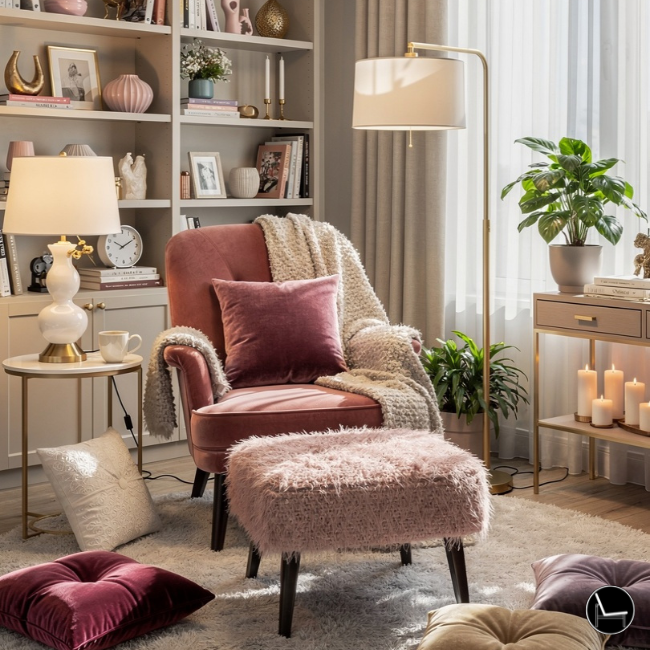
How to style accent chair arrangements that actually work comes down to five things: pick the right chair for your scale, give it one clear job, echo one element from your existing furniture, add a proper support system (table + light), and edit before you call it done. Follow the framework below and your accent chair goes from “random extra seat” to an intentional design moment.
How to Style Accent Chair Corners: Why Yours Still Looks Off
You bought the chair. It’s a good chair — maybe even a great one. And it still sits in your living room looking like it wandered in from a different house and hasn’t found its people yet.
You are not alone in this. Every “help me fix my living room” thread eventually lands on the same culprit: an accent chair that looks plopped down instead of placed. The gap between a Pinterest-worthy accent chair moment and the one currently anchoring your corner isn’t the chair itself. It’s almost never the chair. It’s the process nobody actually walks you through — how to style accent chair pieces so they read as a decision, not an afterthought.
This guide fixes that. We’ll cover how to choose the right accent chair for your space, the exact framework designers use to place and style one, how to match it to your room’s vibe, and the five most common accent chair problems with real fixes — not vague reassurances.
What’s Inside This Guide
Click to expand the full guide outline
- Choosing the Right Accent Chair for Your Space
- The Job-Anchor-Echo Framework: How to Style Accent Chair Placement Step by Step
- The Vibe Check: Match Your Accent Chair to Your Style
- The Designer’s Cheat Sheet: Rules, Ratios & Placement
- Real-Life Fixes: The 5 Most Common Accent Chair Problems Solved
- Visual Anti-Patterns: What NOT to Do
- Shop the Look: Editor’s Product Picks
- Upcoming Trends in Accent Chair Styling
- The Real Cost: Budget Breakdown
- Room-by-Room Placement Guide
- Seasonal Restyling: All 4 Seasons
- The Complete Accent Chair Support-System Checklist
- FAQ
Choosing the Right Accent Chair for Your Space

The right accent chair is the foundation everything else builds on. Style it perfectly and it still won’t work if the scale, shape, or function is wrong for your room. Before a single throw pillow gets involved, the chair needs to earn its spot.
Match the Chair Type to the Job
Every accent chair style solves a slightly different problem. Here’s the fast way to sort them:
| Chair Type | Best For | Style Match | Price Range |
|---|---|---|---|
| Wingback | Formal rooms, reading corners | Traditional, Classic | $250–$800 |
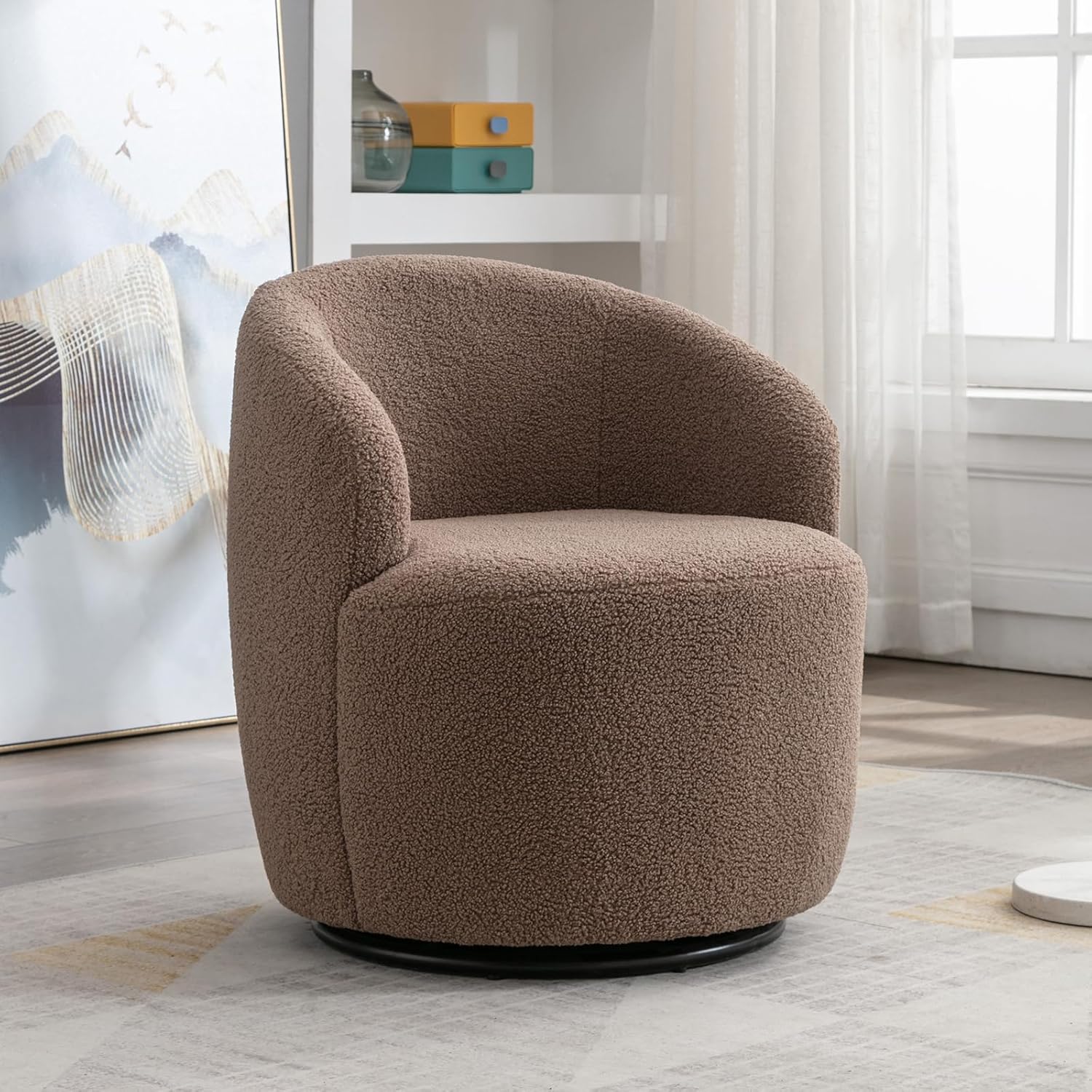
| Swivel / Barrel | Open floor plans, multi-focus rooms | Modern, Mid-Century | $200–$600 |
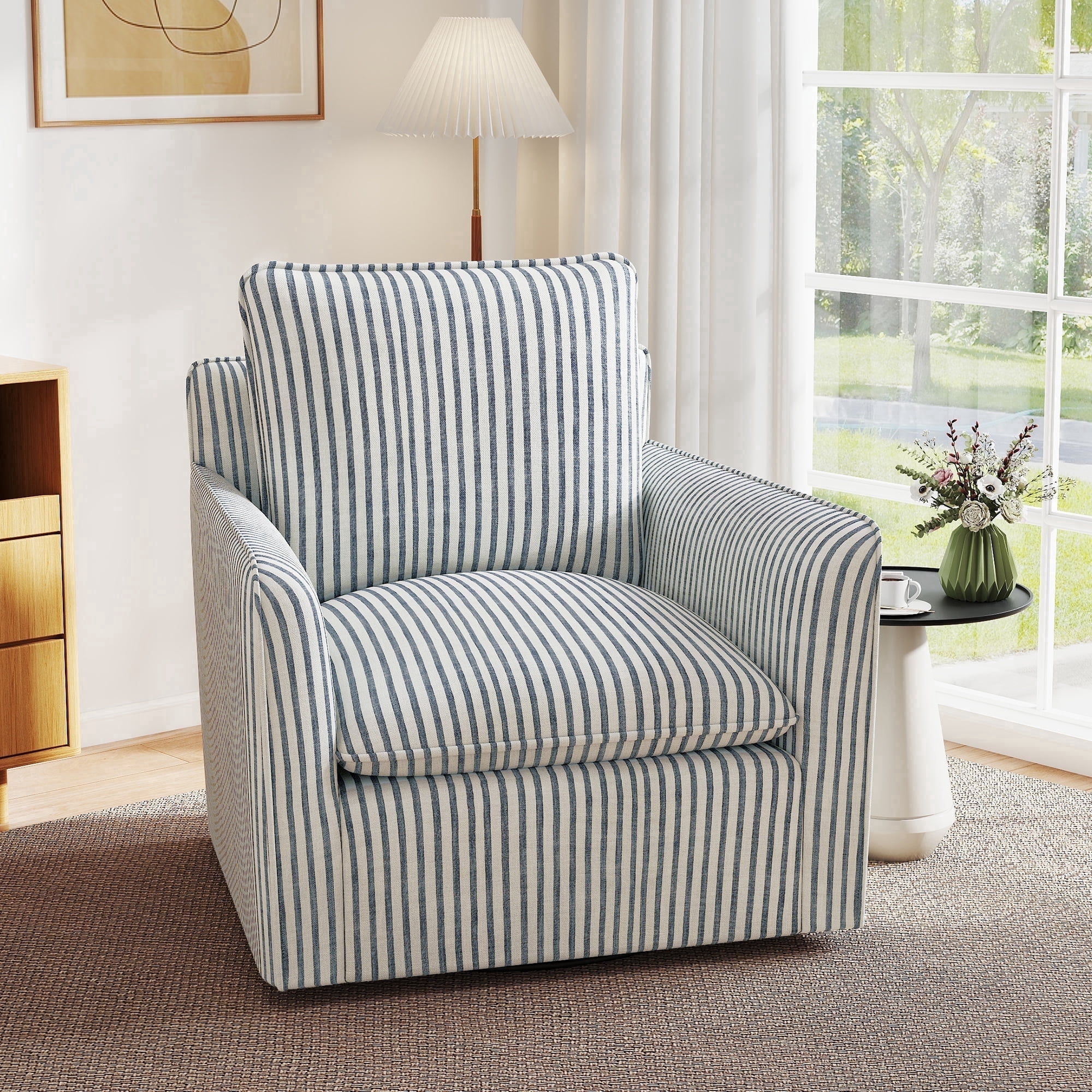
| Club | Casual lounging, family rooms | Rustic, Transitional | $300–$900 |
| Slipper | Small spaces, formal entries | Modern, Minimalist | $150–$450 |
| Occasional / Boucle | Statement corners | Organic Modern, Glam | $220–$650 |
Scale & Proportion: The First Filter
- Small living rooms or apartments: Look for accent chairs under 30 inches wide, ideally on slim or open legs so the chair doesn’t visually block the floor.
- Medium living rooms: A 30–34 inch chair is the sweet spot — enough presence to matter without competing with the sofa.
- Large or open-plan rooms: Size up to 34–40 inches, and consider a higher back so the chair doesn’t disappear against a big wall.


The Job-Anchor-Echo Framework: How to Style Accent Chair Placement Step by Step

Image credit: Luxe
Great accent chair styling isn’t about the chair at all — it’s about the chair’s relationship to everything around it. This is the six-step framework I use with every accent chair I style, whether it’s a $150 slipper chair or a $700 statement swivel.
Give It a Job
Decide what the chair is actually for before you decide what it looks like — conversation seat, reading chair, or pure visual counterweight.Anchor the Placement
Choose one of four proven layouts: symmetrical pair, corner nook, statement piece, or beside-the-sofa companion.Echo One Element
Repeat a wood tone, metal finish, or color already in the room somewhere on the chair or its immediate styling.Contrast One Element
Let the chair differ from the sofa in exactly one way — texture, shape, or scale — so it doesn’t read as a matching set.Add the Support System
A side table and a light source (or a rug edge) turn a lone chair into a defined vignette instead of a stray seat.Edit
Remove one accessory. The chairs that look most “designed” are almost always the ones someone had the restraint to under-style.Designer Strategy: The Echo-and-Contrast Rule for Accent Chairs
When you’re figuring out how to style accent chair pairings with an existing sofa, the instinct is to either match everything or clash on purpose. Neither works as well as picking one shared element and one deliberate difference.
| If Your Sofa Feels… | Let the Chair Do This | Practical Move |
|---|---|---|
| Heavy and deep | Create breathing room | Raised legs, slimmer arms, open base |
| Straight and low | Introduce softness | Rounded back, curved arms |
| Leather and tailored | Add touchable texture | Boucle, chenille, or wool |
| Neutral and quiet | Carry personality | Muted color or sculptural shape |
| Bold pattern or color | Stabilize the pairing | Calm, solid upholstery |
The Vibe Check: Match Your Accent Chair Styling to Your Aesthetic

The reason your accent chair doesn’t look like the ones you’ve saved is almost always a vibe mismatch. A bold boucle swivel chair in a room full of dark walnut and leather will never sit right, no matter how well you style it.
🤍 Warm Minimalist
Clean lines, warm neutrals, negative space around every object.Chair: Natural wood or warm boucle in cream or oat.
Accessories: A single linen cushion, one sculptural object nearby.
🖤 Modern Noir / Bold
Dramatic, editorial, unapologetic. One metallic accent cuts through the dark palette.Chair: Matte black frame, deep jewel-tone upholstery.
Accessories: Brass floor lamp, sculptural black side table.
🌿 Organic Modern
Natural materials, earthy tones, curated imperfection — the fastest-growing style right now.Chair: Boucle, rattan trim, or warm-toned wood frame.
Accessories: A dried botanical, stone coaster, woven throw.
🍂 Mid-Century Modern
Tapered legs, walnut or teak finishes, graphic upholstery lines.Chair: Swivel barrel chair on a wood or brass base.
Accessories: A globe-shaped table lamp, a low ceramic vase.
The Designer’s Cheat Sheet: Rules, Ratios & Placement

Image credit: Luxe/Jeff Herr
These are the actual numbers designers use when they style accent chair placements — not vague advice.
The 18-Inch Rule
Leave at least 18–24 inches of walking clearance around any accent chair. Less and the room feels cramped even if the chair itself looks great.The Triangle Rule
A chair, a side table, and a lamp should form a loose triangle — never a straight line. It reads as intentional instead of accidental.Placement Options at a Glance
| Layout | Best For | Watch Out For |
|---|---|---|
| Symmetrical pair | Formal rooms, fireplaces | Needs a true focal point in the middle |
| Corner nook | Reading corners, awkward corners | Needs a lamp — corners are usually dim |
| Statement piece | Bold or patterned chairs | Give it visual room; don’t crowd it |
| Beside the sofa | Compact living rooms | Angle it slightly inward toward the conversation |
The 5 Most Common Accent Chair Problems — Solved

If your accent chair still looks off after genuine effort, one of these five problems is usually the culprit.
Problem 1: “My Two Accent Chairs Don’t Match”
The fix: They don’t need to. Mismatched accent chairs work when they share one feature — seat height, wood tone, or color family. Unify them further with matching cushions or a shared side table between them.
Problem 2: “It Looks Great But Nobody Ever Sits In It”
The fix: Give the chair an actual job. A chair with no clear function becomes a landing spot for laundry. Pair it with a side table and a light source so it invites use, not just admiration.
Problem 3: “My Apartment Is Small and the Chair Feels Oversized”
The fix: You likely have the wrong scale or the wrong placement. Choose a chair under 30 inches wide, tuck it into a corner rather than the center of the room, and keep accessories to three or fewer.
Problem 4: “It Doesn’t Connect to the Rest of the Room”
The fix: This is almost always a missing echo. Pull one existing color, wood tone, or metal finish from the room into the chair or its immediate styling — a cushion, a throw, a lamp base.
Problem 5: “It Blocks the Room’s Flow”
The fix: Use painter’s tape to mark the chair’s full footprint, including how far it swivels or reclines, before committing to a spot. If you can’t walk the room’s main path without detouring around it, move it.
Visual Anti-Patterns: Accent Chair Styling Mistakes to Avoid
✓ Do This
- Give the chair one clear role
- Echo one element from the room
- Leave 18–24 inches of clearance
- Pair it with a table and a light source
- Angle it slightly toward the conversation
- Test the full footprint before buying
✗ Avoid This
- Pushing it flush against a wall with zero breathing room
- Matching it to the sofa in every possible way
- Overcrowding it with four or more accessories
- Blocking a doorway or main walking path
- Choosing scale based on the showroom, not your room
- Skipping a light source in a corner placement
Shop the Look: Accent Chair Styling Essentials

The right supporting pieces can make a $150 chair look like a $500 one. These are worth investing in.


Upcoming Trends in Accent Chair Styling

Accent chair styling is shifting fast heading into the back half of 2026. The overcrowded, everything-matches look is fading. Here’s what’s replacing it:
Identity Decor: Chairs chosen for personal meaning over trend-chasing — an inherited piece, a vintage find, a color that means something to you.
Organic Modern: Boucle, rattan trim, and warm wood tones pairing with the linen-sofa, jute-rug households that defined the last few years.
Tactile Contrast: Smooth leather sofas paired with textured boucle chairs — texture is doing the work color used to do.
Sculptural Solo Chairs: One striking chair as a room’s only statement piece, rather than a full matching seating set.
The Real Cost of Accent Chair Styling — Budget Breakdown
| Budget Tier | Chair | Side Table | Lamp | Textiles | Total |
|---|---|---|---|---|---|
| Entry ($250–$400) | $150–$250 | $40–$70 | $30–$50 | $20–$40 | ~$320 |
| Mid ($400–$700) | $250–$450 | $70–$120 | $50–$90 | $40–$70 | ~$580 |
| Investment ($700–$1,200+) | $450–$800 | $120–$200 | $90–$150 | $70–$120 | ~$1,000 |
Where to Put Your Accent Chair: Room-by-Room Placement Guide
🛋 Living Room: The primary stage. Tuck it into a corner to define a reading nook, or angle it beside the sofa to join the conversation without blocking traffic.
🛏 Bedroom: A boutique-hotel move. Style it as a spot to put on shoes, read before bed, or lay out tomorrow’s outfit — give it a job so it doesn’t become a clothes pile.
🏠 Entryway: An underused but effective placement. A single slipper chair with a small tray table creates an immediate, welcoming first impression.
💼 Home Office: A second seat for calls or a reading break away from the desk. Choose a chair with good back support if it’ll see regular use.
🍽 Dining Room: A single accent chair at the head of the table, styled differently from the rest of the set, adds a collected-over-time feel.
How to Restyle Your Accent Chair Every Season (Without Buying New)

One of the most underrated things about an accent chair is how quickly it resets. You need three things: one textile swap, one botanical, one scent element.
🌿 Spring: Swap a heavy throw for a linen one; add a small potted plant beside the chair.
☀️ Summer: Bright cushion covers in a woven texture; keep the chair’s surroundings airy and uncluttered.
🍂 Fall: A wool or boucle throw in a warm tone; a small gourd or dried stem on the side table.
❄️ Winter: A faux fur throw draped over the arm; a warm-toned candle on the nearby surface.
The Complete Accent Chair Support-System Checklist

What actually needs to go around an accent chair? Here’s the definitive list.
Tier 1: The Non-Negotiables
- A side table within arm’s reach
- A light source — floor lamp, table lamp, or wall sconce
- One shared element that echoes something in the room
Tier 2: The Impactful Additions (Choose 1–2)
- A throw draped over the back or one arm
- A cushion in a color pulled from elsewhere in the room
- A small rug underneath to ground the arrangement
Tier 3: Keep Off the Chair
- More than two cushions — it starts to look like storage, not seating
- Mail, chargers, or laundry — give it a job so it doesn’t become a catch-all
- A style or color with zero connection to the rest of the room
Most Popular Posts


You’re Already Closer Than You Think
Styling an accent chair isn’t a talent — it’s a system. Give it a job, anchor the placement, echo one element from the room, contrast one, build the support system, then edit.
The gap between the version you’ve saved and the version in your living room is rarely money or taste. It’s almost always one small adjustment — a lamp, a shared wood tone, eighteen inches of breathing room. Pick one section of this guide and act on it today.
Frequently Asked Questions About How to Style Accent Chair Placement
How do I style an accent chair for a small living room?
Choose a chair under 30 inches wide, ideally on slim or open legs, and tuck it into a corner rather than the center of the room. Keep accessories to three or fewer and leave at least 18 inches of clearance so the room still feels navigable.
Do two accent chairs need to match?
No. Mismatched accent chairs work well when they share one feature — seat height, wood tone, or color family. A shared side table between them or matching cushions can unify the pair further without forcing an identical look.
What’s the best way to place an accent chair next to a sofa?
Angle it slightly inward toward the coffee table rather than lining it up straight with the sofa’s edge. This keeps it part of the conversation instead of reading as a separate, disconnected seat placed against the wall.
How do I make an accent chair look expensive?
Add a side table, a floor lamp placed beside (not on) the chair, and one textured throw. These three additions do more visual work than upgrading the chair itself, and they cost far less than a pricier chair with nothing around it.
Should an accent chair match my sofa fabric?
It doesn’t need to match, but it should connect. Echo one element — a wood tone, a metal finish, or a color already used elsewhere in the room — while letting the chair differ in texture or shape from the sofa.
How much space should be around an accent chair?
Leave 18 to 24 inches of clearance on any side where people will walk. Less than that and the room feels cramped even when the chair itself is well-chosen and well-styled.
What accessories does an accent chair actually need?
At minimum: a side table within reach and a light source nearby. Beyond that, one throw and one cushion are usually enough — more than two cushions starts to read as storage rather than styling.
Can an accent chair go in a corner with no windows or natural light?
Yes, as long as you add a dedicated light source. A floor lamp or wall sconce placed beside the chair is what makes a dim corner feel like an intentional reading nook instead of an overlooked dead zone.
CATCH THE LATEST IN HOME DECOR TRENDS:
Steal These 16 Expert-Approved Decorating Secrets

How To Accessorize Your Living Room
How to Make a Small Room Appear Bigger
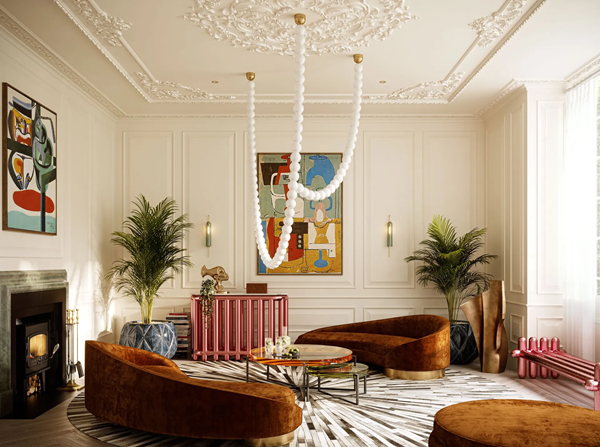
How to Make Your Home Look Expensive
GET CAUGHT UP ON ALL THE INSPIRING DECOR TIPS:
18 Fresh Decorating Ideas To Update Your Fireplace
How to Make a Gallery Wall: The Complete Step-by-Step Guide (Even If You’ve Never Hung a Picture)
