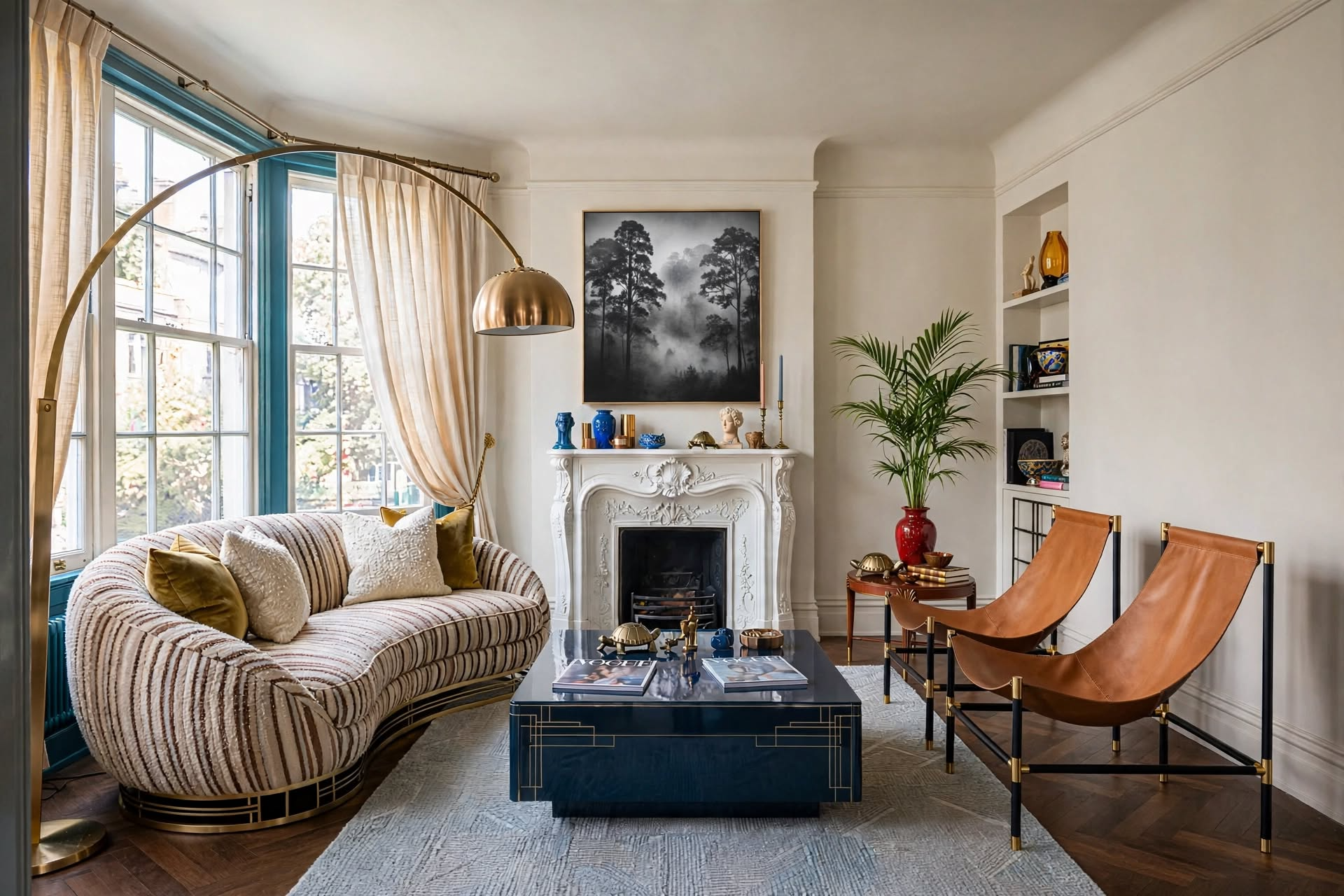
How to Make a Small Room Appear Bigger: The Designer’s Complete Guide (25+ Tricks That Actually Work)
The exact layout, light, and furniture-scale system professional designers use to make a small room appear bigger and feel twice its size — without knocking down a single wall.

You’ve painted the walls white. You’ve added a mirror. You’ve even gotten rid of half your stuff. And the room still feels tight. If you’ve been searching for how to make a small room appear bigger and every article gives you the same five tips — mirrors, white paint, declutter — you already know those alone don’t fix it. They’re pieces of a system, not the system itself.
I’ve styled dozens of small apartments and rental rooms for the Decorholic, and the rooms that read as spacious almost never have more square footage than the ones that feel cramped. They have better layout math, better light layering, and furniture scaled correctly instead of shrunk down out of fear. This guide walks through that full system: the floor-first layout method, the vertical stretch formula, the light and color audit, and how to apply all of it room by room — living room, bedroom, home office, kitchen.
What’s Inside This Guide
- 25+ Ways to Appear Bigger at a Glance
- The Floor-First Layout System
- The Vertical Stretch Formula
- The Light & Color Audit
- The Reframe: The 3-6-30 Rule
- Living Room: Appear Bigger
- Bedroom: Appear Bigger
- Home Office & Small Nooks
- Kitchen & Dining
- The Designer’s Cheat Sheet
- 5 Common Problems — Solved
- Visual Anti-Patterns
- Shop the Look
- The Real Cost: Budget Breakdown
- Room-by-Room Placement Guide
- The Complete Checklist
- FAQ
Related Reading → Small Living Room Optical Illusions That Actually Work
→ Apartment Furniture Essentials: What to Buy First
25+ Ways to Make a Small Room Appear Bigger at a Glance
These are the moves that actually make a small room appear bigger — grouped by category so you can jump to whatever your room needs most. Full how-to for each lives in the sections below.
🪞 Light & Reflection
- Hang one large mirror across from your main light source, not scattered small ones
- Layer three light sources at three different heights instead of one overhead fixture
- Swap to warm 2700K bulbs — depth reads as space, flat brightness doesn’t
- Choose glass or acrylic side tables to keep sightlines open
- Add uplighting behind a plant or into a dark corner to soften hard edges
🛋️ Furniture & Layout
- Float furniture at least 6 inches off the wall
- Choose pieces with exposed legs, not skirted or boxy bases
- Buy properly-scaled furniture — miniature furniture makes a room look fragmented, not bigger
- Keep a clear 30–36 inch walkway through the room
- Anchor with one rug sized so all front sofa/chair legs sit on it
- Create one focal point, not five small competing ones
🎨 Color & Paint
- Choose a monochromatic palette within the same undertone family
- Paint trim the same color as the walls to remove visual “stop points”
- Paint the ceiling the same color (or one shade lighter) than the walls
- For rooms with limited light, look for paint with an LRV of 55+
🪟 Windows & Verticality
- Mount curtain rods 4–6 inches above the window frame, or at the ceiling
- Let curtain panels graze the floor — no pooling, no floating above it
- Pick one tall vertical element per wall (bookcase, mirror, or art)
- Use sheer or lightweight fabric panels instead of heavy drapery
🖼️ Wall & Art
- Hang one large-scale piece instead of a cluster of tiny frames
- Lean an oversized mirror or art piece against the wall for instant height
- Keep at least one wall visually quiet — not every surface needs art
🧺 Storage & Declutter
- Store, don’t display — max 3 object categories per open surface
- Use furniture that pulls double duty (storage ottoman, bed with drawers)
- Corner-mount a floating shelf instead of a floor-standing unit
Don’t try all 25+ moves in one weekend. Fix layout first (it’s free), then light, then furniture scale. Paint and big-ticket furniture come last — they’re the most expensive changes and the least necessary if the first two are already working.
The Floor-First Layout System Every Small Room Needs

Before you touch a paint swatch, the layout is the whole game. A room can be painted the “correct” shade of white, filled with appropriately-scaled furniture, and still feel small if the layout is fighting the architecture. This is the step every “just paint it white” article skips — and it’s the step that determines whether a small room actually reads as bigger or just looks freshly painted.
Float Furniture Off the Wall
Pushing every piece against the perimeter feels safe, but it usually backfires — you end up with a dead zone in the center and tight paths at the edges. Float the sofa or bed at least 6 inches off the wall. That small gap reads as intentional, not wasted.
Protect a 30–36 Inch Walkway
If someone has to angle their body to move through the room, it will always feel tight, no matter what color the walls are. That’s roughly the same clearance real estate professionals cite as comfortable circulation space in compact floor plans. Map your main walking path first, then build furniture placement around it — not the other way around.
Anchor With the Rug, Not the Sofa
Lay the rug before you commit to furniture placement. All front legs of your seating should land on it. An undersized rug makes furniture look like it’s floating with no plan — one of the fastest ways to make a small room look smaller, not bigger.
Pick One Focal Point
Multiple small focal points compete for attention and fragment the room visually. Choose one — a media wall, a large piece of art, a fireplace — and let everything else support it quietly.
Choose Exposed-Leg Furniture
Furniture with visible legs lets you see the floor continue underneath it. That visible floor space is doing more work than almost any other single decision in this guide — it’s the difference between a room that reads as full and one that reads as furnished.
The Vertical Stretch Formula Designers Use Instead of Adding Square Footage

When a room feels tight, most people think about width. Designers think about height. Even compact rooms almost always have more vertical potential than horizontal — and drawing the eye upward is one of the most reliable ways to make a small room appear bigger without moving a single piece of furniture. This is the formula that turns a “make a small room look bigger” Pinterest board into something you can actually execute.
Mount Curtains High
Install the rod 4–6 inches above the window frame — or, for maximum effect, right at the ceiling line — then let the panels run all the way to graze the floor. This single change elongates the wall and makes the window itself look larger than it is.
Choose Tall Over Wide
A tall, narrow bookcase pulls the eye up. A low, wide storage unit does the opposite — it visually lowers the ceiling. The same logic applies to art: one large vertical piece or a stacked pair beats a horizontal spread of small frames.
Use Mirrors as Architecture, Not Accessories
A tall mirror leaned against a wall reinforces vertical lines and bounces light across the room. Scattering several small decorative mirrors does the opposite — it reads as visual noise instead of openness. Treat your mirror as a structural decision, not a finishing touch.
Painting the ceiling the same color as the walls — or one shade lighter — removes the hard stop-line where wall meets ceiling. Without that visual interruption, the eye reads the room as one continuous, taller volume instead of a boxed-in space.
The Light & Color Audit: Why “Just Paint It White” Is Incomplete Advice

White can absolutely help a small room look bigger — but it’s not the whole strategy, and in a dim room it can backfire. White walls with no natural light to bounce around can read flat and gray by evening rather than bright and open. What actually expands a room is how color and light are used together, not the color alone — which is why “how to make a small room appear bigger” can’t be answered with a single paint chip.
Match Paint to Your Light, Not Just Your Square Footage
A room with strong natural light can handle a deeper, more saturated color and still feel spacious, because there’s enough light bouncing around to keep it from feeling heavy. A room with little natural light usually needs a higher LRV (light reflectance value) — look for 55 or above — to make the most of what light it does get.
Reduce Harsh Contrast
Dark trim against bright white walls, or a bold accent wall next to pale neutrals, creates visual “stop points” that chop a small room into segments. A cohesive, low-contrast palette — walls, trim, and furniture within the same tonal family — lets the eye move smoothly across the whole space instead of stopping every few feet.
Layer Three Light Sources
One overhead fixture creates uneven light: bright in the center, dim at the edges, and a ceiling that reads lower than it is. The fix is a three-source rule — one overhead, one mid-height (a table lamp or plug-in sconce), and one low ambient source (a floor lamp or accent light). You don’t need all three running at once; having them available is what changes what the room can do.
The 3-6-30 Rule: My Shortcut for Judging Any Small Room

After styling enough tight apartments and rental rooms, I stopped giving people a long checklist and started giving them three numbers instead. I call it the 3-6-30 Rule, and it’s the fastest gut-check for whether a small room is set up to appear bigger or working against itself:
- 3 — light sources, at three different heights, in every room
- 6 — inches minimum between your largest furniture piece and the wall behind it
- 30 — inches of clear walkway through the room’s main path
If a room fails even one of these three, it will feel tighter than its actual square footage — no matter what color the walls are or how expensive the furniture is. If it passes all three, you’ve already done 80% of the work before a single can of paint gets opened. This is the framework I come back to on every small-space project, because it’s diagnostic: it tells you exactly which lever to pull instead of guessing.
College Apartment or Not — How to Make a Small Living Room Appear Bigger

The living room takes the brunt of “small room” complaints because it’s the room guests see first. Here’s the sequence, applying everything above to this specific room and adapting it whether you’re furnishing a college apartment or a permanent small living room.
- 01Float the sofa 6+ inches off the wall and let a slim console live in the gap behind it — you get storage and openness at once.
- 02Choose one large mirror across from your main window, sized at least 30 inches on the shortest side so it reads as a design piece.
- 03Rug first, furniture second — all front sofa and chair legs should land on it.
- 04Add a floor lamp in the farthest corner from the door to complete your three-light-source minimum.
- 05Hang one large-scale piece of art above the sofa instead of a cluster of small frames.
- 06Style the coffee table with a tray, not scattered objects — a collected look reads as calmer, and calm rooms feel bigger.
Related Reading → How To Accessorize Your Living Room
→ Why Your Small Living Room Feels Unfinished — And How to Fix It
Bedroom: Appear Bigger Without Feeling Empty

Bedrooms get over-decorated fast because it’s the one room you fully control — but a cluttered small bedroom is one of the quickest rooms to feel like it’s shrinking around you. The same rules that make a small living room appear bigger apply here, just gentler.
- 07Choose a bed frame with exposed legs instead of a skirted or platform base — visible floor underneath changes the whole room.
- 08Match your nightstand lamps — a matching pair reads as intentional and calm; mismatched pieces read as visual noise.
- 09Hang curtains at ceiling height, panels grazing the floor, for the same vertical-stretch effect as the living room.
- 10Lean one large mirror against the wall opposite the window to bounce natural light across the room.
- 11Keep the headboard wall to one anchor piece — one large print or textile outperforms a scattered gallery in a small bedroom.
- 12Add plug-in sconces beside the bed to free up nightstand surface and add your mid-height light source.
Related Reading → Apartment Bedroom Decor: The Complete Styling Guide
Home Office & Small Nooks: Appear Bigger Without Losing Function

A desk nook is often the smallest zone in the apartment, which means every one of these rules matters more, not less. If a strategy to make a small room appear bigger doesn’t scale down to a single corner, it isn’t a real strategy.
- 13Choose a desk with an open-frame or slim-leg base instead of a boxy, fully enclosed one.
- 14Go vertical with storage — a tall, narrow shelving unit beats a wide, low one in a tight footprint.
- 15One large piece of art with a picture light does more for the space than several small motivational prints.
- 16Add task lighting plus one ambient source so the nook isn’t relying on a single overhead fixture during work hours.
Kitchen & Dining: Small-Space Rules That Still Apply

Kitchens get treated as purely functional, but the same light and scale rules that expand a living room apply here too — proof that this system works room by room, not just in the spaces built for showing off.
- 17Keep open shelving light-colored and edited — front-to-back rhythm (small in front, tall in back) reads as styled, not cluttered.
- 18Choose glass-front upper cabinets where possible — they keep sightlines open the same way a glass coffee table does in a living room.
- 19One pendant light over a small dining table pulls the eye up instead of leaving the space under a flat, low ceiling of light.
- 20A single framed print above a breakfast bar or small table gives the eye a focal point without adding clutter.
The Designer’s Cheat Sheet: Rules, Ratios & Measurements
These are the actual numbers designers use — not vague advice. Screenshot this section before your next furniture run.
| Rule | Number | Why It Matters |
|---|---|---|
| Walkway clearance | 30–36 inches | Below this, circulation feels tight no matter the room’s color or furniture |
| Furniture float distance | 6+ inches off the wall | Creates flow instead of a dead center and a crowded perimeter |
| Rug sizing | Front legs of all seating on the rug | Anchors the seating zone instead of letting furniture float awkwardly |
| Curtain rod height | 4–6″ above the frame, or ceiling-mounted | Elongates the wall and makes windows look larger |
| Mirror size | 30″+ on the shortest side | Below this, a mirror reads as an accessory, not an architectural move |
| Wall color LRV | 55+ for low-light rooms | Higher LRV reflects more of the light the room does get |
| Floor visibility target | 15–20% visible under furniture | Visible floor reads as more square footage than it actually adds |
The 5 Most Common Problems — Solved
Problem 1: “I Painted It White and It Still Feels Small”
The fix: white alone doesn’t fix a broken layout. Check your 3-6-30 numbers first — light sources, float distance, walkway width. Paint amplifies a good layout; it can’t rescue a bad one.
Problem 2: “My Furniture Fits, But the Room Feels Cramped”
The fix: this is almost always a float-distance and floor-visibility issue. Pull furniture off the walls by 6 inches minimum, and check whether your pieces have exposed legs or skirted bases blocking the floor from view.
Problem 3: “It’s a Rental — I Can’t Paint or Mount Anything”
The fix: layout and lighting need zero permission from a landlord. Float furniture, add a plug-in floor lamp, hang a leaning mirror, and swap bulbs to 2700K. You can appear bigger a room significantly with nothing that touches the walls.
Problem 4: “The Room Has Almost No Natural Light”
The fix: lean into a higher-LRV paint color, add warm layered lighting at three heights, and position your one large mirror to catch whatever light source exists — a lamp, a hallway window, anything reflective it can amplify.
Problem 5: “It Looks Staged, Not Lived-In”
The fix: over-editing can make a small room feel sterile rather than spacious. Keep one or two personal, imperfect touches — a stack of real books, a plant that isn’t perfectly trimmed — so the room reads as calm, not empty.
Visual Anti-Patterns: Mistakes That Make a Small Room Look Smaller
✓ Do This
- Float furniture 6+ inches off the wall
- Choose one large mirror, positioned deliberately
- Layer three light sources at different heights
- Hang curtains high, let them graze the floor
- Choose exposed-leg furniture
- Keep one wall visually quiet
✗ Avoid This
- Pushing every piece flush against the walls
- Scattering several small decorative mirrors
- Relying on a single overhead fixture
- Curtains mounted at the window frame, pooling on the floor
- Skirted, boxy furniture bases that block the floor
- Filling every wall and surface with zero negative space
Want the full set of designer rules and ratios for every room in your home?
“Still rearranging the same room hoping it’ll click? It won’t — until you know this.”
Get The Designer’s SECRET Cheat Sheet →Editor’s Product Picks: The Small-Room Essentials
The right pieces do double duty on this list — they solve a layout problem and look good doing it. Every pick below follows a rule from the Designer’s Cheat Sheet above.
 Game Changer
Jablon Arched Shatterproof Full-Length Mirror
Zero installation, instant vertical stretch and light-bounce for any small room — the single highest-leverage pick on this list.
Shop on Wayfair → Editor’s Pick
68.5″ Arched Floor Lamp with Remote Control
The low-ambient layer of the three-source rule — arcs over a sofa or reading chair without eating floor space.
Shop on Wayfair → Renter Essential
108″ Blackout Linen-Look Curtains, Set of 2
Extra-long panels sized for a ceiling-mount, floor-grazing hang — the exact vertical stretch formula from Step 02.
Shop on Amazon → Budget Pick
Lagoa 84″ Square Arm Upholstered Sofa
Properly-scaled, not miniature — sized to float 6+ inches off the wall with room for the floor to show underneath.
Shop on Wayfair → Sightline Pick
Round Glass-Top Tripod Coffee Table
Lets the eye travel across the room instead of stopping at a solid block in the center.
Shop on Wayfair → Editor’s Pick
Ayjah Cream Modern Geometric Area Rug
Sized generously enough that all front sofa legs land on it — the anchor rule in action.
Shop on Wayfair →The Real Cost: Small-Room Budget Breakdown
Nobody talks about the actual numbers, so here’s how a designer would split a real small-room budget across three tiers.
| Budget Tier | Mirror | Lighting | Rug | Total |
|---|---|---|---|---|
| Starter ($100–$200) | $30–$50 | $30–$60 | $40–$90 | ~$150 |
| Mid ($200–$400) | $60–$100 | $60–$120 | $80–$180 | ~$300 |
| Investment ($400–$700+) | $120–$220 | $120–$250 | $160–$300 | ~$550 |
Where to Start: Room-by-Room Placement Guide
🛋️ Living Room: Fix This First
Highest-traffic, highest-visibility room in the home — start here for the most noticeable before/after.
🛏️ Bedroom: The Quiet Fix
Guests rarely see it, but you spend the most hours here. Float the bed and fix the lighting before anything else.
💼 Home Office: The Focus Fix
Keep it more restrained than other rooms — fewer, larger pieces reduce visual noise during work hours.
🍳 Kitchen & Dining: The Overlooked Fix
Often the most neglected room in a small-space plan, and one pendant light plus edited open shelving goes a long way.
What You Need to Make a Small Room Appear Bigger: The Complete Checklist
Tier 1: The Non-Negotiables
- One large mirror, sized 30″+ on the shortest side
- Three light sources at three different heights
- A tape measure — for the 6-inch float and 30–36 inch walkway rules
Tier 2: The Impactful Additions
- Curtain rod mounted high, sized for ceiling or near-ceiling placement
- One properly-sized area rug
- Exposed-leg furniture where you can swap it in
Tier 3: Keep Off the List
- Multiple small scattered mirrors or frames
- Skirted, boxy furniture that blocks the floor
- A single overhead fixture as the only light source
You’re Already Closer Than You Think
Learning how to make a small room appear bigger isn’t about a renovation budget — it’s a system. Fix the layout first, since it’s free. Then light, since it’s the highest return per dollar. Then scale and color, which amplify everything you’ve already done.
The gap between the room in your head and the one you’re standing in usually isn’t square footage. It’s the 6 inches you haven’t floated your sofa, the third light source you haven’t added, or the curtain rod that’s still sitting on the window frame instead of the ceiling. Run the 3-6-30 Rule on your space today and start with whichever number is furthest off.
Disclosure: This post contains affiliate links. We may earn a small commission at no extra cost to you if you purchase through our links. We only recommend products we genuinely love.
Frequently Asked Questions About Making a Small Room Appear Bigger
What’s the fastest way to make a small room appear bigger?
Float your largest piece of furniture at least 6 inches off the wall and add one properly-sized mirror across from your main light source. Both take under an hour, cost little to nothing if you already own the pieces, and produce an immediate visual shift.
Does painting a room white always make it appear bigger?
No. White helps most in rooms with strong natural light. In dim rooms, white can read flat or gray by evening. Match your paint’s LRV (light reflectance value) to how much natural light the room actually gets — aim for 55+ in low-light rooms.
What size mirror makes a room look bigger?
Aim for at least 30 inches on the shortest side. Below that, a mirror reads as a decorative accessory rather than an architectural move. One large mirror placed deliberately outperforms several small decorative ones every time.
Should furniture in a small room be smaller?
Not necessarily. Undersized furniture often makes a room feel more fragmented, not more spacious. Properly-scaled pieces with exposed legs and a 6-inch float from the wall usually read as more open than miniature furniture crammed into every corner.
How high should curtains be hung to make a room look bigger?
Mount the rod 4–6 inches above the window frame, or as close to the ceiling as your window allows. Let the panels graze the floor. This elongates the wall and makes the window itself look larger than its actual dimensions.
Do darker colors ever make a small room look bigger?
Yes, in certain cases. A consistent, medium-to-deep wall color — including the trim — can soften the edges of a room so you’re less aware of where the walls begin and end. This works especially well in small dining rooms and cozy bedrooms with decent light.
What is the biggest mistake people make when trying to make a small room appear bigger?
Starting with paint before fixing the layout. A fresh coat of white can’t compensate for furniture pushed flush against every wall, a single overhead light, or a walkway under 30 inches. Fix layout and light first; paint amplifies good bones, it doesn’t create them.
Can lighting alone make a small room feel bigger?
It gets you most of the way there. A single overhead fixture creates uneven light and heavy shadows that visually shrink a room. Layering three sources at different heights — overhead, mid, and low ambient — softens corners and adds the depth that makes a space feel larger, even before layout or color changes.
About the Author: Soph is the founder of the Decorholic, where she writes room-by-room styling systems for renters and small-space owners built on real designer rules, not vague advice. She’s the creator of The Designer’s SECRET Cheat Sheet, 121 designer-approved rules for every room in the home, and has spent years developing the no-damage, budget-conscious methods featured across the site’s small-space and renter-friendly guides.
CATCH THE LATEST IN HOME DECOR TRENDS:

Steal These 16 Expert-Approved Decorating Secrets

Accessorize a Small Living Room: 7 Genius Styling Secrets

How to Make a Small Room Appear Bigger

How to Make Your Home Look Expensive
GET CAUGHT UP ON ALL THE INSPIRING DECOR TIPS:

18 Fresh Decorating Ideas To Update Your Fireplace

How to Make a Gallery Wall: The Complete Step-by-Step Guide (Even If You’ve Never Hung a Picture)