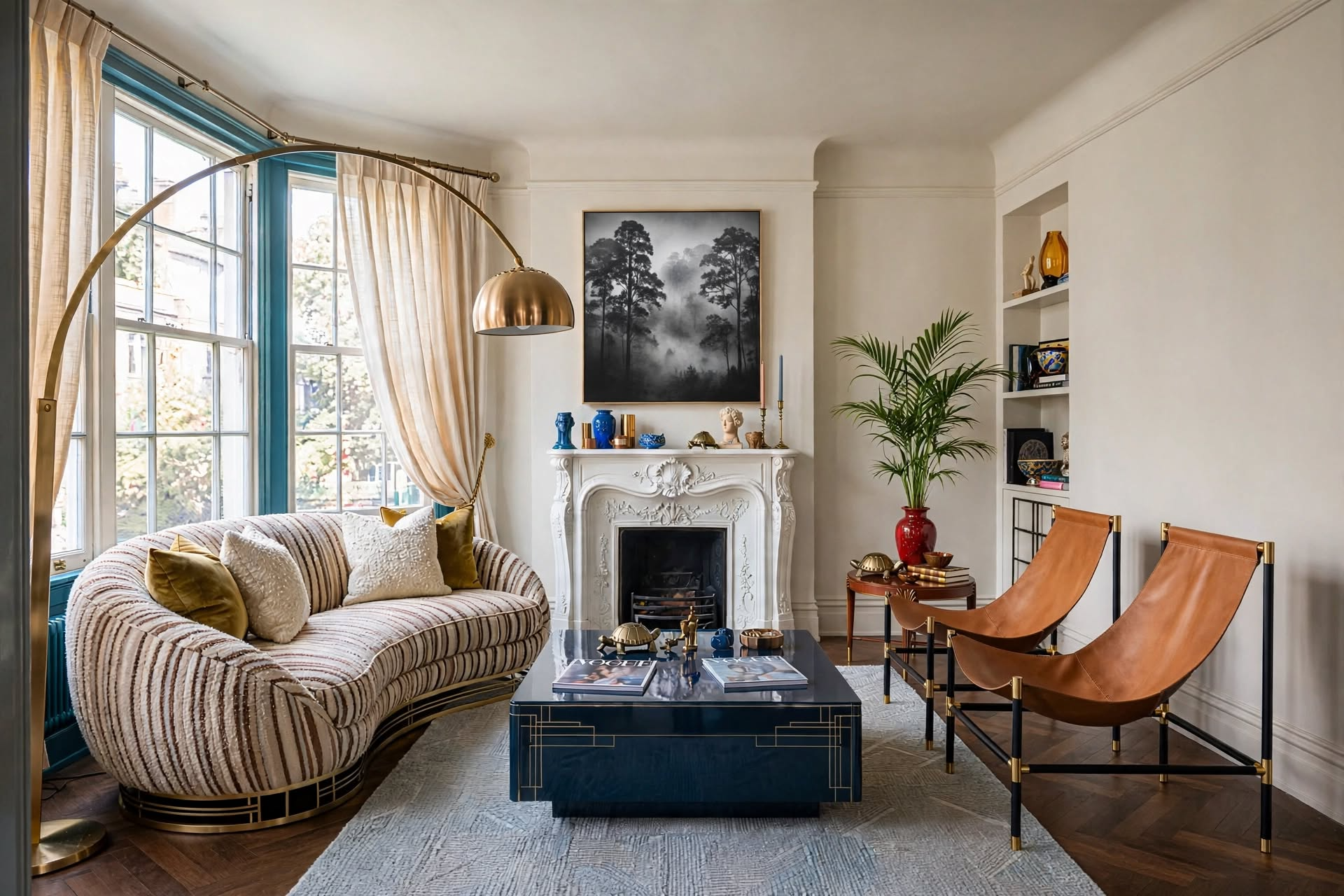
To choose a TV stand, measure your wall width and pick one that’s 4–6 inches wider than your TV on each side, sized so the screen’s center hits eye level when you’re seated (usually 42–48 inches off the floor). From there, match the storage style — open shelving, drawers, or a sliding-door cabinet — to how much you actually need to hide.
You know the feeling. You mounted the TV, pushed some old dresser underneath it “for now,” and eighteen months later that dresser is still there, still wrong, still making the whole wall look unfinished. Learning how to choose a TV stand isn’t really about furniture shopping — it’s about fixing the one piece that quietly sets the tone for your entire living room.

Get the size wrong and the whole room feels lopsided. Get the height wrong and you’re craning your neck through every movie night. Get the style wrong and it doesn’t matter how nice your sofa is — the TV wall will always read as an afterthought. The good news: every one of those problems has a real number attached to it. No guessing required. This guide walks you through the exact measurements, styling framework, and shopping strategy a designer would use to choose a TV stand room by room, including the renter-friendly and small-space workarounds most guides skip entirely.
Table of Contents+
- How to Choose a TV Stand That Actually Fits Your Room
- Get the Height Right: The Eye-Level Rule
- Choosing a TV Stand for Every Room
- Console Styling 101: The Anchor-Stack-Breathe Method
- Lighting Strategy Around Your TV Stand
- Decorating Around a Frame TV
- Best TV Stands for Small Spaces, Corners & Renters
- What NOT to Do When You Choose a TV Stand
- The Designer’s Cheat Sheet
- Final Thoughts
- FAQs
How to Choose a TV Stand That Actually Fits Your Room

Every sizing mistake starts the same way: someone falls in love with a stand online, buys it, and only then holds a tape measure up to the wall. Do it backward and you’re stuck with a piece that either floats awkwardly in the middle of a huge wall or crowds your walkway every time you head to the kitchen. Learning to choose a TV stand the right way just means flipping that order.
The goal is a stand that grounds the TV instead of just holding it up. That comes down to three measurements, taken in this order, before you open a single product page.
Step 1: Measure your wall width and TV width
This is the first real step in how to choose a TV stand: measure the full wall the TV will live on, then measure your TV’s width edge to edge. Your stand should extend 4 to 6 inches beyond the TV on each side — that’s the visual buffer that keeps the screen from looking like it’s teetering on the edge of the furniture. A 55-inch TV (about 48 inches wide) wants a stand in the 56 to 60-inch range.
Step 2: Check your depth clearance
Measure from the wall to the front edge of your sofa or the nearest walking path. Most TV stands run 16 to 20 inches deep — fine for most rooms, but if you’re working with a narrow layout, a wall-mounted floating console (as shallow as 10 to 12 inches) buys back real floor space without shrinking your storage options.
Step 3: Leave breathing room on either side
Don’t let the stand touch adjacent furniture or run wall-to-wall. Leaving at least 6 to 8 inches of clear wall on each end keeps the eye from reading the whole wall as one solid block of furniture.
If your wall is wider than your widest available stand, don’t stretch the furniture to fill it — flank the stand with a floor lamp or a slim bookshelf instead. It reads as intentional, not undersized. This is the kind of adjustment that separates a designer’s approach to how to choose a TV stand from a rushed online purchase.
Get the Height Right: The Eye-Level Rule for TV Stands

Width gets all the attention during shopping, but height is what you’ll actually feel every single time you sit down to watch something. Get it wrong and you’ll be tilting your chin up or down for years. When people ask how to choose a TV stand and end up disappointed, the height rule is almost always the one they skipped.
The rule: when you’re seated in your normal spot, the center of the screen should land roughly at eye level. For most standard sofas, that’s a stand height of 18 to 24 inches, which puts the screen’s center around 42 to 48 inches off the floor.
| Seating Type | Recommended Stand Height | Screen Center From Floor |
|---|---|---|
| Standard sofa (seat ~17–18″) | 18–24 in | 42–48 in |
| Low-profile sofa (seat ~14–16″) | 14–18 in | 38–44 in |
| Floor seating / cushions | 8–14 in | 30–38 in |
If your TV is wall-mounted instead of sitting on the stand, this rule still applies to the mount height — the console below is now purely visual and storage, so measure the screen center independently of where the console lands.
Choosing a TV Stand for Every Room
The “right” TV stand changes completely depending on which room it’s going in. A piece that reads as cozy in a bedroom can look bulky and wrong in a rental living room, which is why choosing a TV stand always starts with the room, not the furniture catalog.
Living Room
This is where the stand carries the most visual weight, so lean into a piece with real presence — a low, wide console with mixed open-and-closed storage handles gaming consoles, a router, and remotes without turning the wall into a media closet.

Bedroom
Keep it compact and quiet. A narrower stand (36 to 48 inches) with one or two drawers is usually plenty, and a lighter wood tone or upholstered base keeps the room feeling like a bedroom first, media room second.

Apartments & Rentals
Skip anything you’d have to drill into the wall to mount. A freestanding low console or a rolling media cart gives you the same function with zero landlord conversation, and lighter-colored wood visually opens up a smaller footprint.

Man Cave or Media Room
This is the one room where you can go bigger and bolder — a full entertainment center with closed cabinet storage for gaming systems, dark wood or matte black finishes, and enough surface depth for a soundbar without it hanging off the edge.

Console Styling 101: The Anchor-Stack-Breathe Method

An empty TV stand looks unfinished. A cluttered one looks worse. The fix is a simple three-part framework I use on every console styling job, regardless of size or budget — it’s the step people forget once they’ve finally figured out how to choose a TV stand and just want to be done shopping.
Anchor
One larger object — a sculptural vase, a small lamp, or a woven basket — placed to one side, never centered under the screen.
Stack
A short stack of 2–3 books topped with a small object, placed opposite the anchor to balance the visual weight.
Breathe
Leave at least a third of the surface completely empty. That negative space is what keeps the vignette from competing with the screen.
Keep everything below the bottom edge of the TV in height — nothing on the console should visually compete with the screen for attention when it’s on.
Lighting Strategy Around Your TV Stand

A TV stand that’s beautifully sized and styled can still feel off if the lighting around it fights with the screen. The goal is soft, indirect light that reduces glare instead of adding it — lighting is the last piece of the puzzle once you’ve already learned how to choose a TV stand and style it.
Step 1: Add bias lighting behind the TV
A slim LED strip mounted behind the screen reduces eye strain by softening the contrast between a bright screen and a dark wall — most kits run under $20 and stick on in minutes.
Step 2: Flank, don’t flood
A pair of wall sconces or slim floor lamps placed on either side of the console gives you ambient light without a direct glare source hitting the screen. Avoid overhead lighting positioned directly in front of the TV — that’s the single most common cause of washed-out, reflective screens.
Step 3: Put it on a dimmer
Movie-night brightness and everyday brightness are not the same thing. A simple plug-in dimmer or smart bulb lets you drop the light level without walking across the room.
Decorating Around a Frame TV

A Frame TV changes the styling rules because the screen is designed to disappear into the wall when it’s off. That only works if the console and surrounding decor treat it like art, not electronics — a different set of rules from a standard screen, but the same core question: how do you choose a TV stand that supports the look instead of fighting it.
- Match the frame color to your existing hardware — walnut with warm wood tones, matte black or white with cooler, minimal spaces.
- Build a light gallery wall around it instead of leaving it isolated — 2 to 3 smaller framed pieces at the same height reinforces the “it’s just art” illusion.
- Keep the console below simple and low-profile so nothing visually competes with the frame when Art Mode is active.
Best TV Stands for Small Spaces, Corners & Renters

Awkward layouts are where most generic TV stand advice falls apart. Here’s what actually works when you need to choose a TV stand for a space that’s short on square footage or a wall you can’t drill into.
Problem: A corner TV setup often looks awkward because a standard rectangular stand is too wide for the angle and leaves dead space behind it.
Solution: A triangular corner stand is built to fit the angle directly, so it hugs the room’s actual shape instead of floating in the middle of it.
Product: This corner stand was designed specifically for that placement — it tucks flush into the angle and reclaims the dead space a rectangular stand wastes. 👉 Check current price
Problem: Renters can’t mount a floating console to drywall without risking their deposit.
Solution: A freestanding low-profile media cart gives the same visual effect — TV appearing to “float” — with zero wall damage.
Product: This rolling media cart delivers the floating-console look while staying entirely portable, so it moves with you at lease renewal. 👉 Check current price
Our Top Picks

Bryner TV Stand (Up to 65″)
A raw, unfinished wood build keeps the price low without cutting the size — this one still clears the 4–6 inch overhang rule on most 55 to 60 inch TVs, and you can stain or seal it to match any room.
Ideal starter piece for a first apartment or guest room.
Check Current Price — Wayfair
Aadam 35.4″ Storage Credenza
Bedrooms and small living rooms don’t need a full-size console — this narrower credenza still gives you closed storage for cords and remotes without eating up wall space you don’t have.
Fits the 36–48 inch bedroom sizing rule exactly.
Check Current Price — Wayfair
Corner TV Stand With Power Outlet
Built specifically for the angle, so it hugs your room’s actual shape instead of leaving dead space behind a rectangular stand — the built-in power outlet also means one less extension cord snaking across the floor.
Solves the awkward-corner problem the rest of this guide covers.
Check Current Price — Wayfair
Abbing Height-Adjustable Swivel Stand
Skips the eye-level guesswork entirely — the screen height and swivel angle adjust on the fly, so you can dial in the exact 42–48 inch center-of-screen rule from any seat in the room.
Fits TVs from 32 to 70 inches on one stand.
Check Current Price — Wayfair
Floating TV Stand With RGB Lights
The built-in bias lighting is already baked into the shelf, so the “add an LED strip behind the TV” step from our lighting section is done before it’s even out of the box.
Best for owners who can mount to the wall.
Check Current Price — Wayfair
Inniss TV Stand (Up to 75″)
Wide enough for large-format screens without ever looking undersized, with enough surface depth that a soundbar sits flush instead of hanging off the front edge.
The overhang rule at scale, for 70-inch-plus TVs.
Check Current Price — WayfairWhat NOT to Do When You Choose a TV Stand
Do This
- Measure your wall and TV before shopping
- Keep the screen center near eye level
- Leave a third of the surface empty
- Choose freestanding pieces if you rent
Not This
- Buying a stand that’s narrower than your TV
- Stacking cords and remotes in plain sight
- Centering every object under the screen
- Drilling into a rental wall without checking your lease
The Designer’s Cheat Sheet
Bookmark this part — it’s the short version of everything above, so you can choose a TV stand in five minutes flat the next time you’re standing in a store or scrolling a product page.
- ◆ 4–6″ wider than TV, each side
- ◆ 18–24″ stand height
- ◆ 42–48″ screen center
- ◆ 16–20″ standard
- ◆ 10–12″ floating
- ◆ 6–8″ clear on each end
- ◆ Anchor–Stack–Breathe: 1/3 surface empty
- ◆ Bias light + flanking sconces, no overhead glare
- Undersized stand, TV overhangs edges
- Cords and clutter piled on top
- Everything centered, no negative space
- Stand extends 4–6″ past the TV each side
- Cable box tucked into closed storage
- Anchor-Stack-Breathe styling on top
Ready to Choose a TV Stand That Actually Fits?
Measure first, style second — that’s the whole secret. Save the cheat sheet above and shop with real numbers instead of guesswork.
Final Thoughts: Choose a TV Stand With Confidence
Getting this right isn’t complicated once you have the numbers — it just takes measuring before you fall in love with a piece online. Grab your tape measure, run through the width and height rules above, and the rest of the styling comes together fast. Your TV wall is one of the most-used spots in your home; it deserves five extra minutes of math before you check out. However you decide to choose a TV stand, let the numbers lead and the style follow.
Take the Designer Shortcuts With You
If you want the full formulas, spacing rules, and layout math from this guide (and every other room in your home) in one place, grab The Designer’s SECRET Cheat Sheet — it’s the shortcut version of everything a designer checks before calling a room finished.
And if you want more of this in your feed, come find us @thedecorholic on Instagram, Facebook, TikTok, and Pinterest for more room-by-room styling breakdowns like this one.
FAQs: How to Choose a TV Stand
CATCH THE LATEST IN HOME DECOR TRENDS:

Steal These 16 Expert-Approved Decorating Secrets

Accessorize a Small Living Room: 7 Genius Styling Secrets

How to Make a Small Room Appear Bigger

How to Make Your Home Look Expensive
GET CAUGHT UP ON ALL THE INSPIRING DECOR TIPS:

Best Fireplace Makeover Ideas

How to Make a Gallery Wall: The Complete Step-by-Step Guide (Even If You’ve Never Hung a Picture)