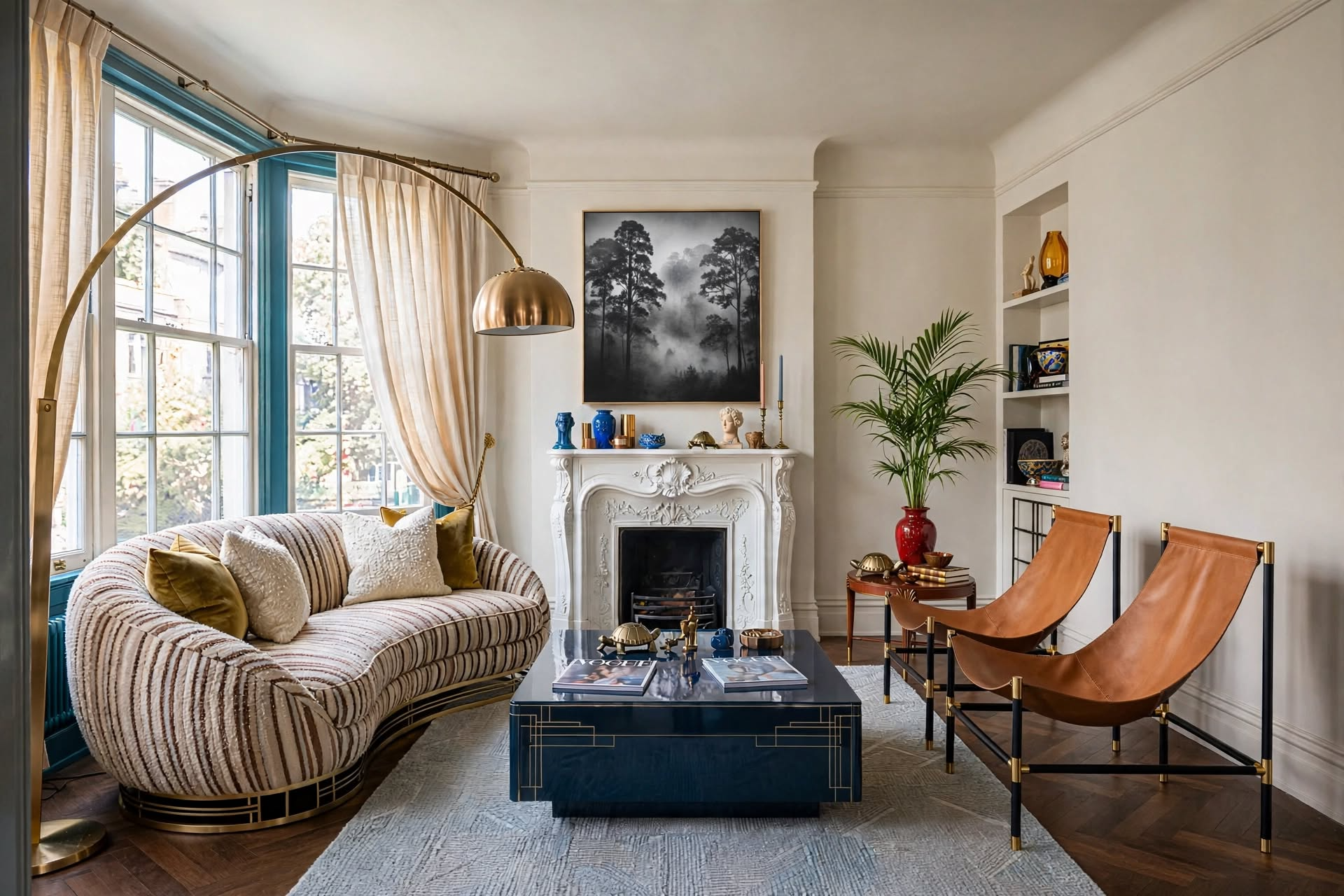
“Still rearranging the same room hoping it’ll click? It won’t — until you know this.”
The Designer’s SECRET Cheat Sheet121 designer-approved rules for every room in your home. The shortcut every well-styled home is built on.
How to Make a Small Apartment Look Cohesive: The Designer’s Step-by-Step Guide
The color, material, sightline, and lighting rules that stop a small apartment from feeling like five different rooms crammed into one.

Learning how to make a small apartment look cohesive comes down to five things: one color story instead of a color scheme, materials and finishes repeated on purpose, sightlines that connect every zone, a room-by-room plan instead of one-room-at-a-time decorating, and a layered lighting strategy that unifies the whole space. Fix those five and a 500-square-foot apartment stops reading as cluttered and starts reading as designed.
Your small apartment doesn’t have a clutter problem. It has a cohesion problem. You’ve got a decent sofa, a rug you actually like, some plants, maybe a gallery wall — and none of it reads as one room. It reads as a pile of individually good decisions that never talked to each other.

That’s the single biggest gap between a small apartment that looks intentional and one that looks like it’s still being unpacked. It isn’t square footage. It isn’t budget. It’s process — and almost nobody explains the actual system for how to make a small apartment look cohesive in a space where every wall does double duty.
Why a Cohesive Small Apartment Actually Matters

Cohesion isn’t a styling preference — it’s the difference between a small apartment that functions well and one that quietly wears you down. When every zone shares a color story, a material palette, and a lighting temperature, your brain stops working to process the room. There’s less visual noise to filter out, which is a large part of why a cohesive apartment feels calmer to simply exist in, day to day.
It also changes how big the space reads. A room with five competing colors and three mismatched metal finishes forces your eye to stop and reset constantly, which makes a small footprint feel even smaller. A cohesive apartment does the opposite: the eye glides across the room instead of tripping over it, and that unbroken sightline is what makes 500 square feet feel like more.
There’s a practical payoff too. A cohesive apartment is faster to restyle seasonally, easier to photograph well for a sublet or resale listing, and far more forgiving when you add or swap a single piece — because everything else is already speaking the same visual language.
📋 What’s Inside This GuideTap to expand
- Build One Color Story, Not a Color Scheme
- Repeat Materials and Finishes on Purpose
- Create Sightlines That Connect Every Room
- Room-by-Room: How to Make a Small Apartment Look Cohesive
- Lighting Strategy for a Cohesive Small Apartment
- The Designer’s Cheat Sheet: Rules & Ratios
- Real-Life Fixes: Common Cohesion Problems Solved
- What NOT to Do
- Shop the Look
- FAQ
Key Takeaways
- A color story carries through every future purchase; a color scheme is picked once and forgotten — that distinction is what keeps an apartment cohesive over years, not weeks.
- Repeating one wood tone and one metal finish across otherwise unrelated pieces does more for cohesion than any single “statement” item.
- Sightlines — not square footage — determine whether a small apartment feels open or chopped up.
- Cohesion has to be planned room-by-room, but built from the same shared palette and materials in every one.
- Lighting temperature is the most overlooked cohesion tool: mismatched bulb temperatures undo an otherwise perfect palette.
Build One Color Story, Not a Color Scheme

A color scheme is a decision you make once, for one room, on one shopping trip. A color story is a rule you carry into every future purchase — the throw blanket you buy next year, the lamp you replace in six months. That distinction is the real answer to how to make a small apartment look cohesive for the long haul, not just on move-in day.
The mechanism is the 60-30-10 rule: cap your palette at three colors, and split them 60% dominant, 30% secondary, 10% accent.
- 60% dominant neutral: Walls, large upholstery, and any rug base. Warm white, greige, or soft sand — pick one and repeat it everywhere it can go.
- 30% secondary tone: Wood furniture, curtains, and larger textiles. This is usually where warmth or contrast enters the room.
- 10% accent: Throw pillows, art, ceramics, one accent chair. This is the only place bold color earns real estate.
Pick your 10% accent color first, then find it in at least two separate zones — a pillow near the sofa and a vase near the kitchen, for example. A color that only appears once looks random. A color that appears twice looks chosen.
Small apartments punish color inconsistency more than any other room type, simply because there’s nowhere for the eye to rest between clashing zones. A studio with a navy accent wall behind the bed and a mustard rug in the living area isn’t “eclectic” — it’s two rooms wearing two outfits in one line of sight.
Repeat Materials and Finishes on Purpose

Color gets a room started, but materials are what actually hold it together once the palette is set. If your kitchen has black hardware, your living room should have at least one black element too — a lamp base, picture frames, or a media console pull. Nothing new needs to be introduced in every zone; the same handful of materials just need to keep showing up.
- One wood tone: Pick a single wood undertone — warm oak or cool walnut — and use it across every wood furniture piece. Mixed wood tones are one of the fastest ways to make a small apartment feel unplanned.
- One dominant metal, one accent max: Two finishes is the ceiling. Three or more reads as visual chaos, especially in a room small enough that every finish is visible at once.
- One repeated texture: A woven, linen, or matte texture that shows up in at least three places — a rug, a throw, a lampshade — gives the eye a pattern to recognize as it moves through the space.
Before buying anything new, audit what you already own by finish. Lay out every metal object in your apartment on one counter. If you count more than two finishes, that’s your first fix — no new furniture required.
Create Sightlines That Connect Every Room

Once your palette and materials are locked, the last lever is what your eye actually travels across. In an open-plan studio or one-bedroom, every wall is visible from every other wall — there’s no hallway to reset the eye between rooms, so anything that blocks the view fragments the apartment into smaller, disconnected pieces.
The Low-Profile Furniture Trick
A sofa with a 34-inch back, a tall bookcase, and a chunky coffee table all compete for the same limited sightline. The fix designers use constantly: keep the back height of your major pieces under 32 inches wherever possible. Lower furniture lets your eye travel over it instead of stopping at it.
- Sofas and armchairs: Look for track arms and a back height at or under 32 inches. Tuxedo-style sofas read taller than they are; avoid them in tight rooms.
- Storage: Choose credenzas and bookcases that top out below eye level (roughly 42–48 inches) rather than floor-to-ceiling units.
- Tables: An open-leg coffee table lets the rug and floor read through it, which visually expands the seating area.
Cohesive Rug Anchoring
If you take one rule from this guide, take this one: an undersized rug is the single most common reason a small apartment feels disjointed. A rug that only fits under the coffee table — with the sofa legs sitting off it — visually cuts the room in half.
- Front legs on, back legs off: The minimum standard. All seating should have at least its front legs on the rug.
- All legs on, for full cohesion: In a room under 200 square feet, an 8×10 rug with every piece of seating fully on it reads as one deliberate zone.
- Let the rug bridge zones: In an open-plan studio, a rug that extends slightly toward the kitchen or entry visually stitches two functions into one continuous room.
“In a small apartment, the rug isn’t decoration — it’s the floor plan. It tells your eye where the room starts and ends before a single piece of furniture does.”
— Interior Design Principle, small-space layout strategy- Four+ colors across the space
- Undersized rug floating under one piece
- Tall furniture blocking every sightline
- Mixed metal finishes with no repetition
- One neutral, one wood tone, one accent color
- One rug anchors the full seating area
- Furniture stays under 32″ through the sightline
- One metal finish repeated in 3+ places
Room-by-Room: How to Make a Small Apartment Look Cohesive
The rules above hold the whole apartment together, but each zone still has its own job. Here’s how to apply the same color story, materials, and sightline logic in each one.

Living Area
This is where your 60% dominant neutral does the most work. Keep furniture under 32″ and let the rug anchor the full seating cluster so the sightline into the rest of the apartment stays open.
Anchor Piece: A low-profile sofa in your dominant neutral
Materials: One wood tone, one metal finish, matching lamp bases

Sleeping Area
In a studio, the bed is often the tallest visual object in the room. Keep the headboard low and the bedding within your palette’s 60% or 30% tones — a bright, unrelated comforter splits a studio into “the bed zone” and “everything else.”
Anchor Piece: A low-profile bed frame in the dominant neutral
Materials: Bedding within the 60/30 palette, one repeated wood tone on nightstands

Kitchen
Hardware and open shelving are your material-repeat opportunity. Matching cabinet pulls to the metal finish used in the living area stitches the kitchen into the rest of the apartment instead of leaving it looking builder-grade.
Anchor Piece: Open shelving styled with the same neutral ceramics
Materials: One hardware finish repeated on every cabinet and drawer

Entryway
Even a few square feet of entry space should carry your palette and one repeated material — it tells guests the story before they’ve even reached the living room.
Anchor Piece: A slim console table in your dominant wood tone
Materials: One repeated metal finish on hooks and hardware
Lighting Strategy for a Cohesive Small Apartment

Lighting is the most overlooked lever in how to make a small apartment look cohesive — and the fastest one to get wrong. A single overhead fixture flattens a room and makes even a well-styled palette look sterile; mismatched bulb temperatures between lamps undo a perfect color story in seconds.
- Layer three light sources: Ambient (overhead or a floor lamp), task (a reading lamp or under-cabinet strip), and accent (a sconce or small table lamp) — even in a studio, all three keep the room from going flat.
- Standardize your bulb temperature: Keep every bulb in the apartment at the same temperature, ideally around 2700K (soft warm white).
- Repeat your metal finish in fixtures: Lamp bases, sconces, and pendant hardware should pull from the same one or two finishes you’ve used everywhere else.
- Use plug-in sconces if you’re renting: Wall-mounted, plug-in swing-arm sconces add a real accent light layer without any wiring.
Turn off every overhead light in the apartment and turn on only your lamps and sconces. If any single bulb reads a different color temperature than the rest, that’s the fix to make before you buy another decor piece.
The Designer’s Cheat Sheet: Rules & Ratios
- ◆ Max 3 colors, split 60/30/10
- ◆ Accent color must appear in 2+ zones
- ◆ New purchases must fit the existing story
- ◆ No single room gets its own palette
- ◆ One wood tone across all furniture
- ◆ Max 2 metal finishes total
- ◆ One texture repeated in 3+ places
- ◆ Audit finishes before buying anything new
- ◆ Nothing above 32″ blocks the main view
- ◆ Rug covers the full seating cluster
- ◆ Taller pieces belong on the perimeter
- ◆ Open sightlines read as cohesive, not empty
- ◆ Layer ambient, task, and accent light
- ◆ Standardize bulb temperature (~2700K)
- ◆ Repeat one metal finish in fixtures
- ◆ Plug-in sconces for rentals
Real-Life Fixes: Common Cohesion Problems Solved
Problem 1: “My Studio Feels Like Three Different Rooms”
The fix: This almost always traces back to color and material inconsistency between zones. Lock your 60-30-10 palette first, then walk the apartment and confirm the dominant neutral appears in the sleeping, living, and kitchen areas alike.
Problem 2: “I Bought a Rug and the Room Still Feels Cut in Half”
The fix: The rug is undersized. Measure your seating cluster, not your floor. If the sofa and chairs can’t all get at least their front legs on the rug, size up — an 8×10 is the realistic minimum for a real living area.
Problem 3: “Every Piece I Own Is Nice, But Nothing Matches”
The fix: Cohesive doesn’t mean matching — it means related. You don’t need a matching furniture set; you need one repeated wood tone and one repeated metal finish running through pieces that otherwise look nothing alike.
Visual Anti-Patterns: What NOT to Do
Do This
- Cap your palette at 3 colors, 60-30-10
- Keep major furniture under 32″ tall
- Size the rug to the full seating cluster
- Repeat one wood tone, one metal finish
- Standardize bulb temperature everywhere
Avoid This
- Letting every room pick its own color story
- Tall bookcases or sofas blocking the sightline
- A rug that only fits under the coffee table
- Mixing 4+ finishes with no repetition
- Mixed cool and warm bulbs zone to zone
Shop the Look: Small Apartment Cohesion Essentials
I’ve pulled together the exact pieces that make a small apartment look cohesive and feel intentional, connected, and beautifully put‑together.
Each item is chosen for scale, versatility, and how effortlessly it repeats your design story across a compact space. If you want the cohesive look without the guesswork, these are the pieces worth saying yes to.

AllModern Laguna 83″ Upholstered Sofa
A sofa that’s too tall or too bulky is one of the fastest ways to block the sightline in a small living room. The Laguna’s low-profile, track-arm silhouette keeps the room open, and its neutral upholstery slots straight into a 60-30-10 color story without a second thought.
Low enough to disappear into the room, sturdy enough to anchor it.
👉 Check Current Price
Amber Lewis x Loloi Alie Taupe / Dove Area Rug
An undersized rug is the single most common reason a small living area feels cut in half. The Alie rug’s soft taupe-and-dove palette works directly as your 60% dominant neutral, and it’s available large enough to get every seating piece fully anchored on it.
The single fastest fix for a room that feels cut in half.
👉 Check Current Price
Mercury Row Campanelli Coffee Table
A bulky, low-slung coffee table can block the rug and shrink a small seating area visually. The Campanelli’s slim, open-leg profile lets the rug and floor read straight through it, which keeps the sightline across the room clean.
Lets the floor breathe instead of blocking it.
👉 Check Current Price
Everly Quinn Steel Rectangular Console Table
Entryways in small apartments often get skipped entirely, breaking the material story before guests even reach the living room. This slim steel console repeats your dominant metal finish in just a few square feet, without eating into walkway space.
The five square feet that finish the story.
👉 Check Current Price
Wrought Studio Varun Plug-In Swing Arm Sconce
A single overhead light flattens a small room and leaves the palette looking sterile. This plug-in swing-arm sconce adds a true accent light layer with no wiring required, and frees up the surface space a table lamp would otherwise take.
Layered light without a single hole in the wall.
👉 Check Current Price
Kent Knurled 7″ Matte Black Bar Pull
Mismatched cabinet and furniture hardware is one of the fastest ways to break the material repeat rule. Swapping every pull in the kitchen to this one matte black finish ties the kitchen straight into the rest of the apartment’s palette.
One finish, swapped everywhere, changes everything.
👉 Check Current PriceConclusion: Small Wins To Make a Small Apartment Look Cohesive
Making a small apartment look cohesive isn’t about buying a matching furniture collection or repainting every wall the same color. It comes down to three repeatable habits: one color story with a consistent undertone, one primary metal finish repeated on purpose, and sightlines that were actually considered before you decorated. Start with whichever room you see most — usually the living room — apply these rules, then let the rest of the apartment follow its lead.
Frequently Asked Questions About Making a Small Apartment Look Cohesive
“A small apartment doesn’t need more square footage to feel put-together — it needs one system, applied consistently, room to room.”
Get The Designer’s PlaybookCATCH THE LATEST IN HOME DECOR TRENDS:

Steal These 16 Expert-Approved Decorating Secrets

Accessorize a Small Living Room: 7 Genius Styling Secrets

How to Make a Small Room Appear Bigger

How to Make Your Home Look Expensive
GET CAUGHT UP ON ALL THE INSPIRING DECOR TIPS:

Best Fireplace Makeover Ideas

How to Make a Gallery Wall: The Complete Step-by-Step Guide (Even If You’ve Never Hung a Picture)