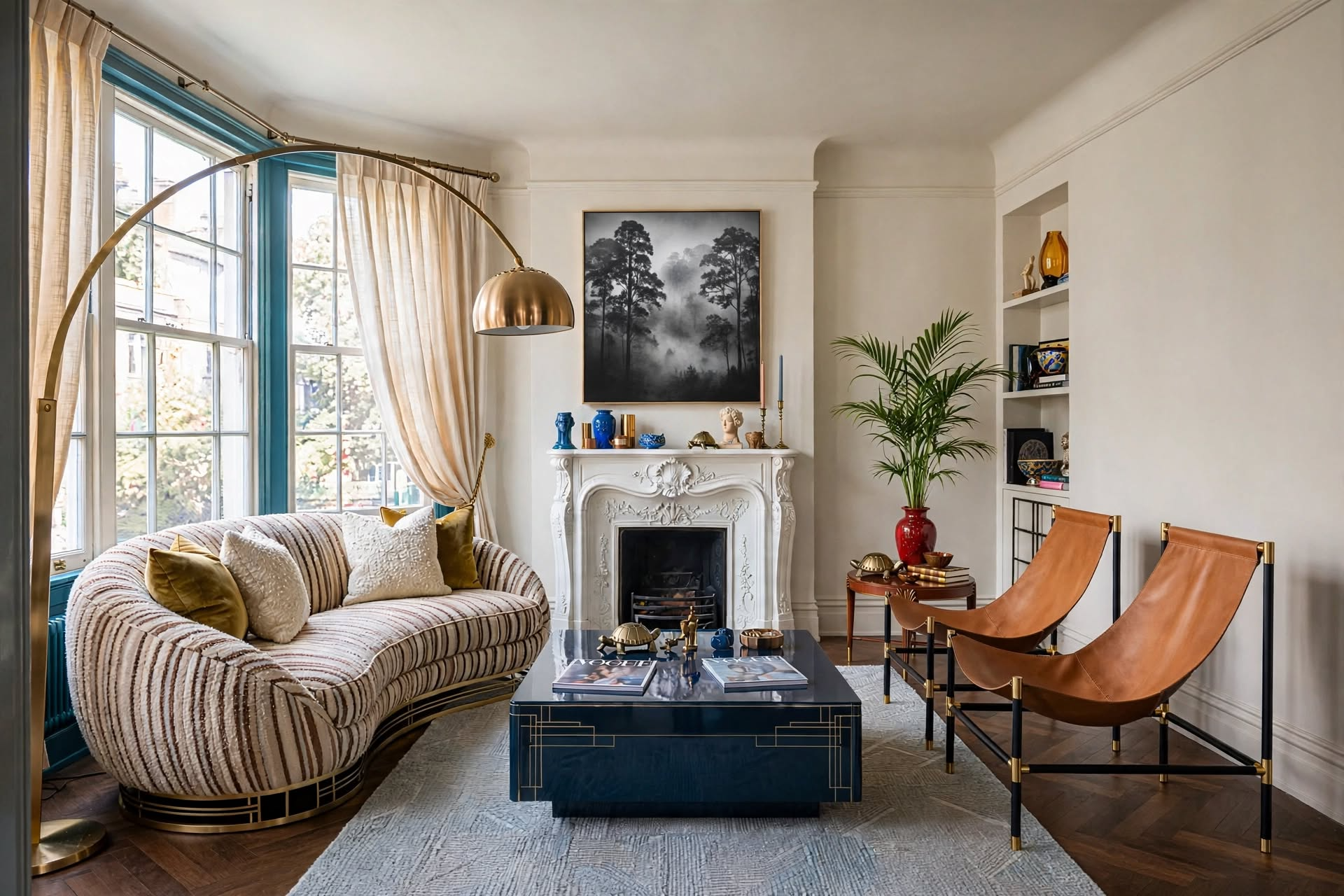
The best entryway decor ideas start with a tape measure, not a shopping cart. Keep a clear walking path of about 36 in., then plan four zones: a Drop zone for bags, coats and shoes, layered Light, something to See (a mirror or art), and a washable rug to Ground the space. Small, narrow and rental entries follow the same plan. Go vertical, choose shallow or wall-mounted pieces, and use no-drill swaps like adhesive hooks and plug-in sconces.
Most entryway decor ideas look great in a photo and fall apart by Tuesday. Shoes pile up by the door, coats land on the nearest chair, keys disappear, and the pretty table you bought blocks half the hallway. The problem usually isn’t your taste. It’s that the entry was decorated before it was planned.

This guide fixes that in order. You’ll start with the layout math, then work through storage, lighting, mirrors and art, rugs and color. After that come the harder cases: small and narrow entryways, rentals, and apartments where the front door opens straight into the living room. Each section ends with picks that fit the advice, along with the measurement to check before you buy.
One note before we start: this post covers the whole entry. If you already have a console table and want help with what goes on top of it, my guide to how to style an entryway table walks through that step by step.
Jump To
- The 7 Entryway Essentials
- Plan the Layout Before You Buy
- Entryway Storage: Benches and Hooks
- Entryway Lighting
- Mirrors, Art and Accent Walls
- Entryway Rugs and Door Mats
- Entryway Color Ideas
- Small Entryway Ideas
- Renter-Friendly Entryway Decor Ideas
- No Entryway? How to Create One
- Mudroom Drop Zone and Front Door
- Keep It Clutter-Free
- Designer’s Cheat Sheet
- FAQ
- Best all-in-one drop zoneAnteus Storage Shoe Bench with Coat Rack — Wayfair
- Best for a clean, minimal wallKazai Wall Coat Rack with Hidden Hooks — Amazon
- Best for rentersPlug-In Wall Sconces with Fabric Shades — Amazon
- Best statement mirrorSolid Wood Irregular Wall Mirror — Wayfair
- Best for muddy shoesWashable Non-Slip Runner Rug — Amazon
- Best for narrow hallsONBRILL Sliding-Door Shoe Cabinet — Amazon
Drop
A place for everything you carry in: a bench to sit on, hooks for coats and bags, and closed storage for shoes.
Light
Overhead light to see by, plus wall or lamp light at eye level so the entry feels warm instead of flat.
See
One focal point at eye level, like a mirror, art or an accent wall, so the eye lands somewhere on purpose.
Ground
A washable rug or runner and a door mat that catch dirt, soften echo and tie the zone together.

What Are the 7 Essentials for a Stylish, Functional Entryway?
A functional entryway needs seven things. You don’t need all of them on day one, and a tiny entry may combine two or three into one piece. These are the jobs an entry has to do, and every section below shows you how to cover them.
A place to sit
A bench or stool for putting shoes on and taking them off. Storage section
Hooks for coats and bags
One hook per person plus one for guests. Storage section
Closed shoe storage
Doors or baskets, so shoes stay out of sight. Small and narrow section
Layered lighting
Overhead light plus a sconce or lamp. Lighting section
A mirror or focal point
Something to look at, and a last check on the way out. Mirror section
A washable rug and door mat
To catch dirt before it travels. Rug section
A landing spot for small things
A tray, wall shelf or table for keys and mail. Reset section
How Do You Plan an Entryway Layout Before You Buy?

Start by measuring the entry and marking where people actually walk. Then choose furniture that fits around that path. Overscaled furniture is one of the most common reasons clients hire me, and the entry is where it shows up first. A bench that looked small online can eat half a hallway, and everyone ends up turning sideways to get past it.
Here’s the one piece of math that prevents that. In a hallway-style entry, keep a clear walking path of about 36 in. Whatever width is left over is the deepest furniture you can add.
Hall width − 36 in. = your maximum furniture depth. A 48 in. wide entry can take a piece about 12 in. deep. A 42 in. entry leaves about 6 in., which means wall-mounted pieces only.
- 1Measure the width and length
Measure wall to wall at the narrowest point, which is often between a door frame and a closet or stair rail.
- 2Map the door swing
Open the front door all the way. Nothing should sit inside that arc, and rugs under it need to be low enough for the door to clear.
- 3Mark outlets, switches and vents
A plug-in sconce needs an outlet nearby, and a cabinet shouldn’t block a light switch or a floor vent.
- 4Tape out the furniture
Use painter’s tape to mark a piece’s width and depth on the floor, then walk through with a bag in each hand. If you turn sideways, it’s too deep.
- 5Check the listing, twice
Compare the product’s W x D x H to your tape marks before you buy. Measure twice, buy once.
Entryway Storage Ideas: Benches, Hooks and Baskets

The most useful entryway decor ideas start with storage. Good storage gives every item a specific spot, so nothing gets dropped on the floor or the nearest chair. Plan it around what your household actually carries in each day, not what looks nice in a showroom.
Storage Bench
A bench gives you a place to sit while you take off your shoes, and it hides clutter underneath. For a small entry, look for a seat depth of 14 to 16 in. and a seat height of about 17 to 19 in., which is a comfortable sitting height for most adults. Choose closed storage or baskets if you don’t want shoes on display.

Anteus Storage Shoe Bench with Coat Rack
If your entry has no system at all, this covers three of the seven essentials in one piece: a cushioned seat, closed shoe storage and a coat rack. Everything has a home on day one, and you don’t have to coordinate separate pieces.
Will it fit? [W x D x H from listing]. Its depth should be no more than your hall width minus 36 in., and the coat rack needs clear wall space above it.
Skip it if your entry is a narrow hallway; an all-in-one unit is bulkier than a bench and separate wall hooks.
See Dimensions & Price on Wayfair →
IUNVR Rubberwood Mid-Century Entryway Bench
If you want warm wood instead of a painted finish, this solid rubberwood bench gives you a seat with shoe storage underneath and a clean mid-century shape that suits most styles.
Will it fit? [W x D x H from listing]. For a small entry, aim for 14–16 in. deep and a seat height of about 17–19 in.
Skip it if you want shoes hidden; open shelves keep everything on display. Add baskets to cover them.
See Dimensions & Price on Amazon →Wall Hooks and Coat Racks
Hooks are the most space-efficient storage an entry can have, because they use wall space you’re not using anyway. Plan one hook per person plus one for guests. Hang adult hooks about 60 to 66 in. off the floor and a second row at about 36 to 42 in. for kids, so they can put away their own things. Choose a rack with a shelf on top if you also need a spot for hats or a small tray.
Baskets are the easy upgrade. Give each person one basket under the bench for gloves, dog leashes and the things that otherwise end up on the floor.

Garfinkel 5-Hook Wall-Mounted Coat Rack
Five hooks cover a family of four plus a guest, which matches the one-per-person rule. A single mounted rack also looks neater than five separate hooks that never quite line up.
Will it fit? [W x H from listing]. Measure the open wall width, and hang it about 60–66 in. high for adults.
Skip it if you can’t drill into your walls; it mounts with screws.
See Dimensions & Price on Wayfair →
Kazai Wall Coat Rack with Hidden Hooks
When nothing is hanging, the hooks fold flat and this reads as a clean wood panel instead of a row of hardware. That’s a good fit for a small entry that’s also part of the living room.
Will it fit? [W x H from listing]. Check the open wall width, and hang it about 60–66 in. high for adults.
Skip it if you want hooks you can grab without thinking; each one flips down before you can use it.
See Dimensions & Price on Amazon →How Should You Light an Entryway? Layer It

Light an entryway in at least two layers: an overhead fixture so you can see, and a light at eye level, like sconces or a lamp, so the space feels warm. With only a ceiling light, faces look shadowed in the mirror and the room feels flat. The eye-level layer fixes both.
- Size the ceiling fixture: a common rule of thumb is to add the room’s length and width in feet. The total is roughly the fixture’s diameter in inches. A 6 x 8 ft entry suits a fixture of about 14 in.
- Hang it high enough: in a standard-height entry, keep the bottom of a pendant at least 7 ft above the floor so no one walks into it.
- Place sconces at eye level: center them about 60 to 66 in. high and on either side of a mirror. That spreads light evenly across your face.
- Choose warm bulbs: 2700K to 3000K bulbs read as cozy. Cooler bulbs can make an entry feel like an office hallway.
If you rent or there’s no wiring where you want light, plug-in sconces are the easiest of all the entryway decor ideas in this post. A paintable cord cover makes the cord nearly disappear against the wall.

Mid-Century Flower Bud Plug-In Wall Sconces
A neutral entry often needs one bold accent. These red flower-bud sconces add that pop at eye level, and because they plug in, you don’t need an electrician.
Will it fit? [W x D x H and cord length from listing]. Make sure the cord reaches your nearest outlet, and center the sconces about 60–66 in. high.
Skip it if your palette is all soft neutrals; the red is meant to stand out.
See Dimensions & Price on Wayfair →
Plug-In Wall Sconces with Fabric Shades, Set of 2
A matched pair of sconces on either side of a mirror makes a plain rental entry look custom. The fabric shades soften the light, which is more flattering for that last mirror check before you leave.
Will it fit? [W x D x H and cord length from listing]. A mirror flanked by sconces needs roughly the mirror’s width plus about 12 in. on each side.
Skip it if you don’t want a visible cord; plan on a cord cover, or choose hardwired sconces if you own.
See Dimensions & Price on Amazon →Mirrors, Art and Accent Walls: Give the Entry a Focal Point

Give your entry one clear focal point at eye level, like a mirror, a large piece of art or an accent wall, so people’s eyes land somewhere on purpose. Of all the entryway decor ideas here, a mirror does the most double duty. It bounces light around a dim entry and gives you a last look before you head out.
- Size the mirror to the furniture: above a bench or console, aim for a mirror about two-thirds of the furniture’s width. Much smaller looks lost. Much bigger looks top-heavy.
- Hang it at eye level: center art and mirrors about 57 to 60 in. off the floor, the same height galleries use. Over furniture, leave about 6 to 10 in. between the top of the piece and the bottom of the frame.
- Place it with care: a mirror facing a window doubles the daylight. A mirror facing a cluttered closet doubles the clutter.
- Try an accent wall: a deep paint color or patterned wallpaper on the wall people face when they walk in makes the biggest impact for the least money. Renters can use peel-and-stick wallpaper.
- Personalize it: family photos or a small gallery of prints makes the entry feel like yours. Keep frames in one or two finishes so it reads as one collection.

Solid Wood Irregular Wall Mirror
An organic, irregular shape turns a mirror into art. If your entry is all straight lines (doors, frames, a rectangular bench), this curve softens the whole wall, and the solid wood frame adds warmth.
Will it fit? [W x H from listing]. Over furniture, choose a mirror about two-thirds the width of the piece below it.
Skip it if your style is classic and symmetrical; the organic shape is meant to be a statement.
See Dimensions & Price on Wayfair →
CIRCUMI Shatterproof Tempered-Glass Mirror
Entries take bumps from backpacks, strollers and dogs. Tempered, shatterproof glass gives you a big, bright mirror without the worry, in a clean design that fits most styles.
Will it fit? [W x H from listing]. Center it about 57–60 in. off the floor, or 6–10 in. above the furniture below.
Skip it if you want an ornate or carved frame; this one keeps the look simple.
See Dimensions & Price on Amazon →Entryway Rugs and Door Mats: Size, Thickness and Washability

Use two layers at the door. Put a tough mat right at the door to scrape off dirt, then lay a washable rug or runner inside to catch the rest. The entry is the hardest-working floor in your home, so washability matters more here than anywhere else.
- Leave a floor border: in a hallway, choose a runner that leaves several inches of floor showing on each side. Wall-to-wall rugs make a narrow entry look narrower.
- Check door clearance: measure the gap under your front door before you buy. If a rug sits inside the door swing, it has to be low-profile enough for the door to pass over it.
- Use a pattern to hide dirt: a vintage-style or multi-tone pattern hides everyday dirt between washes far better than a solid light color.
- Stop the slide: choose a rug with a non-slip back, or add a rug pad. Entry floors get wet, and a sliding rug is a fall waiting to happen.

Griffey Vintage Boho Washable Rug
A faded red-and-blue vintage pattern hides dirt between washes. Because it’s machine-washable with a non-slip back, it’s practical enough for the busiest floor in the house.
Will it fit? [Runner sizes and thickness from listing]. Leave several inches of floor on each side, and confirm it clears your door swing.
Skip it if your entry is all cool neutrals; the red tones are warm and noticeable.
See Dimensions & Price on Wayfair →
Keen Home Design Washable Non-Slip Runner
For homes with kids, pets or snowy winters, a runner you can toss in the wash is the difference between a rug you love and one you replace every year. The non-slip back keeps it in place on wet floors.
Will it fit? [Runner sizes and thickness from listing]. Pick the length that leaves a few inches of floor at each end of your hall.
Skip it if you want a plush, thick rug; washable rugs are flat-woven and thin by design.
See Dimensions & Price on Amazon →What Is the Best Color Scheme for an Entryway?

The best entryway color scheme connects to the rooms you can see from the door. Your entry is the first color people see, and it should flow into the next space instead of fighting it. Paint is also one of the cheapest entryway decor ideas with the biggest payoff. Most entries fall into one of three approaches:
Warm Neutral
Creamy whites, greige and soft beige feel bright and work with any style. Add contrast with black hardware and natural wood.
High Contrast
Pair a deep color like navy, olive or burgundy with crisp white trim. It works best on the wall people face when they walk in.
Muted Pastel
Dusty blue, sage or blush feel calm without looking childish. Ground them with wood, rattan or a vintage rug.
Read your light first. In a bright entry with a window, almost any color works, including deep ones. In a dark, windowless entry, a pale color can look gray and dingy. A rich, deep color that makes the small space feel cozy on purpose often looks better than fighting for brightness. Test a sample on the wall and check it in the morning and again at night.
To keep your colors balanced, use the 60-30-10 approach. Let one main color cover most of the space, a second color cover a smaller share, and a small accent color show up in a few places.

Small Entryway Ideas: Go Up, Not Out

Small entryway ideas all come down to one move: use the walls instead of the floor, especially in a narrow hall. Every piece that sits on the floor narrows your walking path. Pieces mounted on the wall leave the floor open, and an open floor makes a small space feel bigger.
- Choose shallow or wall-mounted pieces: use the hall width − 36 in. rule. In very tight halls, a shoe cabinet under about 10 in. deep or a wall-mounted cabinet is the way to go.
- Use sliding or tip-out doors: a cabinet door that swings out needs clearance in front of it. Sliding and tip-out doors don’t.
- Add a floating shelf for small things: a 6 to 8 in. deep shelf holds keys, mail and a small plant without blocking the path.
- Hang a full-length mirror on the long wall: it makes a narrow hall look wider and gives you a head-to-toe check.
- Use the back of the door: over-the-door hooks or a slim organizer add storage without taking any floor space.
- Keep the palette light and continuous: using the same wall color as the next room makes the entry read as part of a bigger space.

Cerina Boho Rattan Shoe Storage Cabinet
Shoes disappear behind rattan doors, and the woven texture makes a practical piece read as decor. It’s a good match for an entry with baskets, wood and plants.
Will it fit? [W x D x H from listing]. Check the depth against your hall width minus 36 in., and check the shelf height if you store boots.
Skip it if wet coats and umbrellas will hang right above it; natural rattan doesn’t like moisture.
See Dimensions & Price on Wayfair →
ONBRILL Sliding-Door Shoe Cabinet
Sliding doors need no swing space, which is exactly what a tight hallway needs. Shoes stay hidden, and you can open the cabinet even when someone is standing right in front of it.
Will it fit? [W x D x H from listing]. Check the depth against your hall width minus 36 in.
Skip it if you need to store tall boots; check the shelf height in the listing first.
See Dimensions & Price on Amazon →Renter-Friendly Entryway Decor Ideas: No Drilling Required

You can create a finished, functional entry without one nail hole. Rely on freestanding furniture, adhesive hardware and plug-in lighting, so everything comes with you when you move.
- Adhesive hooks: check the weight rating on the package. Heavy winter coats and loaded bags need the heavy-duty versions.
- Plug-in sconces: use them with a paintable cord cover. They give you designer lighting with no wiring.
- Peel-and-stick wallpaper: test a small piece somewhere hidden first. Some wall paints peel off with it.
- A leaning mirror: a full-length mirror leaned against the wall needs no hardware. Secure it with an anti-tip strap if you have kids or pets.
- Over-the-door hooks: they turn the back of the front door or a coat closet door into storage instantly.
- A freestanding bench and baskets: together they give you the full drop zone with nothing attached to the walls.
Before you hang anything, check your lease. Some leases allow small nail holes and some don’t. A quick email to your landlord can open up more options.
No Entryway? How to Create One in an Apartment

Some of the most useful small entryway ideas are for homes with no entry at all. If your front door opens straight into the living room, you can still create one by marking off a small zone next to the door. The goal is to give everyday clutter a home so it never reaches your sofa. You don’t need walls to do it, just a few pieces that signal “this is where you stop and drop.”
- 1Define the zone with a rug
A small washable rug or runner by the door draws an invisible line between “entry” and “living room.”
- 2Use the wall beside the door
Hooks and a mirror on the nearest wall build the entry vertically without taking up living-room floor space.
- 3Add one landing piece
Add a small bench, a slim shoe cabinet or a floating shelf, whichever fits your clearance. One piece is enough.
- 4Give it its own light
A plug-in sconce or small lamp makes the zone feel like a real room instead of a corner of the living room.
- 5Turn furniture into a divider
If space allows, the back of a sofa or an open bookcase can screen the entry from the seating area.
Mudroom Entryway Ideas and a Front Door That Welcomes

If your household comes in through a back or side door, give that door a mudroom-style drop zone. It doesn’t need to be built in. A bench, a row of hooks, one basket per person and a boot tray do the same job.
- Boot tray first: a raised-edge tray holds snowmelt and mud so it doesn’t soak into your floor or rug.
- One cubby or basket per person: everyone knows where their gloves and hats live, so less gets left out.
- Hooks at two heights: adult height for coats and bags, and lower hooks so kids can hang their own things.
- A shelf for the in-between: outgoing mail, library books and returns go here, not on the kitchen counter.
The Front Door

The entry starts outside. A painted front door is one of the cheapest high-impact updates there is. Navy, deep green, black or a warm red all look classic, especially when the color suits your siding. Update the hardware to match your inside finishes, add a sturdy outdoor mat, and place potted plants on either side to frame the door. For the full outdoor plan, see my front porch decor guide.
How Do You Keep an Entryway Clutter-Free?
Keep an entryway clutter-free with a home for every item and a quick daily reset. Most clutter isn’t too much stuff. It’s things without a home. Once the seven essentials are in place, a two-minute routine keeps the entry looking the way it did the day you finished it.
- 1Shoes in, not out
Put everything except today’s pair into the cabinet or baskets.
- 2One coat per hook
Off-season coats go to a closet, since hooks are for what you’re wearing this week.
- 3Empty the landing spot
Keys stay in the tray. Mail gets opened, recycled or moved to wherever bills live.
- 4Shake the mat weekly
Shake the outdoor mat, and wash the runner when it starts to look dull.
Entryway Decor Ideas: Do’s and Don’ts
Do
- Measure and tape out furniture before buying
- Keep a clear walking path of about 36 in.
- Give every person a hook and a basket
- Layer overhead and eye-level light
- Choose a washable, non-slip rug
- Build up the walls in a narrow entry
Don’t
- Buy furniture deeper than your clearance allows
- Put anything inside the door’s swing
- Rely on one overhead light
- Choose a solid light rug for the busiest floor
- Use doors that swing out in a tight hall
- Leave keys and mail without a landing spot
Designer’s Cheat Sheet: Entryway Decor Ideas
- ◆36 in. clear walking path
- ◆Width − 36 in. = max depth
- ◆Keep the door swing clear
- ◆Bench 14–16 in. deep
- ◆Seat 17–19 in. high
- ◆One hook per person + 1
- ◆L + W (ft) = fixture size (in.)
- ◆Sconces 60–66 in. high
- ◆2700K–3000K bulbs
- ◆Mirror ≈ ⅔ furniture width
- ◆Art centered 57–60 in.
- ◆6–10 in. above furniture
- ◆Mat outside, runner inside
- ◆Floor showing on each side
- ◆Washable + non-slip
- ◆Shoe cabinet under 10 in.
- ◆Sliding or tip-out doors
- ◆Use the back of the door
Your Entryway, Zone by Zone
The best entryway decor ideas all come back to the same order: measure first, then Drop, Light, See and Ground. Once the path is clear and every coat, shoe and set of keys has a home, the pretty part gets easy, whether that’s the mirror, the accent wall or the vintage runner.
You don’t have to do it all this weekend. Measure your entry today, tape out the walking path, and fix the one zone that causes the most daily frustration. For most homes, that’s shoes. Build the rest from there. If you have a console in the mix, finish it off with my guide to styling an entryway table.
If you want the full formulas, spacing rules, and layout math from this guide (and every other room in your home) in one place, grab The Designer’s SECRET Cheat Sheet — it’s the shortcut version of everything a designer checks before calling a room finished.
Get the Cheat Sheet →And if you want more of this in your feed, come find us @thedecorholic on Instagram, Facebook, TikTok, and Pinterest for more room-by-room styling breakdowns like this one.
Entryway Decor Ideas: Your Questions
The seven entryway essentials are a place to sit, hooks for coats and bags, closed shoe storage, layered lighting, a mirror or focal point, a washable rug with a door mat, and a landing spot for keys and mail. A small entry can combine several of these into one piece, like a storage bench with a coat rack.
Build up the walls instead of filling the floor. Keep a clear walking path of about 36 in., and use the hall width minus 36 in. as your maximum furniture depth. Choose wall-mounted hooks, a floating shelf, a shoe cabinet under about 10 in. deep with sliding or tip-out doors, and a full-length mirror on the long wall to make the hall feel wider.
Mark off a small zone beside the door. Lay a washable rug to define it, hang hooks and a mirror on the nearest wall, add one landing piece like a small bench or floating shelf, and give the zone its own light with a plug-in sconce or lamp. If there’s room, the back of a sofa or an open bookcase can act as a divider.
Use at least two layers: an overhead fixture for general light and wall sconces or a lamp at eye level. A common rule of thumb sizes the ceiling fixture by adding the room’s length and width in feet and using that number as its diameter in inches. Center sconces about 60 to 66 in. high and choose warm 2700K to 3000K bulbs.
Choose a rug or runner that leaves several inches of floor showing on every side, so the entry doesn’t look smaller. Measure the gap under your front door first: any rug inside the door’s swing has to be low enough for the door to clear it. For busy entries, pick a washable rug with a non-slip back.
Use freestanding furniture, adhesive hooks rated for the weight of your coats, plug-in sconces with a paintable cord cover, a leaning full-length mirror secured with an anti-tip strap, over-the-door hooks, and peel-and-stick wallpaper tested on a hidden spot first. Check your lease too, since some allow small nail holes.

CATCH THE LATEST IN HOME DECOR TRENDS:

Accessorize a Small Living Room: 7 Genius Styling Secrets

How to Make a Small Room Appear Bigger

How to Make Your Home Look Expensive
GET CAUGHT UP ON ALL THE INSPIRING DECOR TIPS:

Best Fireplace Makeover Ideas

How to Make a Gallery Wall: The Complete Step-by-Step Guide (Even If You’ve Never Hung a Picture)