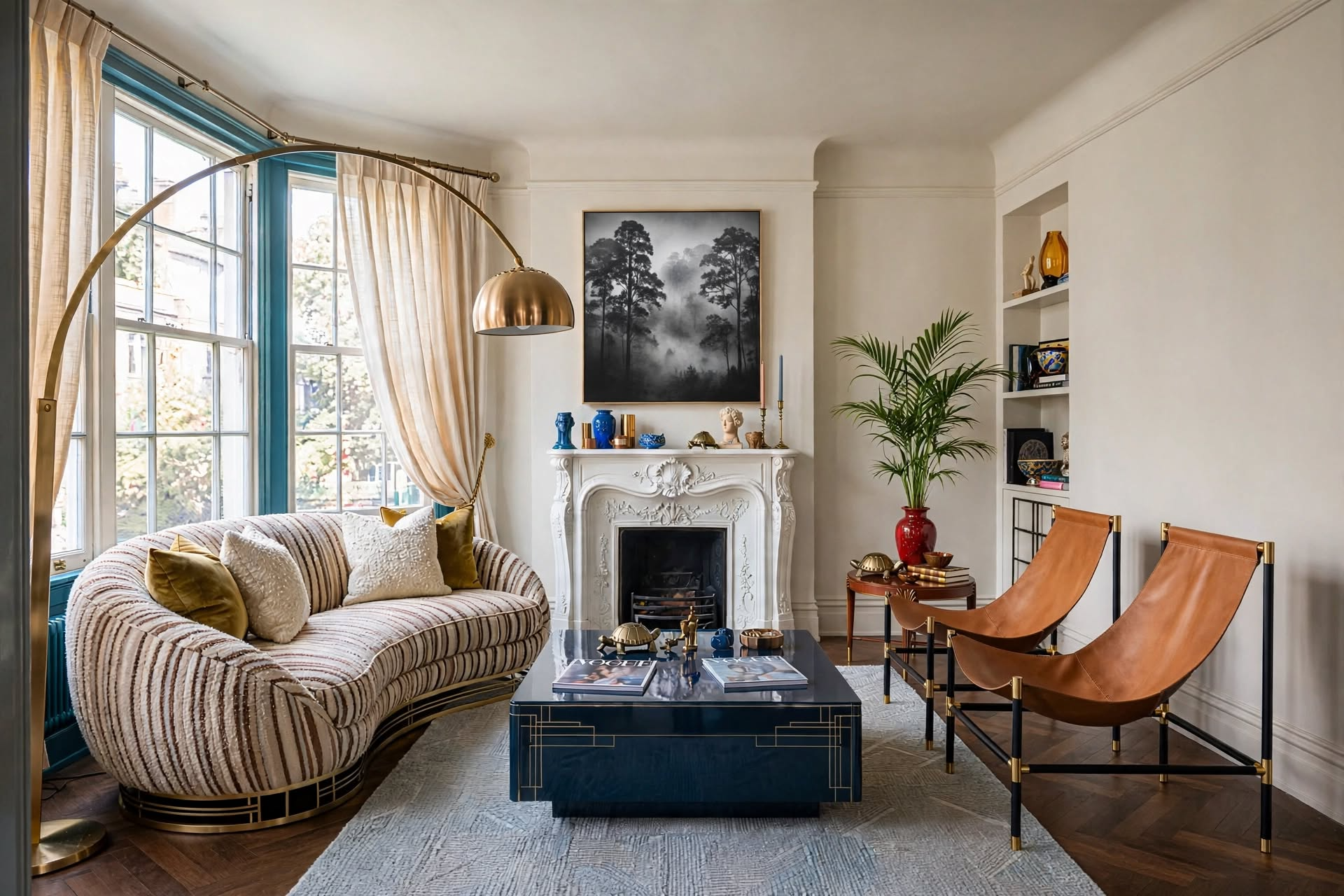
How to Style a Curved Sofa: 7 Designer Rules for Every Living Room
If you’ve ever bought a curved sofa because it looked incredible on Pinterest, then got it home and realized nothing else in the room quite works with it — you’re not imagining the problem. A curved sofa doesn’t follow the same styling rules as a standard sectional or straight-arm sofa, and most advice out there treats it like it does.

Here’s what changes: placement math, coffee table shape, rug sizing, even where you put your lamps. In this guide, I’ll walk you through exactly how to style a curved sofa using the same measurements and decision framework I use with clients — no vague “just make it flow” advice, just real numbers you can apply today.
What’s Inside This Guide+
- What Makes a Curved Sofa Different to Style?
- What Fabric Should You Choose for a Curved Sofa?
- Where Should You Place a Curved Sofa?
- How Do You Choose a Coffee Table for a Curved Sofa?
- The Arc-Anchor-Flow Method
- What Rug Size Works Under a Curved Sofa?
- How Do You Layer Lighting Around a Curved Sofa?
- What Accent Chairs Pair Best With a Curved Sofa?
- What Throw Pillows and Blankets Work Best?
- How Do You Style a Curved Sofa in a Small Space?
- How to Style a Curved Sofa on a Budget
- What NOT to Do
- Designer’s Cheat Sheet
- FAQ
What Makes a Curved Sofa Different to Style?

Photo: Collection Noir
A straight sofa gives you two hard right angles and a flat front edge — everything you place around it can line up with those edges. A curved sofa has neither. Its silhouette is defined by a radius, not a rectangle, which means the old “square coffee table, straight rug edge” playbook works against it instead of for it.
The practical effect: every piece you place near a curved sofa should either continue its arc or intentionally contrast it with something soft — never something rigidly rectangular sitting flush against the curve. That single shift is why so many curved sofa setups look slightly off even when every individual piece is beautiful.
What Fabric Should You Choose for a Curved Sofa?
Fabric matters more on a curved sofa than a straight one, because the arm and back panels are cut on a curve — some fabrics drape and stretch over that shape cleanly, while others pucker at the seams.
- Bouclé: The most common choice for a reason — its texture hides minor seam puckering on the curve and reads as soft and inviting. Higher-maintenance around pets and spills.
- Performance fabric: Best if you have kids, pets, or want a curved sofa as a genuine everyday piece rather than a showpiece. Cleans easily, holds its shape over the curve.
- Velvet: Drapes beautifully over a deep curve and adds richness, but shows crushing and watermarks more than bouclé or performance fabric.
- Leather: Works on gentler curves; very tight arcs can cause visible seaming since leather has less stretch than woven fabric.
Where Should You Place a Curved Sofa?

Photo: KATIE MARTINEZ DESIGN
Placement is where most curved sofa guides stay vague — “leave room to walk around it” isn’t a plan, it’s a wish. Here’s the actual math designers use.
- Walkway clearance: Leave a minimum of 36″ between the sofa’s outer curve and any wall or piece of furniture along a main traffic path. Under 30″ starts to feel cramped even in a large room.
- Coffee table gap: Leave 16″–18″ between the sofa’s front curve and the coffee table’s nearest edge — enough to extend your legs, tight enough to keep the conversation area intact.
- Focal point orientation: Curved sofas read best angled slightly toward a focal point (fireplace, TV, window) rather than squared off dead-center. A 5–10 degree angle is usually enough to soften the arrangement.
On placement style: floating a curved sofa away from the wall is the look most designers reach for first, because the curve needs breathing room on both sides to actually read as a shape rather than a lump against the wall. But in a small apartment or a rental where floor space is tight, that’s not always realistic — and that’s a gap most curved sofa advice doesn’t address.
How Do You Choose a Coffee Table for a Curved Sofa?

Photo: DUNELM
This is where the “curve echoes curve” rule matters most, because the coffee table sits directly in front of your sofa’s most visible line. A rectangular table with hard corners fights the sofa’s shape every time you look at it — even if you can’t immediately articulate why the room feels off.
- Round tables work best when your sofa’s curve is deep and dramatic — the table becomes an echo of the whole shape. Shop a round coffee table →
- Oval tables are the safest universal choice. Aim for a table length equal to roughly 55–65% of your sofa’s total width. Shop an oval coffee table →
- Nesting tables (round, varying heights) work well for smaller curved sofas or apartments where flexibility matters more than a single anchor piece. Shop a nesting coffee table set →
The Arc-Anchor-Flow Method
Arc
Measure your sofa’s curve depth and width before choosing a single other piece. Every decision below starts from this number.
Anchor
Choose the coffee table, rug, and accent pieces that either echo the curve or intentionally contrast it — never fight it with hard rectangles.
Flow
Set your clearances — 36″ walkway, 16–18″ to the coffee table — so the room functions as well as it photographs.
What Rug Size Works Under a Curved Sofa?

Interior Fox; Photo: Daniel Villarreal
Rug shape matters more with a curved sofa than with almost any other furniture style, because the rug is the one element sitting directly beneath the arc, visible in full from every angle in the room.
| Rug Shape | Best For | Sizing Rule | Shop |
|---|---|---|---|
| Round | Dramatic, deep-curve sofas; conversation-first layouts | Diameter should clear the sofa’s front edge by at least 12″ | Shop round → |
| Oval | Most curved sofa setups; works with an oval or round coffee table | Front two-thirds of all seating should sit on the rug | Shop oval → |
| Rectangular | Curved sofa + straight-lined room (e.g. paired with a media console) | Rug should extend 8–10″ past both ends of the sofa | Shop rectangular → |
If you’re unsure which to pick, an oval or round rug is the lower-risk choice — it echoes the sofa’s arc instead of introducing a second, competing shape into the room.
How Do You Layer Lighting Around a Curved Sofa?

Photo: Collection Noir
Curved sofas tend to sit further from walls than straight ones, which means overhead lighting alone often leaves the seating area feeling flat and under-lit. Layered lighting fixes this — and it’s a step most curved sofa guides skip entirely.
- Arc floor lamp: Position one behind or beside the sofa’s tallest point so the arm reaches over the seating area, following the same curved logic as the sofa itself. Shop an arc floor lamp →
- Table lamp: Place on a side table at one end of the curve — this gives asymmetrical warmth rather than a mirrored, overly formal look. Shop a table lamp →
- Overhead layer: A rounded or sputnik-style ceiling fixture reinforces the same soft-shape logic from above instead of a boxy flush mount. Shop a ceiling light →
- Layer height: Aim for three light sources at three heights (floor, table, overhead) so the room doesn’t rely on one flat wash of light.
What Accent Chairs Pair Best With a Curved Sofa?

Photo: KATIE MARTINEZ DESIGN
Accent chairs finish a curved sofa’s conversation area, and the same “echo the curve” rule applies — a barrel chair, swivel chair, or anything with a rounded back reads as a natural extension of the sofa rather than a competing shape. A bouclé swivel armchair is the classic pairing (shop this one →), or for more color, a curved velvet accent chair does the same job (shop this one →).
✓ Do This
- Choose a rounded-back or barrel chair
- Angle chairs slightly inward toward the sofa
- Use a swivel base for flexible conversation flow
- Keep side table shapes round or oval
✗ Avoid This
- Square-back or boxy accent chairs
- Chairs placed flush against a flat wall
- A rectangular side table pushed into the curve
- Mismatched leg finishes across every piece
- Rectangular coffee table against the curve
- Sofa pushed flat against the wall
- Single overhead light only
- Square-back accent chair
- Oval coffee table sized to the sofa
- Sofa floated or angled into a corner
- Arc lamp + table lamp layered in
- Rounded barrel chair, angled inward
What Throw Pillows and Blankets Work Best With a Curved Sofa?

Photo: DUNELM
Soft furnishings are the fastest, cheapest way to finish a curved sofa’s styling — and they follow the same curve-echo logic as everything else in this guide. A row of square pillows lined up like soldiers fights the arc; rounded shapes and draped textures work with it.
- Round or sphere pillows: A single round bouclé pillow at each end of the curve repeats the sofa’s shape better than any square pillow can.
- Mix one textured pillow in: A sheepskin or shearling pillow adds tactile contrast without introducing a hard edge.
- Drape, don’t fold, the blanket: Let a hand-woven throw blanket drape loosely over one arm or the low point of the curve — a tightly folded blanket reads stiff against a soft silhouette.
- Layer a sheepskin throw: Draped over the seat or an accent chair, it adds warmth and softens any remaining hard lines in the room.

Round Sphere Bouclé Pillow
Since square pillows fight a curved sofa’s silhouette, this round sphere pillow repeats the arc in miniature and reads as intentional rather than an afterthought.
👉 Check Current Price
Lamb Wool Throw Pillow
A flat cotton pillow can look one-note against a curved sofa’s soft lines, so this lamb wool cover adds the tactile contrast that makes a styled arrangement feel finished.
👉 Check Current Price
Hand-Woven Throw Blanket
A stiffly folded blanket looks out of place on a curved silhouette, so this hand-woven throw is made to drape loosely over the arm instead, softening the line rather than squaring it off.
👉 Check Current Price
Natural Sheepskin Throw
Draped over the low point of the curve or an accent chair, this sheepskin throw adds warmth and one more soft, rounded texture to a room that’s already speaking the curved-sofa language.
👉 Check Current PriceHow Do You Style a Curved Sofa in a Small Space?

Interior Fox; Photo: Daniel Villarreal
A curved sofa in a small apartment isn’t a liability — the rounded shape actually opens up walking paths that a boxy sectional would block. The key is choosing scale correctly and committing to the corner-angle placement instead of trying to float it.
- Size down deliberately: Look for a curved loveseat or compact two-seater (under 72″) rather than a full curved sectional in anything under 250 sq ft.
- Angle into the corner: This preserves the most floor space while still letting the curve read as intentional rather than crammed in.
- Skip the accent chair: In tight layouts, a single well-placed pouf or ottoman does the same visual job without eating clearance.
How to Style a Curved Sofa on a Budget
You don’t need to replace every piece of furniture in the room to style a curved sofa well — you need to spend in the right order.
What to skip if funds are tight: Don’t rush to replace an accent chair or side table — a round tray or a slipcover can bridge the gap. Prioritize the coffee table and rug first since they touch the sofa’s silhouette most directly.
What NOT to Do
- Pushing it flush against a flat wall with no angle — the fix: angle it 5–10 degrees or pull it 4–6 inches off the wall minimum.
- Pairing it with a rectangular coffee table — the fix: swap for round, oval, or nesting round tables sized to 55–65% of the sofa’s width.
- Under-lighting the seating area — the fix: add at least one floor lamp and one table lamp at different heights.
- Choosing a rug too small to reach the seating — the fix: make sure the front two-thirds of the sofa sits on the rug.
- Squaring it off dead-center to the room — the fix: angle it slightly toward your room’s actual focal point.
Designer’s Cheat Sheet
Walkway Clearance
- 36″ minimum along traffic paths
- 30″ is the absolute floor
Coffee Table Gap
- 16–18″ from sofa’s front curve
- Table length: 55–65% of sofa width
Table Shape
- Round for deep, dramatic curves
- Oval as the universal safe choice
Rug Coverage
- Front 2/3 of seating on the rug
- Round rug clears front edge by 12″
Focal Point Angle
- 5–10 degrees toward the focal point
- Never squared dead-center
Lighting Layers
- 3 heights: floor, table, overhead
- Warm white, 2700–3000K
Shop the Curved Sofa Styling Essentials

Oval Coffee Table
If your curved sofa still has a rectangular table sitting flush against it, this oval silhouette closes that gap immediately and gives you the 55–65% width ratio this guide walks through.
👉 Check Current Price
Round Hand-Tufted Area Rug
A rug that’s the wrong shape is one of the fastest ways to undercut a curved sofa’s whole look, so this hand-tufted round rug gives the floor plane the same arc as the furniture above it.
👉 Check Current Price
68.5″ Arched Floor Lamp
Since flat overhead light leaves most curved sofa layouts under-lit, this dimmable arc lamp solves it by physically repeating the sofa’s curve while adding the warm, layered light this guide recommends.
👉 Check Current Price
Bouclé Swivel Armchair
A square-back accent chair fights a curved sofa’s silhouette every time, so this rounded, swivel-base pick keeps the whole conversation area speaking the same shape language.
👉 Check Current PriceFrequently Asked Questions About Styling a Curved Sofa
A curved sofa isn’t just a trend piece — it’s a genuine shift in how a room can feel. Every rule in this guide comes back to one idea: let the curve lead, and build everything else in conversation with it instead of against it. Once you start looking at a room that way, straight-lined furniture starts to feel like the compromise, not the default.
You don’t need to overhaul your whole living room to get this right. Start with one decision — float the sofa, swap the coffee table, or add the rug — and the rest will follow, because you now know the measurements that make it work. That’s the difference between styling by instinct and styling with a method: you stop guessing and start designing with confidence.
Get The Decorator’s Black Book →If you want the full formulas, spacing rules, and layout math from this guide (and every other room in your home) in one place, grab The Designer’s SECRET Cheat Sheet — it’s the shortcut version of everything a designer checks before calling a room finished.
And if you want more of this in your feed, come find us @thedecorholic on Instagram, Facebook, TikTok, and Pinterest for more room-by-room styling breakdowns like this one.
CATCH THE LATEST IN HOME DECOR TRENDS:

Steal These 16 Expert-Approved Decorating Secrets

Accessorize a Small Living Room: 7 Genius Styling Secrets

How to Make a Small Room Appear Bigger

How to Make Your Home Look Expensive
GET CAUGHT UP ON ALL THE INSPIRING DECOR TIPS:

Best Fireplace Makeover Ideas

How to Make a Gallery Wall: The Complete Step-by-Step Guide (Even If You’ve Never Hung a Picture)