Best Dining Set for Small Spaces: The Designer’s Sizing & Styling Guide
TL;DR
Looking for the best dining set for small spaces? It isn’t the smallest one you can find — it’s the one sized to your actual clear floor width, built on a pedestal or trestle base so chairs tuck in completely, and shaped (round, drop-leaf, or extendable) to solve your specific squeeze points. Use the 18-36 Clearance Method in this guide and you’ll know exactly what will and won’t fit before you ever click “buy.”
You’ve measured the room. You’ve stared at the empty corner where a table should go. You’ve probably also opened and closed twelve different Wayfair tabs, because every “best dining set for small spaces” list online just says “get a round table” and calls it a day — without ever answering the question that’s actually keeping you stuck: will this specific table fit past my sofa, my doorway, my radiator, without turning dinner into a game of Twister?

This guide fixes that. We’re not going to hand you a generic “10 cute dining sets” roundup — we’re going to show you how to actually choose the best dining set for small spaces. We’re going to give you the actual formula designers use to size a dining set for a tight footprint, the base styles that let chairs disappear completely under the table when not in use, and real fixes for the shape dilemmas that show up in every small-space dining thread: round vs. rectangular, extendable vs. fixed, bench vs. chairs, and exactly how many inches you need before a table stops being a design choice and starts being a daily obstacle course.
What’s Inside This Guide
- Choosing the Right Dining Set Shape for Your Space
- The 18-36 Clearance Method: How to Size a Small-Space Dining Set
- The Shape Check: Match Your Dining Set to Your Room
- The Designer’s Cheat Sheet: Rules, Ratios & Placement
- Real-Life Fixes: The 5 Most Common Small-Space Dining Problems Solved
- Visual Anti-Patterns: What NOT to Do
- Shop the Look: Editor’s Product Picks
- Upcoming Trends in Small-Space Dining
- The Real Cost: Budget Breakdown
- Layout-by-Layout Placement Guide
- How to Host Guests Without Owning a Bigger Table
- The Complete Small-Space Dining Set Checklist
- FAQ
Choosing the Right Dining Set Shape for Your Space

The shape of your dining set matters more than its size — it’s one of the biggest factors in finding the best dining set for small spaces. Two tables with identical footprints can feel completely different in a small room depending on where the legs land, how the base is built, and whether the corners can catch a hip on the way past. Get the shape right and even a snug room feels workable. Get it wrong and no clever styling will fix it.
Base Style: The First Filter
Before shape, look at the base. This is the single most overlooked spec in small-space dining, and it’s the direct answer to “will chairs tuck in completely?”
- Pedestal base (single center column): Chairs slide in on every side with nothing to knock knees against. The best option for round or oval tables in tight footprints.
- Trestle base (two slim end supports, set back from the edges): Frees up the long sides completely — ideal for narrow rectangular tables against a wall.
- Four-leg base (traditional): Stable and often the cheapest, but corner legs limit exactly where a chair can sit and how far it tucks in. Fine for larger rooms, a liability in small ones.
Best Table Shapes For Small Spaces
- Round pedestal: no corners to navigate, chairs tuck fully
- Drop-leaf: shrinks to a console when not in use
- Extendable (leaf or expanding): daily-small, guest-ready large
- Narrow rectangular (30–34″ wide): good for galley-style rooms
Shapes to Reconsider in Tight Rooms
- Large square: hardest shape to walk around on all sides
- Wide rectangular (40″+): eats clearance on both long sides
- Four-leg corner-post tables: chairs can’t tuck fully in tight footprints
- Sets with armchairs on every seat: armchairs need 26–30″ vs. 24″ for armless
The 18-36 Clearance Method: How to Size a Small-Space Dining Set
Sizing a dining set for a small room isn’t about eyeballing it — it’s a formula. This is the exact method to use if you’re trying to find the best dining set for small spaces without a single wasted measurement. Designers use two numbers to check whether any dining set will actually work in a given footprint: 18 and 36. Here’s the six-step method built around them.
Anchor
Measure your actual clear floor width — wall to wall, or to the nearest fixed obstruction (sofa arm, radiator, doorway swing). Not the whole room. Just the usable dining zone.
Subtract
Subtract 36″ of clearance from each side (72″ total) from your clear width. What’s left is your maximum table footprint. In a genuinely tight room, subtract 36″ on the tight side and use the fuller 42–48″ on the main walkway side.
Swing
Check the 18″ chair-pullback rule: every seated chair needs at least 18″ of open space behind it to slide out and let someone sit down. This is the number that decides whether a table “squeezes past the sofa” or not.
Shape It
If your maximum footprint is tight in both directions, default to round or oval on a pedestal base — no corners means no collision points along the walking path.
Tape It
Mark the table’s exact footprint on the floor with painter’s tape, including one chair pulled fully out. Physically walk the path you’d take carrying a plate from the kitchen. This catches problems no tape measure alone will show you.
Edit
Commit to the smaller, everyday-comfortable size. If you need more seats twice a year, that’s what a drop-leaf or extendable table is for — not a reason to live with a too-big table 363 days a year.
Why the Sofa Question Comes Up So Often
“Will a round table squeeze past my sofa?” is one of the most common small-space dining questions, and it almost always comes down to one measurement: the distance between the sofa’s back or arm and the nearest wall or wall unit. If that gap is under 36″, a rectangular table’s flat side will always feel tight passing through — but a round table’s curved edge effectively “cheats” a few extra inches of usable path, because nothing juts out at a hard 90-degree angle. This is also why round pedestal tables outperform square four-leg tables of the exact same square footage in every real-world walk-through test.
Match Your Dining Set to Your Room

The reason a “perfect” dining set from Pinterest looks wrong in your apartment is almost always a shape mismatch, not a style mismatch. Matching shape to room is half the battle in finding the best dining set for small spaces. A dining set needs to speak the same spatial language as the room it’s sitting in — round rooms want round tables, narrow galley rooms want narrow rectangles, and multi-purpose rooms want a set that can shrink.
| Room Type | Best Shape | Best Base | Seats |
|---|---|---|---|
| Studio / open-plan corner | Round, 36–42″ diameter | Pedestal | 2–4 |
| Narrow galley dining nook | Rectangular, 30–34″ wide | Trestle | 2–4 |
| Multi-purpose room (also an office) | Drop-leaf or extendable | Pedestal or 2-leg | 2 daily / 4–6 expanded |
| Alcove or bay window | Round or oval | Pedestal | 2–4 |
| Apartment that hosts often | Extendable rectangular | Trestle | 4 daily / 6–8 expanded |
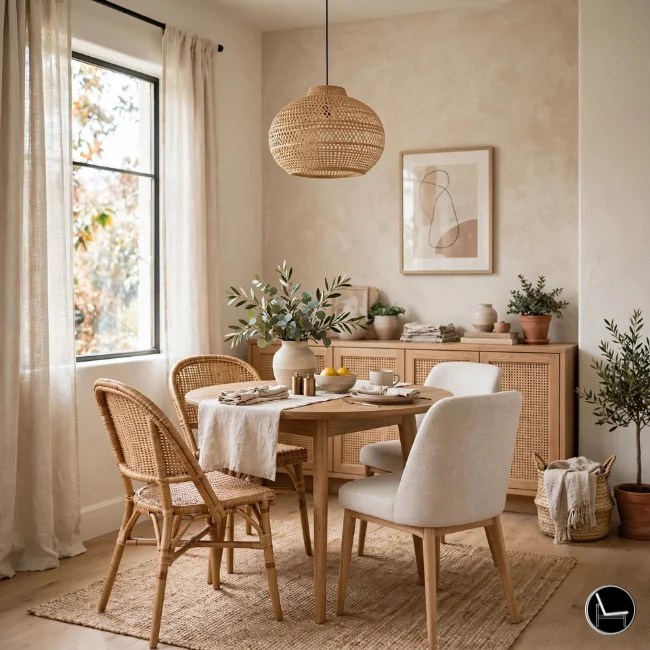
🤍 Warm Minimalist Dining
- Light wood round pedestal table
- Armless bentwood or woven-seat chairs
- Neutral linen runner instead of a full tablecloth
🌿 Organic Modern Dining
- Natural wood tone, slightly organic table edge
- Rattan or cane-back chairs (visually light, easy to tuck)
- One ceramic or stoneware centerpiece
The Designer’s Cheat Sheet: Rules, Ratios & Placement
These are the actual numbers designers use — not vague advice. Screenshot this section before you shop.
The 36-Inch Rule
- ◆ Minimum clearance, table edge to wall or furniture
- ◆ Applies on every side, not just one
- ◆ Below this, chairs can’t pull out fully
The 42–48 Comfort Zone
- ◆ Ideal clearance if the room allows it
- ◆ Needed on the “walk-behind” side especially
- ◆ Standard for rooms that double as a walkway
The Chair-Pullback Rule
- ◆ 18″ minimum to sit down comfortably
- ◆ 24–30″ if using armchairs
- ◆ Armless chairs save real inches in tight rooms
The Per-Person Rule
- ◆ 24″ of table width per seated person
- ◆ Round tables: divide the circumference, not the diameter
- ◆ Bench seating tightens this to 18–24″
Most Searched Small-Space Dining Questions
The 5 Most Common Small-Space Dining Problems — Solved
If your dining area still feels cramped after a “small space” table purchase, one of these five problems is usually the real cause. Even the best dining set for small spaces can feel wrong if one of these gets overlooked.
Problem 1: “Will a Round Table Actually Squeeze Past My Sofa?”
The fix: Measure the exact gap between your sofa’s back or arm and the nearest wall. If it’s under 36″, choose a round table on a pedestal base under 40″ in diameter — the curved edge and single center leg give you a few extra usable inches over a rectangular or four-leg table of the same footprint.
- Tape the table’s circle on the floor first and physically walk the path
- Choose armless chairs to shave 4–6″ off the pullback distance
- If the gap is under 30″, look at a drop-leaf table instead of forcing a fixed round one
Problem 2: “My Chairs Won’t Tuck All the Way In”
The fix: This is almost always a base problem, not a chair problem. Four-leg tables put a post exactly where a chair wants to slide in flush. Switch to a pedestal or trestle base and the same chairs will tuck completely, freeing up several inches of walking room around the whole table.
- Check the base’s footprint, not just the tabletop size
- Pedestal bases with a wide “foot” ring can still block chairs — check the true clearance at floor level
- Armless chairs slide flush against a table edge; armchairs rarely do
Problem 3: “I Need It to Seat 6 Twice a Year, but 2 Every Other Day”
The fix: Stop sizing for the twice-a-year scenario. An extendable or drop-leaf table solves this directly — small footprint daily, full capacity when you add the leaf or raise the flaps for guests.
- Store the leaf flat under a bed or in a closet if the table doesn’t have built-in storage
- Pair with 2 stackable or foldable chairs to bring out only when needed
- Practice the expansion once before your first dinner party — some mechanisms need a light push
Problem 4: “The Table Fits, but the Room Still Feels Tiny”
The fix: This is a visual weight problem, not a floor space problem. Glass tops, light wood tones, and open pedestal bases all read as visually lighter than solid, dark, four-leg tables — even at the exact same footprint.
- Choose a glass or light-wood tabletop to keep sightlines open
- Match chair color to the wall behind them to reduce visual contrast
- Skip a bulky rug under the table in genuinely tight rooms — it can visually shrink the space further
Problem 5: “There’s No Real Dining Room — Just a Corner”
The fix: Treat the corner as its own zone, not an afterthought. A round table anchored into a true corner uses the two walls as natural boundaries and needs clearance on only two open sides instead of four.
- Angle the table slightly for a less rigid, more intentional look
- Use a bench on the wall side to eliminate chair-pullback clearance entirely on that side
- Add a wall-mounted light above the corner to make the zone feel designed, not squeezed in
Visual Anti-Patterns: Small-Space Dining Mistakes to Avoid
Even the best dining set for small spaces can look wrong on the floor if it’s paired with the wrong habits. Here’s what separates a set that reads intentional from one that reads squeezed in.
✓ Do This
- Measure clear floor width before shopping
- Choose pedestal or trestle bases in tight rooms
- Tape the footprint before buying
- Pick armless chairs for tight pullback zones
- Choose extendable or drop-leaf for occasional guests
- Keep 1/3 visual negative space around the set
✗ Avoid This
- Buying based on tabletop size alone, ignoring the base
- Choosing armchairs for every seat in a tight room
- Sizing for once-a-year gatherings
- Pushing a table flush against a walkway wall
- Mixing 3+ wood or metal finishes in one small set
- Skipping the painter’s-tape test
Editor’s Product Picks: Best Dining Sets for Small Spaces
These picks were chosen specifically for the clearance problems covered in this guide — pedestal and trestle bases, round and drop-leaf shapes, and finishes that keep a small room feeling open rather than boxed in. Consider this our curated shortlist of the best dining set for small spaces picks on the market right now.

Latitude Run 46″ Pedestal Dining Table Set with Modern Dining Chairs
Splayed pedestal-style legs replace the usual four corner posts, so every chair slides in flush against the tabletop with nothing to catch a knee or ankle. At 46 inches across, it reads large enough to seat four without demanding the extra clearance a rectangular table of the same capacity would need.
- Footprint: 46″ round tabletop
- Chairs: 32.4″H, faux leather, seats up to 4
- Base: Solid + engineered wood, splayed pedestal-style legs
- Faux leather wipes clean instantly
- Splayed base frees up all four sides for chair tuck-in
- Compact enough for studio and apartment corners
- Still needs roughly an 8-foot clear span to hit the full 36″ clearance rule on every side

George Oliver Lyan 3-Piece Wood Dining Set with Corner Table and 2 Chairs
Built specifically to sit in a corner instead of the middle of a room, this set cuts your clearance math in half — you only need to solve for two open sides, not four. The angled three-leg base tucks neatly against two walls, freeing up the rest of the floor entirely.
- Table: 35.4″W x 31.5″D x 29.5″H
- Chairs: 33.1″H x 19.1″W x 21.5″D, seat height 18.5″
- Seats: 2 | Weight capacity: 250 lbs
- Corner placement removes two full clearance zones from the equation
- Solid rubberwood construction with a mid-century profile
- Upholstered polyester seats add comfort in a genuinely compact footprint
- Fixed 2-seat capacity — not a fit if you regularly host more than one guest

Wade Logan Folmar 4-Person Dining Set with 35″ Round Table and 4 Upholstered Fabric Chairs
The X-cross pedestal base and glass tabletop work together to keep this set visually weightless — critical in a small room, where a bulky wood table can make the whole space feel boxed in. Because the base tapers to a slim cross instead of four splayed feet, chairs tuck all the way to the table’s edge on every side.
- Footprint: 35″ round tempered glass top
- Base: Engineered wood + steel, X-cross pedestal
- Chairs: 4 included, upholstered chenille scoop-back
- Glass top keeps sightlines open in tight rooms
- X-cross base clears all four sides for full chair tuck-in
- Seats 4 in a genuinely small footprint
- Glass surface shows fingerprints and water spots more than a matte wood top
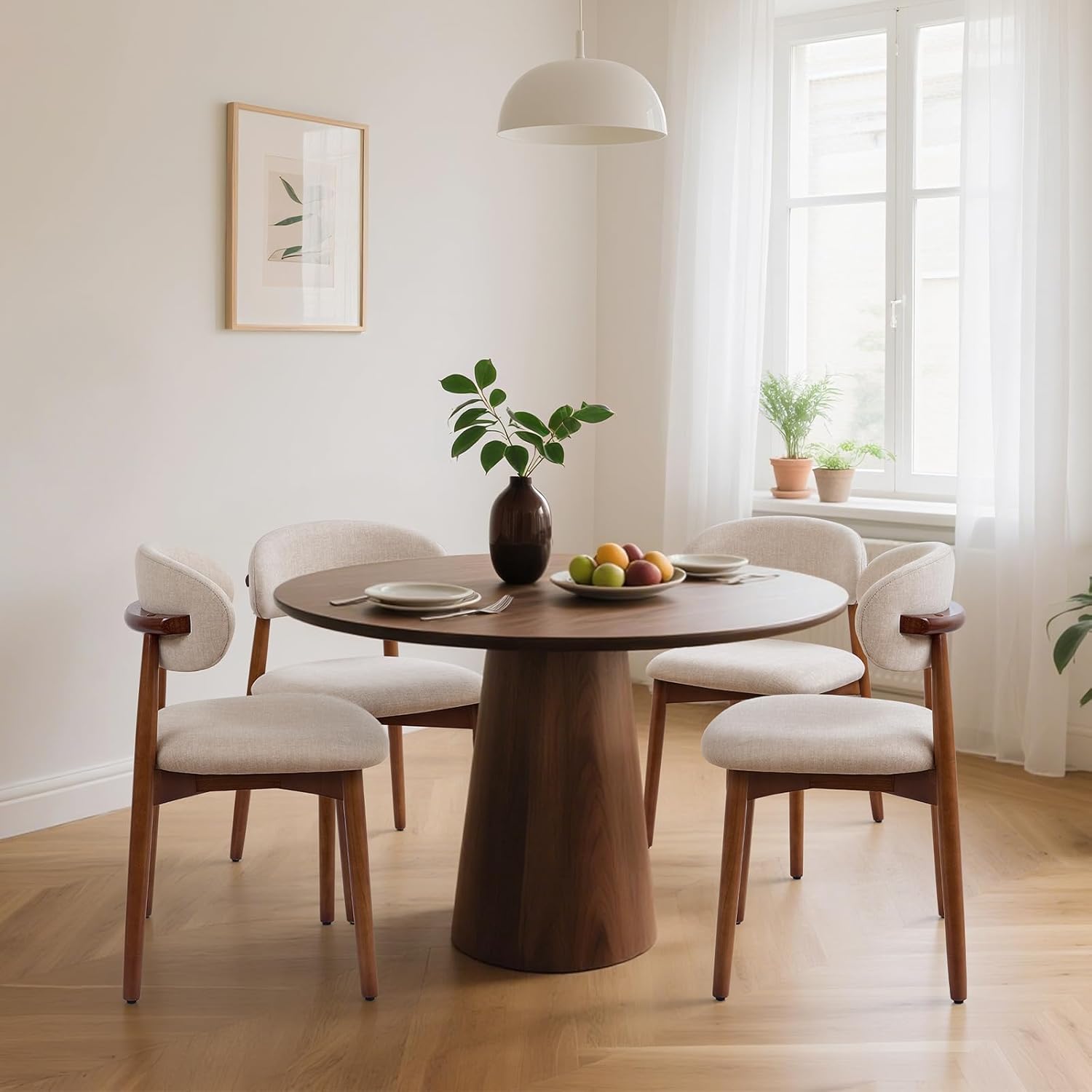
Farmhouse Upholstered Dining Set for 4, Curved-Back Chairs
This set solves the tension between everyday comfort and real seating capacity — curved-back, cushioned chairs make daily use comfortable, while the set still holds a genuine 4-person capacity in a farmhouse profile sized for apartment kitchens. Solid wood legs with non-slip leveling feet keep it steady without adding visual bulk.
- Seats: 4 | Weight capacity: 300 lbs per chair
- Upholstery: Baby velvet fabric, high-density sponge fill
- Legs: Solid wood with swivel leveling feet
- 300 lb weight capacity per chair is well above the category average
- Chairs tuck fully under the table when not in use
- Assembles in about 10–15 minutes
- Velvet upholstery needs more careful spot-cleaning than a wipeable finish

East West Furniture 3-Piece Small-Space Dining Set with Round Pedestal Table
This is the 18-36 Clearance Method brought to life at true entry-level pedestal scale — a 36-inch round top on a single pedestal leg, small enough to anchor a genuine corner or alcove without eating the whole room. Because there’s no second leg to work around, both chairs tuck in completely flush.
- Table: 36″L x 36″W x 29.5″H, round pedestal base
- Chairs: 20″L x 17″W x 37″H, linen fabric, 300 lb capacity
- Seats: 2 | Material: Rubberwood, oak finish
- True pedestal base at an entry-level price point
- Compact enough for a genuine studio corner
- 300 lb per-chair weight capacity
- 2-seat capacity only — pair with a bench or second table if you need more seating occasionally

HNY Farmhouse Dining Set with Curved-Back Upholstered Chairs
The ergonomic curved backrest and linen upholstery make this one of the more comfortable options in this roundup for daily use, and the solid wood legs keep the visual footprint slim enough not to overwhelm a small dining nook. A strong pick if daily comfort matters more to you than shaving the last few inches of floor space.
- Chairs: Mid-century curved backrest, upholstered linen, solid wood legs
- Seats: 4 | Style: Farmhouse
- Ergonomic curved back is noticeably more comfortable for long meals
- Solid wood legs read lighter than a bulky wood table
- Farmhouse finish pairs easily with warm, gold-and-cream palettes
- Table specs vary by bundle — confirm exact tabletop dimensions at checkout against your clear floor width

31.5″ Round Dining Table Set for 2, 3-Piece Modern Small Dinette
At just 31.5 inches across, this is the smallest genuine dining set in this roundup — built for studio apartments and truly tight nooks where even a 36-inch table would eat too much floor. The compact scale clears the 36-inch walkway rule in rooms where nothing else will.
- Footprint: 31.5″ round tabletop
- Pieces: 3-piece set (table + 2 chairs)
- Best for: Studio apartments, tightest footprints
- The smallest genuine round dining set in this roundup
- Ideal for a true corner or alcove placement
- Budget-friendly entry point
- 2-seat capacity is a hard ceiling — not expandable

5-Piece 39″ Round Dining Table Set, Mid-Century with Khaki Fabric Chairs
A 39-inch round top splits the difference between the ultra-compact 31.5-inch option and a full 4-person table, giving you genuine seating for four without demanding the clearance a rectangular equivalent would. Upholstered khaki chairs keep the palette warm and neutral, matching a cream-and-espresso room easily.
- Footprint: 39″ round tabletop
- Pieces: 5-piece set (table + 4 chairs)
- Chairs: Khaki fabric upholstered, mid-century silhouette
- Seats 4 at a footprint most small dining nooks can absorb
- Upholstered chairs add comfort over bare wood
- Neutral khaki tone is easy to style around
- At 39″, still confirm the full 36″ clearance ring fits your actual room before buying

5-Piece Round Dining Table Set, Mid-Century 47″ Oak Table with Faux Leather Chairs
This is the largest table in the roundup, best suited to rooms with slightly more breathing room that still want a small-space-friendly round shape. The metal-leg base keeps the visual weight lower than a solid wood four-leg table of the same size, and faux leather chairs wipe clean easily for daily family use.
- Footprint: 47″ round, oak-finish tabletop
- Pieces: 5-piece set (table + 4 faux leather chairs)
- Base: Metal legs
- Genuinely fits a family of 4 comfortably
- Faux leather chairs are low-maintenance
- Metal-leg base keeps visual bulk down despite the larger top
- At 47″ round, this needs closer to a 9–10-foot clear span to hit the full 36″ clearance rule — measure carefully before buying
Upcoming Trends in Small-Space Dining

Small-space dining is shifting away from “shrink everything” toward “make it multi-functional.” Here’s what’s replacing the old default of just buying the smallest table available — and what it means for the best dining set for small spaces going forward.
Convertible Furniture
Console-to-dining-table conversions are gaining real traction — a piece that lives against the wall at 18″ deep and unfolds to a full 40″+ table for dinner. This solves the small-space dilemma at the furniture level instead of the room level.
Visually Light Bases
Slim metal pedestal and trestle bases are replacing chunky wood four-leg constructions, specifically because they read as smaller even at the same tabletop dimensions.
Mixed Seating
A bench on one side plus two or three chairs on the other is increasingly common in small dining sets — it reduces total clearance needs while still looking intentional rather than mismatched.
Round Returns
After a few years of long rectangular farmhouse tables dominating, round and oval pedestal tables are having a real resurgence — driven almost entirely by small-space living and the circulation math covered in this guide.
The Real Cost of a Small-Space Dining Set — Budget Breakdown
| Budget Tier | Table | Chairs (Set of 2–4) | Total |
|---|---|---|---|
| Entry ($250–$400) | $150–$250 | $100–$150 | ~$350 |
| Mid ($400–$800) | $250–$450 | $150–$350 | ~$650 |
| Investment ($800–$1,500+) | $500–$900 | $300–$600 | ~$1,200 |
Where to Splurge vs. Where to Save
✓ Worth Splurging On
- The base construction (pedestal or trestle quality)
- An extendable mechanism that actually glides smoothly
- Armless chairs with a slim profile
✗ Easy to Save On
- Placemats and table linens
- A centerpiece — a single plant does the job
- Extra leaves you’ll use twice a year
Where to Put a Small Dining Set: Layout-by-Layout Placement Guide

🏠 Studio Apartment Corner
Where you place it matters as much as which set you buy. This is the most common placement for the best dining set for small spaces — and the one where a round pedestal table earns its keep most. Anchor the table where two walls meet, and you only need to solve clearance on two open sides instead of four.
🍽 Open-Plan Kitchen-to-Living Transition
Here the dining set does double duty as a visual divider between zones. A narrow rectangular table on a trestle base, positioned parallel to the main walking path, keeps the sightline open in both directions.
🪟 Alcove or Bay Window
An underused spot with real potential. A round or oval table tucked into a bay window uses the curved or angled walls as a natural frame, and typically only needs clearance on the room-facing side.
🧑💻 Multi-Purpose Room (Also an Office or Guest Room)
This is the strongest case for a drop-leaf or console-to-table conversion. Keep it folded against the wall as a console 90% of the time, and unfold it fully only when you’re actually eating there.
How to Host Guests Without Owning a Bigger Table

One of the most underrated features of the best dining set for small spaces is how easily it flexes for company. You don’t need a second table — you need a system for the two or three nights a year you actually need more room.
- Use the leaf or drop-leaf flap. Practice raising it once before guests arrive so it’s not a fumble mid-dinner-party.
- Bring in folding or stacking chairs. Store 2 extra folding chairs in a closet specifically for overflow seating — they don’t need to match perfectly if they’re only out for a few hours.
- Borrow the coffee table. A low coffee table with floor cushions can extend informal seating for a casual dinner without adding a single piece of permanent furniture.
- Stagger seating times. For more than 6 guests in a genuinely small space, consider a rotating “first course here, dessert on the sofa” flow instead of forcing everyone around one table at once.
The Complete Small-Space Dining Set Checklist
Run any shortlist through this checklist before you buy — it’s the fastest way to confirm you’ve actually found the best dining set for small spaces, not just a smaller version of a big-room table.
Tier 1: The Non-Negotiables
- Confirmed clear floor width measured on-site, not estimated
- Pedestal or trestle base to protect chair tuck-in
- 18″ minimum chair-pullback clearance checked on every seat
- 36″ minimum walkway clearance on the busiest side of the table
Tier 2: The Impactful Additions
- Extendable leaf or drop-leaf flap for occasional guests
- Armless chairs to shave inches off every clearance measurement
- Glass or light-toned tabletop to keep the room feeling open
Tier 3: What to Skip in a Small Room
- Bulky rugs under the table in genuinely tight footprints
- Armchairs on every seat — reserve them for the table ends only if at all
- A permanent 6-seat table sized for a gathering you host twice a year
Most Popular Posts
- Interior Design Style Quiz
- Timeless Paint Colors That Never Go Out of Style
- Create Your Perfect Ergonomic Home Office: A Complete Guide
- Must-Have Accessories for Guys: The Secret to a Stylish Space
- Modular Sofas for Small Spaces: Brilliant Solutions for Compact Living
- Bathroom Peel and Stick Wallpaper Ideas: 7 Designer Tricks That Look High-End
You’re Already Closer Than You Think
Choosing the best dining set for small spaces isn’t a talent — it’s a formula. Anchor your real clear floor width, subtract the 36-inch clearance, check the 18-inch chair swing, and default to a pedestal or trestle base whenever corners are working against you. That’s the whole method.
The gap between a Pinterest-perfect small dining nook and yours isn’t taste. It’s usually one measurement you haven’t taken yet, or one four-leg table standing between your chairs and a full tuck-in. Tape the footprint, walk the path, and buy for the room you actually have — not the one you’re hoping for.
Disclosure: This post contains affiliate links. We may earn a small commission at no extra cost to you if you purchase through our links. We only recommend products we genuinely love.
Frequently Asked Questions About the Best Dining Set for Small Spaces
What is the best dining set for small spaces?
Round tables on a pedestal base are the strongest all-around choice — for most rooms, this combination is the best dining set for small spaces. Without corner legs, chairs can tuck in fully from every angle, and the curved edge makes it easier to pass through the space than a rectangular or square table of the same footprint. Drop-leaf and extendable shapes are excellent runners-up when the room also needs to seat more people occasionally.
Will a round table squeeze past my sofa?
Measure the exact gap between your sofa’s back or arm and the nearest wall. If that gap is 36 inches or more, a round table under 40 inches in diameter on a pedestal base will typically pass through comfortably. Under 30 inches, consider a drop-leaf table that can fold down for everyday movement and only open fully when you’re actually dining.
How much clearance do I need around a small dining table?
Leave at least 36 inches of clearance between the table’s edge and the nearest wall or furniture on every side, and 42 to 48 inches on whichever side doubles as a main walkway. Add at least 18 inches behind every seated chair so it can be pulled out and sat in comfortably.
What base is best for small-space dining tables?
Pedestal bases (a single center column) and trestle bases (two slim end supports set back from the edges) both outperform traditional four-leg bases in small rooms. Neither puts a post where a chair needs to tuck in, which frees up several inches of usable floor space around the entire table.
Are extendable dining tables worth it for small apartments?
Yes, especially if you regularly host more people than you seat daily. An extendable or drop-leaf table lets you keep a small, comfortable footprint for everyday use and expand only when guests arrive, avoiding the trade-off of living with an oversized table year-round for the sake of a few gatherings.
CATCH THE LATEST IN HOME DECOR TRENDS:

Steal These 16 Expert-Approved Decorating Secrets

Accessorize a Small Living Room: 7 Genius Styling Secrets

How to Make a Small Room Appear Bigger

How to Make Your Home Look Expensive
GET CAUGHT UP ON ALL THE INSPIRING DECOR TIPS:

Best Fireplace Makeover Ideas

How to Make a Gallery Wall: The Complete Step-by-Step Guide (Even If You’ve Never Hung a Picture)