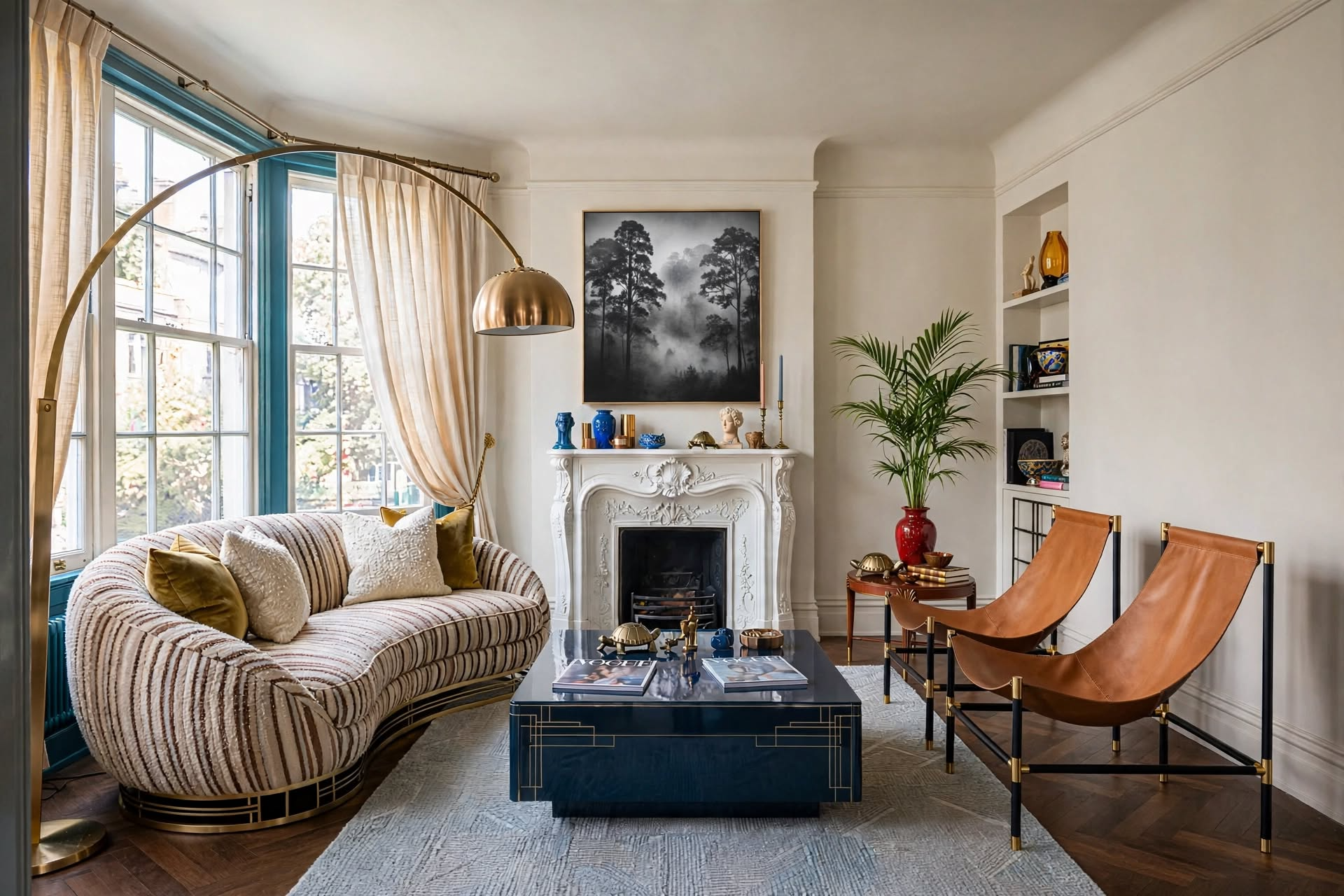
“Still rearranging the same room hoping it’ll click? It won’t — until you know this.”
The Designer’s SECRET Cheat Sheet121 designer-approved rules for every room in your home. The shortcut every well-styled home is built on.
College Apartment Ideas: 30+ Ways to Decorate Your First Apartment (Without Losing Your Deposit)
The complete renter-friendly playbook: from a full collage wall system to living room, bedroom, kitchen, and lighting upgrades that make a first apartment look lived-in, intentional, and adult.
College apartment ideas are really two things at once: a wall decor strategy (the no-damage hanging system, the 60/30/10 color rule, the layering formula) and a whole-apartment approach — layered lighting, furniture anchors, bedroom styling, kitchen shelfie moments. This guide covers all 30+. Start wherever your apartment needs the most help right now.

You’ve signed the lease and now you’re hunting for college apartment ideas that actually work. You’ve got the kitchen, the living room, and the bedroom you’ve been daydreaming about since the dorm room days — and you’ve also got a security deposit you’d very much like back. Collage apartment ideas are everywhere on TikTok and Pinterest, but most of them skip the part that actually matters: how to build that “collected over years” look in a few weekends, on a real budget, without losing a single dollar to wall damage.

This guide is the college apartment ideas system. We’ll walk through the no-damage hanging method designers actually use, the color and spacing rules that keep a collage from sliding into clutter, room-by-room placement, a real budget breakdown, and the five mistakes that make a collage apartment look unfinished instead of styled.
What’s Inside This Guide+
- 30+ Collage Apartment Ideas at a Glance
- The No-Damage Wall Hanging System
- The Layering Formula: Building Your Collage Wall
- The Vibe Check: Match Your Aesthetic
- Living Room Collage Ideas
- Bedroom Ideas: From Headboard Wall to Nightstand
- Kitchen & Open Shelf Styling
- Lighting Upgrades Under $50
- The Designer’s Cheat Sheet: Rules & Ratios
- The 5 Most Common Problems — Solved
- Visual Anti-Patterns: What NOT to Do
- Shop the Look: Editor’s Product Picks
- The Real Cost: Budget Breakdown
- Room-by-Room Placement Guide
- The Complete Checklist
- FAQ
The Master List
30+ College Apartment Ideas to Steal Right Now
These are the college apartment ideas that actually transform a first apartment — ranked from highest visual impact per dollar to lowest. Jump to any section below for the full how-to.
🖼️ Wall & Collage
- Build a no-damage collage wall with Command strips and mixed-finish frames
- Use the 60/30/10 color rule to pick prints that actually go together
- Add one woven textile as a non-frame anchor piece for depth
- Create a Polaroid + photo corner cluster above your desk
- Lean a full-length mirror next to a collage wall to double perceived height
- Use washi tape to display postcards and paper prints damage-free
- Frame a single large botanical print as a solo statement (no cluster needed)
- Add a small floating shelf to break up a flat arrangement with a real object
🛋️ Living Room
- Anchor the room with a vintage-style area rug before buying any furniture
- Style a coffee table tray with a candle, a stack of books, and one small object
- Layer two throw pillows + one lumbar in your 60/30/10 color palette
- Drape a textured throw blanket over one sofa arm — never folded, always casual
- Add a floor lamp in a corner to remove harsh overhead lighting from the equation
- Style your media console top like a shelf: vary height, add one trailing plant
- Use a tray on your ottoman to give floating furniture a visual anchor
🛏️ Bedroom
- Create a headboard wall cluster of 5–7 pieces hung as a single composition
- Layer two pillow sizes + Euro shams to make a bed look styled, not just made
- Add a matching pair of nightstand lamps — symmetry makes a room read “adult”
- Style your dresser top with a tray, a candle, and your best-smelling thing
- Use a curtain rod mounted high (near ceiling) to make windows look taller
- Add a woven or faux-fur bench at the foot of the bed for instant hotel energy
🍳 Kitchen & Shelf
- Style open kitchen shelves in a front-to-back rhythm: small in front, tall in back
- Add a ceramic canister set on your counter — functional objects are still decor
- Use a small cutting board leaned upright against the backsplash as a visual riser
- Hang a single framed print above your kitchen table or breakfast bar
- Add a small pothos or herb plant on the windowsill — the easiest kitchen upgrade
Step 01
The No-Damage Hanging System Every Renter Needs to Know

Before a single frame goes up, the hanging system is the whole game. A beautiful collage held up by the wrong hardware is a security deposit problem waiting to happen — and a collage that falls off the wall at 2am is nobody’s idea of a Pinterest moment.
“The wall is a complex surface — paint chemistry, texture, hidden contaminants — not a blank canvas. Wipe every hanging spot with isopropyl alcohol before you commit to adhesive. That single step is the difference between decor that lasts years and decor that fails in 48 hours.”— Renter-Friendly Decor Principle
| Hanging Method | Best For | Weight Limit | Removal |
|---|---|---|---|
| Command picture strips | Most frames, prints | Up to 16 lbs (large strips) | Clean pull, no damage |
| Hercules Hooks | Heavier framed pieces | Up to 20 lbs | Pinhole only, paintable |
| Removable adhesive hooks | Mirrors, light shelves | Up to 7 lbs | Clean pull |
| Washi tape + photo corners | Polaroids, postcards, paper art | Featherweight only | Instant, zero residue |
Surface Prep: The Step Almost Everyone Skips
Apartment walls carry a microscopic film of cooking oil, dust, and paint off-gassing — invisible, but enough to ruin adhesive bonds. Wipe the entire hanging area with 70% isopropyl alcohol on a microfiber cloth and let it dry fully before sticking anything up. This single five-minute step is why some collage walls last the full lease term and others start sagging by week three.
Step 02
The Layering Formula: How to Build a Collage Wall Step by Step

A great collage apartment wall isn’t more stuff — it’s the right stuff, layered in the right order. Designers use a six-step framework that turns a pile of frames into a wall that reads as one cohesive collection.
Lay It Out on the Floor First
Arrange every piece on the floor exactly as you plan to hang it. This is the one step that prevents the most wasted Command strips — you get to edit before anything touches the wall.
Anchor With Your Largest Piece
Place your biggest print, mirror, or textile slightly off-center. This is your visual anchor — everything else builds outward from it.
Build the Frame
Mix 3–5 frame finishes max (black, walnut, brass, white) so the eye reads variety as intentional, not random.
Keep Consistent Spacing
2–3 inches between every frame. Consistent gaps are what separates “gallery wall” from “collage that got out of hand.”
Add Texture and Dimension
Bring in one non-frame object — a small shelf, a woven hanging, a mirror — so the wall has depth, not just flat rectangles.
Edit
Remove two pieces. The most photographed collage walls are the ones where someone had the discipline to leave something out.
Designer Strategy: The 60/30/10 Color Rule for Collage Walls
A collage with no color plan looks like a thrift store haul taped to a wall. A collage with a ratio looks like a design decision. Here’s how to build yours:
- 60% neutral base: white mats, cream backgrounds, natural wood and black frames carry most of the wall.
- 30% secondary tone: one recurring color across 3–4 pieces — terracotta, sage, dusty blue — ties the collection together.
- 10% accent: one bold, saturated piece (a bright print, a neon sign, a vivid textile) that gives the eye somewhere to land first.
Before: The Common Mistake
- Every piece a different size, scattered randomly
- 5+ frame finishes competing
- No spacing consistency
- Every color in the rainbow represented
- No anchor piece — the eye doesn’t know where to land
After: The Designer Edit
- One large anchor piece, smaller pieces orbiting it
- 3 frame finishes max, repeated intentionally
- 2–3 inch consistent spacing throughout
- 60/30/10 color ratio applied
- One textured, non-frame object for depth
The Vibe Check
Match Your Collage Apartment Style to Your Aesthetic
The reason your collage doesn’t look like the ones you’ve pinned is almost always a vibe mismatch. A neon sign and a kantha quilt can both be great — but not necessarily on the same wall. Pick the lane that matches the rest of your apartment first.
Eclectic Maximalist

Layered, personal, unapologetically full. Mixed mediums — photos, posters, postcards, small shelves — all coexist because the color story ties them together, not because they match.
Frames: Mixed finishes, vintage thrift finds Accents: Polaroids, ticket stubs, fairy lights woven through
Must-have: a working set of clear photo corners
Warm Minimalist Collage

A restrained version — 5–9 pieces, generous negative space between them, one consistent frame finish. Proof that “collage” doesn’t have to mean “covered.”
Frames: Natural wood or matte white, all matching Accents: One art print, one mirror, one small shelf
Must-have: a tape measure for consistent spacing
Organic Modern

Natural materials and earthy tones over glossy prints. The fastest-growing collage style right now, built around texture instead of flat images.
Frames: Warm wood, rattan-edged Accents: A woven wall hanging, dried botanicals, a small ceramic shelf
Must-have: one large woven textile as the anchor
Dark Academia / Moody Collage

Rich tones, vintage botanical prints, postcards in black frames. Built for a room that wants to feel like a well-read corner of a much older apartment.
Frames: Black or dark walnut, uniform Accents: A small leaning mirror, a brass picture light
Must-have: one oversized vintage-style print as the anchor
Room Ideas
College Apartment Living Room Ideas: How to Style the Room Guests Actually See
The living room is where first impressions happen — and one of the most-searched college apartment ideas for good reason. The mistake is buying furniture before establishing an anchor. Every well-styled living room starts with the rug, then builds outward. Here’s the sequence designers use.
The Rug Comes First
Before any furniture moves in, lay the rug. It defines the zone, establishes scale, and tells you exactly how big your sofa can be. All front legs of the sofa should land on the rug — furniture floating off it looks accidental.
The Sofa Is the Canvas, Not the Statement
Choose a neutral sofa (warm cream, charcoal, camel) and make the statement through your throw pillows, blanket, and coffee table styling. Neutral sofas outlast every trend; statement pillows cost $20 to swap out.
Coffee Table: The Tray Rule
Group objects on a tray so they read as a collection, not clutter. The rule: one tall object (a candle or small plant), one textural object (a woven coaster or small stone), one stack of books. Done.
Collage Wall Above the Sofa
The sofa wall is the highest-impact spot in the apartment. Bottom edge of the lowest frame sits 6–8 inches above the sofa back — close enough to feel connected, high enough not to get hit.
Corner Lighting Instead of Overhead
A floor lamp in the far corner and a table lamp on a side table give you three light sources — the minimum for a room that doesn’t look like a dentist’s waiting room. Turn the overhead off.
Layer 3 throw pillows: two matching + one lumbar in an accent color
Drape the throw casually over one arm — never folded flat on the seat
Style your media console with varying heights: books flat, a plant, one sculptural object
Float your sofa away from the wall — even 6 inches makes the room breathe
Add a tray to your ottoman to give a multipurpose piece a styled moment
Put a plant in a corner — the organic shape breaks up all the right angles
College Apartment Bedroom Ideas: The Headboard Wall, Bedding Layers, and the Nightstand Rule

Bedroom college apartment ideas are either neglected (because guests don’t see it) or over-decorated (because it’s the only room you can truly claim). The goal is neither. Here’s the framework for a bedroom that feels designed without feeling like a set.
The Headboard Wall: Your Personal Collage
The wall behind your bed is the most forgiving canvas in the apartment — guests rarely see it, so it can be the most personal, most layered, most “you” wall in the space. Keep the cluster tight (5–7 pieces in a connected arrangement) rather than spreading across the whole wall, and hang the center point at 57–60 inches from the floor just as you would any gallery wall.
The Bedding Formula
A made bed that reads as styled follows a simple layer count: flat sheet tucked, duvet on top in a neutral or your 30% color, two sleeping pillows in matching shams, two decorative pillows in your dominant color, and one lumbar pillow in your 10% accent. Arrange them from back to front, largest to smallest. That’s it.
Match your nightstand lamps — pairs read as intentional, singles read as forgotten
Add a bench at the foot of the bed — the single fastest upgrade to a “just got the keys” bedroom
Hang curtains high — rod at ceiling level, panels pooling 1 inch on the floor for height illusion
Style your dresser top with a tray, one candle, one small framed print, and your best-smelling thing
Plug-in sconces on either side of the bed replace nightstand lamps and free up surface space
One large mirror on or leaning against the wall makes a small bedroom feel twice its size
Kitchen & Open Shelf Collage Ideas: The “Shelfie” Formula

The kitchen is the most underrated decorating opportunity in a first apartment. Most renters treat it as purely functional — but open shelves, a counter vignette, and one framed print above the table can make a kitchen feel like it belongs to someone who has their life together.
The Open Shelf Rule: Front-to-Back Rhythm
On any open shelf, place the smallest objects at the front edge and the tallest at the back. This creates visual depth instead of a flat row of things. The rhythm: one decorative object (a small ceramic, a plant), one stack of dishes leaned as art, one functional-but-beautiful item (a wooden cutting board upright, a glass jar of utensils). Never more than three “categories” per shelf.
Lean a cutting board upright against the backsplash as a free visual riser
Ceramic canister set on the counter: functional objects are still decor when they match
One small pothos on the windowsill — the easiest, cheapest kitchen upgrade available
Frame a single print above your table or breakfast bar — the wall above kitchen seating is almost always blank
A small tray corrals your oils, salt, and pepper so the counter reads as a curated vignette, not a counter
Matching dish towels hung on an oven handle: the cheapest textile upgrade in the kitchen
Lighting Upgrades Under $50: The Fastest Way to Make Any Room Feel Expensive
Nothing dates a first apartment faster than bad lighting — specifically, overhead-only fluorescent lighting with the wrong bulb temperature. The fix is a three-source rule, and most of it costs less than dinner out.
“Lighting is the single most impactful change in any room, and it’s also the one most renters never touch. Swap one overhead bulb and add one lamp and you’ve changed the entire mood of the room for under $30.”— Interior Design Principle
The Three-Source Rule
Every room needs at least three light sources at three different heights to avoid the flat, institutional look of overhead-only lighting. The formula: one overhead (now on a warm bulb), one mid-height (a table lamp or plug-in sconce), one low ambient (a floor lamp, fairy lights, a candle). You don’t need all three on simultaneously — having them available changes what the room can do.
Swap to 2700K warm LED bulbs in every fixture — the single highest-ROI change in any apartment
Plug-in floor lamp in the farthest corner from the door — creates depth and warmth simultaneously
Café lights or fairy lights along a bookshelf or window edge add ambient warmth for under $20
A candle on the coffee table counts as a light source — and as scent, and as vignette styling
Plug-in sconces don’t require an electrician — they hang like art and plug into any outlet
A dimmer plug adapter adds dimming capability to any lamp without rewiring — under $15
Shop Lighting Picks
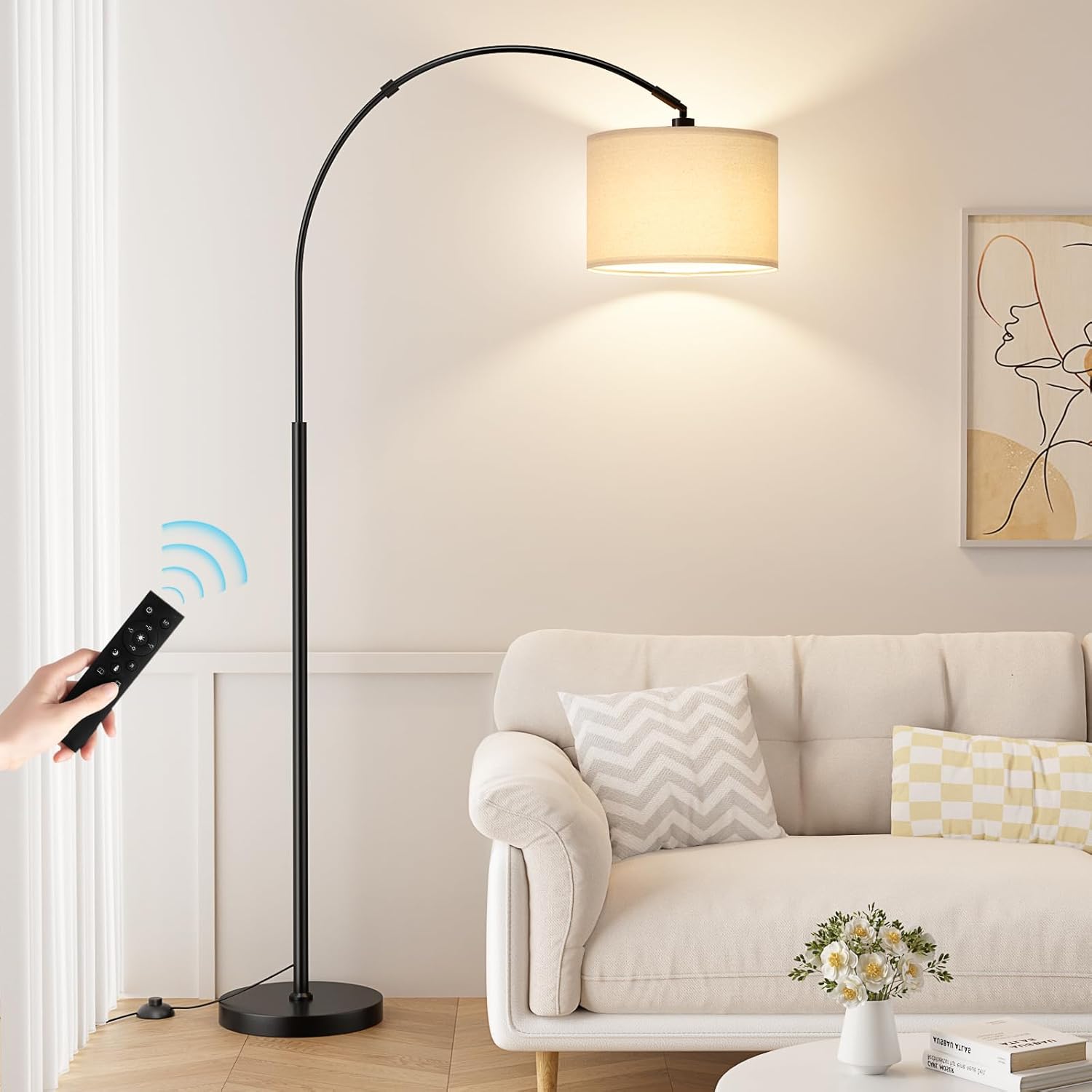
Ambimall 70” Dimmable Arc Floor Lamp with Remote
Color temp + brightness adjustable, rotating head. Arcs perfectly over a sofa for the three-source lighting rule.
Shop on Amazon →
Natyswan Touch-Control Table Lamps, Set of 2 (USB + Dimmable)
3-way dimmable with built-in USB ports. A matching pair makes nightstands look intentional instantly.
Shop on Walmart →
Ebern Designs Nevaen 63” Dimmable Floor Lamp
Sleek, slim profile — ideal corner piece for the warm ambient layer in a living room or bedroom.
Shop on Wayfair →The Cheat Sheet
The Designer’s Cheat Sheet: Rules, Ratios & Spacing

These are the actual numbers designers use — not vague advice. Screenshot this section before your next Target run.
| Rule | Number | Why It Matters |
|---|---|---|
| Eye-level center point | 57–60 inches from floor | Matches average eye level; the wall’s visual center should land here |
| Spacing between frames | 2–3 inches | Consistent gaps read as “gallery,” random gaps read as “clutter” |
| Frame finishes | 3–5 max | More than 5 finishes competing reads as visual noise |
| Largest piece weight | Under 8 lbs for strips | Keeps you in Command strip territory — no nails required |
| Total piece count | 9–15 for a full wall | Below 9 reads sparse; above 15 needs serious editing discipline |
Most-Searched Collage Wall Add-Ons
Real-Life Fixes
The 5 Most Common College Apartment Decorating Problems — Solved

If your collage wall still feels off after good-intention styling, one of these five problems is usually the culprit.
Problem 1: “It Looks Cluttered, Not Curated”
The fix: Too many pieces are competing for attention. Pull three pieces down entirely. Re-lay the remaining collection on the floor with 2–3 inch spacing before re-hanging. The clutter threshold is lower than you think — 12 well-spaced pieces almost always beats 20 crowded ones.
Problem 2: “I’m a Renter — I Can’t Drill or Damage Walls”
The fix: Command strips and Hercules Hooks handle nearly everything under 20 lbs with zero permanent damage. Test one strip in a hidden corner first, and always wipe the wall with isopropyl alcohol before sticking anything up — most “the strip fell off” complaints trace back to skipping this step.
Problem 3: “My Apartment Is Small and a Full Wall Feels Overwhelming”
The fix: Build a smaller, tighter cluster instead of a full wall — 6 to 9 pieces in a clean grid above a desk or headboard reads as intentional rather than overwhelming. In small spaces, one well-edited cluster outperforms an ambitious full wall every time.
Problem 4: “Why Does It Still Look Like a Dorm Room?”
The fix: Dorm-room collages usually skip frames entirely — posters taped flat to the wall. Even budget frames from a thrift store or Target instantly read as “apartment,” not “dorm.” Add a mat board behind smaller prints for extra polish at almost no cost.
Problem 5: “It Doesn’t Match the Rest of My Room”
The fix: Your collage is an island because it shares no color or material story with the room around it. Pull one existing color from your bedding or rug into at least two pieces on the wall, and repeat your room’s dominant metal finish in at least one frame.
What NOT to Do
Visual Anti-Patterns: Collage Wall Mistakes to Avoid
✓ Do This
- Lay the arrangement out on the floor first
- Keep 2–3 inch consistent spacing
- Mix 3–5 frame finishes, never more
- Anchor the wall with one larger piece
- Apply the 60/30/10 color ratio
- Test adhesive strips before committing
- Leave the wall’s edges loose, not boxed-in
✗ Avoid This
- Taping posters flat with no frames at all
- Random spacing with no consistent gap
- Mixing 6+ frame finishes
- Hanging everything the same size
- Filling every inch with zero breathing room
- Skipping the wall-prep wipe-down step
- Pushing the whole collage into one tight corner
“The most common collage wall mistake isn’t bad taste — it’s skipping the floor layout. Restraint and planning are design skills. It takes more confidence to leave something out than to put everything up.”— Interior Design Principle, Rule of Thirds
Shop the Look
Editor’s Product Picks: The Collage Apartment Essentials
The right hardware and a few statement pieces can transform a blank wall into a design moment. These are the specific picks worth budgeting for.
Renter-Safe Hanging Hooks

Command Heavy-Duty Utility Hooks (14-Hook Variety Pack)
Holds frames and decor with zero wall damage on move-out day. The single most-used item on this whole list.
“The unglamorous hero of every renter’s collage wall.”
Shop on Amazon →
Command Large Hooks, Value Pack (Frosted, Holds 5 lbs)
A second damage-free option for lighter pieces — small frames, hanging plants, or a shelf accent.
“Backup hooks for the lighter pieces on the wall.”
Shop on Walmart →Mixed-Finish Gallery Frame Sets
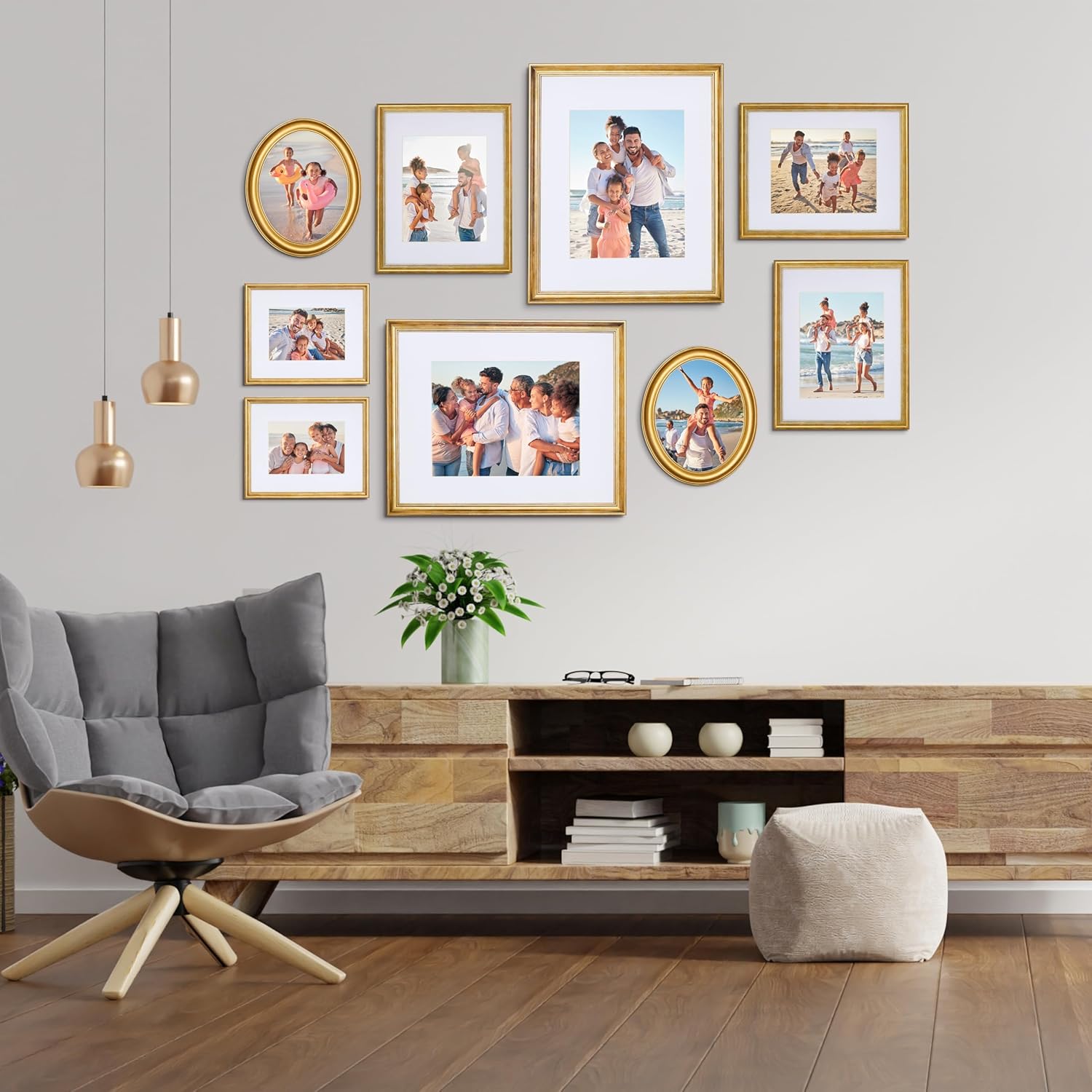
Camden Reed Mixed Gallery Frame Set, 9-Piece (Brass)
A coordinated set across multiple sizes — built for the layering formula in this guide.
Shop on Amazon →
Beveled Wood Gallery Frame Set, 10-Piece with Mat
A natural-wood finish set for the organic modern and warm minimalist collage styles.
Shop on Wayfair →
Kate & Laurel Bordeaux Gallery Frame Kit, 6-Piece
Three finishes in one box — whitewash, charcoal gray, and rustic gray — ready for the 60/30/10 rule.
Shop on Walmart →Handwoven Wall Hangings

Flber Large-Scale Macrame Wall Hanging (57″ W)
The non-frame texture piece every collage wall needs for depth and sound-dampening.
Shop on Amazon →
Bungalow Rose Wool & Cotton Hand-Woven Wall Hanging
A neutral, textural anchor piece that pairs with nearly every collage style on this list.
Shop on Wayfair →
Boho Macrame Cotton Hand-Woven Wall Tapestry
A budget-friendly large-scale woven piece for the eclectic maximalist and organic modern looks.
Shop on Walmart →Leaning Floor Mirrors

Suidia Full-Length Mirror, Solid Wood Frame (Dark Walnut)
Zero installation, instant architectural presence beside a collage wall to draw the eye upward.
Shop on Amazon →
Ebern Designs Arched Shatterproof Full-Length Mirror
An arched aluminum frame for the warm minimalist and dark academia collage styles.
Shop on Wayfair →
Cuteday Arched Full-Length Mirror, Baroque Style (Bronze)
An ornate, vintage-style finish that anchors a dark academia or eclectic maximalist collage wall.
Shop on Walmart →Area Rugs to Ground the Room
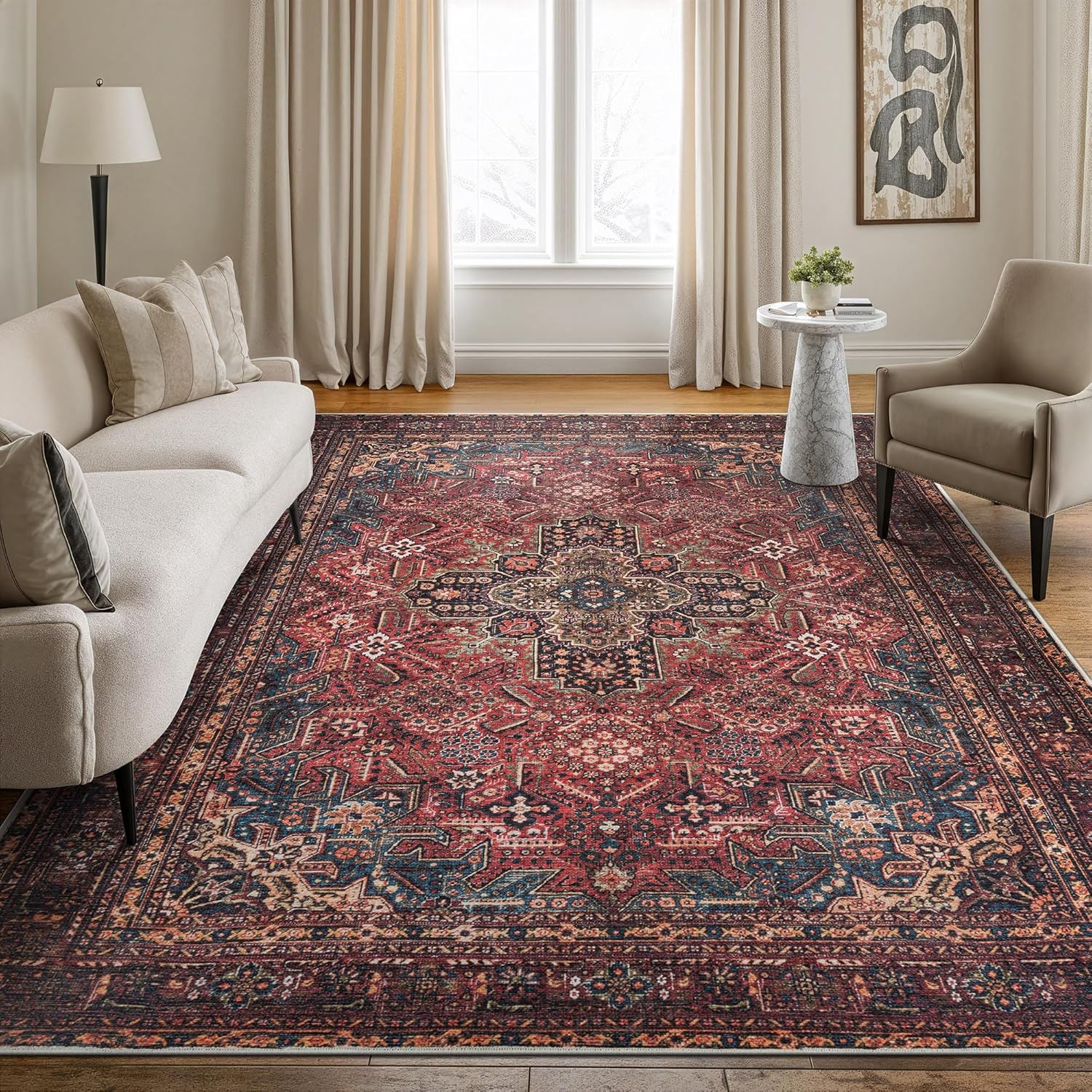
Bloom Rugs Washable Non-Slip Area Rug
An easy-care rug that grounds the room your collage wall is anchoring.
Shop on Amazon →
SAFAVIEH Heritage York Oriental Wool Area Rug
A patterned wool rug that pulls a secondary color from your collage wall into the floor.
Shop on Walmart →
Wade Logan Caelob Wool Geometric Indoor Rug
A textural geometric wool rug that complements the organic modern collage style.
Shop on Wayfair →Ready to Build Your Collage Wall?
Lay it out on the floor, mix three finishes, and edit ruthlessly. The result is worth every Command strip.
Get the Designer’s Cheat Sheet →Budget Guide
The Real Cost of Collage Apartment Decor — Budget Breakdown

Nobody talks about the actual numbers, so here’s how a designer would split a real college apartment ideas budget across three tiers.
| Budget Tier | Frames | Hanging Hardware | Prints/Art | Texture Piece | Total |
|---|---|---|---|---|---|
| Starter ($75–$150) | $30–$60 | $10–$20 | $20–$40 (free/printable) | $15–$30 | ~$110 |
| Mid ($150–$300) | $60–$100 | $15–$25 | $40–$90 | $35–$85 | ~$240 |
| Investment ($300–$500+) | $120–$180 | $20–$30 | $100–$200 | $60–$150 | ~$420 |
Where to Splurge vs. Where to Save
✓ Worth Splurging On
- One large anchor print or textile
- Quality hanging hardware (don’t skimp here)
- A few well-made frames in your dominant finish
✗ Easy to Save On
- Small filler frames — thrift stores are full of them
- Printable digital art instead of purchased prints
- Photo corners instead of frames for casual pieces
Room by Room
Where to Build Your Collage: Room-by-Room Placement Guide
🛋️ Living Room: The Conversation Starter

Build the collage above the sofa or behind a media console — the highest-traffic, highest-visibility wall in the apartment. Keep the bottom edge 6–8 inches above the sofa back so it reads as connected, not floating.
🛏️ Bedroom: The Personal Archive

The headboard wall is the most forgiving spot for an eclectic, deeply personal collage — photos, ticket stubs, postcards. This is the wall guests rarely see, so it can be the most “you” wall in the apartment.
🚪 Entryway: The First Impression

A tight, edited cluster of 5–7 pieces by the front door sets the tone immediately. Pair with a small shelf or hook rail for function alongside the visual impact.
💼 Home Office / Desk Nook

Keep this collage more restrained — 6–9 pieces in a clean grid above the desk reduces visual noise during work hours while still adding personality.
The Full Checklist
What You Need for Your College Apartment Wall: The Complete Checklist
Tier 1: The Non-Negotiables
- Command strips or Hercules Hooks (sized to your heaviest piece)
- 3–5 frames in a consistent finish family
- One anchor piece — your largest print, mirror, or textile
- A tape measure for consistent 2–3 inch spacing
Tier 2: The Impactful Additions
- One woven or textured non-frame piece
- A small floating shelf for a real object
- Photo corners for unframed prints and Polaroids
Tier 3: Keep OFF the Wall
- Posters taped flat with no frame or mat at all
- More than 5 competing frame finishes
- Anything over 20 lbs without a stud or proper anchor
You’re Already Closer Than You Think
College apartment ideas aren’t about talent — they’re a system. Lay your pieces out on the floor, mix three frame finishes, apply the 60/30/10 color ratio, and edit before you hang a single strip.
The gap between the apartment in your head and the one on your wall isn’t money or taste. It’s almost always one adjustment — consistent spacing, a tested adhesive strip, the discipline to leave two pieces off the wall. Pick one section of this guide and start there.
“A collage wall that looks collected over years is really just a floor layout, a tape measure, and the patience to test one strip before you commit to fifteen.”Shop the Designer’s Cheat Sheet →
Get the Full Formulas
If you want the full formulas, spacing rules, and layout math from this guide (and every other room in your home) in one place, grab The Designer’s SECRET Cheat Sheet — it’s the shortcut version of everything a designer checks before calling a room finished.
Get the Cheat Sheet →Follow Along @thedecorholic
And if you want more of this in your feed, come find us @thedecorholic on Instagram, Facebook, TikTok, and Pinterest for more room-by-room styling breakdowns like this one.
Frequently Asked Questions About College Apartment Ideas
What are the best college apartment ideas for renters who can’t damage walls?
Use Command picture hanging strips for frames under 16 lbs and Hercules Hooks (pinhole-only) for heavier pieces. Always wipe the wall with isopropyl alcohol first, and test one strip in a hidden spot 24 hours before committing to the full wall.
How many pieces do I need for a full collage wall?
Most well-styled collage walls use 9–15 pieces total. Below 9 reads sparse, above 15 needs serious editing discipline. Smaller clusters above a desk or headboard work well with as few as 5–7 pieces.
What’s the cheapest way to start a collage apartment wall?
Thrift store frames, printable digital art, and clear photo corners for unframed prints. A starter budget of $75–$150 covers Command strips, 4–5 thrifted frames, and a handful of free or low-cost prints — no purchased art required to start.
Should all my frames match on a collage wall?
No — matching frames read as a matched set, not a collage. The designer rule is 3–5 finishes maximum, repeated intentionally across the wall so the variety feels curated instead of random.
Can I build a collage wall in a studio apartment?
Yes, and it’s one of the highest-impact moves for a studio. A tighter 6–9 piece cluster works better than an ambitious full wall in compact layouts — it adds personality without visually shrinking the room the way an overcrowded wall can.
What’s the first thing I should buy for a first apartment?
A rug — always the rug first. It defines the room’s zone, establishes scale for every furniture decision that follows, and does more visual work per dollar than anything else in the apartment. Get the rug, then buy the sofa to fit it, not the other way around.
How do I make a small apartment living room look bigger?
Four moves: put all front sofa legs on the rug (even a small one), float the sofa 6 inches from the wall, add a large mirror to bounce light, and use a tall floor lamp in the corner to draw the eye upward. Lighter colored walls help but aren’t always renter-permitted — these four are all furniture-level changes.
How do I decorate a first apartment on a $300 budget?
Prioritize in this order: command strips and hanging hardware ($20), a secondhand or budget rug ($60–80), one large anchor print for your collage wall ($20–40 printed locally), a warm-toned floor lamp ($40–60), and throw pillows ($30–50). That covers your highest-visual-impact investments and leaves room for a few frames from the thrift store.
What bulb temperature makes an apartment feel cozy?
2700K (labeled “soft white” or “warm white”) is the sweet spot — it’s what most designer-photographed interiors use. Avoid 5000K “daylight” bulbs in living areas; they’re great for task lighting but make every room feel like a hospital waiting room after dark.
CATCH THE LATEST IN HOME DECOR TRENDS:

Steal These 16 Expert-Approved Decorating Secrets

Accessorize a Small Living Room: 7 Genius Styling Secrets

How to Make a Small Room Appear Bigger

How to Make Your Home Look Expensive
GET CAUGHT UP ON ALL THE INSPIRING DECOR TIPS:

Best Fireplace Makeover Ideas

How to Make a Gallery Wall: The Complete Step-by-Step Guide (Even If You’ve Never Hung a Picture)