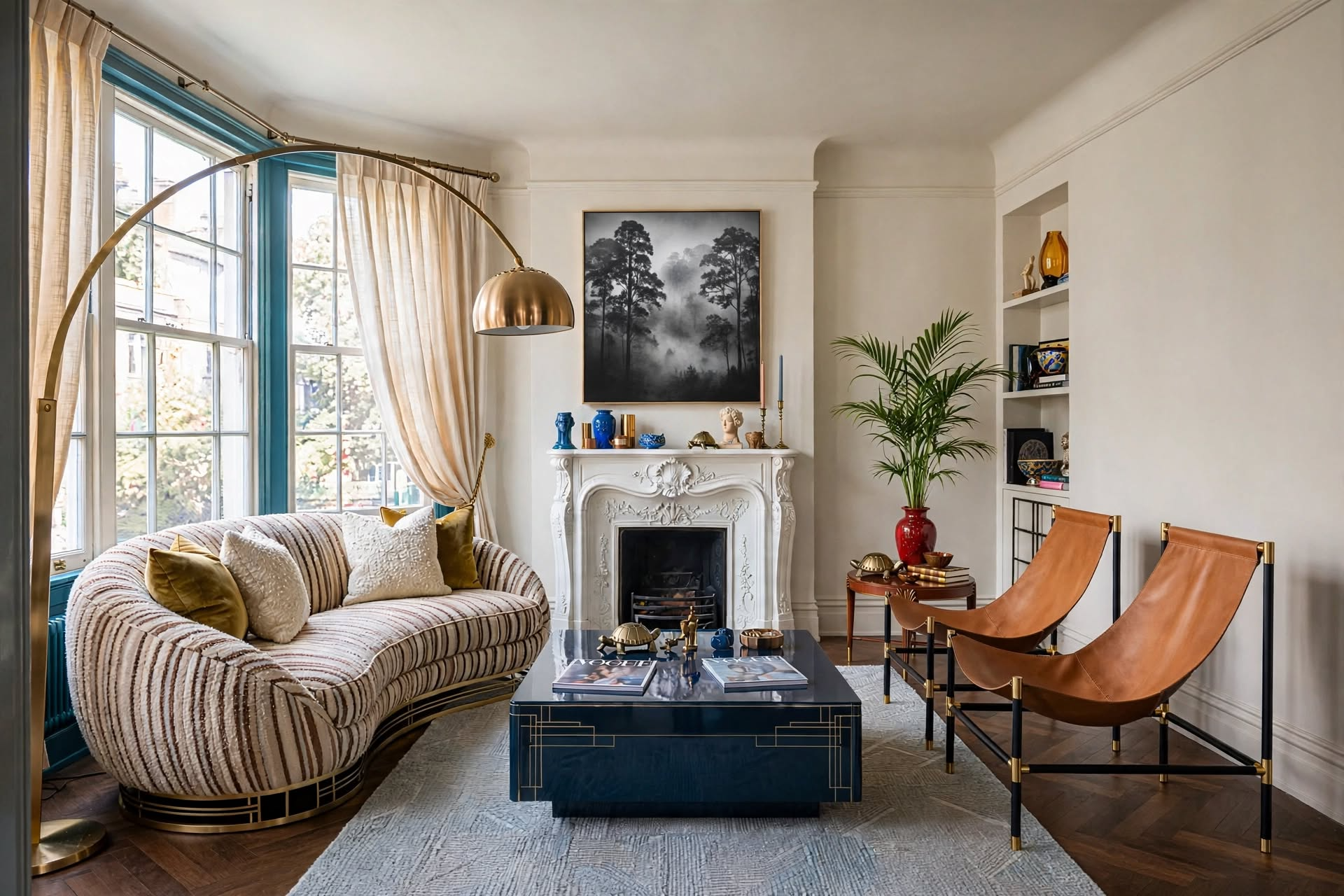
Interior design rules are the measurable checks that make a room feel finished. Give the room one focal point. Size the sofa to about two-thirds of its wall. Keep 30–36 inch walkways. Choose a rug big enough for at least the front legs of every seat. Split color 60-30-10, use three layers of light, and center art around 57 inches from the floor. Apply them in order (Plan, Place, Layer), then break the ones your room doesn’t need.
Most rooms that feel “off” aren’t suffering from bad taste. They’re missing a step. These interior design rules are the checks I run on every room before a single accessory goes in. They’re also why an inexpensive sofa can look custom while a pricey one looks wrong.

I’ve grouped the 15 interior design rules into three phases (Plan, Place and Layer) because the order matters. Great pillows can’t save a sofa that’s too big for the wall. At the end you’ll also find six old decorating rules worth breaking, and exactly when to break each one.
In This Guide
One pick per category, each tied to one of the interior design rules below. Tap a name to jump to its card.
- Laser MeasureHuepar Bluetooth Green Laser MeasureBest for measuring twice before you buy (Rule 4)
- Painter’s TapeAmazon Basics Blue Painter’s TapeBest for taping furniture footprints (Rule 4)
- Area RugLatitude Run Lahjar Speckled Wool-Blend RugBest neutral base for anchoring a seating group (Rule 9)
- Floor LampBarfield 66″ Tripod Floor LampBest for adding a second light layer by the sofa (Rule 12)
- ThrowMistana Smith Knitted Throw BlanketBest chunky texture for a flat neutral room (Rule 13)
- Throw PillowAllModern Daiquiri Wool Blend PillowBest textured anchor pillow (Rule 13)
- Wall ArtSignleader Neutral Framed CanvasBest neutral piece above a sofa (Rule 14)
Plan
Function, budget, focal point, scale and style, all decided before you buy anything.
Place
Float the furniture, protect the walkways, set zones, size the rug and choose your balance.
Layer
Color, light, texture, art and accessories go in last, then you edit.
Every one of the interior design rules below sits in one of these phases. If you’re fixing a room you already live in, start at Phase 1 anyway. Most problems that look like a styling issue (a bare wall, a “cold” room) trace back to a planning or placement rule that got skipped.
Phase 1 · PlanPhase 1: Plan — The Interior Design Rules to Follow Before You Buy
These five interior design rules cost nothing, and they prevent the most expensive mistakes: furniture that doesn’t fit, doesn’t work, or doesn’t belong together.

Rule 1: Decide What the Room Has to Do
Function comes before looks. Before choosing a single color, write down what actually happens in the room. Who uses it, when, and for what: watching TV, working, eating, hosting, reading? A living room arranged for conversation needs seats that face each other. A home office needs good task light and a chair you can sit in for hours.
That list decides what furniture you need and, just as important, what you don’t. It’s first among the interior design rules because every later rule depends on it.
My first real client was my best friend. He’d moved into a small one-room condo and wanted to buy far more furniture than the space could hold. We planned his zones first (sleep, sit, eat, work) and furnished the whole condo with only the essentials on a $2,000 budget. Knowing what the room has to do is what made that possible.
Rule 2: Set the Budget, Then Decide Where to Splurge and Save
Set a realistic number for the whole room, then split it by how hard each piece works. Splurge on what you touch every day: the sofa, the mattress, the desk chair. Save on what you can swap later, like pillows, accessories, side tables and art you’ll outgrow.
- 1Walk the room with a notepad
List every piece you already own, with its condition and measurements.
- 2Sort into keep, refresh, donate
Keep what fits your function list from Rule 1. Refresh pieces with good bones (new paint, new hardware, a slipcover). Donate anything that fails the scale check in Rule 4.
- 3Fund the gaps in order
Spend on the biggest daily-use gap first. Accessories come last, after the room is placed.
For more ways to stretch the number, see my home decor ideas on a budget.
Rule 3: Give Every Room One Focal Point
A focal point is the one thing your eye lands on first. It gives the room a starting point, and everything else is arranged around it. Without one, the eye wanders and the room feels restless even when every piece is pretty. With two strong ones, they compete.
- Living rooms: a fireplace, a window with a view, a media wall or a large piece of art. Point the seating at it.
- Bedrooms: the headboard wall. Make it count with a statement headboard, wallpaper or one large framed piece.
- Rooms with no architecture: create one with an oversized mirror, a gallery wall or one bold piece of furniture on the most visible wall.
Walk in and notice where your eyes go. If the answer is “nowhere in particular,” that’s your first fix. More ideas: how to create a focal point in a room.
Rule 4: Measure Twice. Scale and Proportion Come First
Scale is how a piece’s size relates to the room and to the people using it. Proportion is how pieces relate to each other. Get either one wrong and the room feels uncomfortable, even when each piece is beautiful on its own.
Overscaled furniture is one of the main reasons clients hire me. A sofa that looked perfect in the showroom swallows the living room, or a dining set leaves no room to pull out a chair. My rule: measure twice before you commit to any large piece, whether it’s a sofa, an accent chair, a desk, a dining set or a bed.
The guideline most people mean by the 2/3 rule: a sofa should be roughly two-thirds the length of the wall behind it. On a 9-foot wall that’s a sofa of about 6 feet. The same ratio works for art over furniture, which should be about two-thirds the width of the piece below it.
- 1Measure the room and its openings
Wall lengths, ceiling height, window sills, vents and radiators. Then measure every doorway, hallway turn and stairwell the piece has to pass through.
- 2Tape the footprint on the floor
Mark the exact width and depth with painter’s tape and live with it for a day. Walk around it and sit where you’d sit.
- 3Check the clearances
Keep 30–36 inches for main walkways and 14–18 inches between the sofa and the coffee table (Rule 7).
- 4Measure again, then buy
Compare the listing’s W × D × H against your tape. Check the depth carefully. It’s the number people forget.
The two tools I’d have on hand before buying any large piece:

Huepar Bluetooth Green Laser Measure
Measuring a long wall alone with a tape measure is how numbers end up wrong. A laser measure gives you wall lengths and ceiling heights in seconds, and the Bluetooth version can send your measurements to your phone, so you have them with you when you shop.
Will it fit? Pocket-sized. Use it for wall lengths, ceiling height and doorway widths (step 1 above).
Skip it if… you only need a measurement or two. A regular tape measure will do.
See Dimensions & Price on Amazon →
Amazon Basics Blue Painter’s Tape
The cheapest way to avoid an expensive mistake. Tape the exact width and depth of a sofa, rug or dining table on the floor and live with it for a day before you order.
Will it fit? Mark the full W × D from the listing, then check your 30–36 in. walkways around it (Rule 7).
Skip it if… you’re marking textured or freshly painted surfaces. Test a small piece first.
See Dimensions & Price on Amazon →Ceiling height matters too. Tall ceilings can take taller pieces and vertical art, while low ceilings look better with lower, horizontal arrangements. For sizing by piece, see the sofa buying guide and the best furniture for a small living room.
Rule 5: Know Your Style Before You Shop

Style is the filter every purchase passes through. Before you buy, paint or accessorize, answer one question: what is this room supposed to feel like? Calm and airy, warm and collected, crisp and modern? Without that answer, you end up with nice pieces that don’t belong together.
You don’t have to pick one label. Most good rooms blend two styles, with one leading. If you’re not sure where you land, take the interior design style quiz, then read how to mix interior design styles.
Phase 2 · PlacePhase 2: Place — Interior Design Rules for Layout and Flow
Placement is where a room starts to look designed rather than just furnished. These interior design rules are mostly free to apply. You’re moving what you have.
Rule 6: Float Your Furniture Off the Walls

Floating is one of the interior design rules that costs nothing. Pushing everything against the walls feels like it saves space. It actually makes the middle of the room dead space and puts conversations too far apart. Pull seating in, even 6–12 inches, so the group faces inward and the eye can travel around the furniture.
- Small rooms: even a few inches between the sofa and the wall adds depth.
- Large rooms: float the seating group toward the center so nobody has to cross open floor to reach a chair.
- Narrow rooms: angle two chairs slightly toward each other across a small rug to break up the corridor feeling.
Rule 7: Protect Your Walkways
Flow is how easily you move through a room and from one room to the next. Plan the paths before you place anything, then keep them clear:
- Main walkways: 30–36 inches wide.
- Sofa to coffee table: 14–18 inches, close enough to reach a drink and wide enough to pass.
- No obstacle courses: a path shouldn’t cut through the middle of a conversation group or force a zigzag around corners.
When a room feels cramped, it’s usually the walkways that are the problem, not the square footage. For long or awkward rooms, see long living room layout ideas.
Rule 8: Create Zones, Even in One Room
Zones turn one big room into several purposeful ones. In an open plan, combine at least two tools to define each zone: a rug, a light fixture, furniture orientation, or an open shelf or console used as a divider.
- Open plan: a rug anchors the living zone, a pendant marks the dining zone, and a console behind the sofa separates them. No construction needed.
- Studio apartments: turn the sofa’s back to the sleeping area so it reads as its own room.
- Long rooms: give each end its own job, like seating at one end and a desk or reading chair at the other.
Small-space version: the best living room layout for small spaces.
Rule 9: Size Up the Rug and Anchor Every Seating Group

A rug that’s too small makes the furniture look like it’s floating. A rug is what ties the seats into one group, so when in doubt, go a size up from what feels right in the store.
- 1Choose all legs on or front legs on
Either every leg of every seat sits on the rug, or at least the front legs do. Front-legs-on is the forgiving choice for smaller rooms. Avoid rugs that touch only the coffee table.
- 2Go wider than the sofa
Let the rug extend at least 6 inches past each end of the sofa. In a bedroom, aim for 18–24 inches of rug on each side of the bed.
- 3Leave a border of floor
In most rooms, keep 12–18 inches of bare floor between the rug and the walls so it doesn’t read as wall-to-wall carpet.
- 4Add the coffee table
Rug plus table anchors the group both visually and practically. Choose a table within an inch or two of the sofa seat height.
Full guide: how to choose and arrange an area rug.

Latitude Run Lahjar Speckled Wool-Blend Area Rug
A busy pattern can fight with your sofa and art. This speckled wool-blend rug adds texture without competing, so it works as the 30% layer in your 60-30-10 split (Rule 11).
Will it fit? Pick the size where your sofa’s and chairs’ front legs land on the rug. An 8 × 10 fits most living rooms, as long as it still runs at least 6 in. past each end of the sofa.
Skip it if… you want the rug to be the room’s statement piece.
See Dimensions & Price on Wayfair →
Safavieh Abstract Collection Handmade Wool Rug
If your living room feels flat, a rug with a soft abstract pattern brings movement to the floor. This handmade wool rug works as the room’s starting point when you pull your palette from it.
Will it fit? Pick the size where your sofa’s and chairs’ front legs land on the rug. An 8 × 10 fits most living rooms.
Skip it if… your sofa and pillows are already patterned.
See Dimensions & Price on Amazon →Rule 10: Choose Your Balance and Commit to It
Balance means visual weight is spread so no side of the room feels heavier than the other. It doesn’t have to mean symmetry.
- Symmetrical balance (matching nightstands, paired lamps, mirrored shelving) feels calm and formal, which suits traditional and transitional rooms.
- Asymmetrical balance (one large piece of art on one side, a floor lamp and plant grouping on the other) feels relaxed and modern. The two sides should carry equal visual weight. One large, dark object can balance several smaller, lighter ones.
- Mixed: a symmetrical furniture layout with asymmetrical accessories reads as collected rather than random.
More on this: tips to create balance and harmony in your home.
Phase 3: Layer — Interior Design Rules for Color, Light and Art
Layering is the fun part, and these interior design rules work best last, once the room is planned and placed.
Rule 11: Split Color 60-30-10, and Match the Undertones

Of the interior design rules for color, 60-30-10 is the easiest to apply: one dominant color, one supporting color and one accent.
| Share | Where it goes | Job |
|---|---|---|
| 60% Dominant | Walls, sofa, large upholstered pieces | The calm backdrop you live with every day |
| 30% Secondary | Curtains, accent chairs, rug, bedding | Contrast and depth |
| 10% Accent | Pillows, art, ceramics, flowers | Personality, and where you can take risks |
The catch: three colors can follow the ratio perfectly and still clash because their undertones fight. Keep one temperature in charge, warm or cool, and let the other appear only in small doses. Go deeper with the 60-30-10 design rule and how to choose the right color for your room.
Rule 12: Use Three Layers of Light in Every Room
A room lit only from the ceiling looks flat, no matter how good the furniture is. Every room needs three layers:
| Layer | Examples | Common miss |
|---|---|---|
| Ambient | Ceiling fixtures, flush mounts, recessed lights | Using it as the only light |
| Task | Reading lamps, desk lamps, under-cabinet lights | No reading light beside the sofa or bed |
| Accent | Picture lights, uplights, shelf lighting, candles | Skipping it, so the room stays flat at night |
Put a dimmer on overhead fixtures wherever you can. Renters can get the same effect with dimmable plug-in lamps and smart bulbs. When seated, the bottom of a table-lamp shade should sit around eye level, which keeps glare out of your eyes. More in table lamps: your guide to decorating for function and flair.

Barfield 66″ Tripod Floor Lamp
If your room runs on the ceiling light alone, this adds a second layer of light where you sit. Slim tripod legs keep the base light and put an unused corner to work.
Will it fit? 66″ tall. It needs roughly a 2 ft circle of floor in a corner or beside the sofa, outside your 30–36 in. walkway (Rule 7).
Skip it if… the corner is in a walkway. Tripod legs are easy to trip on.
See Dimensions & Price on Wayfair →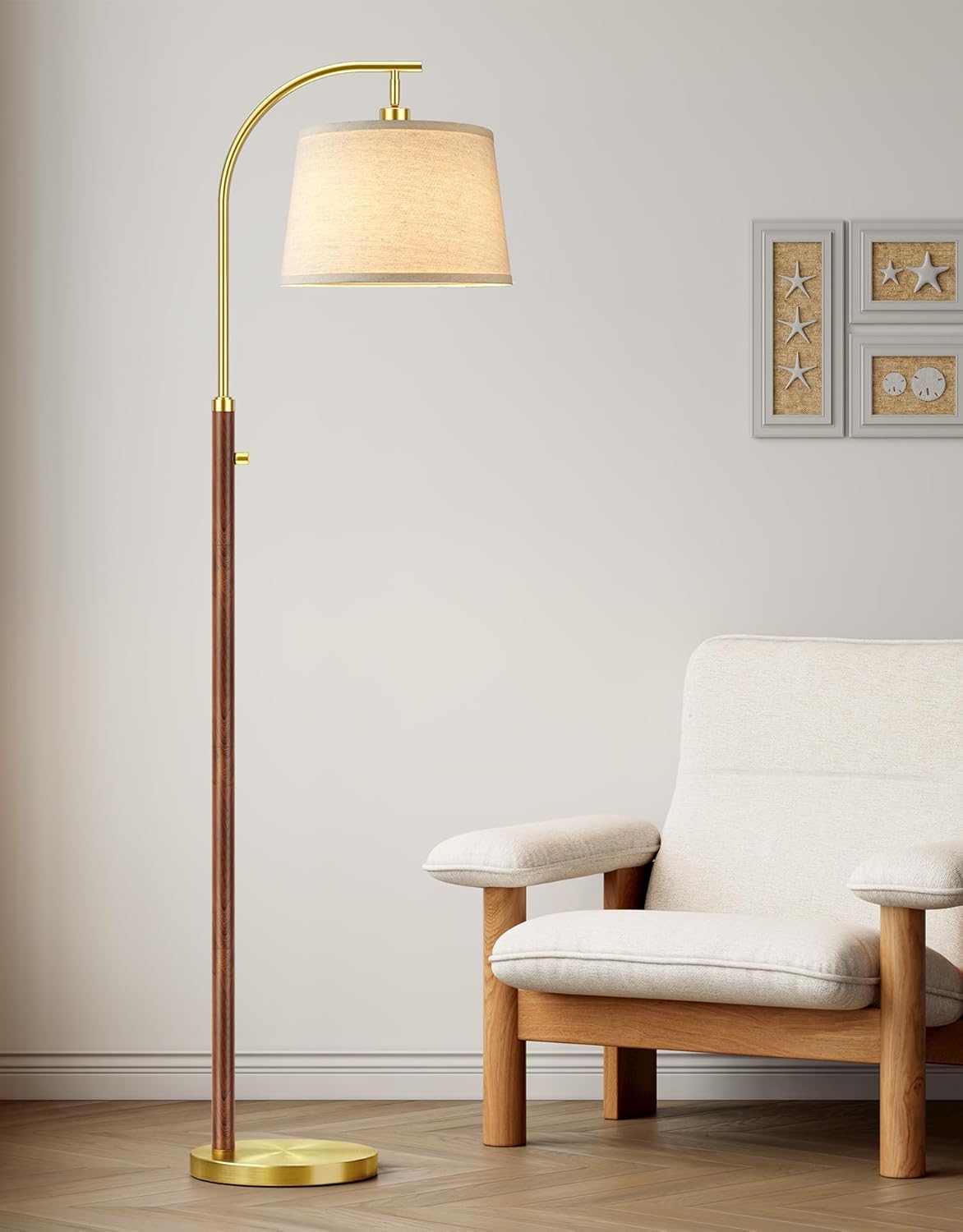
Dimmable Modern Standing Lamp
A slim pole with a built-in dimmer, so one lamp handles bright reading light and soft evening light. It’s the renter-friendly way to get the dimmer effect without rewiring.
Will it fit? A slim pole fits in tight spots beside a sofa or chair.
Skip it if… you want a statement shape. This one is meant to blend in.
See Dimensions & Price on Amazon →Rule 13: Mix at Least Four Textures
In a neutral room, texture does the job color would otherwise do. It’s what separates a beige room that looks flat from one that looks rich. Aim for at least four distinct textures, and pair opposites: matte with shiny, rough with smooth, soft with hard.
- An easy formula: linen sofa, wood or rattan side table, ceramic lamp, wool or bouclé throw.
- Watch for all-smooth rooms: glass, leather, painted walls and hardwood together read cold. One jute rug or knit throw fixes it.
- Repeat each texture at least twice so it looks chosen, not accidental.
Full guide: secrets to mixing textures like an interior designer.

Mistana Smith Knitted Throw Blanket
In an all-smooth room (leather, glass, painted walls), a chunky knit is the fastest way to add the soft, nubby texture that’s missing.
Will it fit? Drape it diagonally over one arm or fold it in thirds along the seat back.
Skip it if… you have pets that pull at loops. Choose a tighter weave.
See Dimensions & Price on Wayfair →
Temminc Lightweight All-Season Throw
A lightweight throw adds softness without bulk, so it works year-round and looks neat folded on the arm.
Will it fit? Pick a color that appears in at least one of your pillows so the texture repeats, per Rule 13.
Skip it if… you want a heavy, chunky texture.
See Dimensions & Price on Amazon →
AllModern Daiquiri Wool Blend Throw Pillow
A wool-blend square has the weight and texture of a designer anchor pillow. In a neutral room, texture like this does the job pattern would and keeps the sofa from looking flat.
Will it fit? Choose the largest size that sits at or just below the top of your sofa back.
Skip it if… you want something easy to spot-clean. Wool blends need gentle care.
See Dimensions & Price on Wayfair →
decorUhome Neutral Textured Pillow Covers
Neutral textured covers are the easiest way to build a calm, layered sofa. They pair with any accent color you add later, so they work season after season.
Will it fit? An 18×18″ cover works for loveseats and as the middle layer on a standard sofa.
Skip it if… you want a strong statement. These are designed to blend in.
See Dimensions & Price on Amazon →Rule 14: Hang Art at Eye Level (the 57-Inch Rule)

Art hung too high is one of the quickest ways to make a room feel disconnected. Center it around 57 inches from the floor, roughly average eye level and a common gallery standard, so it relates to the furniture and the people in the room.
- 1Find the center, not the top
Mark 57 inches from the floor. That’s where the middle of the piece goes, not the hook and not the top edge.
- 2Above furniture, connect to it
Over a sofa or console, leave about 6–10 inches between the top of the furniture and the bottom of the frame. Keep the art about two-thirds the width of the piece below.
- 3Treat a gallery wall as one piece
Center the whole arrangement at 57 inches and keep 2–3 inches between frames.
- 4Paper first, nails last
Trace each frame on kraft paper, tape the templates up, adjust, then nail through the paper.
Step-by-step photos: how to hang a gallery wall. Renting? See how to decorate blank walls for renters.

Signleader Geometric Abstract Neutral Framed Canvas
Small art on a big wall makes the room feel unfinished. This framed neutral canvas works with almost any palette, so it’s a safe anchor above the sofa. Hang it with its center at 57 in.
Will it fit? Above a sofa, aim for art about two-thirds of the sofa’s width.
Skip it if… it’s going over a very long sofa. Size up or hang a pair.
See Dimensions & Price on Wayfair →
Large Framed Abstract Wall Art
Struggling to fill the wall above the sofa? Large framed abstract art covers about two-thirds of the sofa width without the work of planning a full gallery wall, and it’s an easy way to bring in your accent color.
Will it fit? Above a sofa, aim for art about two-thirds of the sofa’s width.
Skip it if… your sofa wall is short. Large art can crowd it.
See Dimensions & Price on Amazon →Rule 15: Group in Odds, Vary Heights, Then Edit

This is the last of the 15 interior design rules, and it has three parts:
- Odds: group accessories in threes and fives. An even pair lets the eye settle on the middle. An odd group keeps it moving, which reads as styled. See the rule of three for decorating and the 3-5-7 decorating rule.
- Heights: every grouping needs a tall, a medium and a low piece. Across the room, move the eye from a low tray to sofa height to a floor lamp or tall plant.
- Edit: leave breathing room on every shelf and surface. If a surface feels busy, box up a third of what’s on it for a week. You probably won’t miss most of it.
That’s all 15 interior design rules. Next, the ones worth breaking.
Break Them on Purpose6 Interior Design Rules Worth Breaking (and When to Break Them)

Some interior decorating rules are really just habits that got handed down. The interior design rules above (scale, walkways, light) hold up in almost every room. These six are worth questioning once you know why they exist.
“Never mix warm and cool colors”
Break it when one temperature leads (your 60%) and the other shows up as an accent, like warm wood with a cool blue sofa.
Keep it when the undertones are fighting at full strength across large surfaces.
“No black in small spaces”
Break it when the black goes on one surface (an accent wall, trim, a dining table) and the room has decent light. Dark colors can blur corners and make a small room feel cozier.
Keep it when the room has little natural light and no lamps yet. When dark paint backfires
“Ceilings must be white”
Break it when you want a room to feel enveloping. A soft tint or a deep color on the ceiling can be the room’s focal point.
Keep it when the ceiling is low and the room is short on light. Wall and ceiling color combinations
“Dining chairs must match”
Break it when the chairs share one thing: seat height, color or material. That shared element is what makes mismatched read as intentional.
Keep it when the table is small and every chair is visible at once.
“Never put a sofa in front of a window”
Break it when the sofa back sits below the sill and you leave a few inches so curtains can still move.
Keep it when the sofa would block a radiator, vent or the only path to the window.
“Don’t mix modern and traditional”
Break it when one style clearly leads and the other repeats at least twice, through color, wood tone or metal.
Keep it when every piece is a different style and nothing ties them together. How to mix styles
The test for any rule you break: can you say why it serves this room? If yes, it’s a choice. If you just ended up there, it’s a mistake. The interior design rules I don’t break are scale (Rule 4), walkways (Rule 7) and lighting (Rule 12), because breaking those makes a room harder to live in, not more interesting.
Do’s, Don’ts and the Interior Design Rules Cheat Sheet
Save this summary of the interior design rules for your next room project.
Do
- Write down what the room has to do before you shop
- Tape furniture footprints on the floor before buying
- Pull seating off the walls into a group
- Buy the rug a size bigger than feels right
- Light every room in three layers
- Edit surfaces until they have breathing room
Don’t
- Buy a large piece without measuring twice, including doorways
- Let a walkway shrink below 30 inches
- Float a small rug under just the coffee table
- Hang art by the hook instead of its center
- Rely on one ceiling light
- Give a room two competing focal points
- ◆About 2/3 the wall length
- ◆Measure depth and doorways
- ◆30–36 in. main paths
- ◆14–18 in. sofa to coffee table
- ◆All legs or front legs on
- ◆6+ in. past each sofa end
- ◆Center at 57 in.
- ◆6–10 in. above furniture
- ◆60 / 30 / 10 split
- ◆One undertone in charge
- ◆Ambient + task + accent
- ◆Group in 3s and 5s
Interior Design Rules: Frequently Asked Questions
The basic interior design rules are: plan the room around how it’s used, give it one focal point, scale furniture to the room, keep 30–36 inch walkways, size the rug to hold at least the front legs of every seat, split color 60-30-10, light every room in three layers, and hang art centered around 57 inches. Apply them in that order: plan, place, then layer.
The 2/3 rule is a proportion guideline. A sofa should be about two-thirds the length of the wall behind it, and art hung over furniture should be about two-thirds the width of that piece. On a 9-foot wall, that means a sofa of roughly 6 feet. It keeps furniture from looking lost or overstuffed.
Scale. Furniture that’s too big or too small for the room undermines everything around it, and overscaled furniture is one of the main reasons clients hire me. Measure twice, including doorways and stair turns, before you commit to any large piece.
Yes. Interior design rules are guidelines, so break one once you know why it exists. Mixing warm and cool colors, painting a ceiling, or using black in a small room can all work when it’s a deliberate choice. Breaking scale, walkway or lighting rules usually just makes a room harder to live in.
People use the terms interchangeably. Strictly speaking, design rules cover layout, scale and function, while decorating rules cover finishes like color, textiles and accessories. In this guide, Phases 1 and 2 are the design rules and Phase 3 is the decorating layer.
Yes. Most interior design rules need no installation: floating furniture, walkways, zones and rug sizing are all just placement. Layer light with plug-in floor and table lamps, lean large art or mirrors instead of drilling, and use removable hooks rated for the weight of each piece.
Start With the Rule Your Room Breaks Most
You don’t need to apply all 15 interior design rules this weekend. Pick the one rule your room breaks most. Size up the rug. Pull the sofa off the wall. Lower the art. Add a lamp to the room that only has a ceiling light. Each fix makes the next one easier to see.
And when one of the interior design rules doesn’t serve your room, break it on purpose. That’s what separates a designed room from a rule-following one.
If you want the full formulas, spacing rules, and layout math from this guide (and every other room in your home) in one place, grab The Designer’s SECRET Cheat Sheet — it’s the shortcut version of everything a designer checks before calling a room finished.
Get the Cheat Sheet →And if you want more of this in your feed, come find us @thedecorholic on Instagram, Facebook, TikTok, and Pinterest for more room-by-room styling breakdowns like this one.

Stephanie is the designer and writer at The Decorholic. She works with interior design clients and writes about small-space and rental-friendly decor. Her number-one rule: measure twice before buying any large piece.
About Stephanie →CATCH THE LATEST IN HOME DECOR TRENDS:

Accessorize a Small Living Room: 7 Genius Styling Secrets

How to Make a Small Room Appear Bigger

How to Make Your Home Look Expensive
GET CAUGHT UP ON ALL THE INSPIRING DECOR TIPS:

Best Fireplace Makeover Ideas

How to Make a Gallery Wall: The Complete Step-by-Step Guide (Even If You’ve Never Hung a Picture)