To organize a small walk-in closet: empty it completely, keep only what you wear and what fits, then measure before you buy anything. Pick the layout your width allows, double your hanging space with a second rod, switch to slim matching hangers, and sort everything into three reach zones: daily pieces between shoulder and hip, weekly pieces just above or below, and storage on the top shelf and floor. Leave about 20% of the space empty so it stays organized.
A small walk-in closet is a strange kind of problem. You technically have a whole room for your clothes, but it’s narrow, the corners are dead space, the top shelf turns into an avalanche, and somehow there’s still a pile on the floor. Most people respond by buying more bins. That almost never fixes it.

What fixes it is a plan: decide what stays, measure the space, choose the right layout for your width, and give every item a spot based on how often you reach for it. As an interior designer, I’d tell you the same thing I tell clients about furniture: measure twice before you buy anything. Closet systems, drawer units, and shoe racks that are too deep for a narrow walk-in are one of the fastest ways to make it feel smaller.
This guide walks you through how to organize a small walk-in closet step by step, with the real measurements designers use, so you buy the right things once.

✦ In This Guide (tap to open)
- How to Organize a Small Walk-In Closet: The Reach-Zone Method
- Step 1: Empty It and Run the Keep Test
- Step 2: Measure and Pick Your Small Walk-In Closet Layout
- Step 3: Double Your Hanging Space
- Step 4: Switch to Slim, Matching Hangers
- Step 5: Zone Everything by Reach
- Step 6: Tame Shelves With Dividers and Bins
- Step 7: Get Shoes Off the Floor
- Step 8: Use the Spots Everyone Forgets
- Step 9: Keep It Organized
- Small Walk-In Closet Ideas on a Budget
- Do’s, Don’ts and the Cheat Sheet
- FAQs
- Double your hanging: Rebrilliant Closet Rod Extender 2-Pack (best for L- and U-shape closets)
- Slim hangers: Premium Velvet Hanger Set (best for replacing every hanger at once)
- Folded storage: Latitude Run 4-Tier Stackable Organizer (best for closets with few shelves)
- Shelf dividers: Sorbus Acrylic Shelf Dividers (best for sweater stacks)
- Shoe storage: Clie 16-Pair Shoe Cabinet (best for getting shoes off the floor)
How to Organize a Small Walk-In Closet: The Reach-Zone Method
Every organizing system you’ve seen (by color, by category, by season) answers the question “what goes together?” In a small walk-in closet, the more important question is “how often do I reach for this?” Space within easy reach is the most valuable real estate you have, so it should only hold what you use every day.

Daily Zone
Shoulder to hip height, closest to the door. The pieces you wear every week, everyday shoes, your go-to bag.
Weekly Zone
Just above eye level and just below the hip. Workwear you rotate, going-out pieces, belts and scarves.
Storage Zone
Top shelf, the floor, and the far end of the closet. Off-season clothes, formalwear, luggage, keepsakes.
Keep the method in mind as you work through the steps below on how to organize a small walk-in closet. Every decision, from which rod gets your jeans to where the boots go, comes back to the zones.
Empty It and Run the Five-Question Keep Test
Moving things around inside a full closet only rearranges the clutter. Take everything out: clothes, shoes, bins, the bag of bags. Give yourself a two-to-three-hour block, set up three piles (keep, donate or sell, discard), and snap a “before” photo so you can see what wasn’t working.

While it’s empty, vacuum the floor and wipe down the shelves and rods. Let everything dry before anything goes back in. Then hold up each piece and ask:
- 1Do I actually like it?
Rate it from 1 to 10 based on how you feel wearing it. Anything under a 7 is taking space from something you love.
- 2Does it fit right now?
Try on anything you’re unsure about, sitting and moving. “Someday” sizes go in one labeled bin in the Storage Zone, not on your rod.
- 3Is it in good shape?
Check it in daylight for stains, holes, stretched elastic and broken zippers. If you won’t repair it this month, let it go.
- 4When did I last wear it?
Use the six-month rule for everyday clothes, with seasonal and special-occasion pieces judged by their own season.
- 5Do I have a duplicate?
Line up similar items side by side (five black tees, three denim jackets) and keep the ones you reach for first.
Give keepsakes one memory box and stop there. It lives on the top shelf in the Storage Zone, so it’s protected but not competing with what you wear.
Measure, Then Pick the Right Small Walk-In Closet Layout
Now that you know how much you’re keeping, measure the closet: width wall to wall, depth from the door to the back wall, and height to the ceiling. Note where the door swings, any light switch, outlet or vent, and the window if you have one.

Two numbers decide your layout. Hanging clothes need about 24 inches of depth so shoulders don’t brush the wall, and you need a walkway of at least 24 inches to move comfortably, with 30 to 36 inches being the comfortable target. Here’s what that means for a small walk-in closet:
| Closet width | Best layout | How to set it up |
|---|---|---|
| Under 4 ft | Single wall | Hang on one long wall only. Use the opposite wall for 12-inch-deep shelves or hooks, not a second rod. |
| 4 to 6 ft | L-shape | Hang along the long wall, and run shelves or shoe storage across the back wall. Keep the short side wall shallow. |
| 6 ft and up | U-shape or two-sided | Rods on both long walls with a walkway down the middle. Put drawers or shelves on the back wall. |
Overscaled furniture is one of the main reasons I get hired, and closets are no different. A dresser or drawer tower that’s 20 inches deep in a narrow walk-in eats your walkway. Measure twice before you buy any closet piece, and look for drawer units around 12 to 16 inches deep.
Double Your Hanging Space With a Second Rod
Most closets come with one rod at about 66 to 70 inches and a shelf on top. That height is built for long dresses and coats, which is wasted space if most of what you own is shirts, blouses and folded pants. A second rod below it is the single biggest upgrade you can make in a small walk-in closet.

- Double-hang section: upper rod at about 80 to 84 inches, lower rod at about 40 to 42 inches. Shirts, blouses, jackets and folded-over pants fit on both.
- Long-hang section: keep one stretch, about 2 to 3 feet wide, with a single rod around 66 to 70 inches for dresses, coats and jumpsuits.
- Top shelf: sits about 2 to 3 inches above the highest rod, which becomes part of your Storage Zone.
Renting or not ready to install? A hanging closet rod doubler hooks onto your existing rod and adds a lower one in minutes, with no drilling.

Supforce Adjustable Stainless Steel Closet Rod
If your closet only has one rod with a long empty drop under your shirts, this hooks onto the rod you already have and hangs a second one below it, so you get a full extra row of hanging without drilling a single hole.
Will it fit? Check the adjustable length against your rod span, and set the drop so the lower rod lands about 40 to 42 inches off the floor.
Skip it if… you mostly hang long dresses and coats. A doubler only pays off over short-hang pieces like shirts and folded pants.
See Dimensions & Price on Amazon →
Rebrilliant Adjustable Closet Rod Extender (2-Pack, Black)
Two hang-down rods in one box means you can double-hang both walls of an L-shape or U-shape small walk-in closet at once, and the black finish disappears against dark clothes.
Will it fit? Measure each double-hang section wall to wall before ordering, and keep a 2 to 3 foot stretch with no doubler for long pieces.
Skip it if… your closet is under 4 feet wide with one hanging wall. You may only need one rod, so the single Amazon pick is the better buy.
See Dimensions & Price on Wayfair →Switch to Slim, Matching Hangers
Bulky plastic and wooden hangers take up far more rod space than the clothes on them. Slim velvet hangers are a fraction of the thickness, they grip so silk and wide necklines don’t slide off, and when every hanger matches, the whole closet instantly looks calmer. It’s the cheapest way to make a small walk-in closet feel like a custom one.

Hang in this order: category, then length, then color
- Category first: tops together, pants together, dresses together, work separate from casual. This is what lets you find things fast.
- Length second: within each category, go short to long, left to right. The rising hemline frees up floor space under the short pieces for shoes or a small drawer unit.
- Color last: light to dark within each group. It’s the finishing step that makes the closet look styled, not the system that makes it work.
After you rehang everything, turn every hanger backward. When you wear something, hang it back the normal way. In six months, anything still backward is a strong donate candidate.

Premium Velvet Hanger Set
Bulky mismatched hangers eat your rod and let silky tops slide to the floor. A big set of slim velvet hangers reclaims rod space and makes the whole closet look calm and uniform in one afternoon.
Will it fit? Count your hanging pieces after the keep test and buy that number plus about 10%, so every item gets a matching hanger.
Skip it if… you hang a lot of heavy winter coats. Velvet hangers are built for everyday clothes, so keep a few sturdier hangers for the long-hang section.
See Dimensions & Price on Amazon →
Rebrilliant Santos Velvet Non-Slip Hanger
The 360° swivel hook lets you turn every hanger to face the same way on either rod, which is what makes a double-hang wall look tidy instead of tangled.
Will it fit? Check the pack size on the listing against your hanging count, and order enough to replace every old hanger at once.
Skip it if… you want the lowest price per hanger. Bulk sets usually win on cost, while these win on the swivel hook.
See Dimensions & Price on Wayfair →
Zone Everything by Reach
This is where the Reach-Zone Method does its job. Walk in and notice where your hand naturally goes first. That spot, usually at shoulder-to-hip height near the door, is your Daily Zone. Build outward from there.

Shoulder to hip, near the door
Your weekly rotation of tops and bottoms, everyday shoes, the bag you carry most, and a small tray for watch, keys and sunglasses.
Just above and just below
Workwear you rotate, going-out tops, belts, scarves and ties on hooks or slim organizers, plus folded sweaters on a mid-height shelf.
Top shelf, floor, far end
Off-season clothes in lidded bins, formalwear, luggage, the memory box and your “transition size” bin. Label every bin you can’t see into.
Short on shelves for Zone 2? Stackable closet organizers add folded storage to any open wall without installing anything.

Yociyoga Stackable Closet Organizers
Folded sweaters and jeans need shelves, and most small walk-in closets don’t have enough. Stackable cubbies add shelving to any open wall without installing anything, and you can restack them as your zones change.
Will it fit? Check the depth on the listing and keep it at about 12 to 16 inches so it doesn’t crowd the walkway.
Skip it if… you already have built-in shelves with room to spare. Shelf dividers will do the job for less.
See Dimensions & Price on Amazon →
Latitude Run 4-Tier Stackable Closet Organizer
Four tiers turn one narrow strip of wall into a full Zone 2 for folded sweaters, tees and workout clothes, and it folds flat when you rearrange.
Will it fit? Check the overall height on the listing. In a single-wall closet under 4 feet wide, it goes on the wall opposite your rod.
Skip it if… you need it to hold heavy items like jeans stacked high. Check the shelf weight rating on the listing first.
See Dimensions & Price on Wayfair →Twice a year, when the season changes, swap Zones 1 and 3: summer pieces go up to the top-shelf bins and sweaters come down. That one habit keeps a small walk-in closet from overflowing.
Tame Shelves With Dividers and Bins
Open shelves are where a small walk-in closet falls apart: one sweater gets pulled from the bottom of a stack and the whole tower topples. Three small fixes stop it.

- Shelf dividers clip onto the shelf and keep folded stacks and handbags upright. Keep stacks to about 8 to 10 inches tall so you can pull from the middle.
- Clear or labeled lidded bins for the Storage Zone. Clear for things you need to see, labeled fabric bins for a calmer look on open shelves.
- File-fold drawers. Fold tees, leggings and pajamas into small rectangles and stand them upright, so you see every piece at once instead of a stack.

Clear Closet Shelf Dividers
Handbags slump and sweater stacks slide into each other on open shelves. Dividers clip on and give each stack or bag its own lane, so pulling one out doesn’t topple the rest.
Will it fit? Dividers clip over the shelf edge, so measure your shelf thickness first and compare it with the listing.
Skip it if… your shelves are thicker than the clip allows or you have adjustable wire shelving. Check compatibility before ordering.
See Dimensions & Price on Amazon →
Sorbus Acrylic Shelf Dividers (4-Pack)
Clear acrylic keeps sweater stacks upright without adding visual clutter, which matters in a small walk-in closet where every shelf is in view.
Will it fit? Four dividers make three lanes on one shelf. Measure your shelf width to see how many packs you need, and check the clip fits your shelf thickness.
Skip it if… your shelves are wire. Clip-on dividers are made for solid shelves.
See Dimensions & Price on Wayfair →Get Shoes Off the Floor of a Small Walk-In Closet
A pile of shoes on the floor is the first thing you see when you open the door, and it makes the whole space read as messy. Give them a structure:

- Everyday pairs in the Daily Zone on a slim rack under the short-hang section, where the rising hemline left room.
- Special-occasion shoes in clear boxes on a higher shelf, so you can see them without the dust.
- Tall boots stand up with boot shapers, or move to the long-hang section with boot clips.
- Too many pairs? A slim shoe cabinet on the back wall hides them behind doors and gives you a top surface for a tray or your everyday bag. In a closet under 4 feet wide, an over-the-door organizer works better.
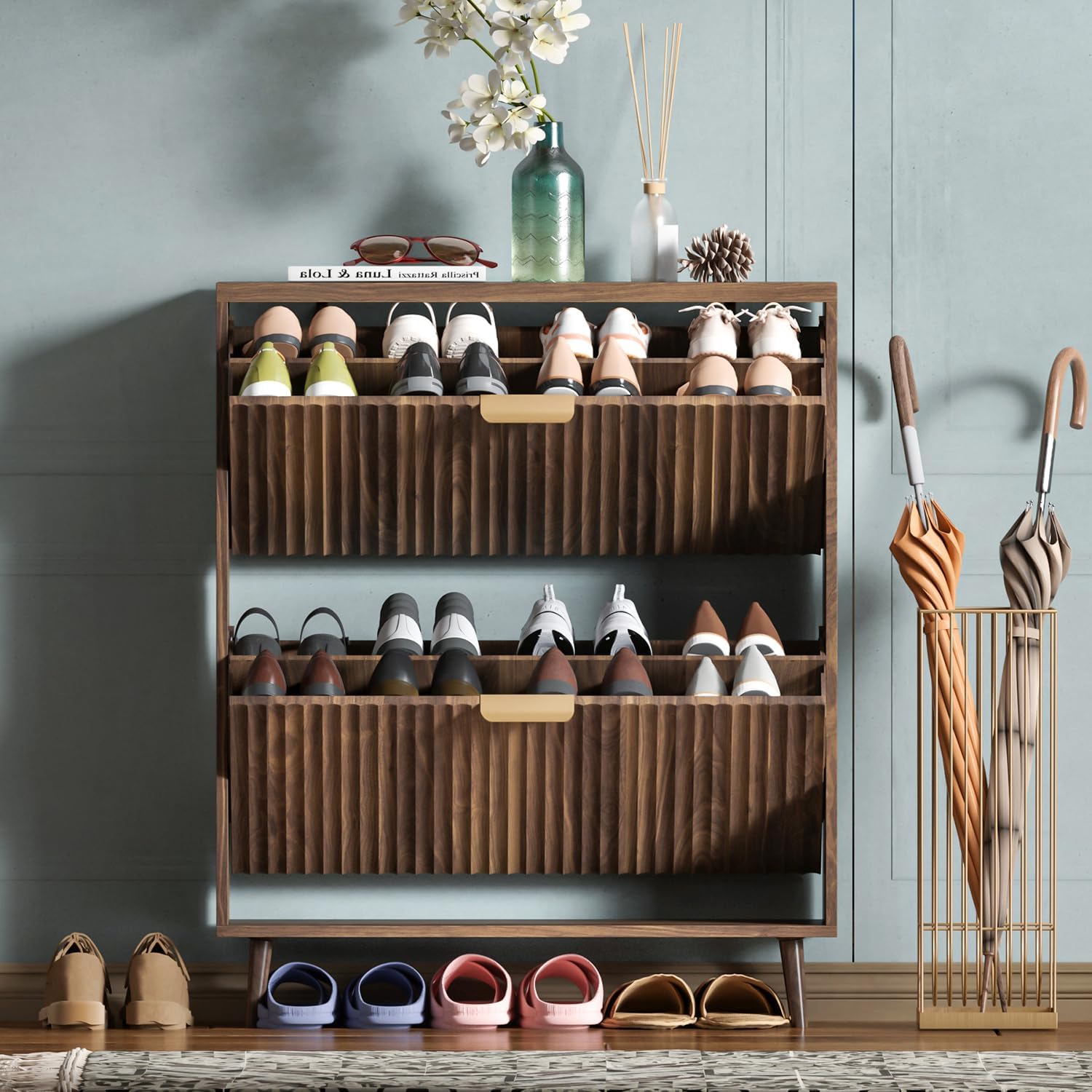
QIVOMIX Freestanding Shoe Cabinet
A pile of sneakers is the first thing you see when you open the closet. A closed cabinet hides them behind doors, and the top becomes a landing spot for a tray or your everyday bag.
Will it fit? Check the depth on the listing. Anything deeper than about 14 inches starts eating into a 24 to 30 inch walkway, so it belongs on the back wall.
Skip it if… your closet is under 4 feet wide with no back-wall space. An over-the-door organizer will work better there.
See Dimensions & Price on Amazon →
Bay Isle Home Clie 16-Pair Shoe Storage Cabinet
Sixteen pairs behind closed doors frees the whole closet floor, and it reads like furniture rather than a plastic rack.
Will it fit? Check the depth and height on the listing. Place it on the back wall of an L- or U-shape layout where it won’t narrow your walkway.
Skip it if… most of your shoes are tall boots. Check the compartment height before you order.
See Dimensions & Price on Wayfair →Use the Spots Everyone Forgets
In a small walk-in closet, the leftover spaces add up to a surprising amount of storage:

- The back of the door: over-the-door hooks or a pocket organizer for belts, scarves, bags and hats.
- Corners: corner shelves catch the dead space where two rods meet in an L or U layout.
- Narrow wall strips: a row of wall hooks by the door for tomorrow’s outfit, a robe or the bag you use daily.
- Above the top shelf: if your ceiling is high, a second shelf holds luggage and keepsake bins.
- The light: a plug-free, motion-sensor LED strip makes dark corners usable and the whole closet feel bigger.
Add a full-length mirror to the inside of the door or the end wall. It bounces light, makes a narrow closet feel wider, and turns it into a place you actually get ready in.
Keep It Organized With the 20% Rule
The most functional closets are never full. Aim to leave about 20% of your rod and shelf space empty. That breathing room is what lets you put things back easily, absorb new purchases, and swap seasons without a total re-do. Pair it with a one-in, one-out rule: when something new comes in, something old goes in the donation bag you keep on the floor of the Storage Zone.

- 1Daily: two minutes
Hang up or fold anything you took out. Nothing stays on the floor or the hook overnight.
- 2Weekly: a ten-minute reset
Put strays back in their zone, straighten shelf stacks, and drop anything you didn’t love wearing into the donation bag.
- 3Monthly: one category check
Pick one category (shoes, bags, workwear) and run it through the Five-Question Keep Test again.
- 4Seasonally: swap and clean
Rotate Zone 1 and Zone 3, vacuum and wipe shelves, and take the donation bag out of the house the same day.
Split it by wall, not by rod. Each person gets their own Daily Zone near the door, and shared storage (luggage, holiday bins) goes on the top shelf.
Small Walk-In Closet Ideas on a Budget
You don’t need a custom system to make this work. These swaps cost little or nothing:
- A tension rod wedged between two walls adds a lower hanging rod with no drilling.
- Shower curtain rings on one hanger hold several scarves or tank tops.
- Shoeboxes cut down make free drawer dividers for socks and underwear.
- A pegboard on a narrow wall holds bags, belts and jewelry, and you can rearrange it anytime.
- An old dresser that’s 16 inches deep or less can live in the closet and replace a pricey drawer system.
Do’s, Don’ts and the Designer’s Cheat Sheet
Do
- Empty the whole closet before you organize
- Measure width, depth and height before buying
- Add a second rod for shirts and folded pants
- Use slim, matching hangers throughout
- Put daily pieces between shoulder and hip
- Leave about 20% of the space empty
Don’t
- Buy bins before you’ve decluttered
- Put a deep dresser in a narrow walkway
- Stack folded clothes taller than about 10 inches
- Leave shoes in a pile on the floor
- Store “someday” sizes on your main rod
- Fill every inch the moment you finish
- ✦About 24 in. for hanging clothes
- ✦12–16 in. for shelves and drawers
- ✦24 in. minimum
- ✦30–36 in. comfortable
- ✦Upper rod about 80–84 in.
- ✦Lower rod about 40–42 in.
- ✦Single rod about 66–70 in.
- ✦2–3 ft wide section
- ✦Top shelf 2–3 in. above rod
- ✦Stacks about 8–10 in. tall
- ✦Keep about 20% empty
- ✦One in, one out
Small Walk-In Closet Organization FAQs
Empty it completely and keep only what you wear and what fits. Measure the space, pick a single-wall, L-shape or U-shape layout based on the width, add a second hanging rod, and switch to slim matching hangers. Then put daily pieces between shoulder and hip height, weekly pieces just above and below, and off-season items on the top shelf.
Hanging clothes need about 24 inches of depth and you need a walkway of at least 24 inches, so a one-sided walk-in closet works from about 4 feet wide. Hanging on both sides needs roughly 6 feet or more so the walkway stays comfortable.
Under 4 feet wide, hang clothes on one wall only and use the other side for shallow shelves or hooks. Between 4 and 6 feet, an L-shape with hanging on the long wall and shelves across the back works best. At 6 feet and wider, you can hang on both sides in a U-shape.
For double hanging, set the upper rod at about 80 to 84 inches and the lower rod at about 40 to 42 inches. A single rod for long dresses and coats usually sits around 66 to 70 inches.
Keep everyday pairs on a slim rack under your short-hanging clothes, store special-occasion shoes in clear boxes on a higher shelf, and use an over-the-door organizer if you have more pairs than floor space.
Do a full cleanout about twice a year when the seasons change, a ten-minute reset each week, and a quick check on one category each month. A donation bag that lives in the closet makes it easy to keep up.
Your Small Walk-In Closet, Finally Working
Organizing a small walk-in closet isn’t about owning more storage. It’s about keeping fewer, better things and putting each one where your hand naturally goes. Clear it out, measure, choose the layout your width allows, double your hanging space, and sort by reach. Then protect that empty 20% so it stays organized.
Now you know how to organize a small walk-in closet from start to finish. Start with Step 1 this weekend. Even if you only get through the keep test, you’ll feel the difference the next morning.
If you want the full formulas, spacing rules, and layout math from this guide (and every other room in your home) in one place, grab The Designer’s SECRET Cheat Sheet — it’s the shortcut version of everything a designer checks before calling a room finished.
Get the Cheat Sheet →And if you want more of this in your feed, come find us @thedecorholic on Instagram, Facebook, TikTok, and Pinterest for more room-by-room styling breakdowns like this one.

CATCH THE LATEST IN HOME DECOR TRENDS:

Accessorize a Small Living Room: 7 Genius Styling Secrets

How to Make a Small Room Appear Bigger

How to Make Your Home Look Expensive
GET CAUGHT UP ON ALL THE INSPIRING DECOR TIPS:

Best Fireplace Makeover Ideas

How to Make a Gallery Wall: The Complete Step-by-Step Guide (Even If You’ve Never Hung a Picture)