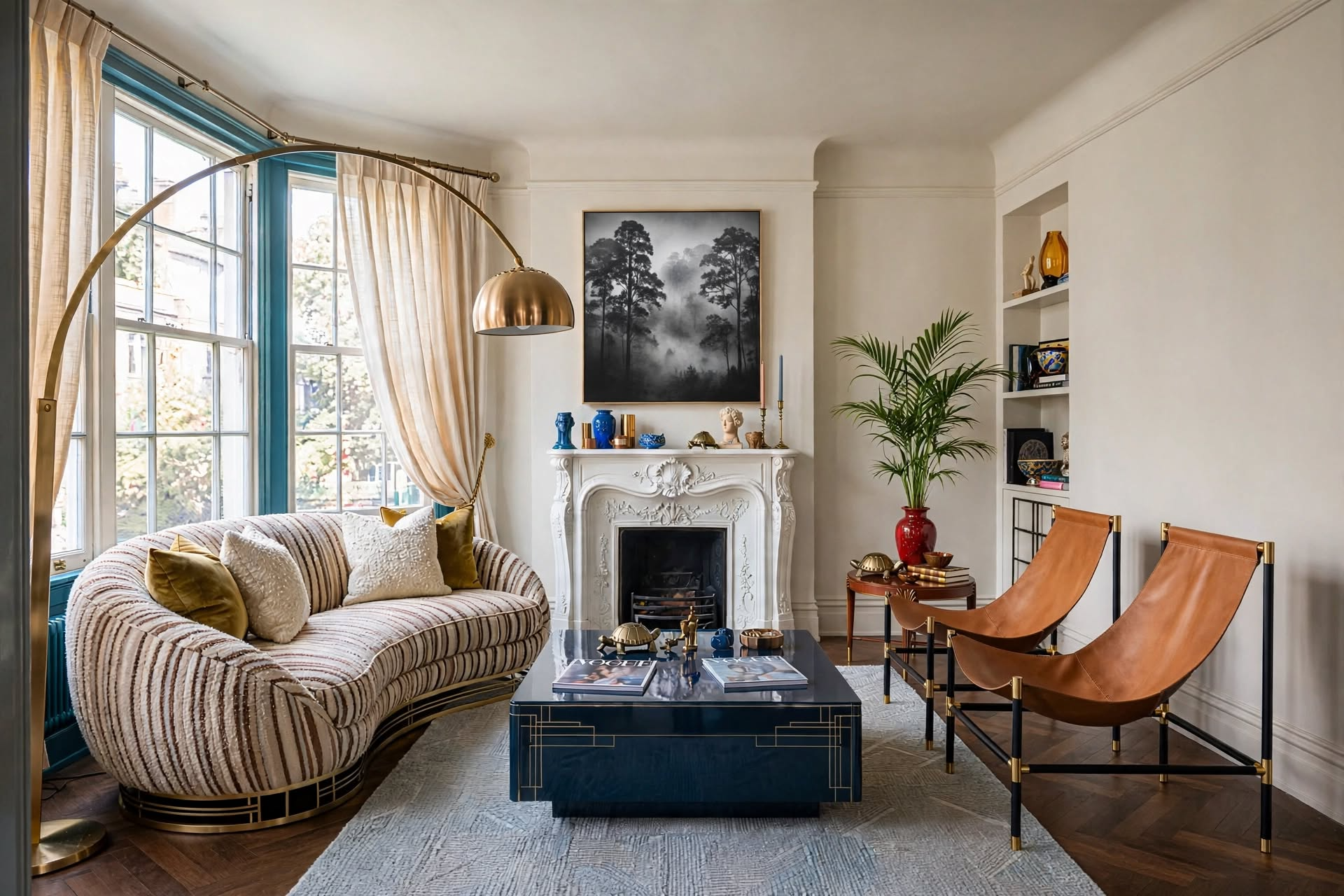
To make a small living room look bigger, start with layout before color — float furniture away from walls, hang curtains at ceiling height, use one large rug instead of several small ones, and layer three types of lighting. Light paint helps, but a low-contrast monochromatic palette matters more than going all-white. These optical illusions work in apartments, rentals, and older homes without any renovation.
How to Make a Small Living Room Look Bigger: 21 Designer-Proven Tricks That Actually Work
You’ve measured the room twice, rearranged the sofa three times, and you still feel like the walls are closing in. If your small living room makes you claustrophobic instead of cozy, you’re dealing with one of the most common frustrations in home design — and the fix is rarely what you think.

Most advice online tells you to “paint it white and add a mirror.” That’s not wrong — but it’s not enough to outperform a well-designed small space. The real secret? Interior designers don’t start with color. They start with layout, scale, and sightlines. Color is the finishing touch, not the foundation.
This guide goes beyond surface-level tips. We’ll cover the exact techniques that professionals like Studio McGee, Amber Lewis, and Louise Bradley use in compact living rooms — including the design psychology behind why each trick works, the common mistakes that make rooms feel smaller, and step-by-step action plans you can start this weekend.
Whether you’re in a 400-square-foot apartment, a narrow rental, or an older home with an awkward floor plan, these 21 strategies will help you make your small living room look and feel significantly bigger — no renovation required.
Why Small Living Rooms Actually Feel Cramped

A small living room feels cramped because of poor visual flow, not insufficient square footage. When your eye hits obstacles — furniture blocking walkways, competing colors, dark corners — the brain registers “tight space” regardless of actual dimensions. Fixing those visual interruptions is how you make a small living room look bigger without moving a single wall.
After analyzing hundreds of small-space makeovers, the three root causes are always the same:
- Blocked sightlines — Tall furniture or clutter stops the eye from traveling across the room, making it feel shorter
- Poor light distribution — A single overhead fixture creates harsh shadows and dark corners that visually shrink walls
- Scale imbalance — One oversized sectional or an undersized rug throws off the room’s proportions, making everything feel “off”
Interior designer Joshua Jones of JJones Design Co. puts it best: “A room’s sense of openness has far more to do with scale, flow, and visual decisions than with actual square footage. I’ve seen compact living rooms feel calm and spacious — and larger rooms feel cramped — simply because of how they were arranged.”
The solution is a systematic approach. We’ll tackle each of these root causes in order: layout and flow first, then light and color, then furnishings and accessories.
1. Start with Layout Before You Touch Color

The single most effective way to make a small living room look bigger is to fix the furniture layout. Floating your sofa even 3–4 inches off the wall, anchoring it with one properly sized rug, and keeping walkways at least 30 inches wide instantly creates visual breathing room that no paint color can replicate.
Why It Works
When furniture hugs every wall, you create a dead zone in the center and cramped traffic lanes along the perimeter. The eye reads this as “no room to move.” By pulling the sofa forward and creating a deliberate traffic path, you give the room an intentional structure — the same technique Nate Berkus and Emily Henderson’s design team use in their small-space projects.
Common Mistake
Pushing every piece of furniture flat against the walls. This is the number-one instinct in small rooms, and it backfires every time. You end up with an awkward open center, furniture that feels disconnected, and tight spots where the perimeter path narrows.
Better Alternative
Float your sofa 4–6 inches from the wall. Place a slim console table or a narrow floating shelf behind it. This creates a layered look that makes the room feel designed rather than arranged by default.
✓ Do This
- Float the sofa 4–6 inches from the wall
- Keep walkways at least 30–36 inches wide
- Use one large area rug that goes under the front legs of all seating
- Place furniture to guide natural movement toward the room’s focal point
✗ Avoid This
- Pushing everything flush against walls
- Using multiple small rugs that fragment the floor
- Blocking windows with tall bookshelves
- Creating furniture “islands” with no clear path between them
Measure your room and sketch the floor plan
Note windows, doors, and electrical outlets. Free apps like Magicplan work well for this.
Identify your focal point
Fireplace, window, TV, or a statement art piece. Everything else orients around this anchor.
Place the sofa first, then build outward
Position it facing the focal point with at least 30 inches for walkways on all traffic sides.
Add one rug that anchors all seating
An 8×10 or 6×9 rug depending on room size. Front legs of all furniture should rest on it.
“To achieve a light and spacious feel within a living room, it’s best to incorporate refined furniture pieces in lighter toned natural finishes. When selecting a piece, be mindful to consider the scale and avoid oversized options.”
— Louise Bradley, Interior Designer2. Choose the Right Scale and Proportion

Correctly scaled furniture makes a small living room look bigger than downsizing everything. One properly proportioned sofa paired with a substantial rug reads as intentional and spacious, while several tiny pieces fragment the room and emphasize its compact dimensions.
Why It Works
Design psychology tells us that fewer, well-proportioned objects create visual calm. When every item is mini-sized, the eye bounces between objects, registering “cramped.” When proportions are balanced, the room feels cohesive — and cohesion reads as space. This is the negative space principle that Architectural Digest features regularly in small-space tours.
Common Mistake
Buying “apartment-size” everything. A 60-inch loveseat, a 3×5 rug, and a tiny round coffee table actually makes a 12×14 room feel smaller because the proportions are off. The pieces look like dollhouse furniture and the room looks fragmented.
The Scale Formula
Sofa Length
Should be approximately 2/3 the length of the wall it faces. For a 10-ft wall: ~80-inch sofa.
Rug Size
At minimum, the front legs of all seating should be on the rug. 8×10 for most small living rooms.
Coffee Table
Should be approximately 2/3 the length of the sofa. Leave 14–18 inches between sofa and table.
Choose furniture with exposed legs — sofas, chairs, and console tables that show floor underneath. Visible floor space is the cheapest square footage in your room. A sofa with 6-inch tapered legs feels dramatically lighter than a skirted one, even at the same dimensions.
Glass and acrylic pieces are another designer favorite. A clear acrylic coffee table or a glass-topped side table takes up physical space without consuming visual weight. The eye passes right through, reading open floor where solid furniture would register as an obstacle.
3. Use Vertical Space to Stretch the Room

Drawing the eye upward is one of the fastest ways to make a small living room look bigger. Hanging curtains at ceiling height, mounting shelves above eye level, and choosing tall floor lamps over table lamps all create the illusion that your ceilings are higher — and higher ceilings always make a room feel more expansive.
Curtain Trick: Ceiling-Mount, Full-Length
Install your curtain rod 2–4 inches below the ceiling line (not at the window frame). Let the panels drop all the way to the floor — or pool very slightly. This single change elongates your wall by 12–18 visual inches. Choose lightweight, semi-sheer fabric to let natural light filter through while maintaining the height illusion.
Vertical Elements Over Horizontal
When adding storage or decor, think tall instead of wide. A tall narrow bookcase pulls the eye upward. A wide media console makes the ceiling feel lower. The same principle applies to artwork — a single large vertical piece or a stacked gallery arrangement will stretch the room’s perceived height more than a horizontal row of small frames.
✓ Vertical Wins
- Floor-to-ceiling curtains
- Tall leaning mirrors
- Floor-to-ceiling floating shelves
- Slim tall floor lamps
- Vertical gallery wall arrangement
✗ Horizontal Traps
- Short curtains that end at the windowsill
- Wide, low TV consoles
- Horizontal row of small picture frames
- Squat, wide table lamps
- Low-mounted shelving at waist height
4. Rethink Color — It’s Not Just “Paint It White”

A low-contrast, monochromatic color palette makes a small living room look bigger than any single paint color. The goal isn’t to go all-white — it’s to reduce harsh visual “stops” that chop the room into segments. When walls, trim, and major furniture share a similar tonal range, the eye travels smoothly across surfaces, and the room feels seamlessly larger.
Why Monochromatic Beats All-White
Pure white in a room with limited natural light can look flat, cold, and institutional — actually making the space feel more confined. Emily Henderson’s design team documented this in their farmhouse project: a dark-walled family room with poor natural light that went taupe felt dead, but switching to a rich teal made it feel larger because the enveloping tone dissolved the wall boundaries.
The key is matching your tone to your light level:
- Abundant natural light → Soft whites, warm creams, and pale grays work beautifully
- Limited natural light → A deeper, enveloping tone (warm greige, soft sage, muted blue) can paradoxically feel more spacious than a washed-out white
- Mixed light → Warm whites with undertones (Benjamin Moore White Dove, Farrow & Ball Wimborne White) bridge the gap
The Low-Contrast Rule
High contrast chops up a room. Dark trim against white walls, a bold accent wall flanked by light neutrals, or jet-black furniture on a white floor — these create visual stopping points. In a small living room, every stop makes the space feel tighter. Instead, paint trim the same color as walls (or within two shades) and choose furniture that blends with the overall palette.
Studio McGee’s signature move in small spaces: a monochromatic palette of warm whites and soft taupes, with texture variation instead of color variation. The eye stays calm, the room feels continuous, and the space reads 20–30% larger than bold accent-wall approaches.
| Light Level | Best Wall Color Strategy | Paint Examples |
|---|---|---|
| Bright, south-facing | Soft warm whites or pale neutrals | BM Chantilly Lace, SW Alabaster |
| Moderate, east/west | Warm whites with depth | BM White Dove, F&B Wimborne White |
| Limited, north-facing | Enveloping warm medium tone | BM Revere Pewter, F&B Elephant’s Breath |
| Very dark, interior room | Go bold — dissolve the boundaries | BM Hale Navy, F&B Inchyra Blue |
5. Use Mirrors Strategically (Not Decoratively)

One large mirror placed directly across from a window doubles the perceived depth of a small living room. The mirror reflects both the light and the outdoor view, creating a visual “window” on the opposite wall. This is the most reliable optical illusion in interior design — but only when placed with precision. Scatter small mirrors randomly and you get visual noise, not openness.
Placement Rules
- Across from the window — Reflects natural light and the outdoor view, extending the sightline
- Adjacent to the window — Bounces light sideways, brightening a dark corner
- Leaning against a wall — A tall leaning mirror (60 inches or taller) reinforces vertical lines while adding depth
- Above a console table — Creates a vignette that anchors one wall and adds visual depth behind the furniture
Common Mistake
Hanging a mirror where it reflects a cluttered corner, a dark hallway, or the back of the sofa. A mirror amplifies whatever it faces. If it faces mess, it doubles the mess. Always check what the mirror “sees” before mounting it.
A large leaning floor mirror from IKEA (the HOVET or LINDBYN) costs under $100 and has more visual impact in a small living room than $500 worth of wall art. Lean it against the wall opposite your largest window for instant depth.

6. Maximize Natural Light and Layer Artificial Light

A well-lit room always feels larger than a dimly lit one. To make a small living room look bigger with lighting, maximize every window by removing heavy drapes, then supplement with three types of artificial light — ambient, task, and accent — placed at different heights to eliminate shadows that shrink the space.
Natural Light: Remove Every Barrier
- Swap blackout curtains for sheer or semi-sheer panels
- Move tall furniture away from windows
- Clean windows thoroughly — a 20% increase in light transmission costs nothing
- If privacy is needed, use bottom-up cellular shades that let light in from the top
The Three-Layer Lighting Plan
Ambient (Ceiling)
One flush-mount fixture or recessed lights. Set on a dimmer so brightness adapts to time of day.
Task (Mid-Level)
A slim floor lamp beside the sofa or a reading sconce. Adds vertical light without clutter.
Accent (Low & Focused)
Picture lights above art, LED strip under a floating shelf, or a candle cluster. Creates depth.
Why It Works
A single overhead light casts everything in flat, shadowless sameness — which sounds good but actually flattens depth perception. Layered lighting creates pockets of brightness and gentle shadow that give the brain more spatial cues. The room reads as having more dimension, and dimension reads as space.
7. Invest in Multifunctional Furniture

Every piece of furniture in a small living room should earn its square footage by serving at least two purposes. A storage ottoman replaces both a coffee table and a blanket chest. A narrow console with drawers replaces both a side table and a junk drawer. Fewer pieces mean more open floor, and more open floor means a room that looks and feels bigger.
Best Dual-Purpose Pieces for Small Living Rooms
- Storage ottoman — Coffee table, footrest, and hidden storage for throws and remotes
- Nesting tables — One compact unit that expands when guests arrive, collapses when they leave
- Sofa with built-in storage — Modular sofas with lift-seat compartments hide bedding for overnight guests
- Wall-mounted drop-leaf desk — Folds flat when not in use, creating a work area without permanent floor commitment
- Upholstered bench with storage — Extra seating that doubles as a blanket box under the window
If you can’t drill into walls, look for furniture with built-in vertical storage — a tall narrow étagère, a ladder shelf, or a leaning bookcase. These free up floor space while utilizing wall height without a single screw hole.
8. Declutter with the “One In, One Out” Rule

Visual clutter is the fastest way to make even a decently sized living room feel tiny. In a small space, every visible object competes for the eye’s attention. Decluttering isn’t about minimalism — it’s about editing. Keep the items that bring you joy or serve a function, and remove everything else from view.
The 3-Second Rule
Stand in your doorway and scan the room for three seconds. Whatever your eye lands on first is your room’s dominant impression. If it’s a stack of mail, a tangle of cords, or an overcrowded bookshelf, that’s what visitors (and your subconscious) register as “cluttered.” Address those first.
Practical Steps
- Clear every horizontal surface first — coffee table, side tables, console
- Add back only 3–5 curated items per surface (a tray, a candle, one book stack, a plant)
- Use closed storage for remotes, magazines, chargers, and kids’ toys
- Apply the “one in, one out” rule: new item enters, old item leaves
“The greatest luxury a small room can have is empty space. Negative space isn’t wasted — it’s what lets every beautiful thing you’ve kept actually be seen.”
— Amber Lewis, Amber Interiors9. Create One Strong Focal Point

A single well-defined focal point tricks the brain into perceiving a small living room as bigger because it gives the eye a clear destination instead of competing stimuli. When the eye has one “home base” — a fireplace, a statement art piece, or a large window — it relaxes, and a relaxed eye interprets a room as more spacious.
How to Choose Your Focal Point
Identify the most architecturally interesting feature in the room: a fireplace, a large window with a view, or a built-in niche. If none exists, create one with a single oversized piece of art (30×40 inches or larger) or a gallery wall arranged in a tight grid. Orient your primary seating to face this focal point.
Common Mistake
Competing focal points. A TV on one wall, a gallery wall on another, bold patterned curtains on a third, and a statement rug on the floor create visual chaos. In a small room, the eye has nowhere to rest — and a restless eye perceives “cramped.” Choose one dominant feature and let everything else play a supporting role.
What’s Your Patio Style?
Take our free 2-minute quiz and discover the outdoor furniture style that matches your personality.
Take the Free Quiz →10. Create Flow with Consistent Flooring

Continuous flooring throughout adjacent rooms is one of the most overlooked ways to make a small living room look bigger. When the floor material changes at a doorway, the eye registers a boundary — and boundaries shrink perceived space. One unbroken material (hardwood, LVP, or consistent tile) from the living room into the hallway or kitchen makes the brain read both areas as one larger space.
Rug Strategy
If your flooring can’t change, use one large area rug instead of multiple small ones. A single 8×10 rug that extends under all seating creates a unified “zone” that reads as spacious. Multiple small rugs fragment the floor into patches, making the room look like a collection of tiny areas rather than one cohesive space.
Using a rug that’s too small. If only the coffee table sits on the rug and the sofa legs are on bare floor, the rug looks like a postage stamp. It’s better to have no rug than a rug that’s too small — the size mismatch emphasizes the room’s limitations.
11. Don’t Forget the Fifth Wall: Your Ceiling
Painting your ceiling a shade lighter than your walls — or the same color — makes a small living room look bigger by raising the perceived height. A stark white ceiling against colored walls creates a visible “line” where wall meets ceiling. Matching the tones softens that boundary, and the ceiling visually recedes, making the room feel taller.
Three Ceiling Strategies
- Same color as walls (in eggshell) — Dissolves the wall-ceiling boundary completely. Best for very small rooms.
- One shade lighter than walls — Subtle distinction that reads as “higher” without the uniformity of tone-on-tone.
- Glossy white ceiling — A high-gloss or semi-gloss finish reflects light back downward, amplifying the effect of your other lighting. Designers at House Beautiful call this the “lacquered ceiling” trick.
12. Play with Patterns and Textures the Right Way

Texture variation creates visual interest in a small living room without adding visual weight. Instead of introducing color contrast (which can segment the room), layer textures within the same tonal range: a linen sofa, a chunky wool throw, a jute rug, a smooth ceramic vase. This creates depth and richness that reads as “designed” rather than “small.”
Pattern Rules for Small Rooms
- One bold pattern maximum — Usually the rug or one set of throw pillows
- Vertical stripes on curtains — Adds height without competing with furniture patterns
- Small-scale patterns recede — They add interest without demanding attention
- Avoid large-scale bold prints on walls — Large patterns advance visually, making walls feel closer
Amber Lewis is a master of this: her small living rooms are never “plain,” but the richness comes from mixing materials (velvet, linen, rattan, wool) rather than mixing bold colors. The result feels collected and expansive.
13. Use Horizontal Lines to Widen Narrow Rooms

Horizontal visual lines make a narrow living room appear wider, just as vertical stripes on clothing elongate the body. A horizontal-plank accent wall, a long low console, or a wide piece of landscape art draws the eye side-to-side, counteracting the “tunnel” effect that narrow rooms often create.
How to Apply It
- A long, low media console or floating shelf on the longest wall
- Horizontal shiplap or board-and-batten on one accent wall
- A wide landscape photograph or panoramic print
- Striped area rug with horizontal orientation to the room’s entrance
When to Choose Vertical vs. Horizontal
Low ceilings? Emphasize vertical lines (tall curtains, vertical art, floor lamps). Narrow width? Emphasize horizontal lines (long shelving, wide art, low furniture). If your room is both low and narrow, prioritize vertical lines — height perception has a stronger impact on spaciousness than width.
14. Use Smart Storage to Hide Visual Clutter

Hidden storage eliminates the visual noise that makes a small living room feel cramped. Built-in shelving, furniture with concealed compartments, and wall-mounted storage free up floor space while keeping daily essentials within reach but out of sight.
Best Storage Solutions for Small Living Rooms
- Floating shelves — Display a few curated items without consuming floor space
- Ottoman with lift-top storage — Hides blankets, games, and remotes inside your coffee table
- Console with closed doors — A sleek media console with doors hides cables, routers, and media equipment
- Woven baskets on open shelving — Adds texture while concealing small items
- Behind-the-sofa console — The narrow gap between a floated sofa and wall becomes functional storage
15. Embrace a “Less but Better” Mindset

A small living room with five well-chosen pieces always looks bigger than one with fifteen mediocre items. This isn’t about stark minimalism — it’s about intentional curation. Each item should either be beautiful, functional, or (ideally) both. If a piece is neither, it’s taking up valuable visual and physical real estate.
The Small Room Editing Checklist
- ◆ Serves a clear daily function
- ◆ Brings genuine joy when you see it
- ◆ Fits the room’s scale
- ◆ Kept out of guilt or habit
- ◆ Duplicates something else in the room
- ◆ Too large for the space
- ◆ Seasonal items (holiday decor, extra blankets)
- ◆ Sentimental items better displayed in a bedroom
- ◆ Books you won’t re-read
16–21. Six More Techniques to Make a Small Living Room Look Bigger Designers Swear By

16. Extend Sightlines Through Doorways
Keeping a clear visual path from one room to the next tricks the brain into “borrowing” the adjacent room’s space. Remove doors between the living room and hallway when possible. If you can see from the sofa through the hallway to the kitchen, the living room’s perceived boundary extends all the way to the far wall.
17. Choose Furniture with See-Through Elements
My favorite technique to make a small living room look bigger is to use a glass coffee tables, wire-frame side tables, open-back shelving, and lucite chairs allow the eye to pass through, registering open space where solid furniture would block it. A glass-topped coffee table can reduce a room’s visual density by up to 30% compared to a solid wood one of the same dimensions.
18. Hang Art at the Right Height
Center artwork at 57 inches from the floor (gallery standard), which is average eye level. Art hung too high forces the eye upward and creates dead space below. Art hung at the correct height creates a visual midline that makes walls feel properly proportioned. In a small room, one large piece always beats a scattered collection of small frames.
19. Use Consistent Material Palettes
Limit your room to 2–3 materials maximum. Wood, linen, and glass. Or: metal, cotton, and stone. When materials multiply (wicker, leather, velvet, chrome, marble, rattan, all in one room), the visual complexity makes the space feel busy and smaller. Consistency reads as calm, and calm reads as space.
20. Keep Technology Invisible
Visible cords, routers, power strips, and chargers create visual clutter that registers subconsciously. Use cord management channels (paintable, under $10), wireless charging pads, and a closed media console. The cleaner your tech footprint, the larger the room feels.
21. Add One Living Element
A single large floor plant (fiddle-leaf fig, snake plant, or monstera) in a corner adds life, height, and a natural focal point. Plants draw the eye diagonally across the room — the longest possible sightline — which makes the space feel larger. Avoid clustering many small pots, which creates the same fragmentation problem as too-small furniture.
The Complete Small Living Room Cheat Sheet
| Category | Quick Win | Impact Level |
|---|---|---|
| Layout | Float sofa 4–6″ from wall | ★★★★★ |
| Scale | One proper-sized rug under all seating | ★★★★★ |
| Vertical | Hang curtains at ceiling height | ★★★★☆ |
| Color | Low-contrast monochromatic palette | ★★★★☆ |
| Mirror | One large mirror across from window | ★★★★☆ |
| Light | Three-layer lighting plan | ★★★★☆ |
| Furniture | Pieces with exposed legs | ★★★☆☆ |
| Clutter | 3–5 items max per surface | ★★★★★ |
| Focal Point | One dominant feature, everything else supporting | ★★★☆☆ |
| Flooring | One continuous material + one large rug | ★★★☆☆ |
- 01 Interior Design Style Quiz
- 02 Timeless Paint Colors That Never Go Out of Style
- 03 Create Your Perfect Ergonomic Home Office: A Complete Guide
- 04 Must-Have Accessories for Guys: The Secret to a Stylish Space
- 05 Modular Sofas for Small Spaces: Brilliant Solutions for Compact Living
- 06 Bathroom Peel and Stick Wallpaper Ideas: 7 Designer Tricks
Conclusion: Your Small Living Room Has More Potential Than You Think
Making a small living room look bigger isn’t about one silver-bullet trick — it’s about stacking multiple small optical illusions on top of each other. A floated sofa adds perceived space. Ceiling-height curtains add perceived height. A large mirror adds perceived depth. Layered lighting adds perceived dimension. A monochromatic palette ties it all together into one continuous, breathing room.
Start with the highest-impact changes first: fix the layout, get the right rug size, and hang those curtains higher. These three moves alone can transform the feeling of a room in a single afternoon. Then layer in the color, lighting, and accessory strategies as your time and budget allow.
The difference between a cramped living room and a spacious-feeling one is rarely square footage. It’s intention. And now you have 21 intentional strategies to prove it.
Discover your personal design aesthetic with our free quiz — and get tailored style recommendations for your space.
Take the Style Quiz →FAQs: How to Make a Small Living Room Look Bigger
How We Chose These Space-Enhancing Techniques
Every recommendation in this guide is based on three criteria: (1) it has been documented in professional interior design practice by recognized designers or publications like Architectural Digest, House Beautiful, or the American Society of Interior Designers; (2) it can be implemented without renovation, structural changes, or landlord permission; and (3) it addresses verified design psychology principles — visual weight, negative space, scale, proportion, contrast, and focal point hierarchy — rather than subjective preference.
We also cross-referenced advice from real homeowners on community forums and from our own readers’ before-and-after submissions to verify that these techniques work in real-world apartments, rentals, and older homes — not just styled photo shoots.
CATCH THE LATEST IN HOME DECOR TRENDS:

Steal These 16 Expert-Approved Decorating Secrets

Accessorize a Small Living Room: 7 Genius Styling Secrets

How to Make a Small Room Appear Bigger

How to Make Your Home Look Expensive
GET CAUGHT UP ON ALL THE INSPIRING DECOR TIPS:

Best Fireplace Makeover Ideas

How to Make a Gallery Wall: The Complete Step-by-Step Guide (Even If You’ve Never Hung a Picture)