To find your interior design style, start by auditing the rooms and images you naturally gravitate toward, then match those patterns to one of the nine core design styles. From there, apply a cohesive color palette, follow a few key designer rules, and refine with texture — and your space will finally look the way you’ve always imagined it.
If you’ve been trying to figure out how to find your interior design style and ending up more confused than when you started, you’re not alone. You save hundreds of pins. You screenshot rooms you love. You buy a throw pillow, a lamp, a rug — and somehow your space still doesn’t look like any of them. That gap between what you love online and what you actually live with? That’s the problem this guide exists to solve.

Most advice out there tells you to “just take a quiz” or lists design styles without explaining how to actually apply them to your home. That’s not good enough. What you need is a real, step-by-step blueprint — the kind a designer would walk you through in a paid consultation — that helps you define your style, understand why your space looks the way it does, and fix it with confidence.
Whether you’re starting from scratch, redecorating a rental, or trying to make sense of a room that just feels off, this guide will get you there. Let’s start.
What Is an Interior Design Style — and Why Does It Matter?

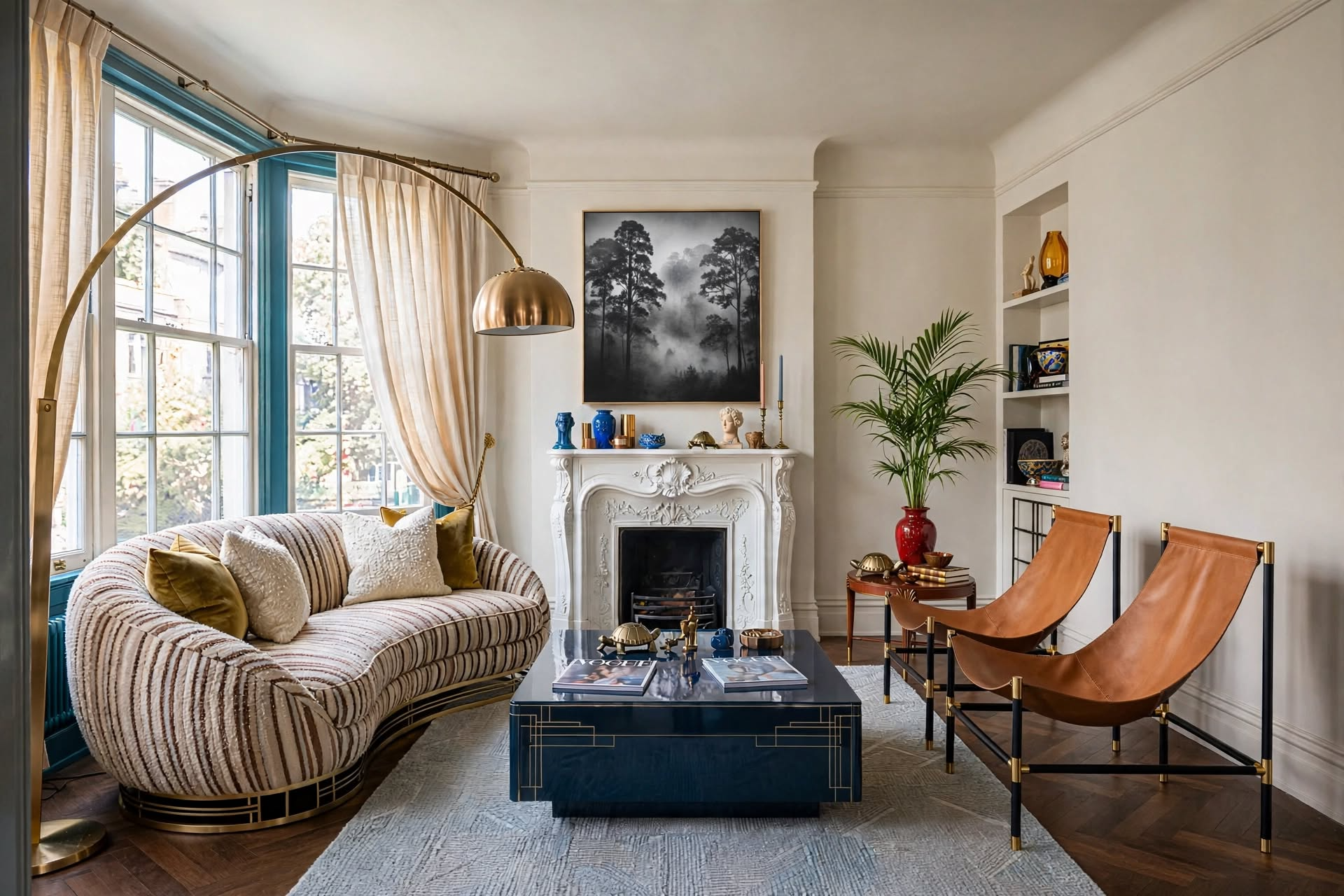
Image source: FERRER
An interior design style is a cohesive visual language for your home — a consistent set of shapes, colors, materials, and moods that work together to create a feeling, not just a look. When you know how to find your interior design style, you stop buying random pieces and start building a room with intention.
Without a defined design style, you end up with what designers call a “collected-without-direction” space: a room full of nice things that don’t speak to each other. According to Houzz, the average homeowner spends over $6,000 on home decor before replacing half of it within two years — mostly because of impulse buys made without a clear style vision. Knowing your style before you shop is the single most cost-saving move you can make.
The difference between style, aesthetic, and trend
These three words get used interchangeably, but they mean very different things — and confusing them is a major reason why rooms feel inconsistent.
| Term | What It Means | How Long It Lasts | Example |
|---|---|---|---|
| Style | A broad design philosophy with consistent rules | Decades — timeless | Mid-Century Modern |
| Aesthetic | A visual mood or feeling, often more personal | 5–10 years | “Dark academia” or “cozy cabin” |
| Trend | A popular moment in design, here today, gone soon | 12–36 months | Terracotta everything (2021) |
Your goal is to anchor your home in a style, layer in your personal aesthetic, and use trends only as accent touches — never as the foundation.
Read Next 31 Most Important Popular Interior Design Styles You Should Know About →Step 1 — Audit What You Already Love (The Save Method)

The fastest way to find your interior design style is to stop looking outward and start looking at what you’ve already saved. Your Pinterest boards, Instagram saves, and phone screenshots are an unfiltered record of your taste — and they’re full of patterns you haven’t noticed yet.
Most people think they “love everything” when it comes to design. But when you look at 50 of your saved images side by side, a very clear style story emerges. This is exactly what designers do in a first consultation — they don’t ask you to describe your style, they ask to see what you love.
How to do a Pinterest audit in 15 minutes
Open your most-used board and scroll through your last 30 saves without reading the descriptions. Ask yourself:
- What materials keep appearing?
- What color palette dominates?
- Is the mood light and airy, or rich and layered?
- Are lines clean or organic?
Look for these three things specifically:
- The predominant color temperature (warm vs. cool)
- The dominant material (wood, metal, linen, marble)
- The overall silhouette style (curved and soft vs. structured and geometric)
Those three data points alone will point you directly to your interior design style.
The 3-word vibe test
Here’s a quick exercise designers use with new clients: write down three words that describe how you want your home to feel — not look. Words like “calm,” “layered,” “warm,” “bold,” “playful,” or “refined.” These emotional anchors are the real foundation of your design style, and they’ll guide every purchase you make after this.
“Your saves don’t lie. I always tell clients: if you’ve saved it more than twice, you like it for a reason. The job is just to find the pattern.” — A recurring principle among professional interior designers who work with indecisive clients.
Step 2 — Know the 9 Core Interior Design Styles

Once you’ve identified the patterns in what you love, the next step is to match them to one of the nine core design styles. Think of this as finding the design language that already speaks to you — so you can use it intentionally instead of accidentally.
Don’t feel like you have to fit perfectly into one box. Most people’s interior design style is a primary style with one or two secondary influences — and that’s exactly what makes a space feel personal rather than like a catalog page.
Related How to Mix Interior Design Styles →Step 3 — Take a Style Quiz (and Actually Use the Results)

A style quiz is one of the quickest tools to find your interior design style when you’re feeling overwhelmed — but only if you use the result as a starting point, not a label to live by. A good quiz cuts through decision paralysis by asking you to make small, instinctive choices. Those micro-decisions add up to a very accurate style profile.
The key is what you do after the quiz. Once you get your result, revisit the vibe check above and ask: does this match the patterns I found in Step 1? If it does, you have your anchor style. If it doesn’t quite fit, treat it as a clue — not a verdict.
Step 4 — Build Your Style Foundation with Color and Texture

Color and texture are the two tools that most directly determine whether your interior design style reads as intentional or accidental. You can have the right furniture and the wrong color palette, and the room will still look off. Or you can have budget furniture and the right layered textures, and the room will look expensive. This step is where the “Pinterest gap” gets closed.
How to build a 60-30-10 color palette for your style
Every interior design style has a natural color language, and the 60-30-10 rule is how you apply it without overcomplicating things. Here’s how it works:
- 60% of the room is your dominant color (walls, large upholstery, flooring)
- 30% is your secondary color (curtains, accent chairs, bedding)
- 10% is your accent (throw pillows, vases, art)
The specific tones you choose should reflect your style:
- Modern and Minimalist: whites, warm greys, and greige
- Bohemian and Eclectic: terracotta, forest green, and ochre
- Coastal: driftwood, soft navy, and white
- Mid-Century Modern: walnut brown, mustard, and olive
Use your style as the guide — not a paint swatch you happened to love in a store.
Use your style as the guide — not a paint swatch you happened to love in a store.
Texture layering by style
Texture is the difference between a room that looks flat in photos and one that looks lush. Every interior design style has a texture language: Modern uses glass, steel, and smooth leather. Bohemian layers rattan, macramé, velvet, and woven textiles. Farmhouse leans on linen, shiplap, and raw wood. Coastal brings in jute, rattan, and organic cotton.
The rule is simple: aim for at least three different textures per room, and make sure they represent different tactile experiences — something smooth, something soft, and something rough or natural.
Related Secrets to Mixing Textures at Home Like an Interior Designer → Related Timeless Paint Colors That Never Go Out of Style →Step 5 — Apply the Designer’s Cheat Sheet (Scale, Layout & Rules)

This is the step that turns a decorated room into a designed one. You can have a beautifully defined interior design style and still end up with a room that feels off — usually because of scale, proportion, or placement. These are the rules designers use on every single project, and they work regardless of your style or budget.
The 57-inch rule for art and mirrors
Art should always be hung so its center sits at 57 to 60 inches from the floor — the average human eye level. This is the standard used in most art galleries and it’s the reason professionally styled rooms look so grounded. Most people hang art too high, which makes ceilings feel lower and walls feel disconnected from the furniture below.
The 2/3 rule for sofas and rugs
Your rug should be at least two-thirds the length of your sofa, and ideally large enough so all furniture legs sit either fully on or fully off it — “two on, two off” is acceptable, but all four off is the most common decorating mistake made in living rooms. For sofas against walls, leave at least 18 inches of walkable space on each side and in front.
Spacing formulas — coffee tables, art groupings, lighting
Coffee table to sofa: 14–18 inches of clearance. Art grouping: treat the entire arrangement as one piece — step back and check the outer edges, not just the individual frames. Pendant lighting over a dining table should hang 28–34 inches above the table surface. These numbers aren’t arbitrary — they’re based on human ergonomics and visual comfort.
Real-Life Fixes — When Your Interior Design Style Still Isn’t Working

Knowing your interior design style is one thing. Getting it to work in your actual home — with its awkward corners, renter restrictions, and weird lighting — is another entirely. These are the five most common real-world problems that keep people stuck, and the designer-approved fixes for each.
- Too-small rug floating in center
- Art hung at 80 inches — too high
- Three different wood tones clashing
- No clear focal point
- Furniture pushed against all walls
- Rug anchors all furniture legs
- Art centered at 57 inches — grounded
- Two wood tones max, intentionally mixed
- Fireplace or sofa as clear focal point
- Furniture pulled in, conversation-focused
The most common mistake in awkward spaces is trying to fight the architecture. Instead, identify the natural focal point of the room (a window, a fireplace, the longest wall) and orient your largest furniture piece toward it. Pull furniture away from the walls — a sofa floating 12 inches from the wall creates a more intimate, designed feel than one pushed flat against it. Use rugs to define zones in open-plan rooms.
The television is the enemy of style — until you design around it deliberately. Frame it with symmetrical sconces, build a gallery wall that includes it as one element, or mount it inside a built-in unit that anchors the whole wall. The goal is to make the TV part of the composition, not the default focal point of a room that happens to have one.
No-drill art hanging systems (like Command strips rated for 16+ lbs) let you create full gallery walls without a single nail. Peel-and-stick wallpaper transforms a rental accent wall without damaging the surface. Freestanding furniture like bookcases, room dividers, and floor lamps give you maximum style flexibility. Your interior design style doesn’t need to wait until you own a home.
Nine times out of ten, the answer is lighting. Most rooms rely entirely on overhead lighting, which is the least flattering and least designerly of all light sources. The fix: layer your lighting with at least three sources — overhead (ambient), table or floor lamp (task), and candles or low-wattage accent lighting. This alone transforms flat rooms into ones that look like the photos that inspired you.
The secret to mixing design styles successfully is to pick one anchor style (70% of the room) and one supporting style (30%), then find a single color or material that bridges them. For example: Modern anchor with Bohemian warmth bridged by natural linen. The shared element is what makes the mix look intentional instead of accidental.
Visual Anti-Patterns — What Not to Do When Defining Your Interior Design Style
Knowing what not to do is just as valuable as knowing the rules. These five visual mistakes are the most common reasons a well-intentioned room never quite looks designed — even when the pieces are great.
-
✕
The Floating Rug Rug is too small, floating disconnected from all furniture. Fix: size up — anchor at least the front legs of all seating.
-
✕
Matchy-Matchy Everything Every piece from the same collection reads as a showroom. Fix: mix at least two different furniture sources.
-
✕
Dead Symmetry Perfect mirroring on both sides reads as sterile. Fix: break symmetry with one different element — same height, different shape.
-
✕
Scale Blindness Tiny art on a massive wall, or an oversized sofa in a small room. Fix: tape out furniture dimensions on the floor before buying.
-
✕
Too Many Wood Tones Four different wood tones in one room creates visual noise. Fix: pick two complementary wood tones maximum. Everything else in non-wood materials.
2026 Trends Reshaping How We Find and Express Interior Design Style

These aren’t passing moments — they’re the three movements actively reshaping how people think about interior design style. Understanding them helps you stay current without abandoning the timeless foundation you’ve built.
Identity Decor — decorating that tells your story
The biggest shift in how people find their interior design style right now is the move away from aesthetics borrowed from social media toward spaces that reflect personal history. Travelers are displaying objects from trips. Book lovers are making their libraries the centerpiece of their living rooms. This isn’t a style — it’s a philosophy: your home should be readable as yours, not interchangeable with anyone else’s saved board.
Organic Modern — the style that’s everywhere in 2026
Organic Modern is the style most people end up gravitating toward when they want to find their interior design style but feel stuck between “too cold” and “too rustic.” It bridges the clean lines of Modern design with the warmth of natural materials — think white plaster walls, curved furniture silhouettes, live-edge wood, and plenty of organic textures. It photographs beautifully and lives comfortably, which is why it’s currently the fastest-growing search in home decor.
Tactile Layers — touch as the new visual
After years of flat, screen-friendly aesthetics dominating interior design style boards, tactile richness is having its moment. Boucle, ribbed linen, hand-thrown ceramics, chunky knit throws, raw plaster walls, and hammered metal accents are all part of the same impulse: to make rooms that feel as good as they look. Start with one tactile upgrade — a bouclé pillow, a ribbed ceramic lamp base — and see how immediately it elevates a room.
Related Modern Organic Interior Design: The Ultimate 2026 Guide →When to Call a Professional Designer (and When You Don’t Need To)

Once you know how to find your interior design style, most decorating decisions become DIY-able. But there are moments when a professional designer will save you more than their fee — in avoided mistakes, time, and trade-pricing access.
Signs you’d benefit from a designer
You’re renovating a kitchen or bathroom where layout decisions are permanent. You’re furnishing an open-concept space and can’t figure out how to zone it. You’ve decorated and redecorated a room three times and it still doesn’t feel right. You have a clear interior design style in mind but no idea how to execute it on your specific budget. Any of these? A single two-hour consultation could be the most valuable design investment you make.
What to expect from online interior design services
Online interior design platforms have made professional guidance accessible at a fraction of traditional pricing. Most offer style questionnaires (essentially a deep-dive version of finding your interior design style), mood boards, floor plans, and shopping lists. Prices range from $75 for a single room package to $500+ for full-service online design. It’s a strong middle ground between doing it all yourself and hiring locally.
Related How to Hire an Interior Designer →Your Interior Design Style Is Already Inside You — You Just Need a Blueprint
Here’s the truth about how to find your interior design style: you don’t actually need to invent it from scratch. It’s already embedded in everything you’ve saved, bookmarked, and admired. The process is simply about surfacing it, naming it, and giving yourself permission to commit to it.
- Step 1: Audit your saves — the patterns are already there.
- Step 2: Match those patterns to one of the nine core styles, with a secondary influence.
- Step 3: Take a style quiz and use the result as a starting point.
- Step 4: Build a 60-30-10 color palette and layer at least three textures.
- Step 5: Apply the designer’s rules — 57-inch art hang, 2/3 rug rule, proper spacing — and your room will look the way you’ve always wanted it to.
None of this requires a renovation, a massive budget, or starting over. It requires clarity — and now you have it.
Ready to Find Your Home’s Color Palette?
Take our free quiz — get your result in under 3 minutes, with a full style breakdown.
Take the Color Palette QuizHow To Find Your Interior Design Style – Frequently Asked Questions
Start with your saves, not a blank page. Open Pinterest or Instagram and look at your last 30 saved images for common colors, materials, and silhouettes. This pattern is your interior design style in raw form. From there, match it to the nine core styles above and take a free style quiz to confirm your direction.
Yes — and most well-styled homes do. The key is the 70/30 rule: one primary interior design style dominates 70% of the room, and a secondary style accounts for the remaining 30%. Then find a shared element — a color, a material, a texture — that bridges both styles and makes the mix feel intentional rather than accidental.
Your interior design style doesn’t require owning the walls. Removable peel-and-stick wallpaper, no-drill hanging systems, freestanding furniture, and large rugs can transform a rental entirely. Focus your budget on textiles, art, and lighting — all portable, all high-impact, and all 100% yours to take when you leave.
A good quiz is a useful starting point, not a verdict. It works by aggregating your instinctive visual preferences and mapping them to known style categories — which is surprisingly accurate for most people. Use the result as a hypothesis, cross-reference it with your saves audit, and adjust from there. Think of it as a shortcut, not a final answer.
Identifying your interior design style takes an afternoon. Executing it is a slower, more rewarding process — most designers recommend one room at a time over 6 to 18 months rather than all at once. This approach lets you live with each decision before committing to the next, and results in a home that evolves rather than one that expires when a trend does.
Decorating refers to the surface layer — choosing colors, furniture, accessories, and artwork. Interior design encompasses everything from architectural planning and spatial layout to lighting design and material specification. When most people talk about finding their interior design style, they mean decorating — which is a skill anyone can learn without a degree.
Clarity is free. Identifying your interior design style costs nothing — and it saves you from expensive impulse buys. Once you have your style defined, invest in the highest-impact items first: a rug, a sofa, and lighting. Then fill in with secondhand finds, DIY projects, and peel-and-stick solutions that align with your style. A cohesive $2,000 room beats a cluttered $8,000 one every time.
DIY works well once you’ve identified your interior design style and are making decorating decisions in existing spaces. Bring in a professional when decisions are permanent (renovations, structural changes), when the scale is large (full home furnishing), or when you’ve tried multiple times and can’t make it work. Even one consultation can recalibrate an entire project and save you from costly direction changes.
CATCH THE LATEST IN HOME DECOR TRENDS:

Steal These 16 Expert-Approved Decorating Secrets

Accessorize a Small Living Room: 7 Genius Styling Secrets

How to Make a Small Room Appear Bigger

How to Make Your Home Look Expensive
GET CAUGHT UP ON ALL THE INSPIRING DECOR TIPS:

18 Fresh Decorating Ideas To Update Your Fireplace

How to Make a Gallery Wall: The Complete Step-by-Step Guide (Even If You’ve Never Hung a Picture)