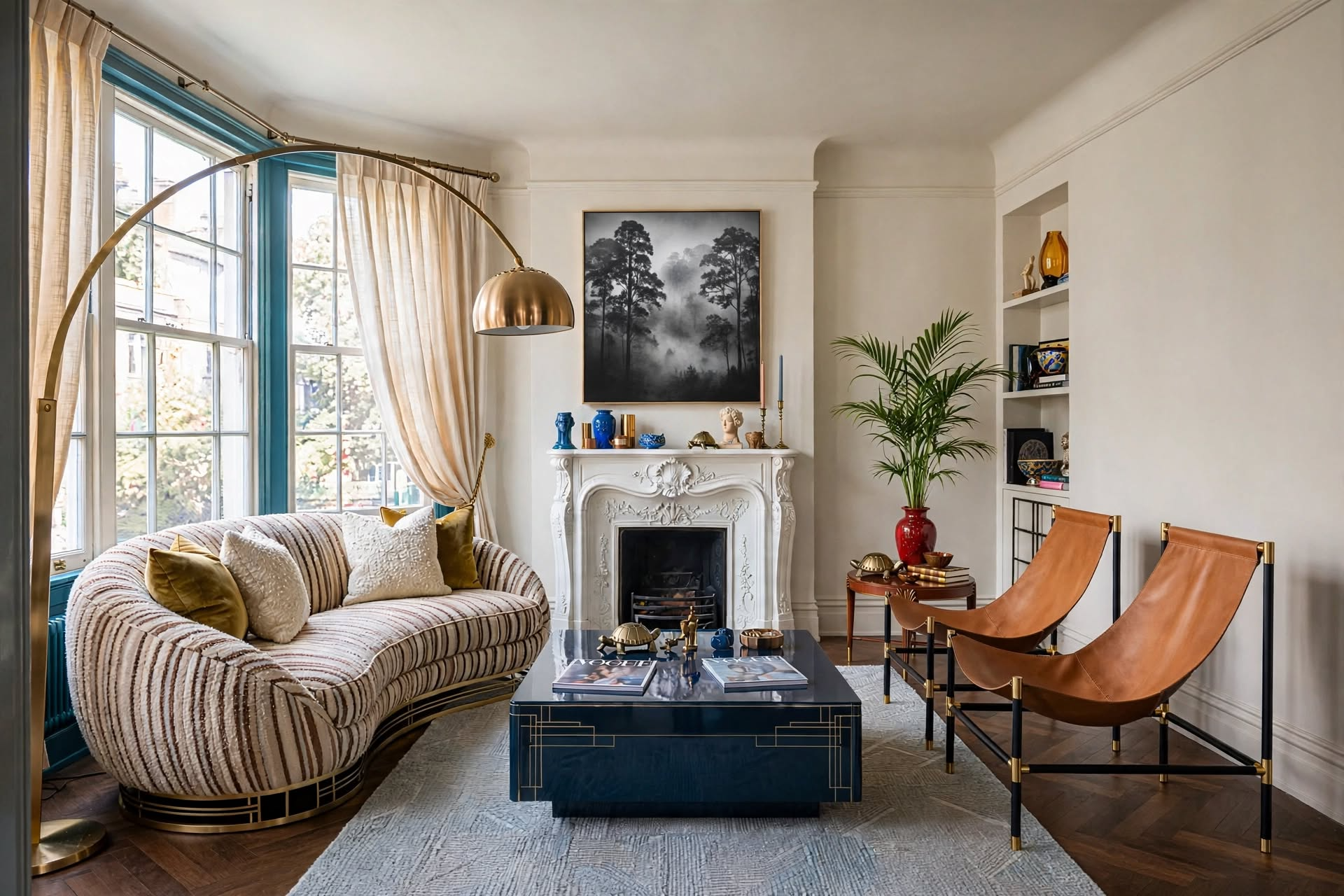
“Still rearranging the same room hoping it’ll click? It won’t — until you know this.”
The Designer’s SECRET Cheat Sheet121 designer-approved rules for every room in your home. The shortcut every well-styled home is built on.
How to Mix Interior Design Styles (Without the Chaos)
To mix interior design styles, choose one base style for about 70% of the room. Bridge your second style in through a shared color, material, or shape, and repeat each accent at least three times so it looks like a choice, not an accident. Two styles are the easiest mix. Three is the most one room can hold.
Learning how to mix interior design styles usually starts with a problem, not a mood board. You love two looks. Your partner loves a third. And you inherited a dresser that fits none of them.

Here’s the good news: most mixed rooms don’t feel “off” because the styles clash. They feel off because nothing connects them. Fix the connection, and almost any pairing can work.
This guide gives you a simple 3-step method you can use on the room you already have, including in a rental or a small apartment. There’s a one-glance cheat sheet at the end.
In This Guide
- What Does It Mean to Mix Interior Design Styles?
- The Base–Bridge–Repeat Method, Step by Step
- What Do My Favorite Styles Have in Common?
- Which Styles Go Well Together?
- Mixing Decor Styles With a Partner
- Mixing Old and New Furniture
- Mixing Styles in a Small Apartment or Rental
- Mixing Styles on a Budget
- What NOT to Do
- Designer’s Cheat Sheet
- FAQ
- Final Thoughts
BASE · About 70%
Choose one lead style. It owns the big pieces and the backdrop: sofa or bed, rug, wall color.
BRIDGE · 1–2 Threads
Find a color, material, or shape both styles share, and let pieces carry it across the room.
REPEAT · 3 Times
Show every secondary-style accent in three spots so the eye reads it as on purpose.
Every section below comes back to these three steps, so you’ll see them called Base, Bridge, and Repeat.
What Does It Mean to Mix Interior Design Styles?

Mixing interior design styles means combining furniture and decor from two or more distinct looks, like modern and traditional, in one room. What holds the mix together is a clear lead style plus a few shared details. Without those, you have a collection of things, not a room.
Two terms get mixed up a lot. Transitional is a calm, balanced blend of traditional and modern. Eclectic is bolder and more collected, with more contrast between pieces. Knowing which one you’re aiming for tells you how far apart your styles can be.
If you’re not sure what your favorite looks are actually called, start with this guide to the 31 most popular interior design styles and pick the two or three that feel most like you.
Name your styles before you shop. “Warm modern plus vintage” gives you a filter. “I like a bit of everything” doesn’t.
How to Mix Interior Design Styles: The Base–Bridge–Repeat Method

Give one style about 70% of the room, connect the second style through at least one shared color, material, or shape, and repeat each accent three times. The base keeps the room calm. The bridge makes the styles relate. The repetition makes the whole mix look deliberate instead of accidental.
The 70/20/10 split is a designer rule of thumb, not a law. It simply keeps one style in charge so the room has a clear point of view.
List the room’s “big five”
Sofa or bed, rug, largest storage piece, wall color, and main light. These belong to your Base style.
Assign the 70 / 20 / 10
70% Base. 20% secondary style (an accent chair, side tables, art). 10% wild card (one vintage find or one bold lamp).
Pick your Bridge
Choose the thread both styles can share. Use the Bridge Menu below.
Place accents in a triangle
Put each secondary-style piece in three spots around the room so your eye travels across it instead of stopping at one corner.
Edit down
Take one item off every surface, then step back. Mixed rooms need more breathing room than single-style rooms.
Step 4 works for the same reason odd-numbered groupings feel balanced. If you want the deeper “why,” this guide to the interior design rule of thirds explains it.
The Bridge Menu: 4 Ways to Connect Two Styles
- Color bridge. Pull one color from your secondary style into pillows, a throw, and a piece of art.
- Material bridge. Repeat one wood tone or one metal finish across both styles. A single finish, like the approach in this chrome home decor styling guide, can tie a whole room together.
- Shape bridge. Keep one shape consistent: all tapered legs, all rounded edges, or all slim track arms.
- Texture bridge. Use the same nubby, woven, or velvety texture in both styles. Here’s more on mixing textures like an interior designer.
How Do I Figure Out What My Favorite Styles Have in Common?

Most people don’t actually have “too many styles.” They have a consistent eye that’s hidden behind style labels. A farmhouse kitchen and a modern loft you both saved might share the same white walls, the same black metal, and the same warm wood.
Designer Michael Helwig describes diagnosing a client’s inspiration photos by looking at color ratios and repeated details instead of style names. You can do a simple version of that yourself.
The 10-Photo Audit
Save 10 rooms you love
Any style. Don’t filter yet.
Note five details in each
Wall color (light or dark), wood tone, metal finish, sofa arm shape, and rug pattern type.
Circle what repeats
Anything that shows up in 6 or more photos is your real style, and it’s your Bridge.
Cross out the one-offs
Something that appears only once is a crush, not a commitment. Keep it for a pillow, not a sofa.
Once you have your circled list, turn it into an interior design mood board so you can test new pieces against it before you buy.
Look at the floors and the light in each photo, not just the furniture. They change how every style reads.
Which Interior Design Styles Go Well Together?

The easiest styles to mix already share one trait, such as a color temperature, a material, or a level of detail. Opposites can work beautifully too, but they need a stronger bridge and a stricter 70/20/10 split so one style stays clearly in charge.
Use this table as a starting point. Each row shows what the pair shares, the one piece that bridges them best, and the mistake to watch for.
| Pairing | What They Share | Best Bridge Piece | Watch Out For |
|---|---|---|---|
| Modern + Traditional | Symmetry, strong silhouettes | A classic-shape sofa in a modern fabric | Too many ornate pieces at once |
| Scandinavian + Boho | Light woods, natural fibers | A jute or wool rug | Letting color spread past 20% |
| Industrial + Farmhouse | Raw wood, black metal | A reclaimed-wood table on metal legs | Heavy pieces on every wall |
| Mid-Century + Traditional | Wood furniture, warm tones | A walnut piece with tapered legs | Too many different wood tones |
| Coastal + Farmhouse | Whites, natural textures | Linen slipcovers or rattan | Theme-y decor (anchors, signs) |
| Cottage + Modern | Soft color, simple forms | A floral print on a clean-lined chair | Too many small accessories |
Opposites need a bigger bridge: aim for two shared threads instead of one. And if you’re drawn to that last pairing, this cottage apartment style guide shows how to keep cottage charm feeling fresh next to modern pieces.
How Do You Mix Decor Styles With a Partner (or Roommate)?

When two people have different tastes, it’s less of a design problem and more of a negotiation. Fair rules matter more than perfect pieces. The goal is a room where both people can point at something and say, “That’s mine.”
Patience helps too. HGTV’s advice on blending design styles with a significant other includes living with pieces in new spots for a while before deciding what goes.
The Fair-Split Process
- Audit separately. Each person does the 10-Photo Audit on their own.
- Find the overlap. Compare your circled lists. Whatever you both circled becomes your shared Bridge.
- Name your must-keeps. Each person picks up to 3 pieces that aren’t up for debate.
- Choose the Base together, then split the 20% so each of you “owns” visible accents.
- Give each person one zone. A desk, a reading corner, or a nightstand that’s fully theirs.
- Try it for two weeks before buying anything big.
If one of you cares about function and the other cares about looks, split the decision: the function person picks the sofa’s size and comfort, and the looks person picks its fabric.
Still stuck after all that? A neutral third party can break the tie. Here’s how to hire an interior designer without overspending.
How Do You Mix Old and New Furniture You Already Own?

Treat inherited or vintage pieces as your 10% wild card or part of your 20% accent, not as the Base. Then bridge them in by repeating their wood tone, hardware finish, or color in two newer items nearby. That way the old piece looks chosen, not leftover.
- Refresh, don’t replace. New hardware, a new lampshade, or reupholstery can pull an old piece into your Base style.
- Use contrast on purpose. An ornate piece pops against a plain wall. Busy surroundings hide it.
- Give it “bodyguards.” Flank the heirloom with simple pieces on both sides so it’s the star.
Do
- Repeat the heirloom’s wood tone in a frame and a tray
- Place it against a clean, uncluttered wall
- Swap hardware to match the room’s main metal
Don’t
- Surround it with more antiques
- Hide it in a dark corner
- Pair it with a wood tone that’s almost (but not quite) the same
How to Mix Design Styles in a Small Apartment or Rental

In a small apartment, you see every piece at once, so mixing styles needs tighter rules. Stick to two styles instead of three, use one wall color and one main metal throughout, and let removable items carry your secondary style: textiles, art, lighting, and small furniture.
Apply 70/20/10 to the whole home
In a studio or open layout, every zone is one room. Plan the split across the entire space.
Run one Bridge through every zone
For example, warm wood plus black metal in the kitchen, living, and sleeping areas.
Put the secondary style on movable pieces
Pillows, art, lamps, and side tables come with you when you move.
Keep big furniture visually light
Choose pieces with visible legs or open bases so mixed styles don’t feel crowded.
For more on pulling a whole small space together, see how to make a small apartment look cohesive, or these studio apartment layout ideas if you’re working with one open room.
Can’t repaint? Make your rug and curtains the Base color instead. Together they cover more visual space than you’d think.
- Three styles fighting for attention
- Brass, chrome, and black metal all mixed
- One boho pillow alone on a modern sofa
- Every surface full
- Two styles, with modern clearly leading
- One metal (black) repeated across the room
- Boho texture repeated 3 times: pillow, basket, wall hanging
- One item removed from every surface
How to Mix Interior Design Styles on a Budget

Mixing styles is naturally budget-friendly, because your secondary style lives in small, affordable pieces. Spend on the Base pieces you’ll keep for years, put mid-level money into rugs and lighting, and save on accents, where thrifted and vintage finds look better than new.
Spend-Priority Order
- Spend: the Base’s biggest piece, usually the sofa or bed. It stays the longest and sets the tone.
- Mid-spend: the rug and lighting. They do the most bridging per dollar.
- Save: accents. Secondhand and vintage pieces are perfect for your 10% wild card.
What to Skip
- Matching furniture sets. They lock you into one style.
- Trendy statement pieces as your Base. Save trends for the 10%.
- Anything you can’t place in your 70/20/10 before you buy it.
Swap pillow covers, lampshades, and art seasonally instead of buying furniture. For art that won’t leave nail holes, try these renter-friendly wall decor ideas.
What NOT to Do When Mixing Interior Design Styles

Most mixed rooms go wrong in one of six predictable ways. Each mistake below comes with its fix.
- Giving every style equal space. A 50/50 split looks like two rooms fighting. Fix: commit to 70/20/10.
- Mixing more than three styles in one room. Fix: move the extras to another room.
- The lonely accent. One industrial lamp in a farmhouse room looks lost. Fix: repeat its metal on a frame and a tray.
- Wood tones that almost match. Close-but-off reads as a mistake. Fix: go clearly lighter or clearly darker, and repeat each tone at least twice.
- Too many patterns at the same size. Fix: one large, one medium, and one small pattern, all sharing one color.
- Buying before auditing. Fix: do the 10-Photo Audit first, then shop.
If you’ve fixed all six and the room still feels incomplete, the problem may not be the mix. Here’s why a small living room feels unfinished and how to fix it.
Designer’s Cheat Sheet: Mixing Styles at a Glance
- ◆70% Base style
- ◆20% secondary style
- ◆10% wild card
- ◆2 styles = easiest
- ◆3 styles = maximum per room
- ◆Small spaces: stick to 2
- ◆At least 1 shared thread
- ◆2 threads for opposite styles
- ◆Color, material, shape, or texture
- ◆Every accent shows up 3 times
- ◆Place repeats in a triangle
- ◆Never one lonely piece
- ◆1 dominant metal
- ◆A second metal used sparingly
- ◆Wood tones clearly different or matching
- ◆3 scales: large, medium, small
- ◆All share 1 color
- ◆Solids between patterns
- 01Interior Design Style Quiz
- 02Timeless Paint Colors That Never Go Out of Style
- 03Create Your Perfect Ergonomic Home Office: A Complete Guide
- 04Must-Have Accessories for Guys: The Secret to a Stylish Space
- 05Modular Sofas for Small Spaces: Brilliant Solutions for Compact Living
- 06Bathroom Peel and Stick Wallpaper Ideas: 7 Designer Tricks That Look High-End
Frequently Asked Questions
Yes, you can mix up to three styles in one room. Let one style lead with about 70% of the space, give the second about 20%, and keep the third to a 10% accent. Make sure all three share at least one color, material, or shape so they look connected.
Stand in the doorway and squint. If one style clearly leads and your eye moves smoothly around the room, it’s cohesive. If it stops on random pieces, check that every accent appears three times and that one shared color or finish runs through the space.
The 70/20/10 rule is a designer rule of thumb for balance. About 70% of a room follows your main style, 20% comes from a secondary style, and 10% is a wild card accent. It keeps one style in charge so the mix feels intentional instead of chaotic.
Transitional style is a calm blend of traditional and modern, with soft contrast and neutral colors. Eclectic style mixes more looks with bolder contrast, like vintage, global, and modern pieces together. Both are mixed styles; eclectic simply allows the styles to sit further apart.
Each person saves 10 favorite rooms and notes what repeats. The details you share become your common thread. Each person keeps up to three must-have pieces, you choose the main style together, and each person gets one small zone that’s fully theirs.
Let your rug and curtains set the base color instead of the walls. Then carry your second style through removable pieces like pillows, art, lamps, and side tables. Stick to one main metal finish and two styles total, since small rentals show every piece at once.
Final Thoughts on Mixing Styles
You don’t need perfect taste or a big budget to make a mixed room work. Knowing how to mix interior design styles really comes down to three moves: one style leads, one thread connects, and every accent shows up more than once.
Your easy first win tonight: pick one accent you love and give it two echoes somewhere else in the room. A brass candlestick gets a brass frame and a brass tray. That’s the whole Base–Bridge–Repeat Method in miniature.
When you’re ready to keep going, these guides pair well with this one: the 15 best interior design rules for decorating your home, and these calming paint colors for choosing a Base wall color that lets every style breathe.
Want every formula from this guide in one place?
Get The Designer’s SECRET Cheat SheetThe Shortcut Version
If you want the full formulas, spacing rules, and layout math from this guide (and every other room in your home) in one place, grab The Designer’s SECRET Cheat Sheet. It’s the shortcut version of everything a designer checks before calling a room finished.
Get the Cheat Sheet →Come Hang Out
And if you want more of this in your feed, come find us @thedecorholic on Instagram, Facebook, TikTok, and Pinterest for more room-by-room styling breakdowns like this one.

Juan has 20+ years of experience in the interior design industry, specializing in small-space living.
About The Decorholic →CATCH THE LATEST IN HOME DECOR TRENDS:

Steal These 16 Expert-Approved Decorating Secrets

Accessorize a Small Living Room: 7 Genius Styling Secrets

How to Make a Small Room Appear Bigger

How to Make Your Home Look Expensive
GET CAUGHT UP ON ALL THE INSPIRING DECOR TIPS:

Best Fireplace Makeover Ideas

How to Make a Gallery Wall: The Complete Step-by-Step Guide (Even If You’ve Never Hung a Picture)