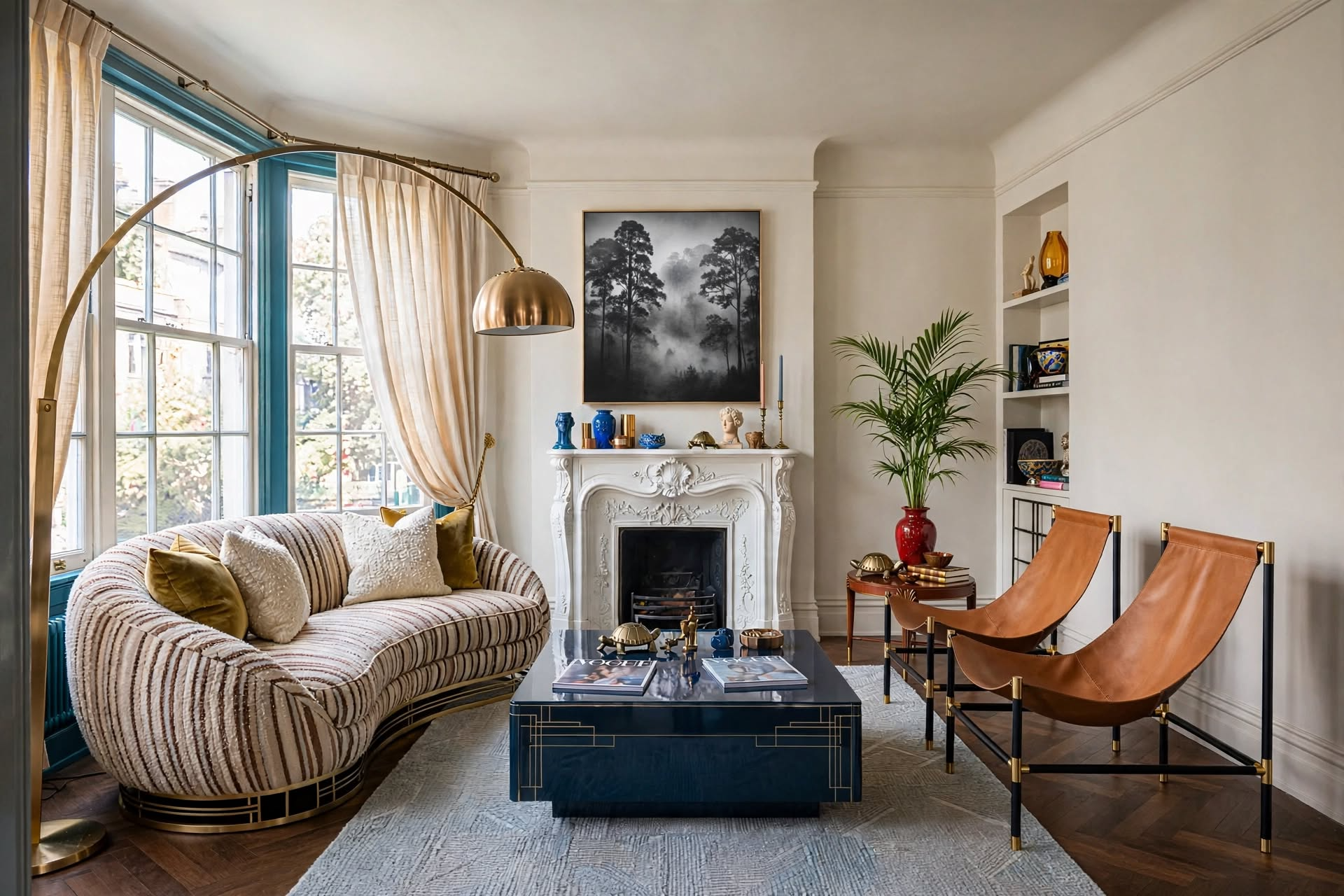
“Still rearranging the same room hoping it’ll click? It won’t — until you know this.”
The Designer’s SECRET Cheat Sheet121 designer-approved rules for every room in your home. The shortcut every well-styled home is built on.
How to Style a Bookcase: The Designer’s 3-Step Formula (That Works With Real Books)
By Juan S. · Last updated October 14, 2026
To style a bookcase, start with an empty, anchored unit and work in three passes. Set your books first, mixing vertical rows and horizontal stacks with the heaviest on the bottom. Add sculptural objects in varied heights and odd-numbered groups. Then edit until every shelf has breathing room, repeating colors and shapes diagonally so the whole bookcase reads as one piece.
If you have ever looked up how to style a bookcase, bought a cart full of cute decor, and still ended up with shelves that look like a yard sale, you are not alone. The problem is almost never the stuff. It is the order you put it in.

Designers do not style shelves one object at a time. They work in passes, building structure first, personality second, and editing last. Once you see the system, it works on a five-shelf flat-pack bookcase in a rental just as well as on custom built-ins.
This guide gives you that system, plus the parts other guides skip: what to do when your shelves are packed with books, how to style a small or narrow bookcase, how to light it without an electrician, and how to anchor it safely in an apartment. Grab a coffee, clear off your shelves, and let’s get to work.
In This Guide +
- The Spine–Shape–Space Method
- What to Do Before You Start
- How to Arrange Books So They Look Good
- Styling Shelves Full of Books
- Styling With Few or No Books
- What Decor Goes on a Bookcase
- How to Keep Bookshelves From Looking Cluttered
- Small or Narrow Bookcases
- Bookcase Ideas for Every Room
- Do You Need to Anchor a Bookcase?
- Renter-Friendly Bookcase Upgrades
- Which Type of Bookcase Is Easiest to Style?
- Bookcase Styling on a Budget
- Bookcase Styling Mistakes to Avoid
- Designer’s Cheat Sheet
- Shop the Look
- FAQ
How to Style a Bookcase: The Spine–Shape–Space Method

The Spine–Shape–Space Method is a three-pass system for styling any bookcase. Spine means placing books first to build structure. Shape means layering in objects that break up all those rectangles. Space means editing until each shelf can breathe. Doing the passes in this order is what keeps shelves from looking cluttered.
Spine
Books go in first. Vertical rows, horizontal stacks, heaviest and tallest on the bottom shelves. This is your skeleton.
Shape
Add rounded, tall, and sculptural pieces that contrast with book rectangles. Group in 1s, 3s, or 5s and vary the heights.
Space
Take out one or two items per shelf, step back 8 to 10 feet, and check that colors and shapes repeat diagonally.
Why does order matter so much? Books are the heaviest, most rigid things on the shelf, both visually and physically. When they go in last, you end up shoving them into whatever gaps the decor left behind. When they go in first, they set a rhythm that everything else can play against.
What Should You Do Before You Style a Bookcase?

Before styling, empty the bookcase completely, wipe it down, anchor it to the wall, and decide its job: mostly books, mostly display, or a mix of both. Then pick a tight palette of two or three tones pulled from the room. Prep takes about 20 minutes and prevents most styling mistakes.
Shop your house before you shop online. A kitchen bowl, a vintage tin, or a framed postcard often looks more personal than anything new. Shelves bought all at once tend to look like a store display.
How Do You Arrange Books on a Bookcase So It Looks Good?

Arrange books in a mix of vertical rows and horizontal stacks, put the heaviest and tallest books on the lower shelves, and pull every spine forward to the same line near the shelf edge. Group by color, size, or subject. Being consistent matters more than which system you pick.
Books jammed spine to spine at uneven depths, mixed dust jackets, every shelf filled edge to edge, and nothing for the eye to rest on.
The same books with spines aligned at the front, one horizontal stack per shelf topped with a small object, and the heaviest books moved to the bottom.
How to Style a Bookcase With a Lot of Books

When books fill most of the bookcase, style through structure instead of decor. Align spines, group by subject or color within each section, add one horizontal stack per shelf to break the line, and use bookends or a single object only where a natural gap appears. Treat side-by-side bookcases as one unit.
Most styling advice assumes you own about twelve books. If you own hundreds, the goal changes. You are not trying to make room for decor. You are trying to make a full wall of books feel calm instead of heavy.
A wall of books helps soften sound, which is a real bonus in apartments with thin walls or hard floors.
How Do You Style a Bookcase With Few or No Books?

With only a few books, let objects carry the shelves. Use larger pieces like tall vases, leaning art, baskets, or a lamp, stack the books you do have horizontally as risers, and leave more open space. A few bigger pieces look intentional, while lots of tiny items read as clutter.
- Go bigger on scale. One tall vase does more than five tiny figurines.
- Use books as risers. Two or three hardcovers lying flat lift a small object to a better height.
- Lean one piece of art every one or two shelves. It fills the back of the shelf and adds depth.
- Put baskets on the bottom shelf. They add weight where the bookcase needs it and hide storage.
- Thrift a few hardcovers. Remove the jackets for a soft, tonal stack that looks collected.
What Decor Goes on a Bookcase (and How Much Per Shelf)?

The best bookcase decor contrasts with the rectangle shape of books: round vases, bowls, sculptural objects, trailing plants, small framed art, and lidded boxes. Plan for one to three groupings per shelf, arranged in odd numbers with varied heights, so each shelf feels collected rather than crowded.
How Do You Keep Bookshelves From Looking Cluttered?

This is the Space pass, and it is the step most people skip. Clutter rarely comes from having too much stuff. It comes from too many things competing for attention. Every shelf needs one clear star, a supporting cast, and some empty space around them.
Start by squinting at the bookcase from across the room. Anything that looks like visual noise, usually the smallest items, goes first. Then look for balance: the open space between groupings should be about the same from shelf to shelf, so no single shelf looks crammed or empty.
Do
- Leave about a hand’s width of breathing room on each shelf
- Group small items on a tray so they read as one piece
- Repeat two or three colors across the bookcase
- Hide remotes, cords, and chargers in lidded boxes
Don’t
- Fill every inch of every shelf
- Scatter single small objects everywhere
- Add every color you own
- Leave everyday clutter sitting out in the open
Minimal, Cottage, or Collected?
Not sure what style your shelves should lean toward? Take the free Interior Design Style Quiz and find out in a few minutes.
Take the Style QuizHow to Style a Small or Narrow Bookcase

On a small or narrow bookcase, use fewer and slightly larger pieces, stick to one or two colors, and style vertically, with a tall item on one shelf and a low stack on the next. For a two-shelf bookcase or one with doors, treat the top surface like a console with a lamp, a stack of books, and one object.
- One grouping per shelf. Narrow shelves cannot hold two groupings without looking crowded.
- Alternate tall and low. Tall vase, then low stack, then tall again. The rhythm makes a skinny bookcase feel taller.
- Style the top like a mini console. On a low bookcase, a lamp, a short book stack, and one sculptural piece do the work.
- Match decor to your wall color. Pieces close to the wall color fade back and make the bookcase feel lighter.
- Use an open bookcase as a divider. In a studio, an open bookcase can work as a studio apartment room divider. Style both sides and keep the heaviest pieces low.
Bookcase Styling Ideas for Every Room
The Spine–Shape–Space Method stays the same everywhere, but the job of the bookcase changes from room to room. Here is how to adjust.

Living Room
The hardest-working bookcase in the house. It leans hybrid: part library, part display, and it should look like it belongs to the sofa and rug around it.
Shelves: Mostly books on the lower half, display pieces at eye level and above
Accessories: Leaning art, one sculptural object, a tall vase, and a low basket for throws

Bedroom
Calm, soft, and quiet. A bedroom bookcase should help the room wind down, so fewer objects and a softer palette win every time.
Shelves: Bedside reads at arm’s reach, everything else tonal and tidy
Accessories: Woven baskets, faux greenery, a framed photo, and a dimmable rechargeable lamp

Home Office
Polished on camera, practical off camera. Style the shelves that show up on video calls first and turn the rest into hidden storage.
Shelves: Reference books low, a short curated row at camera height
Accessories: Lidded boxes for paperwork, bookends, one plant, and a single statement object

Kitchen or Dining
Beautiful and useful at the same time. Every piece on display should also be something you actually reach for when you cook or host.
Shelves: Cookbooks in short rows and flat stacks
Accessories: Serving bowls, wooden boards, a cake stand, and a ceramic pitcher

Flanking a TV or Fireplace
Balanced, not matching. Treat the two bookcases as one mirror image so the focal point in the middle stays the star.
Shelves: Match visual weight and open space side to side, not exact titles
Accessories: Similar (not identical) vases, paired bookends, and art at the same height on both sides
Do You Need to Anchor a Bookcase? (Yes, Even in a Rental)
Yes. The U.S. Consumer Product Safety Commission urges people to anchor bookcases and dressers to the wall to prevent tip-overs. In a rental, use the anchor kit that came with your bookcase or a metal anti-tip kit, screw into a stud, and check your lease first. Small screw holes can usually be patched when you move out.
This is not a small risk. In the CPSC’s report on tip-over injuries, shelving units and bookcases were involved in roughly 16 percent of the furniture tip-over injuries analyzed, according to Kids In Danger’s summary of the CPSC report. The agency’s Anchor It! campaign lists anchoring bookcases as a basic safety step, and a loaded bookcase is far harder to secure than an empty one.
Renter-Friendly Ways to Upgrade a Basic Bookcase

You can make a basic flat-pack bookcase look custom without paint or permanent changes. Line the back panel with peel-and-stick wallpaper, add rechargeable lights, lean art in front of the frame, and style it with fewer, larger pieces. Everything comes off cleanly at move-out.
- Line the back panel. Peel-and-stick wallpaper or fabric-wrapped foam board adds pattern behind your objects and hides a cheap-looking back.
- Add cordless light. Rechargeable lamps or battery puck lights tucked under shelves give a built-in glow with no wiring and no outlet needed.
- Lean art against the frame. A larger print leaning on the front of a lower shelf breaks up the boxy grid.
- Hide the bottom shelf. Matching baskets turn the least attractive shelf into tidy storage.
- Think beyond the bookcase. Pair your shelves with renter-friendly wall decor that will not cost you your deposit.
Test any peel-and-stick product on the back of the bookcase or a hidden corner first. Some adhesives grab harder on raw particleboard than on painted surfaces.
Which Type of Bookcase Is Easiest to Style?
Not all bookcases style the same way. Use this quick comparison to match your approach to the piece you actually have.
| Bookcase Type | Best For | Difficulty | Styling Tip |
|---|---|---|---|
| Standard 5-shelf freestanding | Most rooms, renters | Easy | Run the Spine pass first and add one horizontal stack per shelf |
| Ladder or leaning bookcase | Small spaces | Easy | Keep pieces light and airy; heaviest items on the wide bottom shelf |
| Cube organizer | Kids’ rooms, storage | Medium | Alternate open cubes with fabric bins in a checkerboard pattern |
| Built-ins | Homeowners, large walls | Hard | Treat the wall as one grid and repeat colors diagonally |
| Floating shelves | Tiny spaces | Medium | Use fewer items and stay within the shelf’s weight limit |
How to Style a Bookcase on a Budget
To style a bookcase on a budget, shop your home first, thrift hardcover books and ceramics, and spend only on pieces that do the most work: bookends, one or two larger vases, and baskets. Skip tiny trinkets. Build the shelves over time instead of buying everything at once.
Anchor kit
Safety comes first and costs the least.
Bookends
They hold your Spine pass together and count as decor.
One tall vase and one bowl
Two larger pieces beat ten small ones.
Baskets or lidded boxes
Hide clutter and add texture.
Lighting
A rechargeable lamp changes how the bookcase looks at night.
Art
Start with prints, postcards, or a photo you love in a simple frame.
What to skip: matching decor sets bought all at once, piles of filler books in random colors, and bags of tiny figurines. If you want decorative books, one curated stack in your palette goes much further than a whole shelf of them.
Thrift stores and Facebook Marketplace are great for vintage hardcovers, brass objects, and ceramic vases at a fraction of retail prices.
Bookcase Styling Mistakes (What NOT to Do)
- Styling before anchoring. Anchor the empty bookcase first. It is much easier and safer.
- Filling every inch. Leave small pause points on every shelf so the eye has somewhere to rest.
- Using too many tiny objects. Go bigger, and group small pieces on a tray.
- Keeping everything the same height. Place the tallest piece on each shelf first, then build down.
- Pushing books to uneven depths. Pull every spine forward to the same line.
- Putting heavy items up top. Heaviest books and baskets always go on the lowest shelves.
- Styling each shelf on its own. Step back and style the whole bookcase as one grid.
- Ignoring the room’s colors. Pull two or three colors from the room so the bookcase belongs there.
The Designer’s Cheat Sheet
Screenshot this. It is everything you need to know about how to style a bookcase on one screen.
- ◆Spine: books first
- ◆Shape: objects second
- ◆Space: edit last
- ◆Use 1, 3, or 5 pieces
- ◆Vary heights in each group
- ◆Tallest piece placed first
- ◆1 to 3 groupings
- ◆One clear star
- ◆A hand’s width of space
- ◆Heaviest on the bottom
- ◆Spines aligned at the front
- ◆One flat stack per shelf
- ◆2 to 3 tones from the room
- ◆Repeat diagonally
- ◆One accent color max
- ◆Anchor before you style
- ◆Metal hardware, into a stud
- ◆Check your lease
Shop the Look: Bookcase Styling Essentials
You do not need all of these, and you should always start by shopping your own home. These are the pieces that do the most work in each pass of the method, with one Wayfair and one Amazon option in each category.


Frequently Asked Questions
Use three passes in order. First place your books, mixing vertical rows and horizontal stacks with the heaviest on the bottom. Then add contrasting objects like vases and sculptures in odd-numbered groups. Finally, remove one or two items per shelf and step back to check that colors and shapes repeat across the bookcase.
Plan for one to three groupings per shelf, with one to five pieces in each grouping. Vary the heights inside every group and leave some open space between groupings. If a shelf feels busy, take out the smallest item first, since tiny pieces create the most visual clutter.
Only if you like the look and can still find what you need. Sorting by color, by tone, by height, or by subject all work. What matters is choosing one system and sticking with it, then pulling every spine forward to the same line so the rows look neat.
Use fewer, larger pieces instead of many small ones, hide everyday items in lidded boxes or baskets, and leave a little negative space on every shelf. Group small objects on a tray so they read as one piece, and limit your palette to two or three colors pulled from the room.
Yes. The U.S. Consumer Product Safety Commission recommends anchoring bookcases to the wall to prevent tip-overs. Use the kit that came with your bookcase or a metal anti-tip kit, screw into a stud, and check your lease. Small screw holes can usually be patched with spackle when you move.
Good options include ceramic vases, bowls, sculptural objects or a bust, small framed art leaning against the back, faux or real plants, lidded boxes, baskets, and a small rechargeable lamp. Pick pieces with rounded or organic shapes so they contrast with the straight lines of your books.
- 01Interior Design Style Quiz
- 02Timeless Paint Colors That Never Go Out of Style
- 03Create Your Perfect Ergonomic Home Office: A Complete Guide
- 04Must-Have Accessories for Guys: The Secret to a Stylish Space
- 05Modular Sofas for Small Spaces: Brilliant Solutions for Compact Living
- 06Bathroom Peel and Stick Wallpaper Ideas: 7 Designer Tricks That Look High-End
Your Bookcase, Finally Finished
Learning how to style a bookcase is not about buying more decor. It is about putting things down in the right order. Books first for structure, objects second for personality, and an honest edit at the end. That is the whole Spine–Shape–Space Method.
Here is your easy first win for tonight: do only the Spine pass. Pull every spine forward to the same line and add one horizontal stack per shelf. You will be surprised how finished your shelves look before you add a single new object.
Ready to try it? Clear one shelf tonight and start with the Spine pass.
Review the 3-Step Method
Juan S. has 20+ years working in the interior design industry, specializing in small space living.
CATCH THE LATEST IN HOME DECOR TRENDS:

Accessorize a Small Living Room: 7 Genius Styling Secrets

How to Make a Small Room Appear Bigger

How to Make Your Home Look Expensive
GET CAUGHT UP ON ALL THE INSPIRING DECOR TIPS:

Best Fireplace Makeover Ideas

How to Make a Gallery Wall: The Complete Step-by-Step Guide (Even If You’ve Never Hung a Picture)