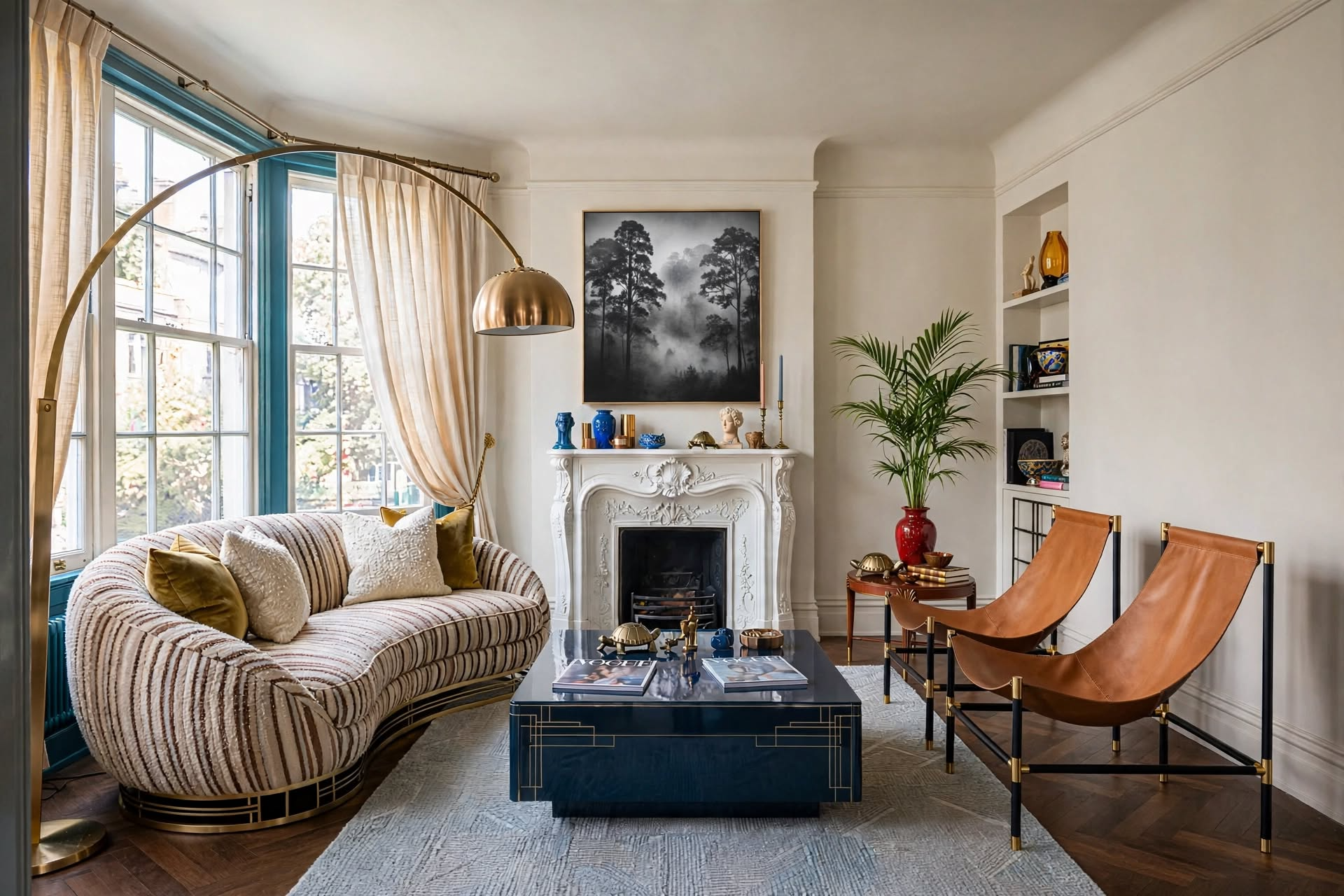
How to Arrange Furniture in a Small Living Room:
The Step-by-Step Designer Blueprint
To arrange furniture in a small living room, start by measuring your space and defining a clear focal point, then choose right-sized pieces and use a large area rug to anchor the layout. Pull furniture away from walls, layer lighting, and follow the 2/3 rule and 57-inch eye-level guideline. Every inch should serve a purpose — and with the right plan, small can feel genuinely luxurious.
Why Arranging Furniture in a Small Living Room Is Harder Than It Looks
Let’s be real: to arrange furniture in a small living room is one of the most frustrating things in home decor. You’ve scrolled Pinterest for hours, measured three times, dragged the sofa across the floor twice — and it still looks off. The room feels cramped, the flow is awkward, and nothing looks like those beautifully staged photos.
You’re not bad at decorating. You’re just missing a designer’s systematic approach — and that’s exactly what this guide delivers.

Whether you’re dealing with an awkward L-shaped room, limited natural light, rental restrictions, or just decision paralysis, this blueprint walks you through every step — with the same logic a professional designer uses. No generic advice, no “$5,000 renovation required.” Just practical, visual, and surprisingly satisfying solutions.
- Step 1: Measure First, Buy Never
- Step 2: Define Your Focal Point
- Step 3: Choose the Right Furniture
- Step 4: Anchor with an Area Rug
- Step 5: Layer Your Lighting
- The Designer’s Cheat Sheet & Rules
- The 5 Biggest Mistakes (and Fixes)
- Best Layouts for Every Shape
- The Vibe Check: Match Your Personality
- Shop the Look
- Upcoming Trends for Small Spaces
- FAQ
Step 1: Measure First, Buy Never (The Rule Designers Live By)

Before you touch a single piece of furniture, measuring your small living room is non-negotiable. According to interior designers, the #1 reason a small room still feels wrong after a redo is that furniture was purchased without accurate spatial planning.
Here’s the truth most blogs skip: measuring isn’t just about fitting pieces in. It’s about understanding your room’s flow paths, proportional zones, and architectural anchors (windows, doors, outlets, radiators).
How to Measure Your Room Like a Designer
- Room footprint: Measure length × width and note every doorway, window, and heating vent location — these are hard constraints.
- Ceiling height: Low ceilings under 8 ft call for lower-profile furniture to avoid a bunker feel.
- Traffic lanes: Mark 30–36 inch clearance paths on your floor plan. These are mandatory walkways — nothing can block them.
- Electrical and lighting points: Outlets dictate where lamps go, which influences furniture placement more than most people expect.
Tape out furniture shapes on your floor with painter’s tape before buying anything. It takes 20 minutes and saves hundreds of dollars in return shipping fees. This is the single most underused trick in small space decorating.
Tools you’ll need: A tape measure, graph paper (or a free app like Magicplan or RoomSketcher), and a pencil. Sketch your room to scale at 1/4 inch = 1 foot. Then sketch potential furniture shapes within it before buying or moving anything.
Step 2: Define Your Focal Point (Everything Orbits This)

Every well-designed living room — regardless of size — has a clear focal point. This is the visual anchor your furniture arrangement should respond to. In a small living room, your focal point eliminates decision paralysis by telling you exactly where to start placing things.
Common focal points include: a fireplace, a TV wall, a large window with a view, or a statement art piece. If your room doesn’t have an obvious one — create one. A bold gallery wall, a large mirror, or a standout sofa in a rich fabric can all serve as a designed focal point.
Designer Strategy: Arranging Around Your Focal Point
- Position your sofa directly facing (or at a slight angle to) the focal point — this is the primary conversational and visual axis.
- If the focal point is a TV, eye-level viewing height should place the screen center at approximately 42–48 inches from the floor — not mounted high on the wall.
- For rooms with two competing focal points (e.g., a fireplace AND a TV), choose one and subordinate the other by reducing its visual weight with a smaller frame or lighter color.
Step 3: Choose the Right Furniture for a Small Living Room

In a small living room, furniture selection directly determines how spacious — or suffocated — the space feels. The goal isn’t to buy the smallest possible furniture. It’s to buy appropriately scaled pieces that serve multiple functions and maintain visual breathing room.
Designer Strategy: Scale & Placement
Design psychologist Dr. Sally Augustin notes that visual clutter is the leading contributor to perceived spatial constraint. Translation: a few well-chosen, properly scaled pieces will always make a room feel bigger than stuffing it with small things.
- Sofa scale: In rooms under 180 sq ft, stick to sofas under 84 inches in length. Modular or L-shaped sectionals with tight arms work beautifully against corner walls.
- Leg height matters: Furniture with visible legs allows light to pass underneath, creating the perception of more floor space. A sofa with legs is always a smarter choice than a platform sofa in a small room.
- Multi-function first: A storage ottoman replaces both a coffee table AND extra seating. A console table doubles as a desk. A sofa bed saves an entire guest room. Prioritize these mergers ruthlessly.


| Furniture Type | Small Room Friendly? | Best Feature | Avoid If… |
|---|---|---|---|
| Modular Sectional | ✓ YES | Corner-hugging, configurable | Room is under 120 sq ft |
| Loveseat (under 60″) | ✓ YES | Leaves circulation space | You need to seat 4+ people |
| Oversized Sectional | ✗ NO | Comfortable lounging | Always in a small room |
| Storage Ottoman | ✓ YES | Replaces table + adds storage | You prefer a solid coffee table |
| Barrel/Swivel Chair | ✓ YES | Small footprint, big personality | You have very narrow traffic lanes |
| Armchair with Arms | ✓ YES | Classic, airy with exposed legs | Room already has bulky sofa |
| Chaise Sectional | ✗ NO | Comfortable for one person | Unless it replaces the sofa entirely |

Step 4: Anchor with an Area Rug (The Most Underrated Layout Tool)

A rug is not decoration. In a small living room, it is architecture. The right rug tells every piece of furniture where to belong. The wrong one — or none at all — makes even good furniture look like it’s floating in limbo.
The 2/3 Rule and Rug Sizing Explained
- The rule: Your rug should be at least 2/3 the length of your sofa, with the front legs of every seating piece resting on it. This visually connects the conversation zone.
- Minimum size for a small living room: In rooms under 12×14 ft, don’t go below a 5×8 ft rug. Many designers recommend 8×10 even in small rooms — a larger rug creates the illusion of more space, not less.
- Pattern and color strategy: Low-contrast geometric patterns in warm neutrals (warm grays, terracottas, soft coppers) add depth without visual clutter. A solid rug in a bold color can serve as the room’s focal anchor if your furniture is neutral.

Step 5: Layer Lighting to Expand Your Space Visually

Lighting is the invisible furniture arrangement tool. In a small living room, flat overhead lighting flattens depth and makes the room feel like a box. Layered lighting — ambient, task, and accent — creates zones, adds warmth, and psychologically expands the space.
Designer Strategy: The Three-Layer Lighting System
- Ambient (overhead): Recessed lights, a flush mount, or a semi-flush with a warm bulb (2700K). This is your base layer — it should never be the only layer.
- Task & accent (floor + table lamps): Position a floor lamp behind and beside the sofa to create a warm pool of light in the conversation zone. A table lamp on a console or side table adds another visual depth cue.
- The 57-inch rule applied to lighting: The center of a wall sconce or the shade of a table lamp should sit near eye level when seated — approximately 57 to 60 inches from the floor — to create human-scaled warmth instead of clinical brightness.


The Designer’s Cheat Sheet: Rules That Actually Work
These aren’t arbitrary guidelines — each one comes from spatial psychology research and decades of professional design practice. Memorize these four and you’ll never arrange furniture in a small living room the wrong way again.
The 5 Biggest Mistakes When You Arrange Furniture in a Small Living Room (And How to Fix Them)

These are pulled directly from the most common complaints on Reddit’s r/HomeDecorating, TikTok comment sections, and design forums. If your room looks “off” despite your best efforts, one of these is likely the culprit.
Sofa pushed flat against wall, creating awkward dead space in the center
5×7 rug barely touching sofa legs, floating in isolation
Single overhead bulb washing the room in flat, cold light
TV mounted near the ceiling, forcing everyone to look up
Mismatched pieces of varying styles with no visual cohesion
Sofa floated 4″ from wall, angled chair creates intimate conversation zone
8×10 rug with all front legs anchored, unifying the seating arrangement
Arched floor lamp + table lamp layered for warm, depth-creating ambient glow
TV center at 44″ from floor — comfortable from seated position
Cohesive warm neutral palette with one statement texture piece (boucle chair)
Best Furniture Layout for Every Small Living Room Shape
Not all small living rooms are created equal. A 10×12 rectangular room has completely different spatial logic than a narrow galley-style room or an awkward L-shaped space. Here’s how to approach the most common configurations when you arrange furniture in a small living room.
The Rectangular Room (Most Common)

This is the bread-and-butter small living room. The key mistake here is treating width and length the same — they’re not. Place your sofa parallel to the longest wall, with a round coffee table centered in front. Position your accent chair at a 45° angle at one end. This creates a diagonal visual line that tricks the eye into reading the room as larger and more dynamic than a fully perpendicular layout.
The Square Room

Square rooms trap people into symmetrical layouts that feel static and rigid. Instead, create intentional asymmetry: position the sofa off-center, use a console table along one wall, and let one corner breathe completely empty. An empty corner with a single floor lamp and plant is more sophisticated than a crammed-in bookshelf.
The Awkward or Oddly-Shaped Room

Angles, alcoves, bay windows, and columns are assets — not obstacles. A bay window becomes a built-in reading nook with a small bench and cushion. An alcove takes a console table and two table lamps beautifully. Columns anchor seating on either side. If your room has architectural quirks, design toward them rather than around them.
The Renter’s Constraint: No Holes, No Paint

Renters can’t anchor things to walls or paint — but they can still arrange furniture in a small living room like a pro. Use Command strips for lightweight art. Use freestanding shelving instead of wall-mounted units. Use removable peel-and-stick wallpaper for a textural accent wall. These are fully reversible and surprisingly high-impact.


The Vibe Check: Match Your Layout to Your Personality

To arrange furniture in a small living room isn’t just a spatial problem — it’s a self-expression problem. Two people can have the same room dimensions and completely different needs. Knowing your design personality type helps you make faster, more confident decisions.
If you’re paralyzed by indecision, take the Interior Design Style Quiz at The Decorholic. In 2 minutes it tells you your dominant design personality — which eliminates 80% of the “but what if I want both?” dilemma most people get stuck in.
Shop the Look: Complete Small Living Room Furniture Edit
Every piece below was chosen for a specific small-room function: space efficiency, multi-functionality, and high design value at accessible prices. This is the complete toolkit for arranging furniture in a small living room that looks intentional, elevated, and genuinely livable.
Upcoming Small Living Room Trends (2026 Edition)

The best time to arrange furniture in a small living room is also the best time to understand where design culture is headed — so your choices stay relevant and feel intentional rather than dated six months after you finish.
Identity Decor
This is the trend of designing for who you actually are rather than what looks good on Instagram. It means mixing the vintage chair from your grandmother with the brand-new boucle ottoman. It means displaying your book collection on open shelves instead of hiding it. In small living rooms, Identity Decor also means editing ruthlessly — keep only what’s personally meaningful.
Organic Modern
Curved silhouettes, natural materials (travertine, cane, rattan, wool), and earthy color palettes continue to dominate small space design. The rounded coffee table, the barrel chair, and the organic wool rug aren’t trends — they’re becoming timeless small-space standards because they’re inherently soft and approachable in constrained footprints.
Tactile Layers
Boucle, bouclé, ribbed velvet, textured linen, and handwoven rugs are replacing the flat, matte surfaces of minimalist 2020-era design. In a small living room, texture does the work that pattern often can’t — it adds richness without visual busyness, making the room feel curated and intentional without feeling cluttered.
Small Room. Big Impact. You’ve Got This.
How to arrange furniture in a small living room is not about compromise — it’s about intelligent, intentional design. You now have the same step-by-step framework professional designers use: measure first, anchor with a focal point, scale your furniture correctly, anchor with the right rug, and layer lighting for depth.
The “my room still looks off” era is officially over. Pick your starting point — even if it’s just taping out furniture shapes on your floor — and take the first step today. Small spaces done right are some of the most memorable, cozy, and personality-filled rooms in existence.
Find Your Design Style Now →How to Arrange Furniture in a Small Living Room- Frequently Asked Questions
CATCH THE LATEST IN HOME DECOR TRENDS:

Steal These 16 Expert-Approved Decorating Secrets

Accessorize a Small Living Room: 7 Genius Styling Secrets

How to Make a Small Room Appear Bigger

How to Make Your Home Look Expensive
GET CAUGHT UP ON ALL THE INSPIRING DECOR TIPS:

Best Fireplace Makeover Ideas

How to Make a Gallery Wall: The Complete Step-by-Step Guide (Even If You’ve Never Hung a Picture)