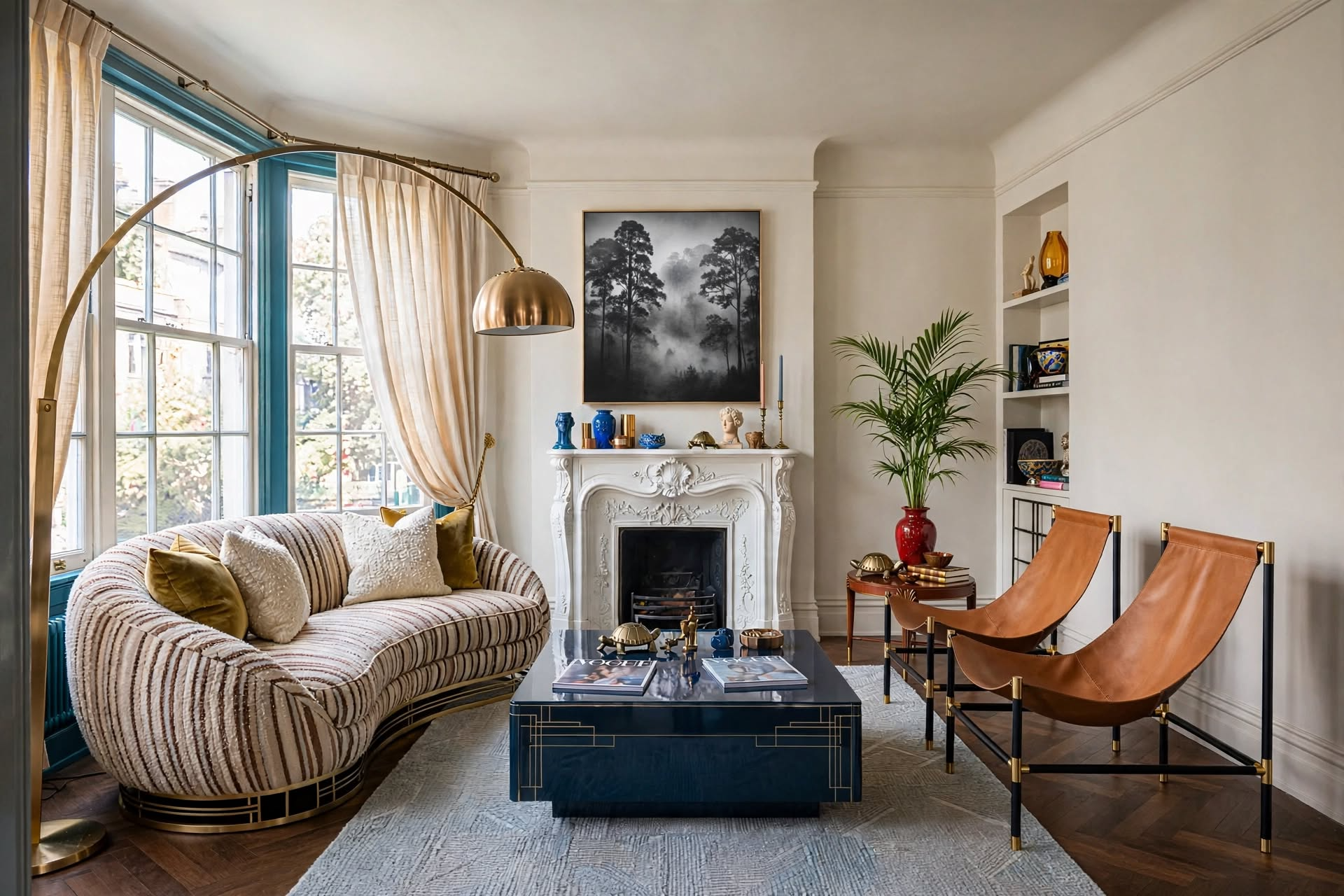
Here’s how to layer a room: add five layers in order, starting with a rug, then the main furniture, soft textiles, lighting, and finishing touches like art and plants. Then check for four textures (rough, smooth, soft, shiny) and three heights (low, middle, high). When all three checks pass, stop adding.
A room can have a good sofa, a nice rug and fresh paint and still feel flat. Usually nothing is wrong with the pieces. The room is just missing a layer or two, so it looks furnished but not finished. Learning how to layer a room fixes that, and it’s more of a checklist than a talent.
Free Ebook
The Small Space Playbook
Layouts, sizing rules and styling formulas for small rooms and apartments, all in one free guide.
This guide shows you how to layer a room step by step: the order to work in, the sizes and heights to aim for, and a simple way to tell when you’re done. It works in a rental, a small apartment or a big living room, and you can start with what you already own.
What’s in This Guide
- Rug · Best pattern anchorThree Posts Hartley Oriental Rug — Wayfair
- Rug · Best washableKeen Home Design Washable Rug — Amazon
- Pillows · Best neutral basedecorUhome Textured Pillow Covers — Amazon
- Throw · Best chunky textureMistana Smith Knitted Throw — Wayfair
- Lamp · Best for a side tableEbern Designs Ceramic Table Lamp — Wayfair
- Art · Best calm neutralidea4wall Abstract Framed Canvas — Wayfair
What Does It Mean to Layer a Room?

Layering a room means building it in stages, from the floor up, so that every surface and every height has something on it that belongs there. In interior design, the layers are the rug, the furniture, the textiles, the lighting and the finishing pieces. Each one sits on top of the one before it, the way a jacket goes over a shirt.
Layering in interior design is not the same as adding more things. A layered room can be very simple. What makes it feel finished is variety: different textures, different heights and more than one source of light. A room with ten items that all sit at one height in one material still looks flat. That’s the difference between layered interior design and a room that’s simply full.
| Layered | Cluttered |
|---|---|
| Each piece has a job | Pieces were added to fill gaps |
| Colors and materials repeat | Every item is a new color or finish |
| Some surfaces are left clear | Every surface is full |
| Things sit at three heights | Everything is at one height |
The 5-4-3 Layering Method
Most advice on how to layer a room tells you what to add. The harder questions are what order to add it in and when to stop. The 5-4-3 Layering Method answers both with three numbers you can check from the doorway.
Layers
Ground, Anchor, Soften, Light, Finish. Add them in that order, biggest pieces first.
Textures
Something rough, something smooth, something soft and something shiny in every room.
Heights
Something low, something at the middle and something high, so the eye moves up the room.
Why the order matters: the big layers decide the size and color of the small ones. If you buy pillows and art first, you end up choosing a rug and sofa to match a $20 pillow. Work from the floor up and each choice gets easier, because the layer below has already narrowed it down.
Before you buy anything, take one photo of the room from the doorway. Count which of the five layers are already there. Most rooms that feel flat have layers one and two and very little of three, four and five.
How to Layer a Room in 5 Steps
Here is how to layer a room in the order a designer works, with the one measurement that matters most at each step.
Step 1 · Ground: Start With the Rug

The rug is the first layer because it marks out where the room happens. It pulls separate pieces of furniture into one group and adds the first texture to a hard floor.
- Size: big enough that at least the front legs of every seat sit on it. A rug that only fits under the coffee table makes the whole room look smaller.
- Pattern: choose a patterned rug if your sofa is solid, and a quiet rug if your sofa or curtains are patterned.
- Renting with carpet? You can still lay a rug over wall-to-wall carpet. Pick a flat weave so it sits smoothly.
For sizes by room, see my guide to choosing and arranging an area rug. If you like the rug-on-rug look, how to layer a rug covers that on its own.

Three Posts Hartley Oriental Indoor Rug
If your seating looks like furniture floating on a bare floor, a patterned rug ties the pieces into one group. An oriental-style pattern also hides everyday wear better than a solid.
Why it’s a must: pattern on the floor means your pillows and art can stay simple, which keeps the upper layers from getting busy.
Skip it if your sofa or curtains already carry a large pattern; choose a solid or low-contrast rug instead.
Check Current Price on Wayfair →
Keen Home Design Washable Non-Slip Rug
If kids, pets or a rental floor make you nervous about a big rug, a washable one with a non-slip back lets you size up without worrying about upkeep.
Why it’s a must: the most common rug mistake is buying too small, and a washable rug makes the bigger size an easy yes.
Skip it if you want a thick, plush pile; washable rugs are thinner by design.
Check Current Price on Amazon →Step 2 · Anchor: Place the Big Furniture

The anchor layer is your largest furniture: the sofa, the bed, the dining table. It goes in second because it has to fit the rug and the walkways, and everything smaller will be sized to it.
- Pull seating off the walls. Even a few inches of space behind a sofa adds depth, and depth is what layering is for.
- Keep walkways 30 to 36 in. wide so the room is easy to move through.
- Leave 14 to 18 in. between the sofa and the coffee table: close enough to reach, far enough to walk past.
- Add the middle pieces. A side table, an ottoman or a bench bridges the gap between big furniture and small decor.
Layout is a full topic of its own. My guide on how to style a living room walks through furniture placement in detail.
Step 3 · Soften: Add Curtains, Pillows and Throws

Textiles are the layer that turns a furnished room into a comfortable one. They also carry most of a room’s color and pattern, so this is where the room starts to look like yours.
- Curtains: hang the rod high and wide, so the fabric frames the window instead of covering it, and let the panels reach the floor.
- Pillows: mix sizes and textures before you mix colors. Two or three fabrics in one color family already look layered.
- Throws: one over a sofa arm or the end of a bed is enough.
- Color: keep it to three. One main color, one supporting color and one accent, repeated at least twice each.
Each of these has its own guide: how to arrange pillows on a couch, how to mix fabric patterns, and the 60-30-10 rule for splitting up your three colors.

AllModern Fulbourn Abstract Pillow
If every pillow on your sofa is a solid, one abstract pattern in cream, burnt orange and charcoal adds the pattern the soft layer is missing.
Why it’s a must: it gives you one warm accent color to repeat in a throw, a vase or a piece of art.
Skip it if your palette is cool-toned; burnt orange will fight blues and grays.
Check Current Price on Wayfair →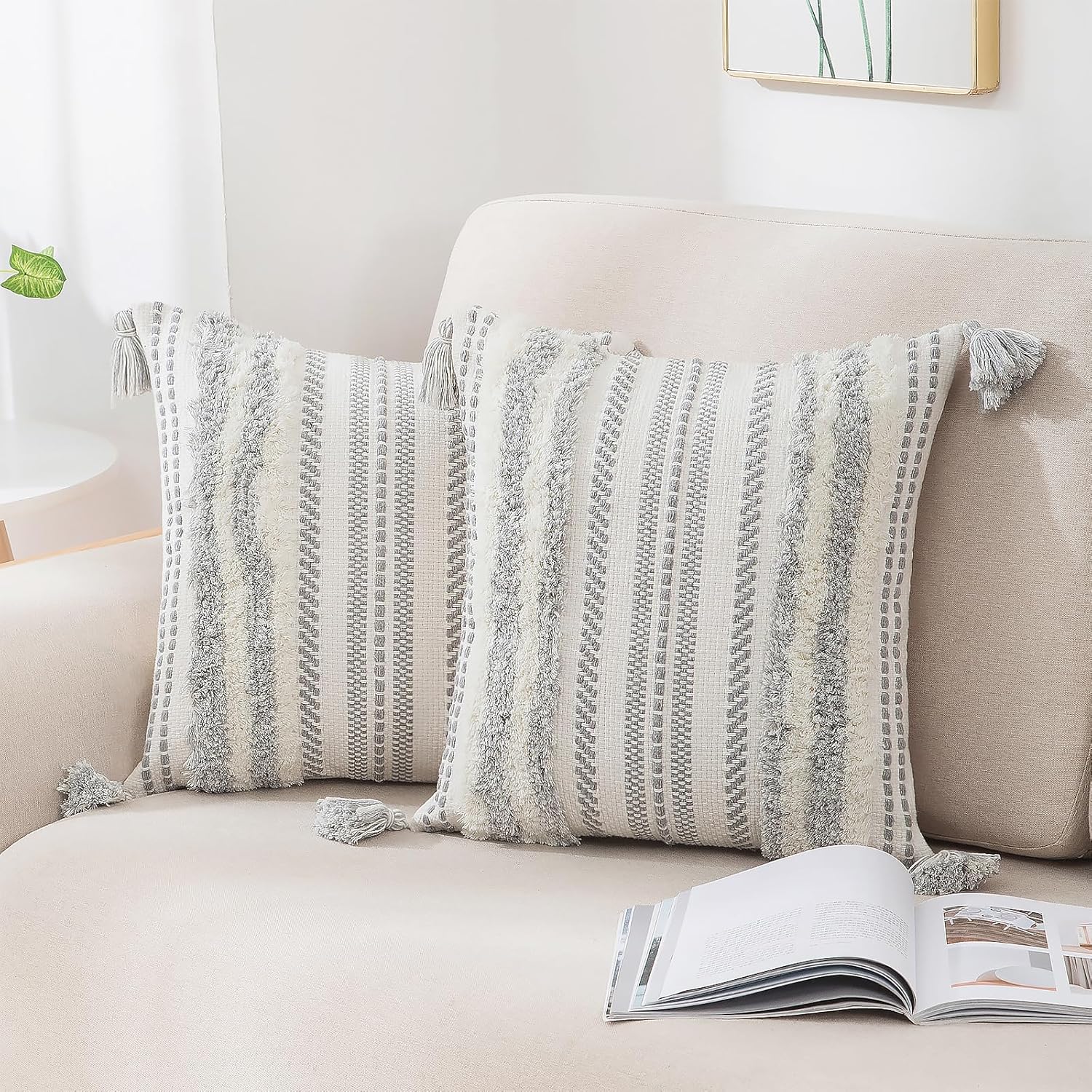
decorUhome Neutral Textured Pillow Covers
If you’re starting from zero, neutral textured covers build the soft layer first, and any accent color you add later will work with them.
Why it’s a must: texture does the work of pattern here, which is the safest way to layer a small room.
Skip it if you want a strong statement; these are meant to blend in. They’re covers, so plan on inserts.
Check Current Price on Amazon →
Mistana Smith Knitted Throw Blanket
If your sofa looks flat even with pillows, a chunky knit draped over one arm adds the touchable texture that makes a room feel lived in.
Why it’s a must: a knit throw is the fastest way to tick “soft” on the 4-texture check.
Skip it if you have pets that pull at loops; choose a tighter weave.
Check Current Price on Wayfair →
Temminc Lightweight All-Season Throw
If you want softness without bulk, a lightweight throw folds neatly over an arm and stays out in every season.
Why it’s a must: it’s an easy way to repeat one of your pillow colors a second time in the room.
Skip it if you want a heavy, chunky texture.
Check Current Price on Amazon →Step 4 · Light: Put Light at Three Heights

A room lit only from the ceiling looks flat, because all the light comes from one direction. Aim for at least three light sources at different heights: one overhead, one at table height and one floor lamp or wall light. Use warm bulbs, around 2700K to 3000K, and keep every bulb in the room the same color.
That’s the short version. My guide on how to light a room properly covers bulbs, placement and renter options in full.

Ebern Designs Ceramic Table Lamp
If your room goes flat at night, a ceramic lamp with a linen drum shade puts warm light at table height. The ceramic base adds texture in daylight too.
Why it’s a must: it fills the middle height, which is the one most rooms are missing.
Skip it if there’s no outlet near the table; look for a cordless lamp instead.
Check Current Price on Wayfair →
LEPOWER Tripod Floor Lamp
If you have a dark corner or no overhead light, a fabric-shade tripod lamp spreads soft light up and out, which makes it an easy fix for renters.
Why it’s a must: it adds height as well as light, so it helps the 3-height check too.
Skip it if your corner is very tight; tripod legs spread wider than a single-pole lamp, so measure first.
Check Current Price on Amazon →Step 5 · Finish: Art, Plants and Personal Pieces

The last layer is the smallest and the most personal. It’s also the one people start with, which is why it so often goes wrong. Added last, it has a rug, furniture, fabric and light to respond to.
- Art: hang it so the center sits about 57 in. from the floor. Over a sofa, the art or group should span about two-thirds of the sofa’s width.
- Surfaces: group objects in threes at different heights, and use a tray to turn small things into one piece.
- Plants: add at least one. Nothing else brings the same shape and life into a room.
- Personal pieces: books you’ve read, a framed photo, something from a trip. These are what stop a room from looking like a showroom.
Go deeper with how to choose living room wall art, the rule of three and my plant styling guide.

idea4wall Abstract Paint Stroke Framed Canvas
If your wall is bare and your room already has color, a tan and gray abstract finishes the wall without adding another color to manage.
Why it’s a must: one larger piece looks calmer than many small ones, and it fills the high level of the room.
Skip it if your room is all neutral already; you’ll want art with more color.
Check Current Price on Wayfair →
SIGNWIN Geometric Wall Art, Set of 3
If you want a gallery look without planning one, a set of three graphic prints hangs as a single unit over a sofa or console.
Why it’s a must: hung 2 to 3 in. apart, three frames cover the two-thirds width that one small print can’t.
Skip it if you prefer traditional or vintage art; this set is graphic and modern.
Check Current Price on Amazon →
The 5 Layers in a Real Room
Here is how to layer a room in practice: the same living room, from a Decorholic client project in Chicago, at layer one and at layer five. In the first photo the room has a rug and curtains and nothing else. In the second, every layer is in.


- Ground: the same gray rug, now holding the seating group.
- Anchor: a blue sofa, two leather sling chairs, a coffee table and a media console.
- Soften: the curtains, pillows on the sofa and a shaggy ottoman.
- Light: a floor lamp by the window and a small lamp on the console, added to the daylight.
- Finish: a gallery wall above the sofa and a few objects on the tables.
Run the 5-4-3 check on the second photo and it passes. There’s rough (the ottoman), smooth (the leather), soft (the sofa and pillows) and shiny (the brass lamp), and there’s something at the floor, at seat height and on the wall.
The 4-Texture Check

Texture is what makes a room in one color still look rich. Once your five layers are in, look for one of each of these. If one is missing, that’s your next purchase, and it can be small.
Rough
Jute, rattan, raw wood, linen, a woven basket, a chunky knit.
Smooth
Leather, painted wood, stone, glazed ceramic.
Soft
Velvet, boucle, wool, sheepskin, a thick rug.
Shiny
Glass, a mirror, brass, chrome, a lacquered tray.
The room above is almost all cream and tan, and it still looks layered: boucle for soft, stone for smooth, wood and woven fiber for rough. For more combinations, see my guide to mixing textures at home.

The 3-Height Check and When to Stop

When everything in a room sits at sofa height, the top half of the room is empty and the eye has nowhere to go. A layered room has something at each of three levels.
| Level | Where | What goes there |
|---|---|---|
| Low | Floor to knee | Rug, ottoman, floor basket, low coffee table |
| Middle | Seat to eye level | Sofa, pillows, table lamps, objects on tables |
| High | Eye level and up | Art, mirrors, curtains, floor lamps, tall plants, shelves |
When to Stop Layering

The last part of how to layer a room is knowing when you’re done. Stop when all three checks pass: five layers, four textures, three heights. After that, more pieces make the room busier, not better. Three quick tests help:
- The photo test: take a picture from the doorway. A photo shows crowding that you’ve stopped noticing in person.
- The clear-surface test: leave at least one surface in the room mostly empty, so the eye has a place to rest.
- The take-one-away test: remove one object from each styled surface. If you don’t miss it by the next day, it wasn’t needed.
Layering Room by Room
How to layer a room depends a little on the room. The five layers stay the same everywhere; what changes is which one does the most work.

Living Room
The living room uses all five layers at full strength. Spend the most on the rug and the lighting, since they set the mood for everything else.
Lead layer: Ground and Light
Full guide: How to style a living room

Bedroom
In a bedroom, the bed is both the anchor and most of the soft layer. Layer the bedding, add a lamp on each side, and keep the finishing pieces few.
Lead layer: Soften
Full guide: How to layer a bed

Small Rooms
Small rooms need every layer, just fewer pieces in each. Layer upward with wall shelves, a floor lamp and art, and keep the floor as clear as you can.
Lead layer: Light and the high level
Full guide: How to make a small room appear bigger

Rentals
Every one of the five layers can go in without paint or drilling: a rug over the floor you can’t change, plug-in lamps, tension-rod curtains and art leaned on a console.
Lead layer: Ground and Soften
Full guide: 25 renter-friendly hacks
Seasonal Swaps: Change One Layer

Once you know how to layer a room, you don’t redo it each season. Layering decor by season is a swap, not a restart. Leave Ground, Anchor and Light alone, and swap only the soft layer and a few finishing pieces.
- Warm months: linen and cotton pillow covers, a lightweight throw, fresh branches or flowers.
- Cool months: velvet, wool and knit covers, a heavier throw, candles and warmer accent colors.
Buy pillow covers, not whole pillows, so a season fits in one drawer. For full seasonal plans, see how to decorate for fall and my spring home decor guide.
Layering a Room: Do’s and Don’ts
Do
- Work from the floor up, biggest pieces first
- Size the rug to hold the front legs of every seat
- Repeat each color at least twice
- Put light at three different heights
- Mix rough, smooth, soft and shiny
- Leave one surface mostly clear
Don’t
- Buy pillows and decor before the rug and sofa
- Push every piece of furniture against a wall
- Rely on one ceiling light
- Keep everything at sofa height
- Match every finish and fabric
- Keep adding once the 5-4-3 check passes
How to Layer a Room: The 5-4-3 Cheat Sheet
- ◆Rug first
- ◆Front legs on the rug
- ◆Pattern here or on the sofa, not both
- ◆Seating off the walls
- ◆30–36 in. walkways
- ◆14–18 in. sofa to table
- ◆Curtains high, wide, to the floor
- ◆Mix pillow sizes and textures
- ◆Three colors, each used twice
- ◆Three sources, three heights
- ◆Warm bulbs, 2700–3000K
- ◆Same bulb color in one room
- ◆Art centered near 57 in.
- ◆Art two-thirds of sofa width
- ◆Group objects in threes
- ◆4 textures present
- ◆3 heights filled
- ◆One clear surface, then stop
How to Layer a Room: Your Questions
Layering in interior design means building a room in stages from the floor up: a rug, the main furniture, textiles, lighting and finishing pieces like art and plants. The goal is a mix of textures, heights and light sources, so the room looks finished instead of just furnished.
The simplest way to remember how to layer a room is largest to smallest: rug, big furniture, curtains and pillows, lamps, then art, plants and accessories. The big layers set the size and color for the small ones, so every later choice gets easier.
Five: a ground layer (the rug), an anchor layer (main furniture), a soft layer (textiles), a light layer and a finishing layer. Within those, aim for four textures and three heights. Once those are in place, the room doesn’t need more.
In a layered room, each piece has a job, colors and materials repeat, and some surfaces are left clear. In a cluttered room, pieces were added to fill gaps, nothing repeats and every surface is full. If you can’t find a place for your eye to rest, take something away.
Use all five layers but fewer pieces in each, and layer upward instead of outward. Wall shelves, art, curtains hung high and a floor lamp add depth without using floor space. Stick to one color family and let texture do the work of pattern.
Yes. Start with the layer you’re missing, which is usually textiles or lighting, and those are the least expensive to add. Pillow covers, one throw and a plug-in lamp change a room more than a new sofa, and none of them need paint or drilling.
Your Room Layering Action Plan
Knowing how to layer a room comes down to order and restraint: floor first, small things last, and stop when the checks pass. You don’t have to do it in a weekend, and most rooms only need one or two layers filled in.
- 1Take a photo from the doorway
Count which of the five layers are already in the room.
- 2Fill the lowest missing layer first
If the rug is wrong, fix that before you buy a single pillow.
- 3Run the 4-texture and 3-height checks
Note the one texture or level that’s missing and add a single piece for it.
- 4Photograph it again and edit
Clear one surface, take one thing away from the others, and you’re done.
That’s the whole 5-4-3 Layering Method. Use it on one room, and the next one goes faster.
If you want the full formulas, spacing rules, and layout math from this guide (and every other room in your home) in one place, grab The Designer’s SECRET Cheat Sheet — it’s the shortcut version of everything a designer checks before calling a room finished.
Get the Cheat Sheet →And if you want more of this in your feed, come find us @thedecorholic on Instagram, Facebook, TikTok, and Pinterest for more room-by-room styling breakdowns like this one.

CATCH THE LATEST IN HOME DECOR TRENDS:

Accessorize a Small Living Room: 7 Genius Styling Secrets

How to Make a Small Room Appear Bigger

How to Make Your Home Look Expensive
GET CAUGHT UP ON ALL THE INSPIRING DECOR TIPS:

Best Fireplace Makeover Ideas

How to Make a Gallery Wall: The Complete Step-by-Step Guide (Even If You’ve Never Hung a Picture)