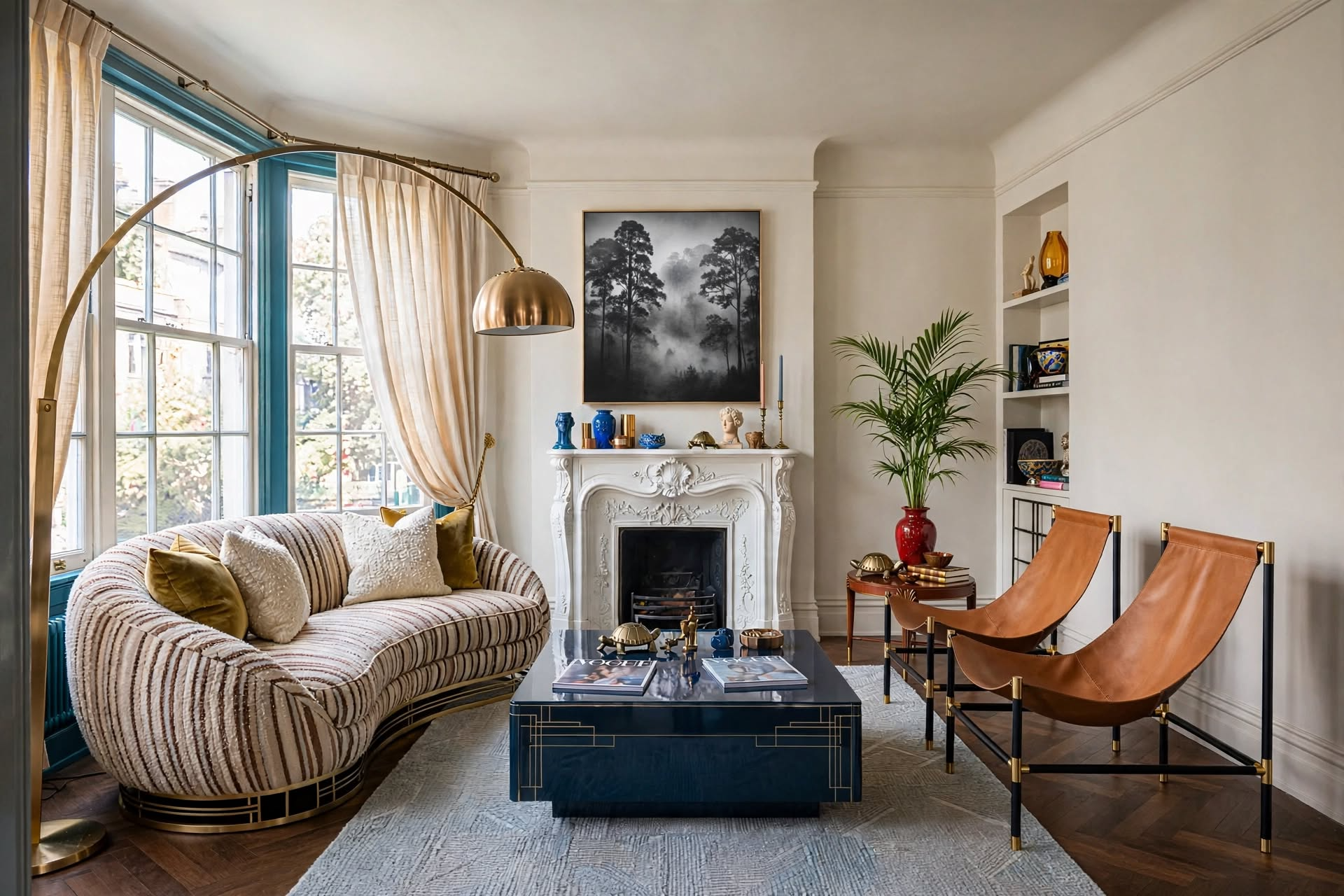
How to light a room properly: layer three kinds of light instead of relying on one ceiling fixture: Base (soft, even ambient light), Task (focused light where you read, cook or work) and Glow (low accent light for warmth). Place them at three heights (high, eye level and low), use one warm color temperature per room (2700K to 3000K for living spaces and bedrooms) and put as much as you can on dimmers or smart plugs. In a rental with no overhead light, an uplight floor lamp becomes your base layer, and plug-in sconces and cordless lamps do the rest with no wiring.
If your apartment looks great in daylight and flat, harsh or gloomy at night, the furniture usually isn’t the problem. The lighting is. Most rentals come with one overhead fixture (or none at all in the living room), and that single source throws light straight down, leaves the corners dark and makes even a well-styled room feel like a waiting room. Learning how to light a room is one of the cheapest upgrades you can make, and almost all of it can be done with plug-in pieces you take with you when you move.
Free Ebook
The Small Space Playbook
Layouts, sizing rules and styling formulas for small rooms and apartments, all in one free guide.
This guide walks you through my Base-Task-Glow Method: the three layers of light, a five-step plan you can use on any room tonight, what to do when there’s no ceiling light, a room-by-room lighting plan, and how to choose bulbs without guessing. Everything is written for renters, apartments and small spaces first.
What’s in This Guide
- The Base-Task-Glow Method
- The 3 Layers of Lighting
- How to Light a Room in 5 Steps
- How to Light a Room With No Overhead Light
- Room-by-Room Lighting Plan
- Choosing Bulbs: Lumens, Kelvin and LEDs
- Dimmers and Smart Lighting for Renters
- How to Light a Room on a Budget
- Do’s, Don’ts and Cheat Sheet
- FAQ
- Your Lighting Action Plan
- Base · Best for no ceiling lightLEPOWER Tripod Floor Lamp — Amazon
- Task · Best for readingIvy Bronx Devon 62″ Task Floor Lamp — Wayfair
- Task · Best for a side tableEbern Designs Ceramic Table Lamp — Wayfair
- Renter · Best no-wiring wall lightPlug-In Wall Sconces, Set of 2 — Amazon
- Glow · Best cordless accentNIORSUN Cordless Mushroom Lamp — Amazon
- Bulbs · Best easy upgradeEnergy-Saving LED Light Bulbs — Amazon
The Base-Task-Glow Method
Most lighting guides explain the three types of light and stop there. That’s the easy part. The hard part is standing in your own living room at 9 p.m. and knowing what to buy and where to put it. The Base-Task-Glow Method turns layered lighting into an order of operations, so you know how to light a room, not just what the layers are called, and every lamp you add has a job.
Base
Soft, even light that fills the room so you can move around safely. Ceiling fixture, or an uplight floor lamp if you don’t have one.
Task
Focused light where your eyes and hands work: the reading chair, the desk, the counter, the mirror.
Glow
Low, warm accent light that adds depth and makes the room feel cozy after dark.

Two rules hold it together. First, light at three heights: something high (ceiling light or uplight), something at eye level (table lamps, sconces) and something low (a small lamp on a shelf or console, candles, under-cabinet strips). Second, use one color temperature per room so the layers blend instead of fighting each other.
In a small apartment, the three heights matter more than the number of lamps. Two well-placed lamps at different heights will make a studio feel bigger than five lamps all sitting on tables at the same level.
The 3 Layers of Lighting: Ambient, Task and Accent

Before you can light a room well, it helps to know the three layers designers use. Every light in your home falls into one of them, and a well-lit room uses all three.
Ambient (Base) lighting
The overall light that lets you see and walk around. Ceiling fixtures, flush mounts, track lights and torchiere or uplight floor lamps.
Task lighting
Brighter, directed light for specific jobs. Reading lamps, desk lamps, swing-arm sconces, vanity lights and under-cabinet lights.
Accent (Glow) lighting
Softer light that highlights art, shelves or texture and adds warmth. Small lamps, picture lights, LED strips and flameless candles.

Why one ceiling light isn’t enough: light from a single point overhead lands on the floor and the tops of furniture, and leaves faces, walls and corners in shadow. Your eyes read those dark walls as the edges of the room, so the space feels smaller. Adding light at eye level and below brightens the walls and pushes those edges back.
How to Light a Room in 5 Steps (Layered Lighting)

Here’s how to light a room from scratch, in the order I use with clients. Do it in the evening, when the room needs the light most.
- 1Do a night audit
Turn on only the lights you have now and sit where you usually sit. Note the dark corners, the shadows on faces and the spots where you squint to read. That list is your shopping list.
- 2Set the Base layer
If you have a ceiling fixture, make sure it’s sized for the room and has a warm bulb. If you don’t, an uplight or arc floor lamp in a corner bounces light off the ceiling and fills the room the same way.
- 3Add Task light where you work
Put a lamp beside every seat where someone reads, a desk lamp on the opposite side of your writing hand, and light at the mirror and the counters.
- 4Finish with Glow and check your heights
Add one or two low, warm lights: a small lamp on a shelf, a picture light or flameless candles. Then check that you have light high, at eye level and low.
- 5Control it
Match the bulbs to one color temperature and put the lamps on dimmers or smart plugs so you can set a bright scene for cleaning and a low one for movie night.
Step 2: Size the Base Light (Measure Twice)
Overscaled furniture is one of the main reasons I get hired, and lighting is no different. A fixture or lamp that’s too big swallows a small room; one that’s too small looks lost. A common designer rule of thumb for a ceiling fixture: add the room’s length and width in feet, and use that number in inches as the fixture’s diameter. A 10 x 12 ft bedroom gets a fixture about 22 inches across. For a floor lamp, measure the corner first and leave at least a foot of walking room around the base.
If your rental’s ceiling light is a bare bulb or a dated dome you can’t change, leave it and lean on lamps. Swapping a hardwired fixture is a job for your landlord’s approval and an electrician, and you’d need to put the original back when you move out.
Step 3: Task Light Where You Actually Sit
If you only fix one thing about how to light a room, make it this: task lighting is the layer most apartments are missing. The goal is light that lands on what you’re looking at, not in your eyes. For a reading chair, the bottom of the lampshade should sit around shoulder height when you’re seated, so the light falls on the page. A floor lamp with an adjustable head saves table space in a small living room.

Ivy Bronx Devon 62″ Task & Reading Floor Lamp
If you read on the sofa and keep reaching for your phone flashlight, this puts directed light right over the page without taking up any table space.
Why it’s a must: a task floor lamp is the one piece that fixes a dim reading corner in a small living room with no side table.
Skip it if you need it to light the whole room; a task lamp is focused light, so pair it with a base layer.
Check Current Price on Wayfair →
LEPOWER Tripod Floor Lamp
If your living room or bedroom has no overhead light, a fabric-shade tripod lamp in the corner spreads soft light up and out, which makes it a simple base layer for renters.
Why it’s a must: it adds height to the room and lights the walls and ceiling, not just the floor.
Skip it if your corner is very tight; tripod legs spread out wider than a single-pole lamp, so measure first.
Check Current Price on Amazon →For side tables and nightstands, pick a table lamp with a fabric or linen shade. The shade softens the bulb and spreads the light sideways onto the wall, which does double duty as task and glow. If you’re styling the nightstand around it, my nightstand styling guide shows how to fit a lamp, a book and a catchall on a small surface.

Ebern Designs Ceramic Table Lamp, Linen Drum Shade
If your sofa side table looks bare and the corner goes dark at night, a ceramic base with a linen drum shade adds both warm light and a finished, collected look.
Why it’s a must: the linen drum shade diffuses the bulb, so you get soft light on the wall instead of glare.
Skip it if you want a bright desk lamp for detail work; this is a living room lamp, not a task light for close work.
Check Current Price on Wayfair →
360 Lighting Geometric Nightstand Lamp
If your nightstand is small and you read before bed, this compact off-white lamp gives you bedside light without crowding the surface.
Why it’s a must: a neutral base works with almost any bedroom palette, and a pair of them instantly balances a bed wall.
Skip it if your nightstand sits much lower than your mattress; a short lamp on a low table can shine in your eyes instead of on the page.
Check Current Price on Amazon →Step 4: Add Glow at the Lowest Level
Glow is the layer that makes a room feel cozy instead of just bright. Keep it low and warm: a small lamp on a bookshelf, a picture light over art, or a few flameless candles on the coffee table. Cordless, rechargeable lamps are a renter’s best friend here because you can put light on a shelf or a dining table with no outlet nearby and no cord to hide.

Winston Porter Flickering LED Wax Candles, 3-Piece
If you love candlelight but don’t want an open flame near curtains, pets or a lease clause, these real-wax LED candles give you the same low, warm flicker.
Why it’s a must: three heights in one set, which is an instant glow layer for a coffee table, mantel or bathroom shelf.
Skip it if you don’t want to replace batteries; check the listing for the battery type before you buy.
Check Current Price on Wayfair →
NIORSUN Cordless Mushroom Lamp
If the darkest spot in your apartment is a bookshelf, a dining table or a bar cart with no outlet in reach, a rechargeable mushroom lamp puts warm light right there with no cord.
Why it’s a must: it moves with you from room to room (and from apartment to apartment), so it’s glow you never have to reinstall.
Skip it if you want a lamp you never have to charge; cordless lamps need regular recharging.
Check Current Price on Amazon →How to Light a Room With No Overhead Light

Many apartment living rooms and bedrooms have no ceiling fixture at all, just a switched outlet near the door, so knowing how to light a room without one is a must for renters. The good news: you can build all three layers with plug-in pieces, and it often looks better than a ceiling light because the light comes from the sides, the way it does in a hotel room.
- Base: one uplight, tripod or arc floor lamp in the darkest corner, aimed so it washes the ceiling. Plug it into the switched outlet so it turns on when you walk in.
- Task: a lamp beside each main seat, and plug-in sconces on either side of the bed or sofa to save table space.
- Glow: a cordless lamp on a shelf or a plug-in LED strip behind the TV or under a floating shelf.
- Bounce it: hang or lean a mirror across from your floor lamp or window to reflect light deeper into the room.
Plug-in wall sconces are the renter’s secret. They mount with a couple of small screws (or heavy-duty adhesive hooks for light ones), plug into the wall and free up your nightstand or side table. Run the cord straight down and cover it with a paintable cord cover so it disappears into the wall. For more styles and placement heights, see my guide to wall sconces that transform a space.

Wrought Studio Mid-Century Flower Bud Plug-In Sconces
If your bedroom or sofa wall feels plain and you can’t hardwire anything, these plug-in sconces add light and a pop of color in one move.
Why it’s a must: wall lights free up a tiny nightstand and put the glow at eye level, where small rooms need it most.
Skip it if you prefer a quiet, neutral look; the red shade is a statement piece.
Check Current Price on Wayfair →
Plug-In Wall Sconces with Fabric Shades, Set of 2
If you want bedside reading light without nightstand lamps, a matching pair of fabric-shade sconces gives you soft, even light on both sides of the bed.
Why it’s a must: a set of two keeps the bed wall symmetrical, and fabric shades keep the light warm and glare-free.
Skip it if you can’t make any holes at all in your walls; check your lease and the mounting hardware first.
Check Current Price on Amazon →Take a photo of every bulb and fixture on move-in day. If you swap bulbs or a shade, keep the originals in a labeled bag so you can put them back before your final walkthrough.
Room-by-Room Lighting Plan
Every room needs all three layers, but in different amounts. Here’s how to light a room in each part of a small home: the Base-Task-Glow recipe for each space, with the one piece I’d buy first.

Entryway
The entry is your first impression and the place you drop keys in the dark. Light it so you can see the hooks, the mirror and the floor.
Base: ceiling fixture or flush mount on a warm bulb.
Task: a pair of sconces beside the mirror, or a small lamp on the console.
Glow: a cordless lamp left on low in the evening.

Living Room
The room that does the most jobs: TV, reading, guests. Aim for a light within reach of every seat, and avoid a lamp that reflects in the TV screen.
Base: ceiling light or an uplight floor lamp in a corner.
Task: a table lamp by the sofa and a reading lamp by the chair.
Glow: a small lamp on a shelf or an LED strip behind the TV.
Planning the TV wall too? My guide on how to decorate around a TV covers where lamps and art go so they don’t compete with the screen, and the small living room guide shows how to fit it all in a tight footprint.


Kitchen
The most task-heavy room in the home. A ceiling light behind you casts your shadow right onto the cutting board, so the counters need their own light.
Base: the existing ceiling fixture on a bright, warm-white bulb.
Task: plug-in or battery LED strips under the upper cabinets; pendants over an island hung about 30 to 36 inches above it, per Room & Board’s lighting guide.
Glow: a small lamp on the counter or open shelf.

Dining Room or Nook
Dining light should flatter faces, not interrogate them. Keep it warm and dimmable, and centered on the table, not the room.
Base: a pendant or chandelier hung 28 to 34 inches above the tabletop, per Room & Board.
Task: a dimmer so the same light works for homework and dinner.
Glow: flameless candles or a cordless lamp on the table or sideboard.

Bedroom
The bedroom should get dimmer and warmer as the night goes on. Bright overhead light right before bed is the thing to avoid.
Base: ceiling light or a corner floor lamp.
Task: a lamp or plug-in sconce on each side of the bed.
Glow: a low lamp on the dresser, on a dimmer or smart plug.

Bathroom
The one room where light from the sides beats light from above. A single light over the mirror shadows your eyes and chin.
Base: the ceiling light with a bright, high-CRI bulb.
Task: lights on both sides of the mirror at about face height, or a lighted mirror if you can’t add sconces.
Glow: flameless candles or a small night light for late-night trips.

Home Office or Desk Nook
Light the desk without lighting your screen. Glare on the monitor and a dark wall behind it both make long days harder on your eyes.
Base: ceiling light or a floor lamp behind or beside the desk.
Task: an adjustable desk lamp on the side opposite your writing hand.
Glow: a soft light behind the monitor or on a shelf to cut contrast.
For more on the desk itself, see my home office design tips and these aesthetic desk setup ideas. If you live in a studio, use light to zone it: a warm lamp by the bed, a brighter task light at the desk and a pendant or cordless lamp over the table make one room read as three. My studio apartment layout ideas show where each zone goes.
Choosing Bulbs: Lumens, Kelvin and LEDs

The right lamp with the wrong bulb still looks wrong. Bulbs are the part of how to light a room that most people skip, and they’re the cheapest fix in the whole guide, and it’s 100% renter-friendly. Read three things on the box:
- Lumens = brightness. Ignore watts on LEDs. ENERGY STAR’s bulb guide matches lumens to the old incandescent watts you’re used to (see the table below).
- Kelvin (K) = warm or cool. Lower numbers are warmer and more yellow; higher numbers are cooler and bluer.
- CRI = color accuracy. A higher Color Rendering Index shows paint, wood and skin tones more truly. I look for 90 or higher in bathrooms and kitchens.
| Old incandescent | LED brightness | Where I use it |
|---|---|---|
| 40 watts | About 450 lumens | Glow lamps, bedside lamps, shelves |
| 60 watts | About 800 lumens | Table lamps, floor lamps, most fixtures |
| 75 watts | About 1,100 lumens | Reading lamps, kitchen and bath fixtures |
| 100 watts | About 1,600 lumens | Uplight floor lamps used as the base layer |
| Color temperature | How it looks | Best rooms |
|---|---|---|
| 2700K | Warm, cozy, like a classic lamp | Living room, bedroom, dining |
| 3000K | Warm white, a little crisper | Living room, entry, kitchen, bath |
| 3500K–4000K | Neutral to cool white | Kitchen task light, desk, laundry |
| 5000K+ | Cool, bluish daylight | Garage or closet; too stark for living spaces |
Why LEDs: according to ENERGY STAR, certified bulbs use up to 90% less energy than standard bulbs and last at least 15 times longer. In a rental, that means fewer burned-out bulbs to replace in fixtures you can barely reach. Not every LED dims, so check the box for “dimmable” if the bulb is going on a dimmer.

Dimmers and Smart Lighting for Renters
Control is the last step in how to light a room, and it’s what turns three layers into a plan you actually use. You don’t need to replace a single wall switch to get it:
- Plug-in dimmers: an inline or plug-in dimmer between the lamp and the outlet lets you lower any dimmable lamp.
- Smart plugs: plug your floor lamp and table lamps into smart plugs and you can turn them all on together from your phone or on a schedule.
- Smart bulbs: they screw into the lamps you already own and let you dim and change color temperature, which is handy for a studio that needs bright light by day and warm light at night.
- Set scenes: make one bright “clean” scene with all layers on, and one “evening” scene with only task and glow, dimmed.
For the bigger picture on automating your home, read my smart home design guide.
How to Light a Room on a Budget

Learning how to light a room well doesn’t have to cost much. Spend in this order and stop when the room feels right:
- 1Bulbs first
Match every bulb in the room to one warm color temperature. It costs the least and changes the most.
- 2One floor lamp
If the room has no ceiling light or only one, a corner floor lamp adds height and base light in one purchase.
- 3Move what you already own
Shop your home: a lamp sitting in a bright room may do more in a dark one. Swap shades for linen or fabric to soften the light.
- 4Add glow last
Flameless candles, a cordless lamp or a plug-in LED strip finish the room without a big spend.
Thrift stores and discount home stores are great for lamp bases. A new shade and a warm bulb make an old base look current. For more ways to stretch your budget, see my budget home decor ideas and these renter-friendly hacks.
The same three layers work on a balcony or patio: string lights overhead for base, a lantern by the seating for task, and solar or flameless candles for glow. Use fixtures rated for outdoor use. See my patio decor ideas on a budget.

How to Light a Room: Do’s and Don’ts
Do
- Do a night audit before you buy anything
- Light at three heights: high, eye level, low
- Use one color temperature per room
- Put a light within reach of every seat
- Use plug-in sconces and cordless lamps in rentals
- Measure the corner before buying a floor lamp
Don’t
- Rely on a single overhead light
- Mix warm and cool bulbs in one room
- Use daylight 5000K bulbs in living spaces
- Put the only bathroom light above the mirror
- Swap a hardwired fixture without landlord approval
- Buy a lamp that’s too big for the room
How to Light a Room: Cheat Sheet
- ◆Base: even ambient light
- ◆Task: where you work
- ◆Glow: low and warm
- ◆High: ceiling or uplight
- ◆Middle: lamps, sconces
- ◆Low: shelf, table, candles
- ◆450 ≈ old 40W
- ◆800 ≈ old 60W
- ◆1,600 ≈ old 100W
- ◆2700K: living, bedroom
- ◆3000K: kitchen, bath
- ◆One temperature per room
- ◆28–34 in. above a table
- ◆30–36 in. above an island
- ◆Center on the table
- ◆Length + width in feet
- ◆= diameter in inches
- ◆10 x 12 room ≈ 22 in.
How to Light a Room: Your Questions
When you’re working out how to light a room, start with at least three light sources, one for each layer: a base light for the whole room, a task light where you read or work, and a low glow light for warmth. Place them at different heights so the light reaches the walls and corners, not just the floor.
Layered lighting means combining ambient, task and accent light in one room instead of relying on a single fixture. Ambient light fills the room, task light is focused where you work, and accent light adds warmth and highlights art or texture. Using all three lets you change the mood by turning layers on and off.
Use an uplight, tripod or arc floor lamp in a corner as your base layer, plugged into the switched outlet if your room has one. Add table lamps or plug-in wall sconces beside the seating or bed for task light, and a cordless lamp or LED strip for glow. A mirror across from the floor lamp reflects light deeper into the room.
Warm white between 2700K and 3000K works best for most living rooms and bedrooms. It feels cozy and flatters skin tones and wood. Use the same color temperature for every bulb in the room so the layers blend.
Room & Board recommends hanging the bottom of a dining pendant 28 to 34 inches above the tabletop, and 30 to 36 inches above a kitchen island. Center it on the table, not the room.
Switch every bulb to the same warm LED, add an uplight floor lamp to bounce light off the ceiling, put lamps at eye level to brighten the walls, and use mirrors and light-filtering curtains to spread daylight. Lighting the walls and corners, not just the center of the room, is what makes a small space feel bigger and brighter.
Your Lighting Action Plan
Knowing how to light a room comes down to one shift: stop thinking about “the light” and start thinking in layers. Pick the room you spend the most evenings in and work through it tonight:
- 1Audit it after dark
Note the dark corners and the seats with no light within reach.
- 2Fix the bulbs
One warm color temperature for every bulb in the room.
- 3Add the missing layer
Usually a floor lamp for base or a lamp by the sofa for task.
- 4Finish with glow and control
One low, warm light and a dimmer or smart plug, and you’re done.
That’s the Base-Task-Glow Method. Once one room is done, the next is faster, and every lamp you buy goes with you to the next apartment.
If you want the full formulas, spacing rules, and layout math from this guide (and every other room in your home) in one place, grab The Designer’s SECRET Cheat Sheet — it’s the shortcut version of everything a designer checks before calling a room finished.
Get the Cheat Sheet →And if you want more of this in your feed, come find us @thedecorholic on Instagram, Facebook, TikTok, and Pinterest for more room-by-room styling breakdowns like this one.

CATCH THE LATEST IN HOME DECOR TRENDS:

Accessorize a Small Living Room: 7 Genius Styling Secrets

How to Make a Small Room Appear Bigger

How to Make Your Home Look Expensive
GET CAUGHT UP ON ALL THE INSPIRING DECOR TIPS:

Best Fireplace Makeover Ideas

How to Make a Gallery Wall: The Complete Step-by-Step Guide (Even If You’ve Never Hung a Picture)