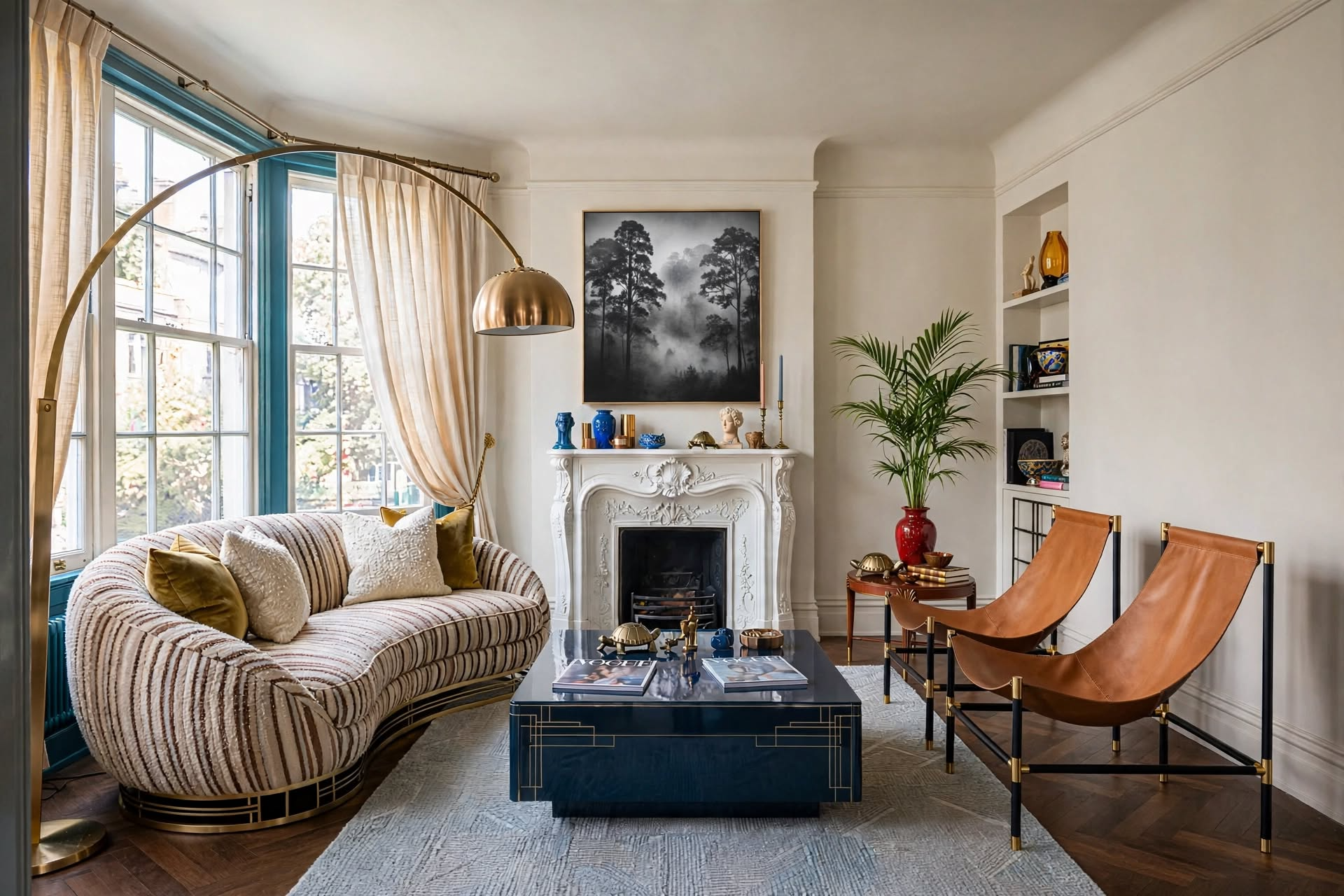
“Still rearranging the same room hoping it’ll click? It won’t — until you know this.”
The Designer’s SECRET Cheat Sheet121 designer-approved rules for every room in your home. The shortcut every well-styled home is built on.
Best Accent Chair for Small Spaces: An Interior Designer’s Buying Guide
By The Decorholic Team · Last Updated September 9, 2026
The best accent chair for small spaces isn’t the smallest one you can find — it’s the one with the right proportions, an open or slim-legged silhouette, and enough clearance around it to actually move through the room. Measure first, choose style second, and check placement before you buy.
You’ve probably scrolled through dozens of “cute” accent chairs that looked perfect online and would’ve swallowed your living room whole. Choosing the best accent chair for small spaces isn’t about guessing which one “looks small” in a photo — it’s a handful of measurements and design decisions that any interior designer runs through before recommending a single chair.
Get those decisions right and one chair can anchor a reading corner, round out a sofa, or fill an awkward gap without ever feeling like it’s in the way. Get them wrong, and even a “compact” chair ends up blocking a walkway or making the whole room feel tighter than it already is.
This guide walks through exactly how to choose — sizing, style, placement, and budget — then hands you real, small-space-tested picks at the end.

What’s In This Guide
- What Size Accent Chair Fits a Small Room?
- What Type of Chair Takes Up the Least Visual Space?
- Where Should You Place an Accent Chair in a Small Room?
- Does an Accent Chair Have to Match Your Sofa?
- Best Picks by Room: Bedroom vs. Living Room
- Best Accent Chair for Small Spaces on a Budget
- What Not to Do
- The 6 Best Accent Chairs for Small Spaces
- FAQ
Measure
Get real numbers before you shop — the room, the doorway, your sofa’s seat height.
Match
Pick the style and material that suits how you’ll actually use the chair, not just how it photographs.
Move
Confirm clearance and placement before you buy, so the chair earns its spot instead of blocking it.
What Size Accent Chair Fits a Small Room?

Sizing an accent chair for a small room is about two different things: its physical footprint (the actual inches it takes up) and its visual weight (how bulky it looks, regardless of the numbers). A chair can technically fit and still feel too big if it reads heavy in the room.
- Small-room accent chairs generally run 26–32″ wide and under 30″ deep — the widely used “30×30” benchmark for a chair that fits almost any small room
- Keep the seat height within about 4 inches of your sofa’s seat height so the two pieces read as one balanced seating group instead of two mismatched heights
- An overall height in the 30–35″ range keeps the chair’s proportions light rather than looming next to a smaller sofa
Measure your doorway or stairwell width too, not just the room itself — a chair that clears the floor plan on paper can still get stuck on the way in if you’re working with a narrow hallway or a walk-up apartment.
Once you know your rough dimensions, the room itself matters just as much as the chair. If you’re still working out the overall furniture plan, our guide to the best living room layout for small spaces walks through how an accent chair fits into the bigger picture, not just its own footprint.
What Type of Chair Takes Up the Least Visual Space?


This is the question that actually determines whether a chair feels small, regardless of its measurements. Open backs, woven details, and slim or exposed legs all let light and floor show through, which reads as “less there” than a solid, boxy silhouette of the exact same size.
Slipper chair vs. barrel chair
An armless slipper chair wins on tuckability — it slides into a corner or under a window in a way a barrel chair can’t. A barrel chair wins on presence and comfort, making it the better pick when you only have room for one statement seat and want it to actually feel substantial.
Swivel accent chair vs. traditional armchair
A swivel base earns its footprint in a small room by doing double duty — facing the sofa for conversation, then turning toward a desk or the TV — in a way a fixed chair simply can’t. If your small space multitasks (living room and home office, say), a swivel chair is usually the smarter buy.
A lightweight, sculptural chair — think Eames-style lounge silhouettes — can double as functional art in a small room, giving you a focal point without adding real bulk.
Multifunctional picks are worth a look if the room needs to earn its keep beyond just seating — a sleeper accent chair or a storage ottoman that stands in as a second seat can flex for guests without taking up permanent square footage.
For a deeper dive into which silhouettes pair well together, our guide to popular interior design styles breaks down the design languages these chair shapes come from, so you can pick one that fits your room’s overall aesthetic.
Where Should You Place an Accent Chair in a Small Room?
Placement is where most small-space chair purchases actually go wrong — not the chair itself. The right chair in the wrong spot still blocks traffic and makes the room feel smaller than it is.


- Leave 18–24 inches of walking clearance around the chair so it doesn’t choke off a path through the room
- Keep 12–18 inches between the chair and a coffee table — close enough to set down a drink, far enough not to bump knees
- Angle the chair 10–15 degrees toward the sofa instead of squaring it off dead-on; it creates a sense of flow without adding any actual footprint
Corners and the dead space beside a fireplace are two of the most underused spots for an accent chair in a small room — both let the chair sit outside the main walking path entirely.
If you’re trying to place a chair in a room that already feels a little scattered, the interior design rule of thirds is a genuinely useful framework for figuring out where a single piece should sit relative to everything else.

@thedecorholic
The Real Rental Life ✨
The blog is the highlight reel. Stories are the real one — daily chaos, tiny-space fixes, and whatever’s currently going wrong in my apartment.
🎥 There’s always a reel live — come see what I’m fixing this week.
@thedecorholic · new stories daily
Does an Accent Chair Have to Match Your Sofa?

No — and in most small rooms, it shouldn’t. A chair that matches the sofa exactly tends to visually merge with it, which can actually make a small room feel more crowded, not less, because there’s nothing to break up the seating area.
Coordinate through color and texture instead of an exact match — pull one shade from your rug or pillows into the chair, or contrast a smooth sofa with a textured boucle or leather chair.
And yes, you can put a swivel chair in a small bedroom corner — the same clearance rules from the placement section above apply. As long as you’ve got 18–24 inches to swing it through its full rotation, a swivel chair actually works harder in a bedroom than a fixed one, letting you face a reading nook one moment and a TV or vanity the next.
Do
- Measure the room and doorway before you shop
- Check seat height against your sofa
- Leave real walkway clearance
Don’t
- Buy on looks alone
- Assume “compact” on a label means it fits your room
- Skip the walkway clearance check
Slipper vs. barrel vs. swivel, side by side
| Chair Type | Typical Footprint | Best For | Comfort Level |
|---|---|---|---|
| Slipper (armless) | Smallest — tucks into corners | Tight spaces, extra seating | Good for short sits |
| Barrel / swivel | Medium, compact from every angle | Multi-use rooms, conversation areas | High — enclosed, supportive |
| Traditional armchair | Largest footprint | A single anchor piece | Highest — deep seat, full arms |
| Ottoman (as seating) | Smallest, most flexible | Overflow guest seating | Low — no back support |
Best Picks by Room: Bedroom vs. Living Room

The “job” the chair needs to do changes which one is right, even at the same dimensions. In a bedroom, the chair is usually a personal reading or dressing spot — comfort and a slightly softer silhouette matter more than how it reads to guests. In a living room, it’s shared seating, so visual weight and how it relates to the sofa carry more weight.
If you’re furnishing a studio or one-room layout where the “bedroom” and “living room” are the same square footage, our studio apartment layout guide is worth reading alongside this one — and if the accent chair is one piece in a bigger refresh, how to make a small apartment look cohesive covers how to make new pieces feel intentional next to what you already own.
Best Accent Chair for Small Spaces on a Budget

Spend where it actually shows up in daily use, and skip the rest.
- Spend first on frame and comfort — a sturdy frame and a seat you actually want to sit in are the two things you can’t upgrade later
- Save on fabric — a simpler upholstery in a great silhouette will always outperform a “luxe” fabric on a poorly proportioned chair
- Skip anything oversized “for the price” — a bigger chair for the same money is a worse deal in a small room, not a better one
If you’re not sure the chair will work in your next place, look for one with a slipcover option or a neutral fabric that’s easy to re-home — it protects the resale value of the chair itself, not just your deposit.
What Not to Do
- Buying by looks alone — a chair that photographs well can still be the wrong scale; check the actual dimensions against your room first
- Ignoring seat depth — a deep seat can make a chair feel oversized even when its width and height check out; sit in it (or measure a similar piece) before buying
- Matching everything exactly — an exact match to the sofa tends to visually merge the two pieces, making the room feel more crowded
- Blocking traffic flow — always confirm walkway clearance before you commit, not after it arrives
Designer’s Cheat Sheet
- ◆ 26–32″ wide, under 30″ deep
- ◆ Within 4″ of sofa seat height
- ◆ 18–24″ walking room around it
- ◆ 12–18″ to a coffee table
- ◆ Open arms/slim legs read lighter
- ◆ Frame and comfort first, fabric later
The 6 Best Accent Chairs for Small Spaces
Everything above is the thinking. These six are the payoff — chairs that already pass the Measure–Match–Move test, so you’re not left cross-checking dimensions against a spec sheet on your own. Each one earns its spot on this list for a specific reason: a swivel base that turns one chair into three uses, a frame narrow enough to clear a tight doorway, legs that keep the floor visible so the room breathes. None of them are “small chairs” in the sense of being cramped or flimsy — they’re full-comfort pieces that just happen to be scaled and styled for a room that can’t afford to waste an inch.
If you’ve been putting off this purchase because everything you’ve seen either felt too big for your space or too small to actually sit in, this is the list built to solve exactly that problem.

Ivy Bronx Hadriel Boucle Swivel Barrel Chair
If you need one chair to work from every angle in a small, open-plan room, this compact barrel swivel — just 29.6″ wide with a 360° base and a solid pine frame — turns to face the sofa, the TV, or a desk without ever leaving its footprint.
👉 Check Current Price
Modway Langford Performance Armchair
Worried about spills before you’ve even moved in? This stain-resistant performance-fabric armchair keeps a clean, low-profile frame so it earns its keep in a small living room without demanding a big budget.
👉 Check Current Price
George Oliver Johniyah 27.5″ Wide Armchair
When you’re not sure a chair will even clear your doorway, this one answers the question up front — 27.5″ wide with round metal arms and a chenille seat that reads soft without adding bulk to a tight living room or bedroom corner.
👉 Check Current Price
Everly Quinn Jura Lounge Chair, Gold Legs
A boxy, heavy-looking chair is the fastest way to shrink a small room, so this one solves it with a raised profile on slim gold metal legs that keeps sightlines clear underneath, in a compact 30.7″-wide frame.
👉 Check Current Price
Wade Logan Crandell Italian Leather Swivel Barrel Chair
If you want the warmth of leather without the footprint of a full-size leather armchair, this 30.25″-wide swivel barrel in top-grain Italian leather brings the texture and patina without overwhelming a small conversation area.
👉 Check Current Price
Mercer41 Tilton Soft Long-Haired Accent Chair
For a cozy, textural focal point that still fits a 28″-wide footprint, this faux-fur lounge chair on a slim wood frame turns a quiet corner into a statement without the visual bulk a fully upholstered piece would bring.
👉 Check Current PriceFAQ: Best Accent Chair for Small Spaces
Choosing the right accent chair for a small space really does come down to those three steps — measure, match, move — in that order. Start with the tape measure, not the shopping cart, and the rest gets a lot easier.
Ready to find your fit?
Shop the Picks AboveAlready have your chair picked out and want to style it once it arrives? Our complete accent chair styling guide covers placement ideas, pairing it with your existing pieces, and room-by-room styling once the buying decision is done.
If you want the full formulas, spacing rules, and layout math from this guide (and every other room in your home) in one place, grab The Designer’s SECRET Cheat Sheet — it’s the shortcut version of everything a designer checks before calling a room finished.
And if you want more of this in your feed, come find us @thedecorholic on Instagram, Facebook, TikTok, and Pinterest for more room-by-room styling breakdowns like this one.
CATCH THE LATEST IN HOME DECOR TRENDS:

Steal These 16 Expert-Approved Decorating Secrets

Accessorize a Small Living Room: 7 Genius Styling Secrets

How to Make a Small Room Appear Bigger

How to Make Your Home Look Expensive
GET CAUGHT UP ON ALL THE INSPIRING DECOR TIPS:

Best Fireplace Makeover Ideas

How to Make a Gallery Wall: The Complete Step-by-Step Guide (Even If You’ve Never Hung a Picture)