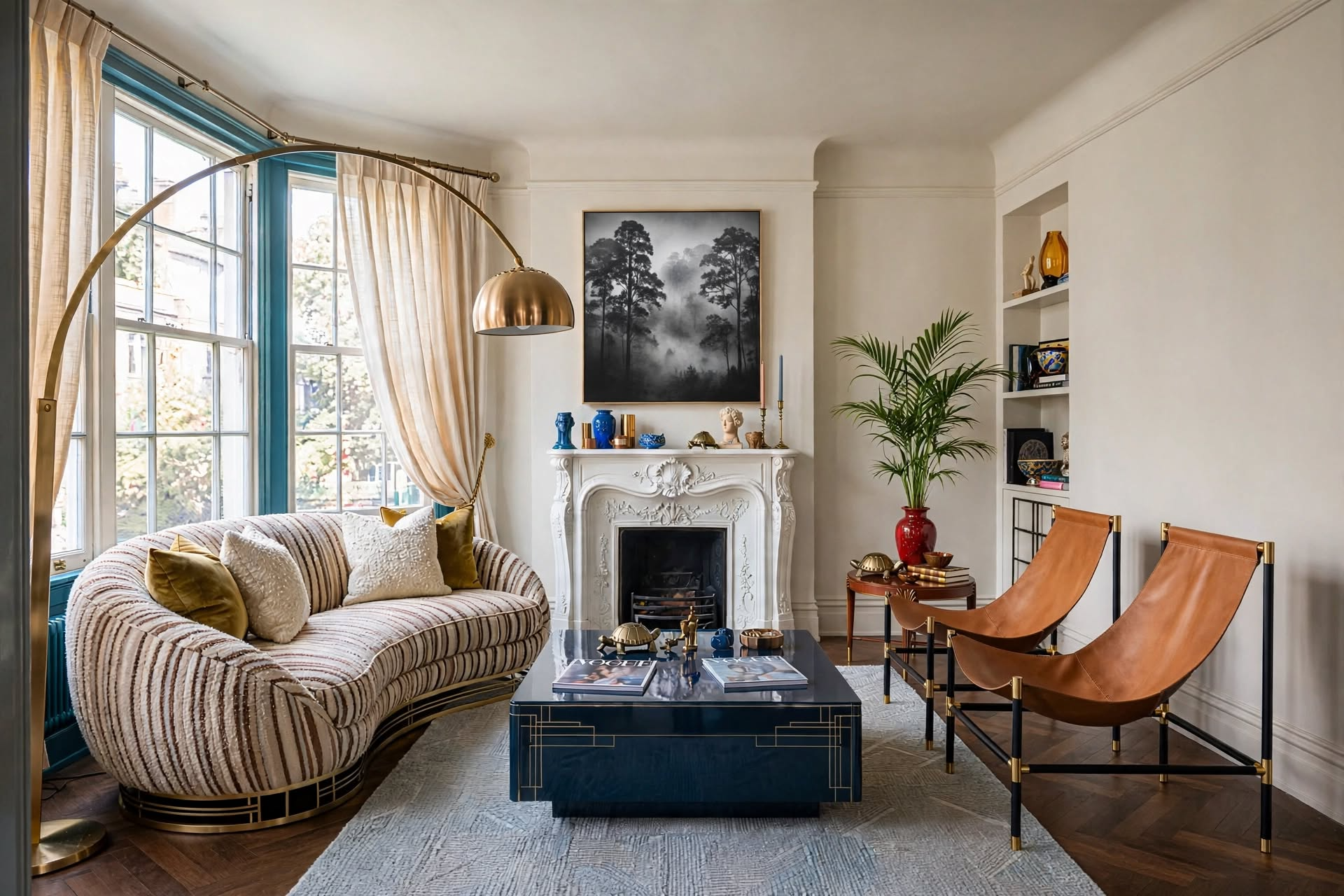
To style an accent chair, match its scale to the room (never the biggest or smallest piece in the space), angle it 15–45° toward the main seating line instead of facing it head-on, and anchor it with a side table, a lamp, and one textured layer like a throw or pillow. The formula changes slightly by room — but the goal is always the same: the chair should look like it was placed on purpose, not left over from a move.
You bought the chair because it caught your eye in the store or on your feed. Now it’s in your apartment, and it just… sits there. Not wrong, exactly — just not doing anything. That gap between “I own an accent chair” and “I know how to style an accent chair” is where most renters get stuck, especially in a space you didn’t design and can’t permanently alter.

The problem isn’t your chair. It’s that most advice on how to style an accent chair is written for homeowners with formal living rooms, not for a 650-square-foot one-bedroom where the “living room” also has to work as a home office by 9 a.m. Here’s the good news: learning how to style an accent chair is a formula, not a talent. Once you know the spacing math and the room-by-room placement rules, you can make any chair — thrifted, inherited, or fresh off Amazon — look like it was chosen by a designer.
This guide walks through exactly that: the universal rules that apply everywhere, then a room-by-room breakdown showing how to style an accent chair in the actual rooms in a rental — living room, bedroom, home office, and the awkward dead corners every apartment has.
- The Anatomy of a Well-Styled Accent Chair
- Renter Rules to Follow Before You Buy or Place
- How to Style an Accent Chair in a Small Living Room
- How to Style an Accent Chair in a Bedroom Corner
- How to Style an Accent Chair in a Home Office or Reading Nook
- How to Style an Accent Chair in an Entryway or Dead Corner
- Anti-Patterns: What NOT to Do
- The Designer’s Cheat Sheet
- Chairs and Accessories Worth Buying
- FAQ
The Anatomy of a Well-Styled Accent Chair

Knowing how to style an accent chair comes down to three things an unstyled chair doesn’t have: a clear angle relative to the room’s main sightline, a supporting object within arm’s reach (table, lamp, or plant), and at least one textural layer that ties it to the rest of the room. Miss any of the three and the chair reads as “extra furniture” instead of a design choice.
The psychology behind it: Our eyes read symmetry and intention automatically. A chair squared up flush against a wall, alone, with nothing near it, registers as storage — something parked, not placed. The moment you angle it and give it a “job” (a spot to set a coffee cup, a light source to read by), your brain reclassifies it as a considered piece of the room. This is why two identical chairs in two different apartments can look completely different in quality — the chair isn’t the variable. The styling is.
Step-by-Step: The 3-Layer Styling Method
- Step 1 — Set the angle. Position the chair 15–45 degrees off the main seating line instead of facing it dead-on. In a small room, 30 degrees is the sweet spot — enough to invite conversation without pointing knees at anyone.
- Step 2 — Add the anchor. Place a side table or plant stand within 6–10 inches of the chair’s arm, sized so its tabletop sits within 2 inches of the chair arm’s height. This is what makes the chair feel “set up” instead of dropped in.
- Step 3 — Layer the texture. Add one throw (draped, not folded flat) or two pillows in a texture that doesn’t already exist elsewhere in the room — bouclé against a linen sofa, leather against a woven rug, and so on.
If you only do one of the three steps, do the angle. It’s free, it takes ten seconds, and it does more visual work than any accessory you could buy.
Renter Rules to Follow Before You Buy or Place

Learning how to style an accent chair as a renter means working around two constraints homeowners don’t have: no permanent wall changes, and furniture that has to earn its square footage in a multi-use room. Every rule below exists to solve one of those two problems.
Before you fall for a chair on looks alone, run it through a quick filter. A wingback that’s gorgeous in a 400-square-foot showroom vignette can swallow a studio apartment whole. The goal is a chair that pulls weight in a small footprint without needing anything drilled, glued, or mounted to make it work.
Step-by-Step: The Renter Filter
- Step 1 — Measure your clearance, not your wall. You need a minimum of 30 inches of walking clearance around any side of the chair that faces a path of travel. Less than that, and the chair becomes an obstacle instead of a feature.
- Step 2 — Choose lightweight over heavy. A chair under 35 lbs can be repositioned solo when you rearrange or move out. Anything heavier usually means a two-person carry every time — which means it never actually gets moved, even when the room stops working.
- Step 3 — Skip anything that needs hardware. No chair should require wall anchors, mounted lighting, or built-in shelving to look styled. If a room needs drilling to make a chair work, the placement is wrong, not the wall.
Use a rug to define the chair’s “zone” instead of a wall or built-in nook. A 5×7 or 4×6 rug under the chair and its side table instantly reads as an intentional area — and it moves with you.
How to Style an Accent Chair in a Small Living Room


To style an accent chair in a small living room, place it opposite or diagonal to the sofa — never beside it in a matching row — angled toward the coffee table at roughly 30 degrees. This creates a seating triangle instead of a straight line, which makes a small room feel like a conversation area instead of a waiting room.
Small living rooms fail in one of two ways: everything gets pushed against the walls (which actually makes the room feel bigger and colder), or everything gets crammed toward the center (which makes it feel cramped). The chair is your fix for both. Pulling it slightly off the wall and angling it toward the room’s focal point — a TV, a fireplace, a window — breaks the “furniture showroom” line-up and gives the eye somewhere to land.
Step-by-Step: The Living Room Triangle
- Step 1 — Find your anchor point. Identify the room’s focal point (TV, fireplace, window) and place the sofa facing it directly.
- Step 2 — Set the chair at a diagonal. Place the accent chair across from the sofa, angled 30 degrees toward the coffee table rather than squared up to it. Leave 14–18 inches between the chair and the coffee table’s edge — enough for knees, not so much that it feels disconnected.
- Step 3 — Keep 30 inches of walkway. If your living room doubles as a hallway to the kitchen or bedroom, the chair’s outer edge needs at least 30 inches of clearance from the nearest wall or doorway.
- Step 4 — Add a floor lamp, not another table. If a side table won’t fit, a slim floor lamp arched over the chair’s shoulder does the same “anchor” job in a fraction of the floor space.
Under 150 sq ft
Choose a chair under 30″ wide — a slipper or barrel chair, no wingback
150–250 sq ft
A 30–34″ armchair works; keep arms slim, not boxy
250+ sq ft
A wingback or club chair up to 38″ wide can anchor the space
How to Style an Accent Chair in a Bedroom Corner

To style an accent chair in a bedroom, place it in the corner diagonal from the bed’s foot, angled slightly toward the window or the room’s natural light source. It should never sit directly at the foot of the bed unless the room is at least 12 feet deep — otherwise it blocks the walk path every single day.
A bedroom accent chair has one job most people get wrong: it’s not there for seating during the day, it’s there for the “landing zone” moment — the spot where you drop a robe, sit to put on shoes, or read for twenty minutes before bed. Style it for that specific use, not for a dinner party that will never happen in your bedroom.
Step-by-Step: The Bedroom Corner Setup
- Step 1 — Claim the corner, not the wall. Angle the chair into the corner at 45 degrees rather than pushing it flat against one wall. This uses dead corner space that would otherwise sit empty.
- Step 2 — Layer in one textile. Drape a sheepskin or knit throw over one arm, letting it fall unevenly rather than folding it square — this is what separates “styled” from “staged.”
- Step 3 — Add low, warm light. A small table lamp on a nearby dresser or a plug-in wall sconce (renter-safe, no hardwiring) at chair height keeps the corner from going pitch black at night.
- Step 4 — Keep the seat clear. The single fastest way to kill a bedroom chair’s styling is letting it become a laundry pile. If you know that’s a habit, add a small woven basket beside it as a “landing spot” decoy for actual clothes.
A swivel base is worth the upgrade in a bedroom corner — it lets the chair face the room during the day and rotate toward a window or reading lamp at night, without you needing to drag it across the floor.
How to Style an Accent Chair in a Home Office or Reading Nook

To style an accent chair in a home office or reading nook, sit it at 90 degrees to the desk chair — never facing it directly — so the two zones feel separate even in a shared room. This is the single trick that keeps a work-from-home corner from bleeding into your relaxation space.
Renters working from a corner of the living room or bedroom face a unique problem: one room, two identities. A desk that faces a work-mode chair head-on all day keeps your nervous system in “task” mode even after you log off. Turning the accent chair away from the desk, toward a window or a low bookshelf, gives your brain a visual cue that the workday zone has ended.
Step-by-Step: The Dual-Zone Nook
- Step 1 — Rotate the sightline. Position the accent chair so its front faces away from the desk setup, toward a window, plant, or piece of art instead.
- Step 2 — Use a rug to split the zones. A small 3×5 rug under just the accent chair visually separates “reading corner” from “desk corner,” even with no wall between them.
- Step 3 — Add a low side table for a book or mug. Keep it under 20 inches tall, lower than a desk surface, to reinforce that this spot is for sitting back, not working.
- Step 4 — Choose a chair with a lower seat depth. An 18–20 inch seat depth signals “lounge,” where a deep 24-inch seat can start to feel like a second desk chair.
A swivel or barrel chair on wheels-free casters can double as overflow seating for video calls, then rotate back toward the window the second the call ends.
How to Style an Accent Chair in an Entryway or Dead Corner

To style an accent chair in a dead corner or awkward entryway, treat it as a “moment,” not a functional seat — meaning it can be smaller, lower-traffic, and more decorative than a living room chair, since its job is to fill visual dead space rather than host daily use.
Every apartment has one: the corner too small for a bookshelf, too big to ignore, right by the front door or at the end of a hallway. Instead of leaving it empty (which reads as unfinished) or cramming in a console table (which often doesn’t fit), a single well-chosen chair fills the volume of the space without demanding floor traffic around it.
Step-by-Step: The Dead-Corner Fix
- Step 1 — Measure the corner’s footprint. If it’s under 3×3 feet, choose a chair with an open base (wood legs, wire frame) rather than a skirted or boxy silhouette, so the corner still reads as spacious.
- Step 2 — Skip the side table. Unlike a functional seating chair, a dead-corner chair doesn’t need an anchor table — a single tall plant or a stack of books on the floor does the same visual job with a smaller footprint.
- Step 3 — Let the chair face into the room. Angle it so it’s visible from the main entry point of the space, not tucked so far into the corner that it disappears.
- Step 4 — Pick one statement material. Because this chair isn’t used daily, it can afford to be bolder — a sculptural silhouette, a saturated color, or a high-shine finish that would be too much in a main seating area.
Entryway
Choose a chair under 26″ wide with an open leg base so it doesn’t block the door swing.
Hallway nook
A slim slipper chair with no arms clears tight passageways best.
Window corner
Face the chair toward the window, not the room, to make it feel like a designed retreat.
Beside a bookshelf
Let the chair’s back sit flush with the shelving unit to save 8–10 inches of floor space.
Anti-Patterns: What NOT to Do
Most mistakes in how to style an accent chair aren’t about taste — they’re about placement and proportion. Here’s what quietly undermines a chair, and the fix for each.
Do This
- Angle the chair 15–45° off the main sightline
- Match scale to room size using the formula above
- Give it one job: reading, landing zone, or overflow seating
- Add one textural layer that doesn’t already exist in the room
- Leave 30″ of walking clearance on any traffic-facing side
Not This
- Pushing the chair flush against a wall with nothing nearby
- Matching the chair’s fabric exactly to the sofa
- Buying a wingback for a studio under 400 sq ft
- Letting the chair become a catch-all for clothes or bags
- Squaring it up to face another seat head-on in a small room
The Designer’s Cheat Sheet
Bookmark this: every number from this guide on how to style an accent chair, in one place.
- ◆ 14–18″ between chair and coffee table
- ◆ 30″ minimum walking clearance
- ◆ 6–10″ between chair arm and side table
- ◆ 15–45° off the main sightline
- ◆ 30° is the small-room default
- ◆ 90° for desk-to-lounge separation
- ◆ Under 150 sq ft → under 30″ wide
- ◆ 150–250 sq ft → 30–34″ wide
- ◆ 250+ sq ft → up to 38″ wide
- ◆ Lamp shade height at eye level, seated
- ◆ 2,700K–3,000K bulbs for warmth
- ◆ One light source per reading chair, minimum
Accent Chairs and Styling Pieces Worth Buying
Once you know how to style an accent chair, the right chair makes it easy. These are the pieces that consistently earn their spot in a rental — sized right, easy to move, and versatile enough to work in more than one room.
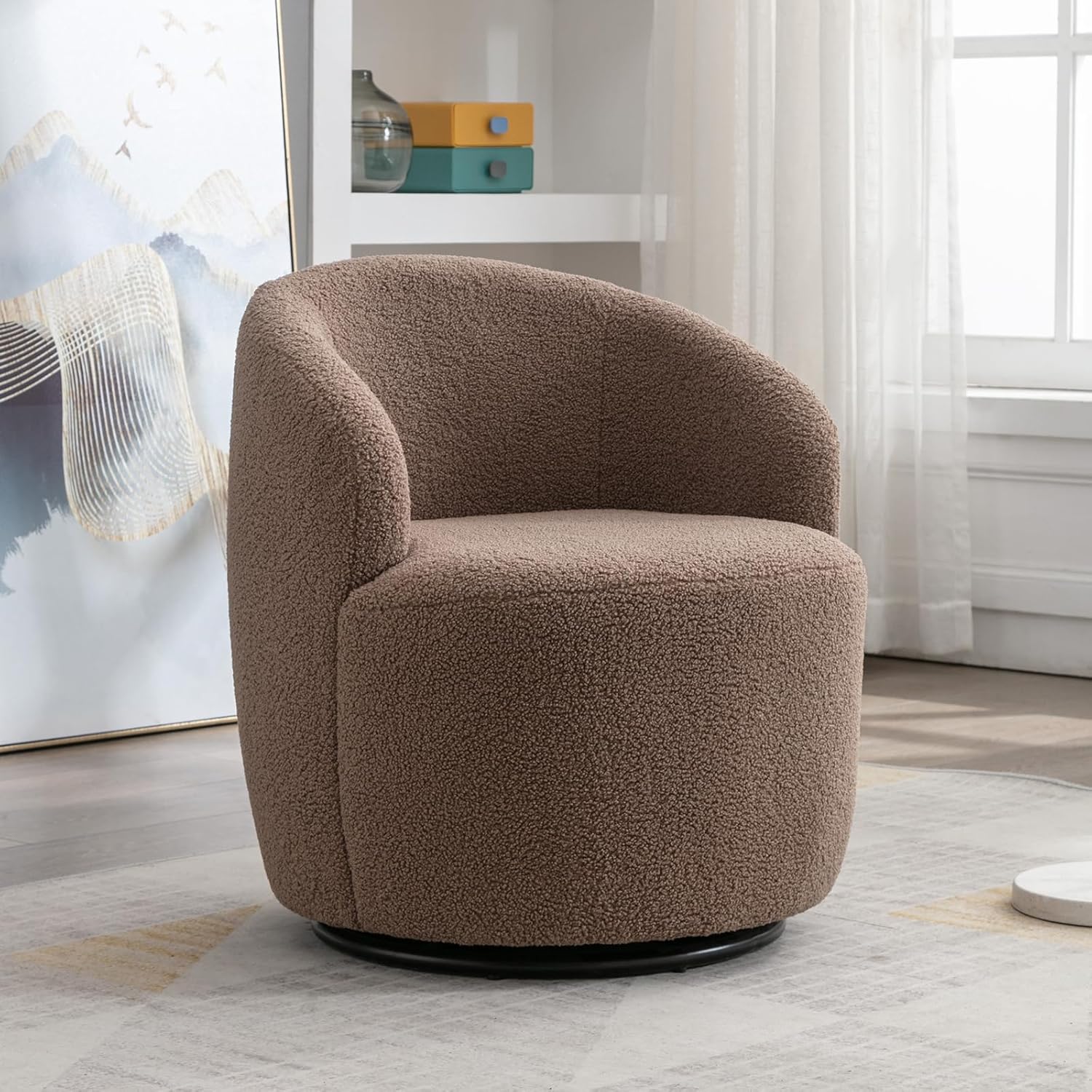
Upholstered Boucle Barrel Chair
Solves the “I need scale without bulk” problem — a barrel silhouette under 30″ wide that fits the small living room formula above. Good for first apartments and starter budgets.
One of the top-selling boucle accent chairs right now — stock moves fast in popular colorways.
Shop on Amazon
Mid-Century Leather Recliner with Ottoman
The rare accent chair that also functions daily — genuine leather over a solid wood frame, with an ottoman for the bedroom “landing zone” setup. Best for renters who want one chair to do it all.
Solid wood construction means it holds up to being repositioned every time you rearrange.
Shop on Wayfair
The Finishing Layers

Genuine Icelandic Sheepskin Throw
The texture layer from Step 3 of the anatomy section — drape it unevenly over one arm for the “lived-in” look, not folded square.
Shop on Amazon
Compact Aluminum Side Table
18″ wide — fits the 6–10″ anchor rule beside almost any chair without eating into the 30″ clearance zone.
Shop on Wayfair
78″ Arched Floor Lamp
The no-table-needed anchor from the living room section — the arch reaches over the chair’s shoulder without adding floor footprint.
Shop on Wayfair
Cotton Throw Pillow
A simple, textured swap that keeps the chair from matching the sofa exactly — the “not this” mistake from the anti-patterns section.
Shop on Wayfair
Brindle Cowhide Rug
Use this to define a chair’s “zone” without a wall, exactly like the renter rug trick above — and it rolls up easily for moving day.
Shop on Wayfair
Metal Desk Lamp
A low-profile light source for the home office nook that won’t compete visually with a desk lamp already on your workspace.
Shop on WayfairFrequently Asked Questions
Your Chair Was Never the Problem
Every rule in this guide on how to style an accent chair comes down to the same idea: an accent chair looks intentional the moment it has an angle, an anchor, and a texture — no permanent changes required. Whether it’s parked diagonal from your sofa, tucked into a bedroom corner, or filling a dead entryway, the formula travels with you from lease to lease.
Start with the room giving you the most trouble, apply the spacing and angle rules above, and reassess after a week of actually living with it. Small adjustments — six inches here, a fifteen-degree turn there — are usually all it takes to go from “chair that’s just there” to the piece guests ask about first. That’s how to style an accent chair for good, in any rental you call home.
Want the Full Styling System?
Grab The Decorator’s Black Book for room-by-room formulas beyond the accent chair.
Get the GuideCATCH THE LATEST IN HOME DECOR TRENDS:

Steal These 16 Expert-Approved Decorating Secrets

Accessorize a Small Living Room: 7 Genius Styling Secrets

How to Make a Small Room Appear Bigger

How to Make Your Home Look Expensive
GET CAUGHT UP ON ALL THE INSPIRING DECOR TIPS:

Best Fireplace Makeover Ideas

How to Make a Gallery Wall: The Complete Step-by-Step Guide (Even If You’ve Never Hung a Picture)