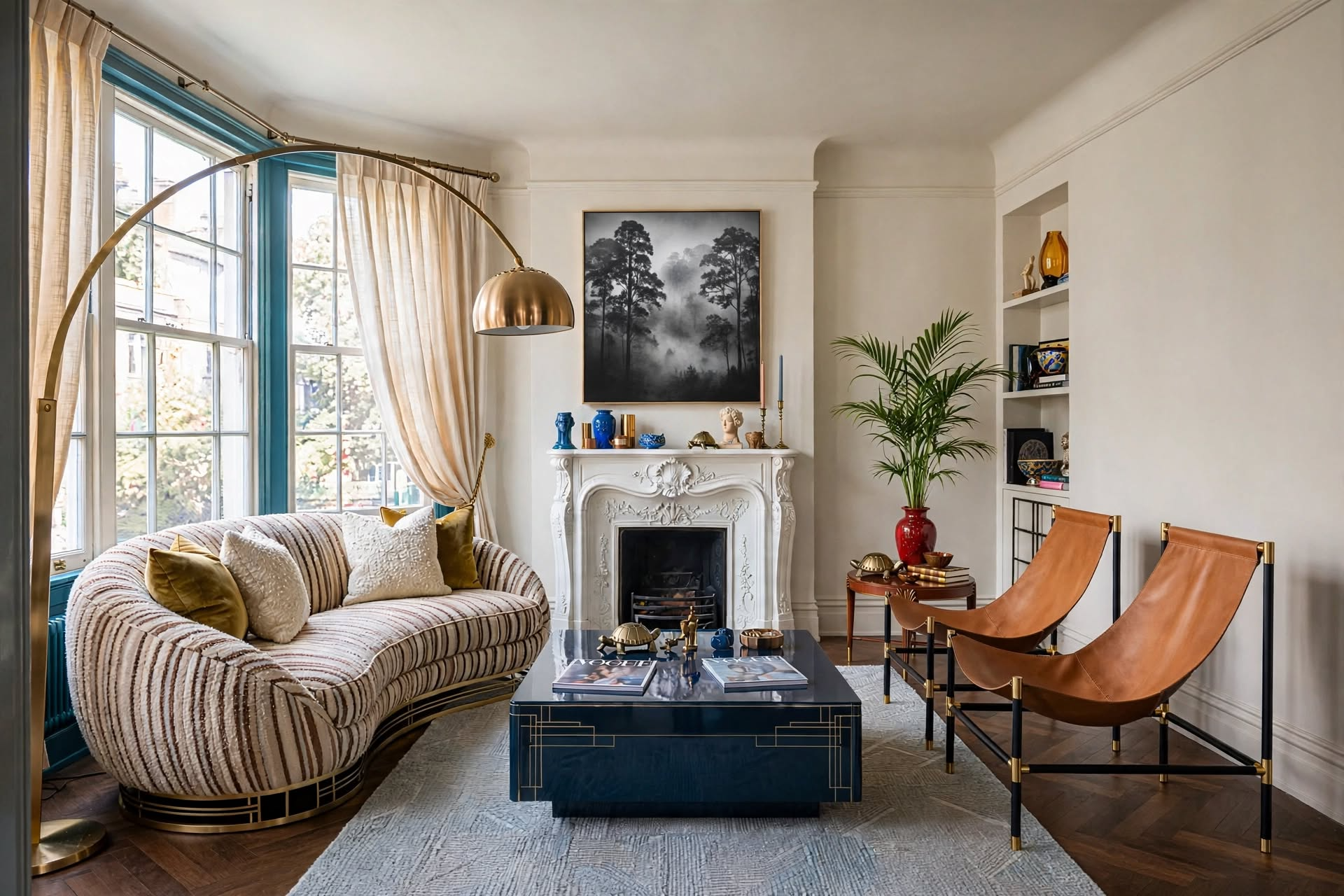
Here’s how to mix patterns so a room looks planned, not busy: use the Hero-Helper-Rest Method. Pick one hero pattern (your biggest, most colorful print, usually the rug, curtains or bedding) and pull your palette from it. Add a helper pattern from a different family (a geometric next to a floral, for example) at about half the size, sharing two of the hero’s colors. Then give the eye a rest with a small stripe, check or dot, plus solids and texture. Different scales, different shapes, shared colors.
Knowing how to mix patterns is the difference between a room that feels collected over years and one that feels like every pillow came from a different store. Most people either play it safe with all solids, or they fall in love with three prints at once and end up with a sofa that looks loud and a little stressful.
Free Ebook
The Small Space Playbook
Layouts, sizing rules and styling formulas for small rooms and apartments, all in one free guide.
Pattern mixing isn’t a talent you’re born with. It’s three decisions made in the right order. Here’s what this guide to how to mix patterns in home decor covers: the Hero-Helper-Rest Method, a simple way to measure pattern scale with a tape measure, a pairing chart for which patterns go together, six ready-made combinations, a small-space and rental version, and fixes for a room that already feels too busy.
What’s in This Guide
- What Is Pattern Mixing?
- The Hero-Helper-Rest Method
- Step 1: Choose Your Hero Pattern
- Step 2: Add a Helper Pattern
- Step 3: Give the Eye a Rest
- How to Measure Pattern Scale
- 6 Pattern Combinations That Always Work
- Mixing Patterns in a Small Space or Rental
- Where Pattern Goes, Room by Room
- Room Feels Too Busy? 5 Fixes
- Do’s, Don’ts and the Cheat Sheet
- Pattern Mixing FAQs
- Hero · Best classic rugThree Posts Hartley Oriental Rug — Wayfair
- Hero · Best for pets & kidsKeen Home Design Washable Rug — Amazon
- Helper · Best ready-made pairBecky Cameron Stripe + Floral Pillow 2-Pack — Wayfair
- Rest · Best quiet stripeRizzy Home Cotton Stripe Lumbar — Amazon
- Rest · Best texture + stripeAllModern Kannon Striped Throw — Wayfair
- Small Space · Best solid anchorEverly Quinn Chynna Velvet Chair — Wayfair

What Is Pattern Mixing?
Pattern mixing is using two or more different prints in the same room, like a floral rug, striped pillows and a checked throw, so they look like they belong together. It works when the patterns differ in size and shape but share colors. It fails when they’re all the same size, or when they share nothing at all.
Every guide on how to mix patterns comes back to the same three levers. Once you can see them, every other rule makes sense:

Scale (how big the pattern is)
In the swatches above, the floral is large, the diamond is medium and the ticking stripe is small. Three sizes means no two prints compete for the same job.
Shape (which pattern family it belongs to)
Curvy and organic (floral, paisley, botanical) versus straight and structured (stripe, geometric, check, plaid). Mixing one of each gives you contrast that feels calm.
Color (what ties it all together)
All three swatches share tan, cream and a soft green. Shared color is the glue. Even very different prints look related when they carry the same two or three colors.
When you learn how to mix patterns, texture is your secret helper. Texture is how a surface feels (bouclé, linen, jute, chunky knit). Pattern is a printed or woven design you can see from across the room. A good mix uses both, and texture is one of the best ways to add interest without adding another print.
The Hero-Helper-Rest Method
This is how to mix patterns in the order a designer actually makes the decisions. You choose one pattern to lead, one to support it and one to calm everything down. Each step has one job.
Hero
Your one largest, most colorful pattern, usually on the rug, curtains or bedding. Its colors become your palette.
Helper
A different pattern family at about half the hero’s size, repeating two of the hero’s colors.
Rest
A small stripe, check or dot, plus solids and texture, so the eye has somewhere to land.
The order matters when you’re learning how to mix patterns. If you start with pillows, you end up hunting for a rug that matches five small prints, which is almost impossible. If you start with the hero, every other choice becomes a simple question: does it share the hero’s colors, and is it a different size and shape?
Step 1: Choose Your Hero Pattern
Your hero is the biggest, boldest pattern in the room, and it sits on the largest surface: a rug, a pair of curtains, a duvet or quilt, or one wall of wallpaper. It’s the piece everything else answers to, so it should be the one you love most.

This living room shows how to mix patterns around one hero: the faded vintage rug. Everything above it is either a solid (the cream sofa, the leather bench) or a quieter pattern in the rug’s own colors. That’s why the room looks calm even though the rug is full of detail.
- 1Choose the biggest surface
Pattern on a large surface reads as calm and intentional. The same print on a small pillow just looks busy. Start with the floor, the windows or the bed.
- 2Pick a multicolor print
A hero with three or more colors gives you a ready-made palette. Vintage-style rugs, florals and ikats are easy heroes because they already hold several colors that work together.
- 3Write down its colors
Name one main color, one secondary color and one accent from the hero. Every other pattern in the room should carry at least two of them.
- 4Keep it to one hero per room
Two big, bold prints fight for attention. In a large open-plan space you can have one hero per zone, as long as the two share a color.
The fastest way to practice how to mix patterns is with what you already own. If you have a patterned sofa or a bold rug, that’s your hero, so don’t fight it. Build the rest of the room around its colors instead of buying a new hero.

Three Posts Hartley Oriental Indoor Rug
An oriental pattern is the easiest hero there is. It already holds several colors at low contrast, so you can pull your pillow and throw colors straight from it, just like the vintage rug in the photo above.
Why it’s a must: the rug is the biggest pattern in the room, so getting it right makes every smaller pattern easier to choose.
Skip it if you need a machine-washable rug for kids or pets; check the care details on the listing first.
Check Current Price on Wayfair →
Keen Home Design Washable Non-Slip Rug
A hero rug has to survive real life. This one is washable with a non-slip backing, so you can start your pattern on the floor in a home with kids, pets or rental floors without worrying about every spill.
Why it’s a must: you get a pattern to build the whole room around, and it can go in the wash.
Skip it if you want a thick, plush rug; washable rugs are flatter, and check that your washer can handle the size you choose.
Check Current Price on Amazon →Step 2: Add a Helper Pattern
The helper is the second pattern, and it has one job: support the hero without copying it. The rule for how to mix patterns at this step is simple. Choose a different pattern family, go about half the size, and repeat two of the hero’s colors.

Look at the pillows on this sofa. There’s a floral, a diamond geometric, a small check and a stripe, four patterns sitting side by side. It works because they all live in the same cream, taupe and charcoal family, and because each one is a different shape. The solid linen sofa and plain jute rug give all that pattern a calm background.
Which Patterns Go Together
Use this chart as a shortcut for how to mix patterns when you’re standing in a store holding two prints. Find your hero in the first column, then pick a helper from the second.
| If your hero is… | Try a helper that’s… | Why it works |
|---|---|---|
| Large floral | Medium geometric or small stripe | Straight lines give soft curves some structure |
| Bold geometric or ikat | Smaller floral or botanical | An organic shape softens hard edges |
| Vintage or oriental rug | Stripe, small check or subtle floral | The rug is already busy, so the helper should be simpler |
| Plaid | Small check, ticking stripe or tiny floral | Same traditional mood, different scale |
| Wide stripe | Floral or medallion | A curvy print breaks up all the parallel lines |
| Animal print | Stripe or solid-heavy mix | Treat animal print like a patterned neutral |
Figuring out how to mix patterns from the same family is easier than it sounds. You can mix two florals or two stripes. Just make them clearly different sizes (a big blowsy floral with a tiny ditsy one, or a wide awning stripe with a thin pinstripe) and keep at least one color exactly the same.
Pillows are the easiest place to start mixing fabric patterns, because they’re cheap to change and they sit right next to the hero. For exactly how many pillows to use and where they go, see my step-by-step pillow guides linked below. This section is about choosing the patterns, not arranging them.

Becky Cameron Yarn-Dyed Pillow 2-Pack (Stripe + Floral)
This set pairs a yarn-dyed Bengal stripe with a distressed floral, one of the most reliable pattern pairings there is, already color-matched for you. Put it next to a rug hero and you’ve done the helper step in one purchase.
Why it’s a must: two pattern families at two scales in one set, so the floral and stripe are guaranteed to share colors.
Skip it if your hero is already a big floral; then choose a geometric helper so the two florals don’t compete.
Check Current Price on Wayfair →
DEZENE Vintage Farmhouse Chenille Floral Pillow Covers
A faded chenille floral works as a helper next to a striped, plaid or geometric hero. It brings a curvy shape to balance straight lines, and the chenille adds soft texture at the same time.
Why it’s a must: an organic floral is the quickest way to soften a room full of stripes and grids.
Skip it if you need inserts included; check the listing, since decorative covers are often sold without them.
Check Current Price on Amazon →Step 3: Give the Eye a Rest
This is the step most people skip when they work out how to mix patterns, and it’s why their rooms feel busy. Rest comes in two forms: a small, simple pattern (a thin stripe, a tiny check, a scattered dot) and solid pieces with texture. Together they give the hero and helper space to look good.

Here the only pattern is a striped throw, and everything around it is solid: the ochre chair, the cream sofa, the jute rug, the linen curtains. The stripe adds rhythm, and the solids give your eye a place to stop. If the rest of your room has a hero and a helper, this corner is what keeps the whole space calm.
- Small-scale patterns: ticking stripes, pinstripes, gingham, tiny dots or a small woven texture. From across the room they almost read as a solid.
- Solids with texture: linen, bouclé, velvet, chunky knit, leather and jute. Texture keeps solids from looking flat.
- Spread the solids around: keep at least one solid next to every patterned piece, so patterns never sit three in a row.
Fabric choice matters here too. A ticking stripe in linen feels relaxed, while the same stripe in velvet feels formal. For a full guide to fabric types and where each one works, see the home textiles guide below.

Joss & Main Cason Rectangular Lumbar Pillow
A long lumbar in a quiet stripe sits in front of your bigger pillows and links them together. Its narrow lines read almost as a solid from across the room, which is exactly what a rest pattern should do.
Why it’s a must: one stripe between a floral and a geometric keeps the two from crowding each other.
Skip it if you need an exact size for a small loveseat; check the listing’s dimensions and whether an insert is included.
Check Current Price on Wayfair →
Rizzy Home Cotton Stripe Lumbar Pillow, Natural
A natural cotton stripe is the easiest rest pattern to work into any palette. The neutral ground lets it sit next to almost any hero, and cotton keeps it relaxed rather than formal.
Why it’s a must: a neutral stripe works with every pattern family, so it’s the safest third print you can buy.
Skip it if your room is already full of stripes; then use a tiny check or dot instead so the lines don’t repeat.
Check Current Price on Amazon →
AllModern Kannon Hand-Woven Striped Throw
A hand-woven wool-blend throw with brown, white and black stripes and a twisted fringe, very close to the throw in the photo above. It’s reversible and 50 x 70 in., big enough to actually use.
Why it’s a must: it adds a small-scale stripe and woven texture at the same time, so one piece covers the whole rest step.
Skip it if you want a throw you can toss in the washer; check the care label on the listing.
Check Current Price on Wayfair →
SARO Lifestyle Confetti Throw Blanket
A confetti pattern is a tiny, scattered print, which makes it a rest pattern that still adds a little fun. Because it carries several colors, it can echo your hero’s palette across a chair or sofa arm.
Why it’s a must: small scattered dots read as texture from a distance, so they calm a room instead of crowding it.
Skip it if your palette is tight and muted; confetti brings in several colors, so check that they match your hero.
Check Current Price on Amazon →How to Measure Pattern Scale
Every guide to mixing fabric patterns tells you to “vary the scale,” but few tell you how to tell large from medium from small. Here’s the simple way to measure it, and it’s the heart of how to mix patterns well. Every pattern is one design that repeats over and over. Measure one full repeat, from where a motif starts to where the same motif starts again.
- 1Find one repeat
Pick a motif, like one flower or one diamond, and find the next identical one. For stripes, measure one full stripe plus the space next to it. Many fabric listings also show the repeat size in the details.
- 2Sort it into a size
Use the working ranges in the table below. They’re guidelines to compare your fabrics against each other, not strict rules.
- 3Check that you have three different sizes
Your hero should land in the largest group, your helper one size down and your rest pattern in the smallest. If two land in the same group, swap one.
| Scale | Repeat size (working range) | Typical patterns | Best job |
|---|---|---|---|
| Large | About 8 in. and up | Big florals, medallion rugs, bold ikat, wide awning stripes | Hero |
| Medium | About 3 to 8 in. | Diamonds, trellis, medium plaid, block prints | Helper |
| Small | Under about 3 in. | Ticking stripe, gingham, pin dots, ditsy florals | Rest |
Lay your fabrics side by side, take a photo with your phone and switch it to black and white. If two prints turn into the same gray blur, they’re too similar in lightness and will look muddy together. You want at least one pattern that reads clearly lighter or darker than the others. It’s the quickest check on how to mix patterns that look crisp instead of muddy.
A room’s size also changes how scale reads. In a small room you see every pattern up close, so a large print looks even larger. In a big room seen from far away, small prints blur into texture. Keep that in mind when you go to the small-space section below.

6 Pattern Combinations That Always Work
If you’d rather learn how to mix patterns from a recipe, here are six pattern mixes to copy. Each one follows Hero-Helper-Rest, and the color dots show the shared palette that holds it together.
Faded Rug + Floral + Ticking
Hero: faded vintage rug. Helper: soft floral pillows. Rest: ticking stripe lumbar, linen sofa. The look in most photos in this post.
Blue Floral + Ikat + Pinstripe
Hero: blue-and-white floral curtains. Helper: medium ikat pillows. Rest: navy pinstripe, white slipcover, jute rug.
Rust Geometric + Botanical + Dot
Hero: rust-and-cream geometric rug. Helper: olive botanical print. Rest: tiny dot throw, cream bouclé chair.
Big Floral + Gingham + Solid
Hero: large floral quilt or curtains. Helper: medium gingham shams. Rest: tiny check pillow, white linen bedding.
Plaid + Paisley + Velvet
Hero: deep green plaid curtains. Helper: rust paisley pillows. Rest: solid velvet and leather, small houndstooth.
Tonal Stripe + Tonal Floral + Texture
Hero: cream-on-oatmeal floral. Helper: tonal stripe. Rest: bouclé, chunky knit and jute. Pattern for people who think they hate pattern.
Want the neutral version but need more help choosing which neutrals go together? The guide to decorating with earthy colors covers warm palettes like the ones above.
Mixing Patterns in a Small Space or Rental
Pattern isn’t off-limits in a small apartment. In fact, a little pattern makes a small room feel finished instead of bare. The trick to how to mix patterns in a small room is that everything is closer to you, so the rules get a bit stricter.

Count the patterns in this small living room: the rug, the curtains, the pouf, four pillows and a plaid throw. That’s a lot of pattern for a small space, and it still feels calm. Every print stays inside the same terracotta, sage and cream palette, the rug is clearly the hero, and the sofa, walls and leather chair are all solid.
One Big Pattern Only
Choose one large-scale hero, usually the rug. Two large prints in a small room crowd each other and make the walls feel closer.
Keep Big Pieces Solid
The sofa, the bed and big chairs should be solid. Let pattern live on smaller things you can swap: pillows, throws, poufs and lampshades.
Swap, Don’t Paint
Patterned curtains, a rug, pillow covers and peel-and-stick wallpaper on one wall give you all three steps without breaking your lease.
Cover, Then Commit
Pillow covers instead of new pillows mean you can change your helper and rest patterns each season for very little money.
Keeping the big pieces solid is the key to how to mix patterns in a tight space, so your sofa and accent chair become the places where the eye rests. A chair in a warm solid, like the ochre one earlier in this post, does more than another patterned piece would.

Everly Quinn Chynna Velvet Accent Chair
A velvet chair in a solid color gives a patterned room a place to rest. Velvet catches the light, so even a solid looks rich next to your prints. Choose a color option pulled from your hero.
Why it’s a must: a solid, textured chair is the rest step at furniture scale, which matters most in a small room.
Skip it if you have pets that scratch; velvet shows claw marks and paw prints.
Check Current Price on Wayfair →
Leftop Multi-Angle Corduroy Lounge Chair
Corduroy is a solid with built-in texture, so it rests the eye without looking flat. This lightweight chair has an adjustable back and is easy to move when you rearrange a small room.
Why it’s a must: the ribbed texture adds interest next to your patterns without adding another print.
Skip it if you want an upright, tailored accent chair; this is a relaxed lounge seat, so check its depth at full recline.
Check Current Price on Amazon →Where Pattern Goes, Room by Room
How to mix patterns works the same way in every room. What changes is which surface makes the best hero. Here’s where to put each step, with links to the room guides that go deeper.

In this bedroom the floral quilt is the hero, the ticking-stripe shams are the rest pattern, and the chunky knit throw and plain jute rug add texture without more print. Two patterns are enough when one is large and one is small.
Hero on the Floor
The rug is usually your hero, with helper and rest patterns on pillows and a throw. Keep the sofa solid. For pillow layouts, see how to arrange pillows on a couch.
Hero on the Bed
A patterned quilt or duvet leads, with striped or checked shams and solid sheets. For the full bedding order, see how to layer a bed, or keep it soft with neutral bedroom ideas.
Hero at the Window or Wall
Patterned curtains or a wallpaper wall make the best hero. Chair cushions or a table runner become the helper, and a solid rug keeps spills easy. More in how to decorate a dining room.
Keep It to Two
A patterned rug or curtains plus one small pattern is plenty. Your desk area should be the calmest view in the room so you can focus. See home office design tips.
Room Feels Too Busy? 5 Fixes
Even once you know how to mix patterns, a room can still feel off. If you already have patterns in a room and something isn’t right, it’s almost always one of these five problems. Find your symptom, then make the one change in the last column before you buy anything new.
| What you notice | What’s really wrong | The fix |
|---|---|---|
| Everything looks like one blur | All your patterns are the same scale | Swap one for a much larger or much smaller print |
| Patterns look random, not collected | They don’t share any colors | Remove the odd one out, or add a piece that contains both palettes |
| Two prints seem to fight | Two heroes, both large and bold | Demote one: move it to a smaller piece or another room |
| The room feels loud and tiring | No solids to rest the eye | Add solid, textured pieces between patterns, like a throw, a chair or plain curtains |
| It looks muddy in photos | Patterns are all the same lightness | Run the black-and-white test and add one clearly lighter or darker print |
When a room feels busy, take pieces out before you add anything. Remove one pillow or throw at a time and step back. The moment the room relaxes, you’ve found the piece that was competing.
Do’s, Don’ts and the Cheat Sheet
Do
- Choose your hero pattern first
- Use three different scales: large, medium, small
- Mix curvy and straight pattern families
- Repeat at least two hero colors in every print
- Put a solid next to every patterned piece
- Test fabrics side by side before you buy
Don’t
- Start with pillows and shop backward
- Put two large, bold prints in one small room
- Use the same size pattern on every piece
- Bring in a print that shares none of your colors
- Upholster every big piece in pattern
- Forget texture; solids need it too
How to Mix Patterns: The Cheat Sheet
- ◆1 per room (or zone)
- ◆Largest surface
- ◆3+ colors to pull from
- ◆Different pattern family
- ◆About half the hero’s size
- ◆Shares 2 hero colors
- ◆Small stripe, check or dot
- ◆Solids with texture
- ◆A solid beside every print
- ◆Large: about 8 in.+
- ◆Medium: about 3–8 in.
- ◆Small: under about 3 in.
- ◆1 main, 1 secondary, 1 accent
- ◆Every print carries 2
- ◆Pass the black-and-white test
- ◆One large print only
- ◆Big furniture stays solid
- ◆Pattern on swappable pieces
Pattern Mixing FAQs
Start with one hero pattern on your largest surface, like a rug or quilt, and pull its colors. Add a helper pattern from a different family at about half the size that shares two of those colors. Finish with a small stripe or check plus solid, textured pieces so the eye has somewhere to rest.
When you’re learning how to mix patterns, three different patterns (one large, one medium and one small) is the easiest number to get right. You can repeat each pattern in more than one place and add more prints once you’re confident, as long as they share your colors and you keep solids in between.
Yes. Stripes and florals are one of the most reliable pairings because one is straight and structured and the other is soft and curvy. Make one clearly bigger than the other and have them share at least one color.
Yes. Make the two florals very different sizes, such as a large floral on curtains and a small ditsy floral on a pillow, and keep at least one color exactly the same. Add a stripe or solid between them so they don’t blur together.
Yes. The key to how to mix patterns in a small room is using only one large-scale pattern, usually the rug, keep the sofa, bed and other big furniture solid, and put helper and rest patterns on small, swappable pieces like pillows, throws and poufs. A shared palette keeps a small patterned room calm.
Pattern is a printed or woven design you can see from across the room, like a stripe or floral. Texture is how a surface feels, like bouclé, linen, jute or chunky knit. Texture adds interest without adding another print, which makes it the best partner for pattern.
Use the same steps for how to mix patterns in color, just with tonal prints, such as a cream-on-oatmeal floral, a beige stripe and a small woven check. Because the colors are close, scale and texture do more of the work, so vary both and include at least one slightly darker print for contrast.
Your First Pattern Mix
Now you know how to mix patterns the way designers do: one hero, one helper and plenty of rest. You don’t have to redo a whole room to try it. Start with what you already own and work through it in this order:
- 1Name your hero
Find the largest pattern in the room. If there isn’t one, that’s your first purchase, usually a rug or curtains.
- 2Pull three colors
Write down the hero’s main, secondary and accent colors. Take a photo of it to bring shopping.
- 3Edit, then add
Remove any print that shares none of those colors. Then add one helper and one rest pattern at clearly different sizes.
- 4Check it in black and white
Snap a black-and-white photo of the room. If anything blurs together or jumps out, swap that one piece.
That’s how to mix patterns with the Hero-Helper-Rest Method. Once those three jobs are filled, you can keep adding pattern for years, and the room will still look like it was planned.
If you want the full formulas, spacing rules, and layout math from this guide (and every other room in your home) in one place, grab The Designer’s SECRET Cheat Sheet — it’s the shortcut version of everything a designer checks before calling a room finished.
Get the Cheat Sheet →And if you want more of this in your feed, come find us @thedecorholic on Instagram, Facebook, TikTok, and Pinterest for more room-by-room styling breakdowns like this one.

CATCH THE LATEST IN HOME DECOR TRENDS:

Accessorize a Small Living Room: 7 Genius Styling Secrets

How to Make a Small Room Appear Bigger

How to Make Your Home Look Expensive
GET CAUGHT UP ON ALL THE INSPIRING DECOR TIPS:

Best Fireplace Makeover Ideas

How to Make a Gallery Wall: The Complete Step-by-Step Guide (Even If You’ve Never Hung a Picture)