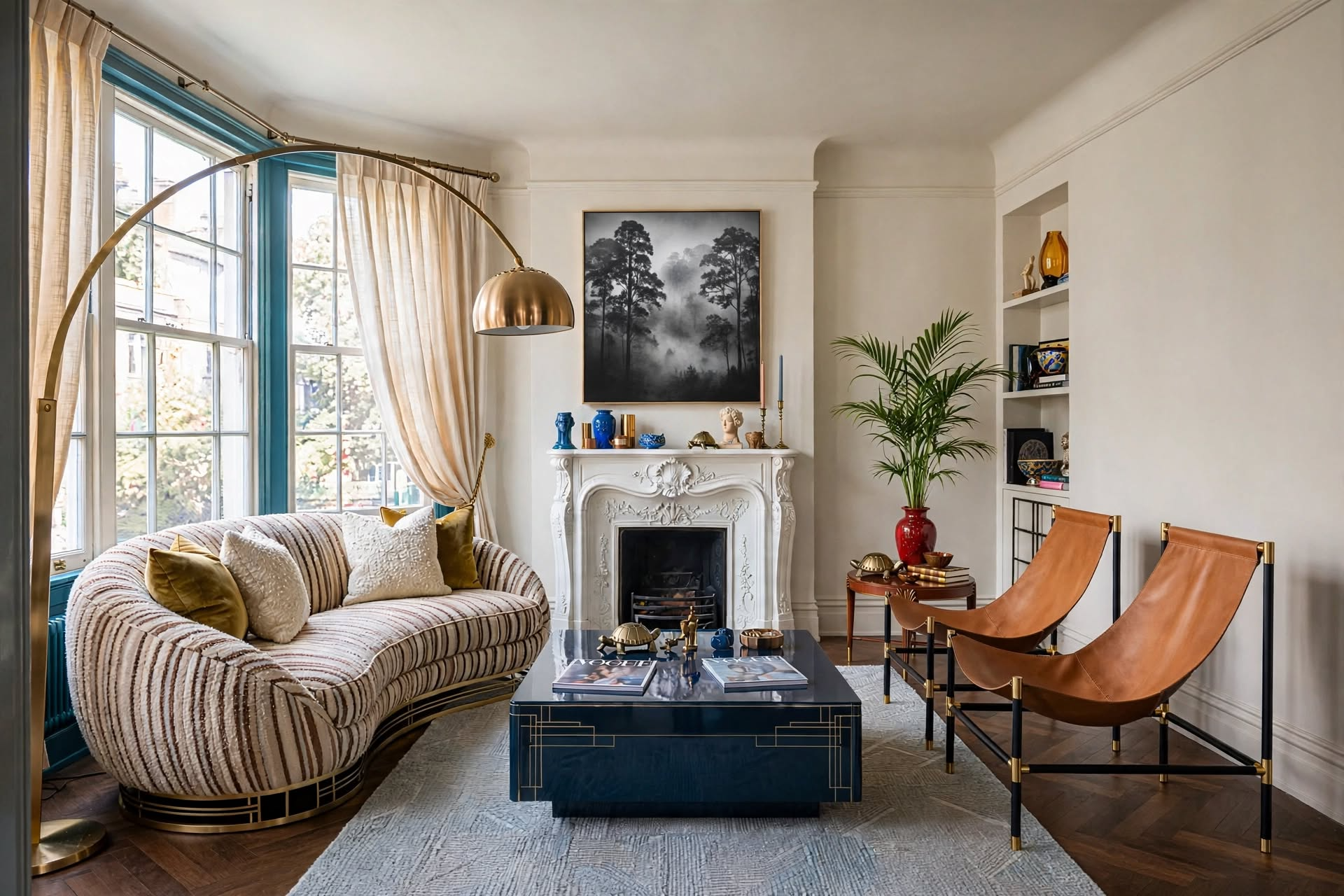
How to decorate shelves in three steps: Peak: set one tall anchor per shelf, about two-thirds of the shelf’s opening height. Stack: build medium and low pieces into a triangle in front of it, using books, art and objects in groups of three. Pause: leave 20–30% of every shelf empty. Then pull the whole unit together with a 2–3 color story and warm lighting.
Knowing how to decorate shelves is less about buying more decor and more about where each piece sits. Most cluttered shelves already have enough stuff on them. It’s just all the same height, spread out in a line, with no empty space for your eye to rest.
For Small Rooms & Rentals
Make every inch of wall and floor work harder
Layouts, sizing rules and storage tricks for small apartments and rooms, all in one designer playbook.
Get the Playbook →In this guide I’ll walk you through the three-step method I use on bookcases, built-ins and open shelving, plus eight ready-made formulas, color and lighting tips, and room-by-room ideas. Have wall-mounted shelves instead? See my guide on how to style floating shelves. It covers spacing, layouts and weight limits.
Table of Contents
Quick Picks
The four pieces that do the most work on a shelf. Tap a pick to jump to its card.
Peak
One tall anchor per shelf, about two-thirds of the opening height. Alternate its side from shelf to shelf.
Stack
Build medium and low pieces into a triangle from back to front: art, books, then a small object.
Pause
Leave 20–30% of every shelf empty. Empty space is what makes the rest look chosen.
Before You Decorate Shelves: Clear, Measure, Edit

Every lesson on how to decorate shelves starts in the same place: an empty shelf. Styling around what’s already there just rearranges the clutter.
- 1Empty every shelf
Take everything off and dust. If you’re stuck on what to keep, my 1-3-5 decluttering rule makes the decisions faster.
- 2Measure each opening
Note the height between shelves and the depth. Most bookcases are 10–12 in. deep, and that number decides what fits.
- 3Sort by height, not by type
Make three piles: tall, medium and low. You’ll pull one from each pile for every grouping.
- 4Edit ruthlessly
Keep what you love or use. Anything under about 3 in. tall either joins a tray or leaves.
Take the dust jackets off a few hardcovers. Bare cloth spines are often a calmer color, and they make books look more like decor.
How to Decorate Shelves, Step 1: Set Your Peak

Every shelf needs one tallest piece, its Peak. It’s the top point of a visual triangle: tall on one side, medium in the middle, low on the other. That triangle shape is what designers mean by the rule of three, and it’s the fastest fix for shelves that look flat.
- Size it to the opening: aim for about two-thirds of the height between shelves. In a 15 in. opening, that’s a piece around 10 in. tall.
- Leave headroom: keep at least 2 in. between the top of your Peak and the shelf above, or it looks jammed in.
- Zigzag it: left on the top shelf, right on the next, left on the one below. The eye follows that zigzag down the whole unit.
- Top shelf exception: an open top or a tall opening is where a big statement piece, like a bust, finally fits.

Joss & Main Ilma Handmade Vase Set of 3
Single vases bought one at a time rarely work together. This handmade set is already matched in finish and stepped in height, so your triangle is built for you.
Why it’s a must: Three heights give you a whole Peak grouping in one buy.
Skip it if you only need one statement vase.
Check Current Price on Wayfair →
Ceramic Farmhouse Vase Set
Glossy vases can look cold next to books and wood. Textured ceramic warms up a shelf and plays well with baskets and greenery.
Why it’s a must: Neutral ceramic fits almost any color story, so it’s the safest first piece.
Skip it if your room is sleek modern or glam; the texture reads rustic.
Check Current Price on Amazon →
Mercer41 Candle Holder Set of 2
One candle holder can look like an afterthought. A matching pair lets you repeat the same piece on two shelves, which ties a whole bookcase together.
Why it’s a must: Repeating one piece across shelves is the easiest way to make a unit look planned.
Skip it if you want a bolder statement finish; see the marble pair.
Check Current Price on Wayfair →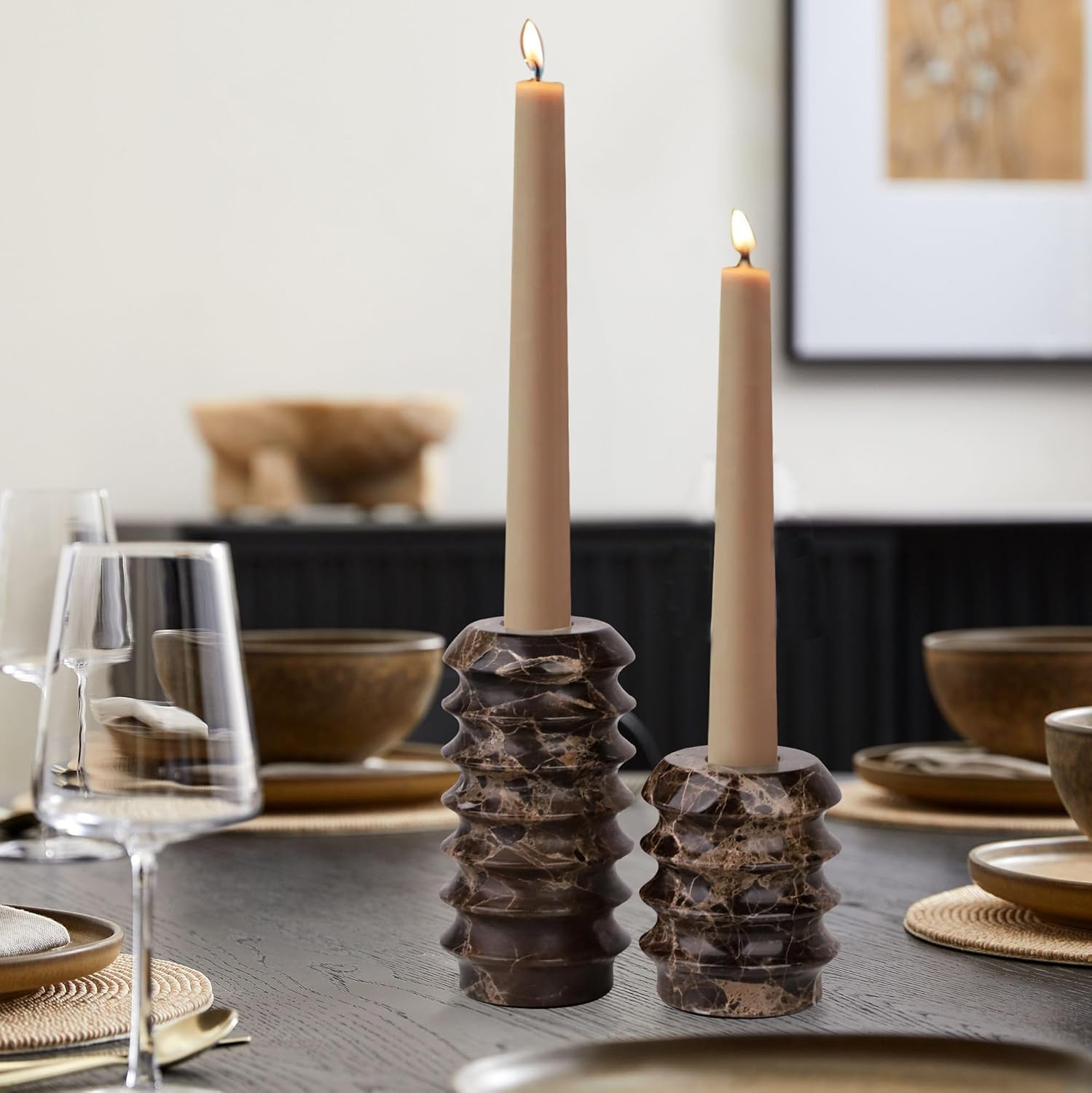
HofferRuffer Marble Candlestick Holders
Tall pieces are often wide pieces. Candlesticks give you a Peak without eating shelf depth, and marble makes them look expensive.
Why it’s a must: The quickest way to add a tall point to a crowded or shallow shelf.
Skip it if you’d burn real flames right under another shelf; use LED tapers.
Check Current Price on Amazon →
Winston Porter Bust on Stand
A shelf of small objects never gets noticed. One large sculpture can carry a whole shelf by itself and gives the eye a clear place to land.
Why it’s a must: It’s a complete Peak in one piece: height, presence and no clutter.
Skip it if your shelves are close together; at 21.5 in. tall it needs a top shelf or tall opening.
Check Current Price on Wayfair →
Design Toscano Augustus Bust
Shelves filled with store-bought decor can look generic. A classical bust gives them an instant gallery, collected-over-time feel.
Why it’s a must: One piece of classic sculpture makes the whole unit look curated.
Skip it if your style is boho or casual; a bust leans formal.
Check Current Price on Amazon →Step 2: Stack the Middle and Low Layers

With the Peak in place, build the rest of the triangle in front of it and beside it. Think back to front, tall to low.
- 1Lean art at the back
A framed print or small mirror leaning against the back wall is your medium layer. It should be about half the height of your Peak.
- 2Stack 3–5 books flat
A horizontal stack works as a riser. Set a small object on top to turn a low piece into a medium one.
- 3Overlap by about a third
Let the front piece cover roughly a third of the piece behind it. Overlap creates depth, which is what makes a shelf look layered instead of lined up.
- 4Mix textures and materials
Pair smooth with rough and shiny with matte: ceramic, wood, glass, woven. Two items in the same material can sit side by side; three in a row starts to look like a store shelf.
Books are the most useful layer here. Mix upright rows held by bookends with flat stacks, and don’t line every book to the front edge. My guide on decorating with coffee table books has more ways to use them.

Wrought Studio Non-Skid Bookends
A short row of upright books leans and slides as soon as you pull one out. Non-skid bases grip the shelf so the row stays straight.
Why it’s a must: Short book rows are the backbone of Stack, and they only look neat when they stand up straight.
Skip it if your look is traditional; these read modern.
Check Current Price on Wayfair →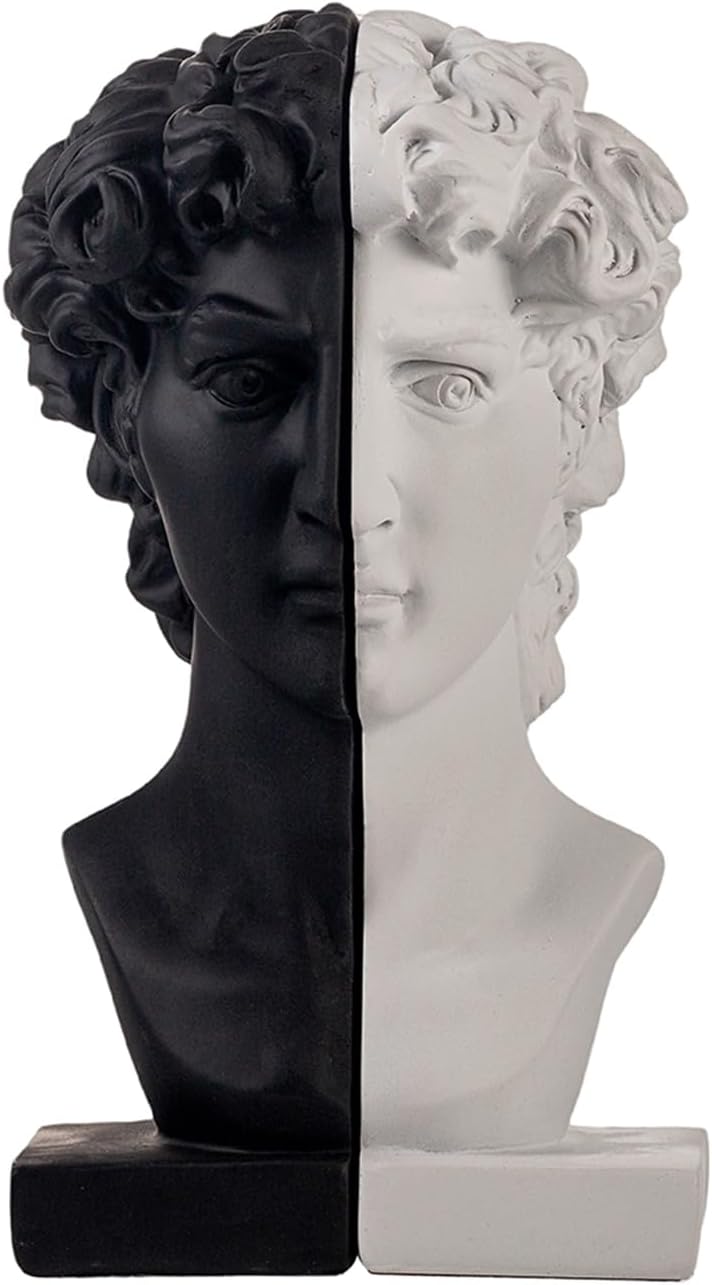
Lukitas David Head Decorative Bookends
Plain bookends do one job. A classical head holds your books and doubles as the sculptural object every grouping needs.
Why it’s a must: Two jobs in one piece means fewer items on the shelf, and more breathing room.
Skip it if your style is minimal or playful; a sculpted face is a strong look.
Check Current Price on Amazon →
Birch Lane Snook Decorative Book Set
Mismatched paperbacks make a shelf look busy. A coordinated onyx-and-gold set gives you a polished stack to lift a small object to the right height.
Why it’s a must: A flat stack is the riser that turns a low object into a medium one.
Skip it if you want books you’ll actually read; these are decor.
Check Current Price on Wayfair →
ORITZIO Oversized Decorative Books
Small books disappear on a wide shelf. Oversized covers give a stack enough presence to hold its own next to art and vases.
Why it’s a must: Bigger books give a stack real visual weight on wide or deep shelves.
Skip it if your shelves are shallow; oversized books can hang past the edge.
Check Current Price on Amazon →
8 Shelf Styling Formulas

Need a starting point? These ready-made groupings work with things you probably already own. Use one per shelf, and don’t repeat the same formula on shelves that sit next to each other.
- 1The Classic Trio
Leaning 8×10 in. print + 3–5 books lying flat + a small plant or object on top.
- 2Art + Greenery + Sculpture
A framed print, a tall plant beside it, and a sculptural object in front.
- 3Books + Bowl + Object
A book stack for height, a decorative bowl for shape, and one small accent.
- 4Candlesticks + Leaning Art + Something Natural
A pair of candlesticks, art leaning behind, and driftwood, a shell or a branch.
- 5Vase + Photo + Box
The vase is the Peak, a framed photo adds meaning, and a lidded box adds texture and storage.
- 6Upright + Flat Books + Sculpture
A short upright row and a flat stack side by side, with one sculptural piece on top of the stack.
- 7The Solo Statement
One large vase or bust alone, centered or set just off-center. Let the empty space do the rest.
- 8The Basket Shelf
Two or three matching baskets on the bottom shelf to ground the unit and hide everyday things.
Step 3: Pause and Leave Breathing Room

Negative space, the empty area around and between objects, is what separates a styled shelf from a stocked one. Leave 20–30% of each shelf empty. On a 36 in. shelf, that’s about 8–11 in. of open space, usually between groupings rather than squeezed at the ends.
- One or two groupings per shelf. Not a line of single objects.
- Vary the density. If one shelf is fuller, keep the next one sparer. That rhythm is what makes a whole bookcase look designed.
- Send clutter to boxes and baskets. Lidded boxes and bottom-shelf baskets keep everyday things close without filling your empty space.
Stand across the room and check three things in order: balance (does one side feel heavier?), color (is any color stuck in one corner?), and edit (does anything feel missing, or like too much?). Then take a phone photo. Photos show imbalance you can’t see in person.

George Oliver Knouse Checkered Decorative Box
All-solid shelves can feel flat. A checkered box adds pattern at the low level and hides the small things you don’t want on display.
Why it’s a must: It’s a low piece and hidden storage in one, so it protects your empty space.
Skip it if your room is already pattern-heavy.
Check Current Price on Wayfair →
REEMTOO Shagreen Decorative Boxes
Remotes, chargers and keys creep onto every open shelf. Lidded shagreen boxes hide them and add a textured, high-end look.
Why it’s a must: Shelves only stay styled when everyday clutter has somewhere to go.
Skip it if you need to see what’s inside at a glance.
Check Current Price on Amazon →
Bungalow Rose Water Hyacinth Baskets, Set of 3
Bottom shelves turn into a pile of blankets, games and cords. Hand-woven baskets hide it all and add warm texture where the unit needs visual weight.
Why it’s a must: Baskets ground the bottom of a shelving unit so the top can stay light.
Skip it if your shelves are shallow; baskets need a deeper shelf to sit fully on it.
Check Current Price on Wayfair →
Handwoven Foldable Storage Boxes with Handles
Rigid bins are hard to pull off a high shelf. Handles make these easy to grab, and they fold flat when you don’t need them.
Why it’s a must: You can reach what’s inside without unstyling the whole shelf.
Skip it if you want rigid boxes for stacking.
Check Current Price on Amazon →How to Decorate Shelves With a Color Story

A color story is what makes a full bookcase look like one design instead of a collection of separate shelves. Pull it from the room you already have: your rug, sofa or art.
- 2–3 main colors make up most of your objects and book spines.
- 1–2 accent colors show up in small doses, like one vase or one book stack.
- Spread each color out. Repeat an accent on at least two shelves, in a loose zigzag, so no single shelf holds all of it.
- Vary the shades within a color family for a richer, layered look.
Not sure where to start with color? My guide to choosing the right color for your room walks through building a palette.

Shelf Lighting That Makes It Glow

Lighting is the part of how to decorate shelves that most guides skip. Most shelves only get overhead light, which flattens everything. A little light on the shelves themselves makes your styling show up at night.
- Puck lights mounted under each shelf wash light over the one below. Battery and rechargeable versions need no wiring.
- Warm white bulbs (about 2700K) keep wood and ceramics looking cozy. Cooler light can look clinical on decor.
- A small lamp on a wide shelf adds a pool of light and counts as your Peak.
- Battery candles in candlesticks give a safe glow right under another shelf.

Ezvalo Rechargeable LED Lights, 6-Pack
Styled shelves disappear after dark. These wireless lights mount under a shelf to wash the one below with light, and they come with a remote.
Why it’s a must: Peel-and-stick mounting lights a bookcase with no wiring and no holes.
Skip it if you don’t want to recharge lights from time to time.
Check Current Price on Wayfair →
Rechargeable Wireless Puck Lights
Overhead light flattens a shelf. Dimmable puck lights add a soft glow that makes vases and art look like a lit display.
Why it’s a must: Lighting is the step most people skip, and it changes the look the most at night.
Skip it if you’d rather have a hardwired system that’s always on.
Check Current Price on Amazon →How to Decorate Shelves in Every Room

How to decorate shelves doesn’t change from room to room. The Peak-Stack-Pause Method works everywhere. What changes is how much of each shelf is useful versus decorative.
Built-Ins Around a Fireplace
Style the two sides as mirror images: matching candlesticks or vases at the same height on each side, with looser, layered groupings in between. For the full room plan, see how to style a living room.
Open Kitchen Shelves
Lead with things you use every day: stacked bowls, mugs and cookbooks. Add one or two decorative pieces per shelf, and keep anything precious away from the stove.
Bathroom Shelves
Use lidded jars and baskets for the everyday things, then add one plant and one candle. Pick materials that handle steam, like glass, ceramic and sealed wood.
Bedroom Shelves
Keep it softer and more personal: photos, a few favorite books and a candle. Keep anything heavy or breakable off shelves that hang over a bed.
Floating Shelves
No sides means every shelf needs both ends capped and a careful weight limit. My guide on how to style floating shelves covers spacing, layouts and hanging.
Full Bookcases
With five or more shelves, plan the whole unit as one picture before styling any single shelf. My bookcase styling guide goes shelf by shelf.
Styling a console or entry table too? The same triangle shows up in my console table 3-step formula, and a trailing plant is one of the easiest Pause-friendly additions. See my plant styling guide for which plants suit a shelf.
Shop the Shelf: The Rule-of-Three Kit
If you’re shopping for how to decorate shelves from scratch, start here. Every grouping on this page uses a tall, a medium and a low piece. Here’s the full kit, sorted by layer. Tap any piece to jump to its card.
Tall
The Peak
- Ilma Vase Set of 3 · Wayfair
- Ceramic Farmhouse Vases · Amazon
- Mercer41 Candle Holders · Wayfair
- Marble Candlesticks · Amazon
- Bust on Stand · Wayfair
- Augustus Bust · Amazon
Medium
The Stack
- Non-Skid Bookends · Wayfair
- David Head Bookends · Amazon
- Snook Book Set · Wayfair
- Oversized Decorative Books · Amazon
- Vintage Frames Set · Amazon
- Ezvalo LED Lights · Wayfair
Low
The Pause
- Checkered Decorative Box · Wayfair
- Shagreen Boxes · Amazon
- Woven Baskets, Set of 3 · Wayfair
- Foldable Storage Boxes · Amazon
- Dimmable Puck Lights · Amazon
Shelf Styling Do’s & Don’ts
Do
- Give every shelf one clear tall Peak
- Group in threes: tall, medium and low
- Leave 20–30% of each shelf empty
- Repeat accent colors on at least two shelves
- Hide everyday clutter in boxes and baskets
Don’t
- Line up a row of same-height objects
- Fill shelves with lots of tiny items
- Make every shelf perfectly symmetrical
- Pair very large pieces with very tiny ones on one shelf
- Push every book to the front edge
The Shelf Styling Cheat Sheet
How to decorate shelves, on one screen. Screenshot it before you start.
- ◆Peak: one tall anchor
- ◆Stack: build the triangle
- ◆Pause: 20–30% empty
- ◆≈ ⅔ of the opening height
- ◆2+ in. headroom above
- ◆Zigzag side to side
- ◆Art at the back
- ◆3–5 books flat as a riser
- ◆Overlap about ⅓
- ◆1–2 groupings per shelf
- ◆Vary density shelf to shelf
- ◆Nothing under ~3 in. alone
- ◆2–3 main colors
- ◆1–2 accents
- ◆Repeat on 2+ shelves
- ◆Warm 2700K light
- ◆Baskets on the bottom shelf
- ◆Step back and photograph
How to Decorate Shelves: FAQs
Use fewer, larger pieces and group them in threes (tall, medium and low) instead of spreading single items in a line. Leave 20–30% of each shelf empty, and move small everyday things into lidded boxes or baskets.
A mix of books, one or two pieces of art, a tall vase or candlestick, a small sculptural object, greenery, and a box or basket for hidden storage. Choose by height first, so every shelf has a tall, medium and low piece.
Most shelves look best with one or two groupings of about three pieces each, so roughly 3–6 items, with a fifth to a third of the shelf left empty.
Layer from back to front: lean art or a large piece at the back, a medium item in the middle, and something low at the front. Stagger the pieces instead of lining them up, so the depth reads as layers.
Treat the two sides as a pair. Put matching or very similar Peak pieces at the same height on both sides for symmetry, then style the groupings between them more loosely.
It’s an arrangement where a tall piece, a medium piece and a low piece form a triangle shape. The shape guides the eye across the shelf and makes a grouping look intentional.
Yes. Mixing vintage and modern pieces or natural and glam finishes adds interest. A consistent color story of 2–3 main colors keeps a mixed shelf from looking random.
Your Shelf Styling Action Plan
Now you know how to decorate shelves the way a designer does. Clear everything off and sort it into tall, medium and low. Then work the Peak-Stack-Pause Method one shelf at a time: set a tall anchor, build the triangle in front of it, and leave a fifth to a third of the shelf empty. Finish with a color story and warm light.
Give it a day, then take one thing off each shelf. The best shelves look collected over time, not filled in an afternoon.
If you want the full formulas, spacing rules, and layout math from this guide (and every other room in your home) in one place, grab The Designer’s SECRET Cheat Sheet — it’s the shortcut version of everything a designer checks before calling a room finished.
Get the Cheat Sheet →And if you want more of this in your feed, come find us @thedecorholic on Instagram, Facebook, TikTok, and Pinterest for more room-by-room styling breakdowns like this one.

CATCH THE LATEST IN HOME DECOR TRENDS:

Accessorize a Small Living Room: 7 Genius Styling Secrets

How to Make a Small Room Appear Bigger

How to Make Your Home Look Expensive
GET CAUGHT UP ON ALL THE INSPIRING DECOR TIPS:

Best Fireplace Makeover Ideas

How to Make a Gallery Wall: The Complete Step-by-Step Guide (Even If You’ve Never Hung a Picture)