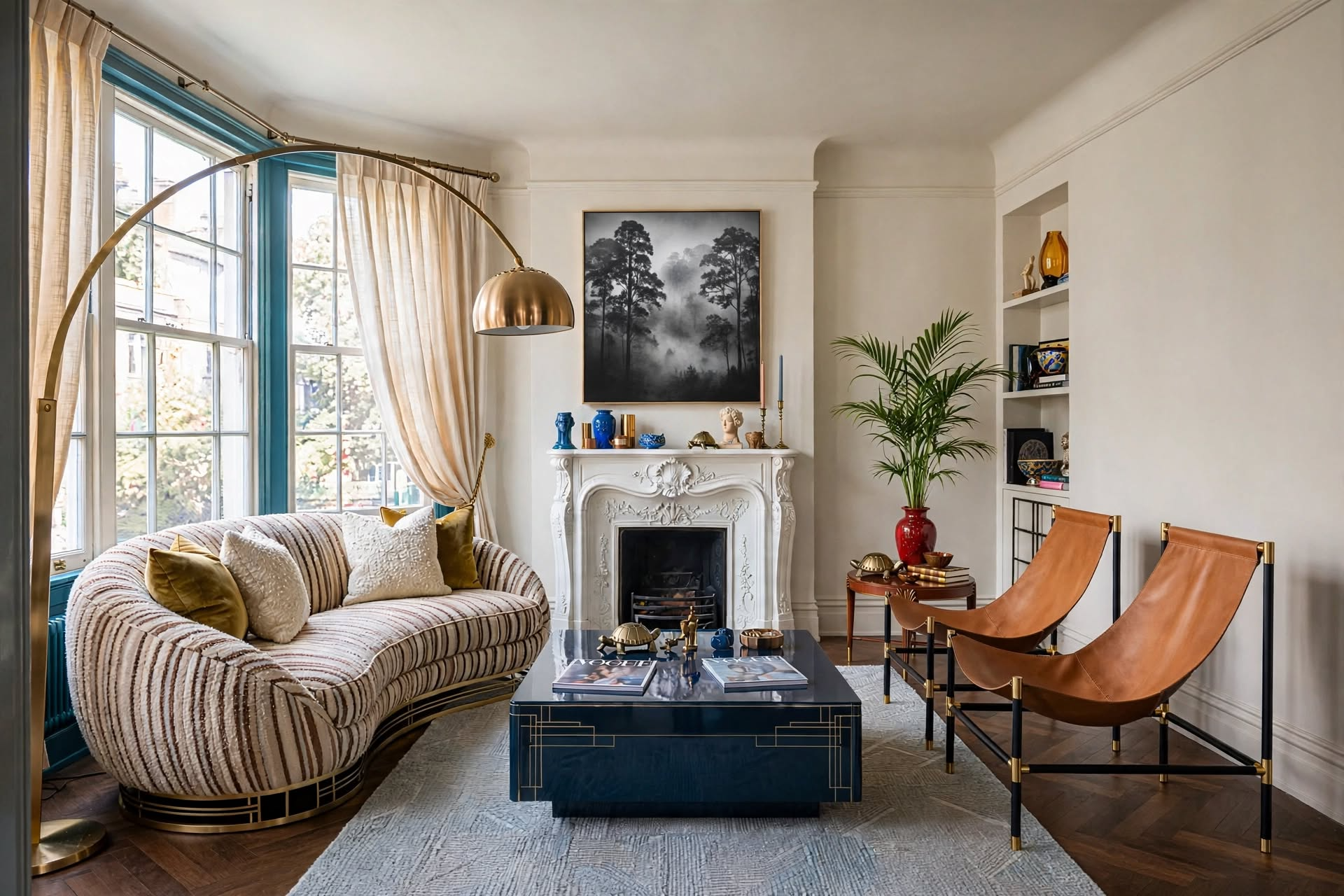
To layer a rug, start with a large, flat, neutral base rug sized to your furniture (usually 8×10 or 9×12 in a living room). Add a smaller top rug with the pattern or texture, leaving at least 12 inches of the base showing on every side, so an 8×10 base takes a 5×8 or 6×9 top. Repeat one color between the two, keep both rugs low and flat, and use a non-slip gripper between the layers.
When you layer a rug well, a room instantly looks more collected. A big, plain rug does the hard work of anchoring the furniture, and a smaller rug on top adds the color, pattern or softness.

It’s also one of the most practical tricks in decorating. Layering lets you use a vintage rug that’s too small for the room, add a bold pattern without committing to it wall to wall, and get a large-rug look for less, because natural jute bases are among the most affordable big rugs you can buy.
When it goes wrong, it’s almost always one of three things: the two rugs are too close in size, the patterns fight, or the stack is a tripping hazard. This guide covers how to avoid all three, with a size pairing chart, texture formulas and a room-by-room plan.
In This Guide
- The Base-Top-Border Method
- Choosing the Base Rug
- Size Pairing Chart
- 4 Ways to Place the Top Rug
- Texture and Pattern Formulas
- Layering a Rug That’s Too Small
- Living Room
- Bedroom
- Dining Room
- Home Office and Entryway
- Small Spaces and Carpet
- Keeping Layers Flat and Safe
- Shopping List
- Do’s and Don’ts
- Designer’s Cheat Sheet
- FAQs
Base
A large, flat, neutral rug sized to the furniture: jute, sisal or a plain flat-weave. It does the anchoring.
Top
A smaller rug with the personality: a vintage pattern, a kilim, a cowhide or a sheepskin.
Border
At least 12 inches of base showing on every side. That border is what makes it look intentional.
Every layered look you’ve admired follows these three steps. The base handles size, the top handles style, and the border is the proof that you meant to do it.
Section 01 · The FoundationChoosing the Base When You Layer a Rug

The base rug is the one that has to be the right size. It follows the same rules as any area rug: in a living room, at least the front legs of every seat should sit on it, with 12 to 18 inches of bare floor to the walls.
- Jute and sisal are the classic base. They’re textured, neutral and among the most affordable large rugs. Jute is softer; sisal is firmer and more refined.
- Flat-weave wool or cotton is softer underfoot and works well in bedrooms.
- Low-pile solids in a neutral tone work when you want a quieter look than natural fiber.
Keep the base low and flat. A thick or shaggy base makes the top rug shift, bunch and catch toes.
Mark both rug outlines on the floor with painter’s tape before you buy. You’ll see right away whether the border is wide enough and whether the top rug lands where you want it.
Rug Layering Size Pairing Chart
The top rug should be clearly smaller than the base, about 1 to 3 feet smaller on each side. If the two rugs are close in size, it looks like a mistake. If the top rug is tiny, it gets lost.
| Base Rug | Top Rug | Best For |
|---|---|---|
| 6×9 | 4×6 | Small living rooms, home offices, bedrooms with a full bed |
| 8×10 | 5×8 or 6×9 | Most living rooms, queen bedrooms |
| 9×12 | 6×9 | Large living rooms, king bedrooms |
| 10×14 | 8×10 | Large and open-plan living rooms |
| Any size | Sheepskin or cowhide | Organic-shaped accents, which don’t need an even border |
Aim for at least 12 inches of base showing on every side of a rectangular top rug. Less than that and it reads as two rugs that almost match; more than about 3 feet and the top rug starts to float.
4 Ways to Place the Top Rug
Once your base is down, there are four ways to place the top rug. Each diagram shows a living room from above.
Centered
The top rug sits right in the middle of the base, under the coffee table, with an even border all around. It’s the classic, tailored look.
Best for: traditional and formal rooms, symmetrical layouts
The safest choiceOff-Center
The top rug shifts toward one side, such as under a reading chair or toward the sofa. It feels relaxed and collected rather than matched.
Best for: boho and eclectic rooms, L-shaped seating
Relaxed and collectedAngled
The top rug is turned at a slight angle. It works best with a hide or a vintage rug and adds energy to a room full of straight lines.
Best for: modern, rustic and boho rooms; cowhides
Add some movementMixed Shapes
A round top rug on a rectangular base softens the layout and frames a round coffee table. The base still follows the furniture.
Best for: round coffee tables, small living rooms
Softens hard linesTwo rugs is the classic layered look. Three can work in a large or boho room, like a base, a top rug and a hide, but keep the base neutral and stop there. More than three starts to look cluttered and becomes a tripping hazard.
Texture and Pattern Formulas
These pairings work when you layer a rug in almost any room. Pick the one that matches your style, then choose rugs that share at least one color.
Natural + Pattern
Jute or sisal base with a vintage, Persian or kilim top rug. Works from traditional to boho.
Flat + Fluffy
A flat-weave base with a sheepskin on top. The contrast in texture does all the work.
Natural + Hide
Jute with a cowhide on top, set at a slight angle. Great for modern and rustic rooms.
Neutral + Graphic
A plain base with a black and white or geometric top rug for modern spaces.
Two Patterns
One large-scale and one small-scale pattern, sharing at least one color.
Tone on Tone
Two rugs in the same color family with different textures, for a calm, layered look.
If you only remember one rule, keep one rug quiet. When both rugs are bold, they compete; when one is plain, the other gets to shine.
Section 05 · Rescue a RugHow to Layer a Rug That’s Too Small
Bought a rug that floats in the middle of the room? Don’t return it yet. Layering is the easiest way to rescue a rug that’s the wrong size, because the base takes over the job of reaching the furniture.
- 1Measure the furniture group
Measure the area the rug should cover, so the front legs of the sofa and chairs can sit on it. That’s the size your base needs to be.
- 2Check the border
Your current rug should be at least 12 inches smaller than the base on every side. If a 5×8 rug is too small, an 8×10 base works; a 6×9 rug needs a 9×12 base.
- 3Choose a plain base
Pick a jute, sisal or flat-weave base in a neutral that suits your current rug, so the rug you already love stays the star.
- 4Place and secure it
Center it under the coffee table or shift it toward the seating, then add a gripper between the layers.
This also works for a vintage or heirloom rug that’s smaller than modern rooms need. Layering lets you keep it in the main living space instead of moving it to a hallway.
Section 06 · Living RoomHow to Layer a Rug in the Living Room
The living room is where layering makes the biggest impact. Size the base for the full seating group, then use the top rug to frame the coffee table area.
- Base: Front legs of the sofa and chairs on it, usually an 8×10 or 9×12.
- Top: Centered under the coffee table, extending past the table on all sides. It doesn’t need to reach the furniture legs.
- Shape: A round or hide-shaped top rug softens a room full of straight lines.
- Open plan: Layering helps define the seating zone within a larger space.
How to Layer a Rug in the Bedroom

In a bedroom, comfort matters more than durability, so this is the place for soft textures.
- Base: Under the bottom two-thirds of the bed, with 18 to 24 inches showing on each side and at the foot. That’s usually an 8×10 for a queen and a 9×12 for a king.
- Top: A sheepskin or small rug at the foot of the bed or on the side you get out of.
- Keep paths clear: Don’t put the top rug in the path to the bathroom or closet, where you’ll walk at night.

 Section 08 · Dining Room
How to Layer a Rug in the Dining Room

Dining rooms are the hardest place to layer, because chairs slide in and out all day. Done right, though, it’s a beautiful look.
- Base: About 24 inches past the table on every side, so chairs stay on the rug when pulled out. That’s usually an 8×10 for a six-seat table and a 9×12 for eight.
- Top: Ideally large enough that the chairs stay on it too when pulled out. If it isn’t, chair legs will catch on its edge.
- Keep both flat: Low-pile and flat-weave rugs let chairs glide. Skip sheepskins and shag here.
- Pick easy-clean tops: A washable or patterned top rug handles spills better than a delicate vintage piece.
In a tight dining room, skip the second layer under the table and use one well-sized rug instead. Layer a rug in the living area nearby and repeat a color, so the two spaces still feel connected.
Home Office and Entryway

Home office: To layer a rug under a desk, make the base big enough that your chair stays on it when you roll back from the desk. A rolling chair works best on a flat top rug, or with the top rug placed in front of the desk where you don’t roll.
Entryway: A small layered pair, like a jute mat with a vintage rug on top, adds personality right at the door. Keep both thin enough to clear the door swing, and use a gripper so nothing slides.
Section 10 · Small SpacesSmall Spaces, Rentals and Carpet

You can layer a rug in a small room, too. In a small space, a large, light base rug makes the room feel bigger, and a small top rug adds personality without clutter.
- Size the base up, not down. A bigger base reads as more floor and makes the room look larger.
- Keep the palette close. In a small room, two rugs in related colors feel calmer than two contrasting ones.
- Layer over carpet. A rug over wall-to-wall carpet is a renter-friendly way to cover a dated color. Use a gripper made for rug-on-carpet so it doesn’t creep.
Keeping Layered Rugs Flat and Safe
When you layer a rug, safety comes down to one thing: keeping both layers flat and still.
- Pad the base. Use a thin non-slip pad under the base rug on hard floors.
- Grip the top. Use a rug-to-rug gripper or thin non-slip pad between the layers so the top rug doesn’t drift.
- Keep it low. Two thin rugs are better than one thin and one thick. Total height matters at doors and in walkways.
- Flatten the corners. Curled edges are trip hazards. Reverse-roll a curling corner or use corner grippers.
- Keep edges out of paths. Don’t let the edge of the top rug cross a main walkway where people will catch a toe.
What You Need to Layer a Rug
Here’s everything that goes into a layered look, and what to look for in each piece before you buy.
| Piece | What to Look For |
|---|---|
| Base rug | Jute, sisal or flat-weave in a neutral tone; low and flat; sized to your furniture (usually 8×10 or 9×12) |
| Top rug | Low pile or flat-weave with the pattern or color; 1 to 3 ft smaller per side than the base |
| Accent hide or sheepskin | A cowhide for modern or rustic rooms, a sheepskin for bedrooms; no even border needed |
| Rug pad | A thin non-slip pad under the base, about an inch smaller than the base on every side |
| Rug-to-rug gripper | A thin gripper or pad made to sit between two rugs, so the top layer doesn’t drift |
| Corner grippers | For any top-rug corner that curls or lifts |
Spend on the rug people see most. A large jute base is one of the most affordable big rugs you can buy, so put more of your budget into the top rug.
Rug Layering Do’s and Don’ts
Do
- Size the base to the furniture
- Leave at least 12 in. of base showing
- Keep one rug neutral
- Repeat one color between the rugs
- Use grippers between layers
- Tape both outlines before buying
Don’t
- Layer two rugs that are close in size
- Use a thick or shaggy base
- Pair two bold patterns of the same scale
- Let a top-rug edge cross a walkway
- Put a sheepskin under a dining table
- Skip the pad on hard floors
Designer’s Cheat Sheet: How to Layer a Rug
Base to Furniture
Front legs of every seat on the base, usually 8×10 or 9×12.
12-Inch Border
At least 12 in. of base showing around the top rug.
One Size Down
8×10 base takes a 5×8 or 6×9; 9×12 takes a 6×9.
One Quiet, One Loud
A plain base lets the patterned top rug shine.
Share One Color
Repeat at least one color between the two rugs.
Low, Flat, Gripped
Thin rugs, a pad under the base, a gripper between layers.
How to Layer a Rug: FAQs
Your Rug Layering Action Plan
Once you know how to layer a rug, it’s simple: a big, plain base sized to your furniture, a smaller top rug with the personality, and at least 12 inches of border between them. Repeat one color, keep everything flat, and the look feels planned.
Start this week: measure your seating area, find your base and top sizes in the pairing chart, and tape both outlines on the floor. If you already own a rug that’s too small for the room, it may be the perfect top layer.
If you want the full formulas, spacing rules, and layout math from this guide (and every other room in your home) in one place, grab The Designer’s SECRET Cheat Sheet — it’s the shortcut version of everything a designer checks before calling a room finished.
Get the Cheat Sheet →And if you want more of this in your feed, come find us @thedecorholic on Instagram, Facebook, TikTok, and Pinterest for more room-by-room styling breakdowns like this one.

CATCH THE LATEST IN HOME DECOR TRENDS:

Accessorize a Small Living Room: 7 Genius Styling Secrets

How to Make a Small Room Appear Bigger

How to Make Your Home Look Expensive
GET CAUGHT UP ON ALL THE INSPIRING DECOR TIPS:

Best Fireplace Makeover Ideas

How to Make a Gallery Wall: The Complete Step-by-Step Guide (Even If You’ve Never Hung a Picture)