TL;DR Summary: Styling a console table successfully requires three elements: an anchor piece (mirror or artwork) at eye level, layered objects following the triangle method for height variation, and intentional negative space. This guide provides the exact formula designers use, adaptable to any budget or style.
Introduction: Why Your Console Table Feels Wrong (And How to Fix It)
You bought the perfect console table. You’ve collected beautiful objects. Yet somehow, when you step back and look at your entryway, something feels… off.
Maybe it looks too empty. Or maybe it’s drowning in clutter. Perhaps you’ve rearranged the same three items seventeen times, and it still doesn’t have that effortless, pulled-together look you see in design magazines. You’re not alone—and more importantly, you’re not “bad at decorating.”
The truth? Learning how to style a console table isn’t about having a magical design eye. It’s about understanding a simple, repeatable formula. One that works whether you’re styling a narrow Ikea table or a vintage heirloom piece. One that transforms your entryway from an afterthought into the most welcoming 10 square feet of your home.
In this guide, I’ll walk you through the exact 3-step process interior designers use to style a console table—the same method I’ve taught to hundreds of overwhelmed homeowners who thought they’d never “get” decorating. By the end, you’ll have a clear roadmap, a shopping strategy, and the confidence to create a console table vignette that makes you smile every single time you walk through your door.
I. The Console Table Styling Formula Decoded
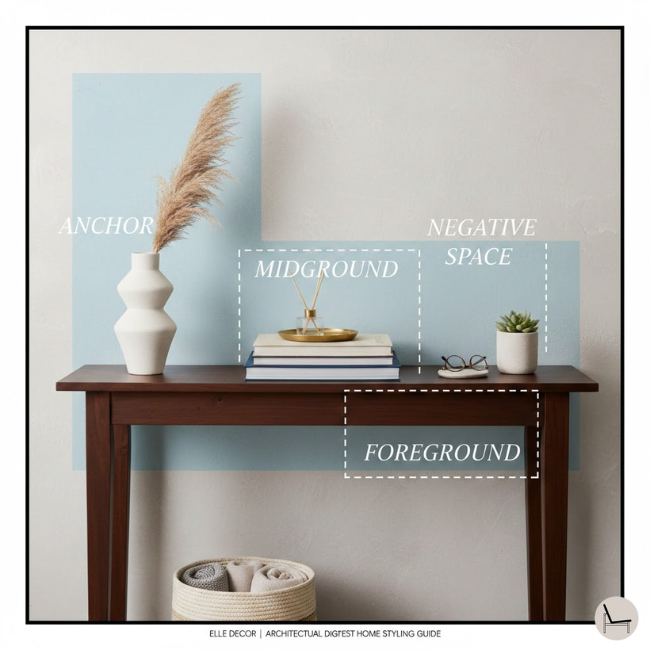
To style a console table successfully, you need three core layers working together: an anchor piece that draws the eye upward, varied-height objects that create visual rhythm through the triangle method, and strategic negative space that prevents the display from feeling cluttered.
Think of your console table as a stage. Every well-designed stage has a focal point (your anchor), supporting actors (your decorative objects), and breathing room (negative space). Without all three, the performance falls flat.
The mistake most people make? They focus solely on objects—buying vase after candle after picture frame—without understanding the architecture of arrangement. This creates what designers call “visual noise”: lots of stuff with no hierarchy, no flow, and no place for the eye to rest.
Here’s what the formula looks like in practice:
The Console Table Styling Framework:
| Layer | Purpose | Examples | Typical Height |
|---|---|---|---|
| Anchor (Background) | Creates vertical interest, fills wall space | Mirror, large artwork, wall sconce | 24-36″ tall |
| Midground | Adds dimension, provides focal objects | Table lamp, tall vase, sculptural object | 18-24″ tall |
| Foreground | Grounds the display, adds variety | Books, small plants, decorative boxes | 4-12″ tall |
| Negative Space | Allows eye to rest, prevents clutter | Empty surface area | 30-40% of table |
The magic ratio? Fill approximately 60-70% of your console table surface, leaving 30-40% empty. This creates the “curated” look that feels intentional rather than cluttered.
💡 Pro Tip: Before buying anything new, photograph your current console table setup. Our eyes adjust to what we see daily, but a photo reveals the truth immediately—you’ll spot imbalances, crowding, or gaps that weren’t obvious in person.
You’ll Also Like: Swivel Chairs Ultimate Guide: How to Choose & Style the Perfect One for Your Home
II. Step 1: Choose Your Anchor Piece (The Foundation of Every Great Console Table)
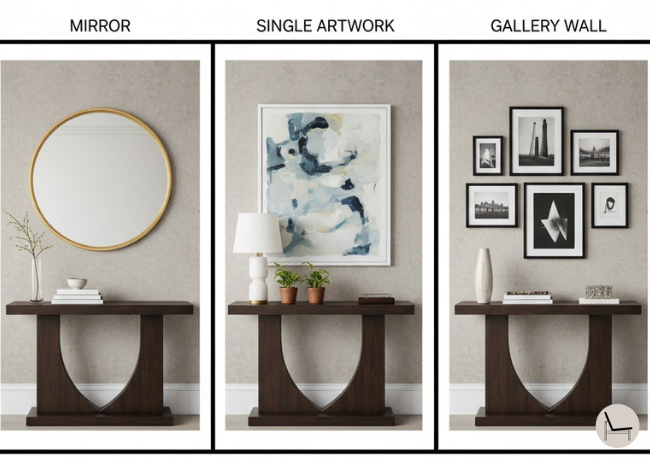
Your anchor piece should fill 50-75% of the wall space above your console table and hang 4-8 inches above the table surface to create visual connection without crowding.
This is where most console table styling fails before it even begins. Without a strong anchor, your display lacks a focal point—everything competes for attention, and nothing wins. Your anchor piece quite literally anchors the eye and establishes the scale for everything else.
Anchor Option 1: The Mirror Strategy
Mirrors are the secret weapon of small entryways. They reflect light, create the illusion of depth, and serve double duty as a functional last-minute appearance check before you leave the house.
When choosing a mirror to style a console table:
- Measure first: Your mirror width should be 50-75% of your console table width. For a 48-inch table, look for mirrors between 24-36 inches wide.
- Consider shape: Round mirrors soften angular modern spaces, while rectangular mirrors complement traditional furniture.
- Frame matters: The frame should echo other metals in your entryway (door hardware, light fixtures) for cohesion.
A designer I worked with in Chicago, Maria Rodriguez, told me: “A mirror is the most forgiving anchor piece because it adapts to your changing decor. Swap out the objects on your console table seasonally, and the mirror reflects the new palette—instant refresh with zero extra investment.”
Anchor Option 2: The Oversized Art Approach
If your entryway has sufficient natural light, oversized art makes a dramatic statement. This works particularly well above wider console tables (60+ inches) where a single piece can command attention.
Art selection guidelines:
- Abstract pieces provide flexibility as your style evolves
- Vertical orientation (portrait) works best for narrow tables
- Horizontal orientation (landscape) balances wide tables
- Lean large artwork against the wall for a relaxed, collected-over-time vibe
Anchor Option 3: The Layered Gallery Approach
For those who love maximalism or have collected smaller art pieces, a small gallery wall above your console creates visual interest without a single large investment.
The formula: One medium piece (18×24″) flanked by two smaller pieces (8×10″ or 11×14″), all hung at the same level or in a gentle arc. This creates a unified anchor while showcasing personality.
💡 Pro Tip: The 57-inch rule applies here—hang art so the center point sits at 57 inches from the floor (average eye level). For console tables, this usually means the bottom of your frame sits 4-8 inches above the table surface.
You’ll Also Like: How to Choose and Style a Mid-Century Wall Unit That Transforms Your Living Space
III. Step 2: Master the Triangle Method (The Secret to Visual Balance)
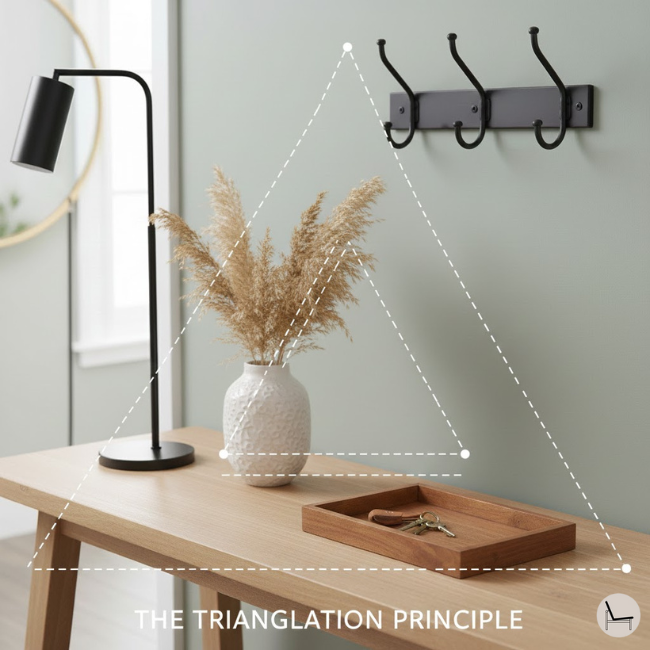
The triangle method for styling a console table requires arranging objects in varying heights that create an imaginary triangle when viewed from the side, with your tallest piece positioned slightly off-center and shorter elements cascading down on either side.
This is the design principle that separates amateur styling from professional-looking spaces. The triangle method creates visual movement—your eye travels from high to low, left to right, discovering new details without feeling overwhelmed.
Here’s how to execute it:
The Height Formula
When you style a console table, think in thirds:
- Tall (18-24 inches): Table lamp, tall vase with branches, sculptural candlestick
- Medium (10-16 inches): Stacked books, medium vase, decorative bowl
- Short (4-8 inches): Small succulents, candles, decorative boxes
The critical mistake: Lining up objects of similar height in a row. This creates a visual “fence” that’s static and boring. Instead, cluster your tall and short pieces together to create dynamic contrast.
The Practical Application
Let’s break down a simple three-object arrangement:
Left Side:
- Tall brass lamp (22 inches) as your primary tall element
- Stack of 3 coffee table books (6 inches) in front and slightly to the right
Right Side:
- Medium ceramic vase with dried pampas (14 inches)
- Small round dish or candle (4 inches) placed in front
When viewed from the side, these create a triangle: lamp peak on the left, sloping down through the vase to the small candle on the right. The books on the left provide a lower secondary triangle.
Odd Numbers Are Your Friend
Designers swear by the “rule of three” because odd numbers prevent symmetry, which can read as formal and stiff. When styling a console table, work in groupings of 3, 5, or 7 objects rather than pairs.
Interior designer Jonathan Adler notes in his book “Design Rules”: “Symmetry is the enemy of interesting. One gorgeous object placed off-center creates more visual tension—and therefore more interest—than two identical objects flanking a mirror.”
💡 Pro Tip: Use your smartphone to take photos from your typical entry angle. Visual balance looks different in person versus in a photo, and the photo reveals the truth about whether your triangle reads clearly.
In Case You Missed It: Bold Wall Art: The Complete Guide to Transforming Your Space with Statement Pieces
IV: Step 3: Layer with Purpose (Creating Depth and Dimension)
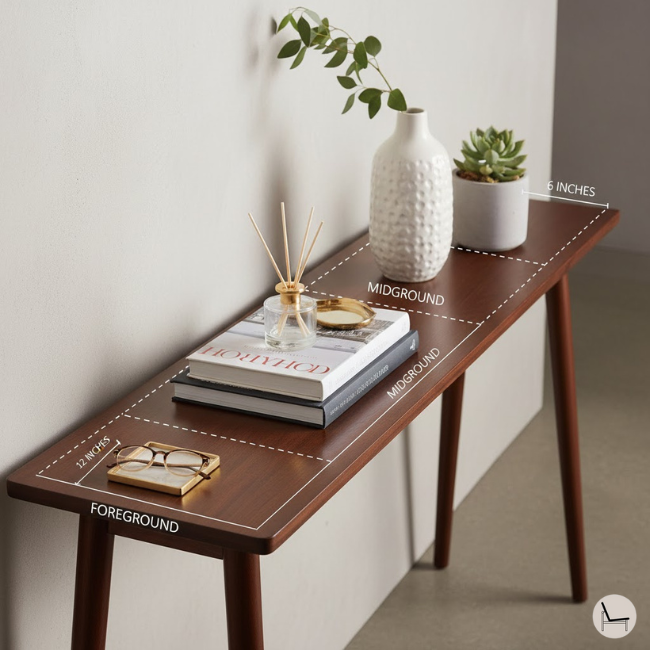
Successful console table layering requires positioning objects at different depths—foreground elements at the table’s edge, midground pieces 6-8 inches back, and background elements touching or near the wall—to create a three-dimensional display rather than a flat line of objects.
Flat styling is the hallmark of amateur design. When every object sits at the same depth (usually pushed against the wall), your console table reads as one-dimensional, even if you’ve nailed the height variation.
The Depth Strategy
Think of your console table as having three depth zones:
Background Zone (Against the Wall):
- Your anchor piece (mirror or art)
- Tall sculptural items (branches in a floor vase)
- Wall-mounted elements (sconces)
Midground Zone (Table Center):
- Medium-height hero objects (your statement lamp or vase)
- Stacked books
- Decorative boxes
Foreground Zone (Table Edge):
- Small, grabbable items if functional (keys, sunglasses)
- Low-profile objects (candles, small plants)
- Items that overhang slightly (books with spine facing out)
Creating Visual Layers
The overlap technique: Position your midground objects so they partially obscure background elements. This creates depth perception. For example, place a table lamp 4-5 inches in front of your mirror so the lamp base is visible in the reflection—instant dimension.
The lean-in method: Lean artwork or large cutting boards against the wall at a slight angle rather than hanging them. This casual approach adds personality and makes your styling feel collected over time rather than “decorated in one shopping trip.”
Texture as an Invisible Layer
When you style a console table, texture creates visual interest even when colors are neutral. Mix materials intentionally:
- Reflective: Mirror, glass vase, metallic objects
- Matte: Ceramic pots, painted wood, stone
- Organic: Woven baskets, dried florals, raw wood
- Soft: Books, small textile elements
A mix of three different textures minimum prevents your display from feeling flat or monotonous, even in a monochromatic color scheme.
💡 Pro Tip: The “touch test” reveals whether you’ve achieved good texture variety. Close your eyes and run your hand over your console table objects. If everything feels similar (all smooth, all rough), add contrasting textures.
Popular Post: Best Stud Finder: Your Essential Tool for Home Decor
V. How to Style a Console Table by Type and Space
Console table styling must adapt to both the table’s dimensions and the room’s function, with narrow tables (under 14 inches deep) requiring vertical emphasis and fewer objects, while wide tables (18+ inches) can accommodate fuller, more complex arrangements.
Not all console tables are created equal. The formula adjusts based on your specific piece and where it lives in your home.
Narrow Console Tables (12-14 inches deep)
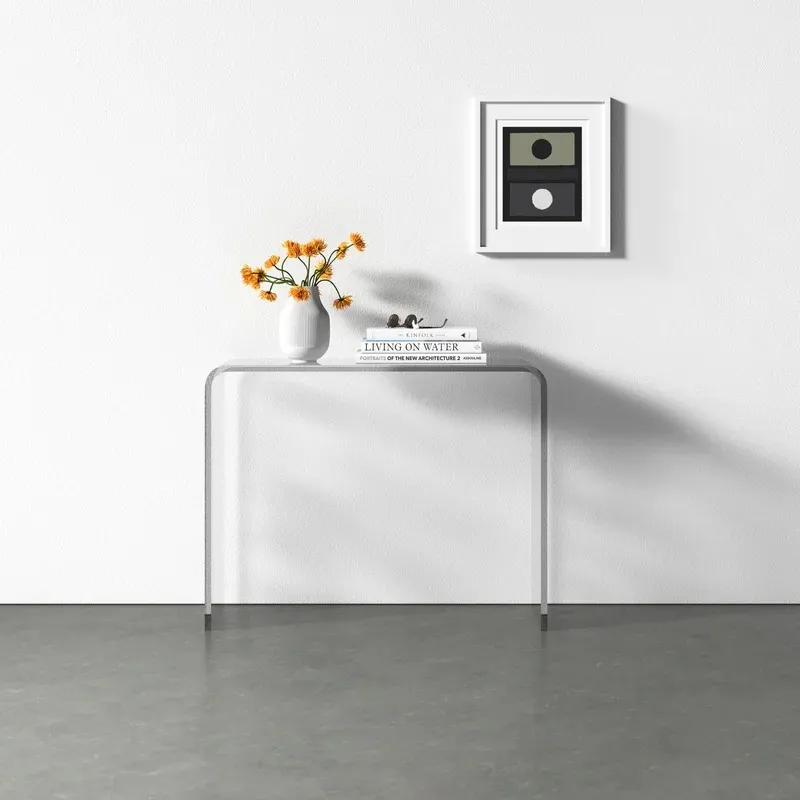
The Challenge: Limited surface area means every object must earn its place.
The Solution: Go vertical and minimal.
- Choose ONE tall anchor (table lamp or tall vase) as your primary statement
- Add 1-2 small foreground objects maximum
- Utilize wall space above aggressively with a large mirror or artwork
- Consider wall-mounted shelves flanking the table for additional display space without crowding the surface
Example arrangement:
- One brass table lamp (tall element)
- One small decorative box (functional catch-all)
- Round mirror above filling 75% of wall space
Standard Console Tables (16-18 inches deep)

The Sweet Spot: This depth accommodates the full triangle method without crowding.
The Approach: Use the complete three-layer strategy.
- Anchor piece above
- 3-5 objects following triangle method
- Maintain 30-40% negative space
Example arrangement:
- Large rectangular mirror above
- Table lamp on left (tall)
- Stack of 3 books in center (medium)
- Ceramic bowl with faux stems on right (medium-tall)
- Small candle in front of books (short)
Wide Console Tables (20+ inches deep)

The Opportunity: Room for more complex, layered styling.
The Strategy: Create multiple mini-vignettes or zones.
- Divide the table mentally into two or three sections
- Each section can have its own mini-triangle
- Increase total object count to 5-7 pieces
- Leave more generous negative space (40-50%) to prevent overcrowding
Example arrangement:
- Leaning oversized artwork against wall (left section)
- Tall sculptural vase with branches (left section, in front of art)
- Stack of large coffee table books (center section)
- Table lamp (right section, back)
- Low bowl with decorative spheres (right section, front)
- Small plant (center section, front)
Room-Specific Adjustments
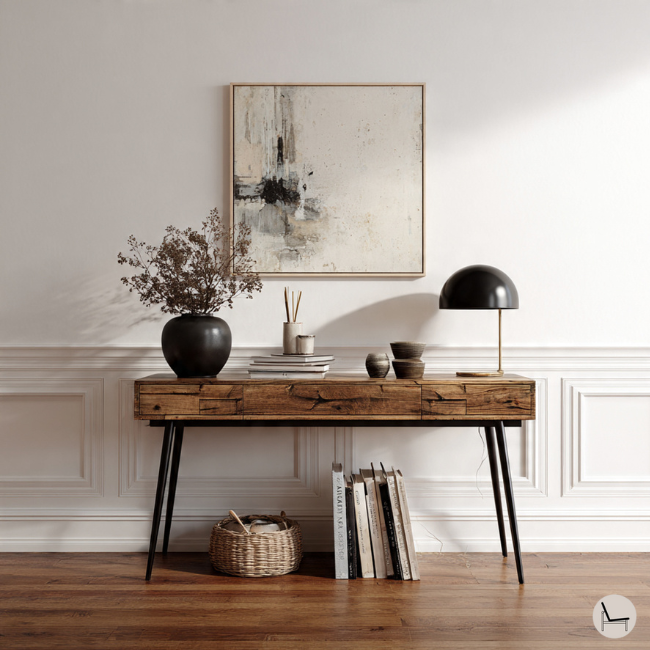
Entryway Console Tables: Must balance beauty with function. Include one catch-all (decorative bowl or small tray) for keys, mail, sunglasses. This prevents the inevitable clutter takeover.
Living Room Console Tables (Behind Sofa): Can be viewed from multiple angles, so styling must look intentional from behind the sofa and from across the room. Symmetry works better here than in entryways.
Dining Room Console Tables (Buffet Style): Should complement your table styling without competing. Use colors and materials that echo your dining space.
💡 Pro Tip: Measure your console table depth before shopping. Bring a tape measure and measure objects in-store. A vase that’s 12 inches wide will overwhelm a 14-inch deep table, creating overhang that looks precarious.
You’ll Also Like: How To Decorate With Coffee Tables Books
VI. Seasonal Console Table Styling (Fresh Looks Without Starting Over)
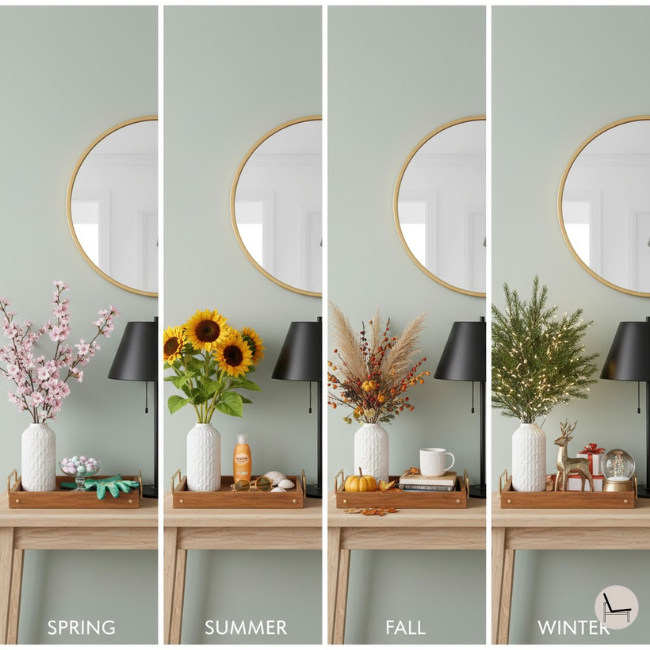
To refresh your console table seasonally, maintain your core anchor piece and structural elements year-round, swapping only 2-3 smaller, affordable accent pieces that reflect seasonal colors, textures, or natural elements.
One of the smartest ways to style a console table is to build a flexible foundation. This prevents the expensive (and exhausting) cycle of completely redecorating every few months while still keeping your space feeling current.
The Investment vs. Rotation Strategy
Invest Once (Keep Year-Round):
- Your anchor piece (mirror or art)
- Quality table lamp with neutral base
- One sculptural statement object (ceramic vase, wooden bowl)
- Coffee table books
Rotate Seasonally (Budget-Friendly Swaps):
- Faux florals or branches
- Small accent objects (candles, small vases)
- Textural elements (woven basket, ceramic dish)
Seasonal Styling Guide
Spring/Summer Console Table:
- Light, airy color palette (whites, soft blues, pale greens)
- Fresh or faux florals (peonies, hydrangeas, eucalyptus)
- Natural textures (woven, ceramic, light wood)
- Incorporate one organic element (driftwood, coral, shells)
Fall/Winter Console Table:
- Warm, rich color palette (terracotta, deep greens, warm neutrals)
- Dried elements (pampas, wheat, preserved leaves)
- Heavier textures (dark wood, matte metals, stone)
- Ambient lighting (pillar candles, warm-toned lamp)
The 20-Minute Seasonal Swap:
- Remove 2-3 smallest current accent pieces
- Clean console table surface thoroughly
- Replace with seasonal accents following same triangle method
- Adjust one element’s position if needed for balance
This targeted approach costs $40-80 per season and takes less time than grocery shopping, yet completely transforms the feel of your space.
💡 Pro Tip: Create a “console table rotation” bin where you store off-season decor. Label it clearly and photograph your seasonal setups on your phone. Next year, you’ll recreate the look in 5 minutes instead of 50.
You’ll Also Like: 25 Easy Renter Friendly Hacks On The Budget
VII. The 5 Most Common Console Table Styling Mistakes (And Quick Fixes)

Mistake #1: Everything Is the Same Height
Why it fails: Creates a visual “fence” that’s boring and static. Your eye has nowhere to travel.
The fix: Introduce height variation immediately. If you have three objects of similar height, elevate one by placing it on stacked books or remove one entirely. Follow the triangle method religiously.
Mistake #2: Pushing Everything Against the Wall
Why it fails: Creates a flat, one-dimensional display that looks scared to take up space.
The fix: Pull your midground objects forward by 4-6 inches. Let them breathe. Create that depth layering we discussed earlier. One object near the table edge changes everything.
Mistake #3: Overcrowding the Surface
Why it fails: When every inch is covered, nothing stands out. The eye doesn’t know where to land, creating visual stress.
The fix: Remove 30-40% of what’s currently on your console table. Start with your core three pieces (one tall, one medium, one short) and add back slowly, one piece at a time, until it feels balanced—but stop before it feels full.
Mistake #4: Ignoring Scale and Proportion
Why it fails: A tiny 4-inch vase on a 60-inch console table looks lost. Conversely, massive objects overwhelm small tables.
The fix: Use the 2/3 rule: Your largest object should be approximately 2/3 the height of your anchor piece. If your mirror is 30 inches tall, your table lamp should be around 20-22 inches.
Mistake #5: Matching Everything Perfectly
Why it fails: Sets of matching decor read as “decorated in one store trip” rather than collected over time. It lacks personality and visual interest.
The fix: Mix metals (brass lamp with silver frame). Vary materials (ceramic with wood with glass). Choose items from different “style families” that share a common element (color palette or texture) rather than buying a matching set.
The Fastest Fix for Any Mistake:
Remove everything from your console table. Clean the surface. Place only your anchor piece (mirror/art). Add back your single favorite object. Stop. Live with just those two elements for 24 hours. Then add a third object if the space truly needs it. This reset prevents the gradual clutter creep that ruins most console table styling.
You’ll Also Like: A Guide to Fiddle Leaf Fig Decor Ideas for a Trendy Home
VIII. Budget Breakdown: Where to Splurge vs. Save When Styling a Console Table

For console table styling, invest 60-70% of your budget in your anchor piece and one quality lighting source, while sourcing remaining decorative objects from budget retailers, thrift stores, or items you already own.
Understanding where to allocate your decorating dollars prevents overspending on items that don’t meaningfully improve your space while ensuring you invest in pieces that provide lasting impact.
The Investment Hierarchy
| Item Category | Budget Allocation | Why It Matters | Splurge Sources | Save Sources |
|---|---|---|---|---|
| Anchor (Mirror/Art) | 30-40% | Creates entire vibe, permanent fixture | West Elm, Crate & Barrel, Article | Target, HomeGoods, Facebook Marketplace |
| Table Lamp | 20-25% | Functional + decorative, quality shows | Lulu & Georgia, Schoolhouse, Rejuvenation | IKEA, Wayfair, Amazon |
| Medium Objects | 15-20% | Visual interest, replaceable | Anthropologie (sale), CB2 | H&M Home, Marshalls, thrift stores |
| Small Accents | 10-15% | Easily swapped, trend-driven | N/A (never splurge here) | Dollar Tree, Target dollar spot, TJ Maxx |
| Books | 5-10% | Texture + height, permanent | Rare/special editions | Used bookstores, library sales, your shelf |
Real Budget Scenarios
The $200 Starter Console Table:
- Large round mirror, brass frame: $80 (Target Threshold line)
- Brass finish table lamp: $50 (IKEA SKAFTET or similar)
- White ceramic vase: $20 (H&M Home)
- Set of 3 decorative spheres: $15 (HomeGoods)
- Faux eucalyptus stems: $12 (Michael’s with coupon)
- 3 coffee table books: $23 (thrifted at $7-8 each)
- Total: $200
The $500 Elevated Console Table:
- Arched floor-to-table mirror, aged brass: $220 (West Elm sale)
- Ceramic table lamp, natural linen shade: $150 (Lulu & Georgia)
- Handmade ceramic vase: $60 (Etsy or local artisan)
- Wooden dough bowl: $35 (Amazon)
- Fresh eucalyptus (monthly): $12/month
- 4 coffee table books: $35 (mix of new and thrifted)
- Total: $512
The $1000+ Investment Console Table:
- Custom or designer mirror: $400-500
- Designer table lamp: $250-350
- High-end ceramic or sculptural object: $150-200
- Curated art books or rare editions: $100
- Fresh florals (weekly): $30/week
- Artisan bowl or decorative object: $100
The Hidden Cost Saver: Shop Your Home First
Before spending a dollar, gather these items from other rooms:
- Books from your shelves (choose neutral spines or turn pages out)
- Vases from the back of cupboards
- Decorative boxes
- Candles
- Small plants you’re currently under-utilizing
One client saved $180 by shopping her own living room and bedroom before buying anything new. She had a beautiful brass tray hiding in her bathroom and a ceramic vase in her kitchen that looked intentional on her console table.
💡 Pro Tip: Time your console table shopping around major sales: Target’s seasonal clearance (usually 50-70% off), West Elm’s semi-annual sale (30-40% off), and post-holiday decor sales in January (up to 75% off).
Most Popular Post:
Interior Design Style Quiz
Timeless Paint Colors That Never Go Out of Style
Create Your Perfect Ergonomic Home Office: A Complete Guide
Must-Have Accessories for Guys: The Secret to a Stylish Space
Modular Sofas for Small Spaces:

Your Console Table Transformation Starts Now
You walked into this guide frustrated, wondering why your console table refused to look “right” no matter how many times you rearranged it. Now you have something more powerful than another shopping list—you have the formula.
The triangle method for visual balance. The three-layer depth strategy. The 2/3 rule for proportion. These aren’t trends that’ll look dated next year. They’re the same timeless principles interior designers use on million-dollar projects and $200 budget makeovers alike.
But here’s what really matters: that twinge of disappointment you felt every time you walked through your door? It’s about to transform into a moment of pride. Because when you style a console table with intention—following this proven framework—you create more than a pretty vignette. You prove to yourself that you CAN design beautiful spaces.
Your Next Steps
Today (10 minutes):
- Clear your console table completely
- Photograph the empty space
- Measure your table dimensions (width x depth x height)
- Identify which anchor option works for your space (mirror, art, or gallery wall)
This Week:
- Gather items from around your home that fit the formula (don’t buy yet)
- Arrange using the triangle method with what you own
- Photograph your first attempt—the camera reveals what your eye misses
- Adjust based on the photo feedback
This Month:
- Invest in your anchor piece if needed (mirror or art)
- Fill gaps strategically with 1-2 quality pieces rather than many cheap ones
- Reference this guide when you feel stuck—the formula always works
The console table styling formula you learned today is your roadmap out of design paralysis. No more scrolling Pinterest at midnight wondering if you’ll ever “get it.” You have the blueprint. Now it’s time to build something beautiful.
What transformation will you create first? Start with your anchor piece and work down through the layers. Your perfectly styled console table is three steps away.
Have questions about styling your specific console table situation? Leave a comment below—I read and respond to every single one, and your question might help another reader facing the same challenge.
Frequently Asked Questions About Console Table Styling
Q: How many items should be on a console table?
A: The ideal number is 3-7 items depending on your table size, following the rule of odds. Narrow tables (under 14″ deep) work best with 3-4 objects, while wider tables (18″+) can accommodate 5-7. Always maintain 30-40% empty surface space to prevent visual clutter. Quality over quantity creates more impact than covering every inch.
Q: What do you put on top of a console table in an entryway?
A: Start with a large mirror or artwork as your anchor, then add a table lamp for ambient lighting, a decorative catch-all bowl or tray for keys and mail, and 2-3 decorative objects at varied heights (vase with stems, stack of books, small plant or candle). Balance aesthetics with function—entryways need to work hard while looking effortless.
Q: Should a console table match other furniture?
A: No. Your console table should complement, not match, your existing furniture. Aim for visual harmony through shared undertones (warm vs. cool woods) or one repeated element (like metal finishes) rather than identical styles. Mixing furniture styles creates a collected, sophisticated look, while perfect matching reads as furniture-set staging.
Q: How do I style a console table without it looking cluttered?
A: Follow three rules: maintain 30-40% negative space, use the triangle method for height variation rather than lining up similar-sized objects, and limit yourself to one “busy” element (patterned vase, colorful books, detailed sculpture) with remaining pieces being simple and streamlined. When in doubt, remove one item.
Q: Can I style a console table without a mirror?
A: Absolutely. Alternative anchors include large-scale artwork (24×36″ or larger), a gallery wall arrangement, floating shelves above the table, or even leaning oversized artwork against the wall for a casual vibe. In spaces with insufficient natural light, prioritize artwork over mirrors to avoid reflecting darkness. The anchor principle remains the same regardless of what you choose.
Q: What is the best height for a table lamp on a console table?
A: Your table lamp (including shade) should be 26-32 inches tall, with the bottom of the lampshade sitting roughly at eye level when standing (58-64 inches from the floor). This ensures the light illuminates properly without glare. For console tables under 30 inches tall, aim for the taller end of this range to maintain proper proportion with your anchor piece above.
Subscribe To the Newsletter!
Subscribe now for an endless feed of inspirational women’s cave decor ideas, pampering rituals, and more tips for curating your ultimate escape. Let’s start making your cozy refuge a reality – you so deserve this!
CATCH THE LATEST IN HOME DECOR TRENDS:
Steal These 16 Expert-Approved Decorating Secrets

How To Accessorize Your Living Room
Small Space? 10 Ways To Make A Room Appear Bigger
Make Your space Look Expensive
GET CAUGHT UP ON ALL THE INSPIRING DECOR TIPS:
18 Fresh Decorating Ideas To Update Your Fireplace
How to Make a Gallery Wall: The Complete Step-by-Step Guide (Even If You’ve Never Hung a Picture)


