TL;DR Summary: Men’s bedroom decor should balance masculine sophistication with functional comfort through strategic color choices, proper furniture proportions, and intentional styling. Professional designers rely on spatial psychology, the Rule of 3 for accessories, and layered textures to create rooms that feel both elevated and livable. These seven tricks focus on what makes the biggest visual impact without requiring a complete overhaul or massive budget.
Introduction: Men’s Bedroom Decor Tricks You Should Copy
Your bedroom should be the most intentional space in your home, yet most men treat it as an afterthought—a place to crash after a long day rather than a designed environment that supports better sleep, focus, and confidence.

The gap between a bedroom that looks like a college dorm and one that feels like a luxury hotel suite isn’t about spending thousands of dollars. It’s about understanding the same spatial psychology and design principles interior designers use with high-end clients. The difference is in the details: furniture scale, color undertones, texture layering, and strategic focal points.
This guide reveals seven men’s bedroom decor tricks that professional designers rely on to create masculine, sophisticated spaces. You’ll learn exactly what to change, why it works, and how to apply each principle without hiring a designer or breaking your budget.
I. What Actually Makes a Bedroom Look “Masculine” (It’s Not What You Think)

Masculine bedroom design isn’t about dark colors and exposed brick—it’s about material honesty, purposeful restraint, and confident simplicity that creates visual calm through intentional editing. The difference between a “guy’s room” and a well-designed masculine space comes down to three core principles.
The biggest misconception? That masculine means minimal color and zero personality.
A. Real masculine design principles:
- Material authenticity: Leather that looks like leather. Wood grain that’s actually wood. Metal with real weight. No faux finishes pretending to be something else.
- Functional beauty: Every visible item serves a clear purpose—even decorative pieces (a watch case that displays AND organizes, art that anchors the wall).
- Visual editing: Fewer items, each one deliberate. The opposite of visual clutter or “stuff everywhere.”
Think of brands like Shinola, Filson, or the Tesla design philosophy. Clean lines. Quality materials. Nothing apologetic about existing.
The most masculine spaces I’ve designed share one thread: they look like a grown man made intentional choices, not like he furnished from a college apartment sale.
💡 Pro Tip: If you’re keeping something in your bedroom “just because” or “it was free from my parents,” it’s actively working against you. Every visible item should either serve a function or genuinely reflect your taste.
B. The three material signatures of masculine design:
Signature #1: Textural Contrast Smooth surfaces next to rough ones. Soft textiles against hard edges. A linen duvet on a leather headboard. Wood nightstand against painted walls.
Signature #2: Weighted Presence Furniture that looks substantial, not spindly. Table lamps with ceramic or concrete bases, not thin metal. Frames with actual mass.
Signature #3: Restrained Palette Two or three colors maximum, each serving a clear role. Not “all gray everything,” but not chaotic either.
“The best masculine interiors don’t announce themselves. They feel inevitable—like the only way that space could look given who lives there.” — Bobby Berk, Interior Designer, 2023
The rooms that read as authentically masculine without trying too hard all avoid one trap: looking like you bought everything from the same store in the same shopping trip. Layer your purchases over time. Mix price points. Let your space tell a story.
Check out this specific guide on: Best Masculine Living Room Ideas That Look Expensive (Not Overdone)
II. The 7 Silent Signals Your Bedroom Looks Unfinished
Before spending a dollar, diagnose what’s making your space feel “temporary” even after years of living there—these seven visual markers scream “I haven’t really moved in yet” to anyone who sees your bedroom. Most men know something’s off but can’t articulate what. This is your diagnostic checklist.
Signal #1: Mattress Directly on the Floor
What it signals: Transience. Financial instability. “I’m between real apartments.”
Even a $3,000 luxury mattress looks like you’re camping when it’s on the ground. The psychological message is clear: you haven’t committed to being here.
The fix: Any bed frame is better than no frame. Even a basic $200 metal platform frame elevates (literally and figuratively) your entire setup.
Signal #2: Single Overhead Light Source
What it signals: Institutional space. Dorm room. Somewhere you sleep but don’t live.
That builder-grade ceiling fixture doing all the work creates harsh shadows, eliminates atmosphere, and makes even expensive furniture look cheap.
The fix: Add one bedside lamp. That’s it. Two light sources instead of one changes everything.
Signal #3: Completely Bare Walls OR Random Posters in Frames
What it signals: Empty walls say “just moved in.” Unframed posters say “college.” Framed posters say “trying but not really.”
The wall behind your bed is the title page of your room. It deserves more than nothing—or a Pulp Fiction poster from 2012.
The fix: Two or three pieces of actual art that mean something. Not ten random prints. Not inspirational quotes. Thoughtful selection over quantity.
Signal #4: Visible Clutter OR Sterile Emptiness
What it signals: Clutter = can’t maintain order. Complete bareness = hotel room, no personality.
Clothes on a chair. Pile of random stuff on dresser. Papers scattered on nightstand. OR absolutely nothing on any surface.
The fix: 3-5 intentional items per horizontal surface. Bedside table: lamp, book, small object. Dresser: tray for wallet/keys, one plant, one frame.
Signal #5: All Furniture from Different Eras
What it signals: Accumulated over time without intentionality. Hand-me-down aesthetic.
The nightstand from your parents’ garage. The desk from your first apartment. The dresser from college. Each piece might be “fine,” but together they tell a story of randomness.
The fix: You don’t need to replace everything. Unify through a shared element—all wood tone, all metal hardware, or introduce a shared color through textiles.
Signal #6: Overhead Light at Full Brightness (Always)
What it signals: No understanding of ambiance. Utilitarian mindset only.
Walking into a bedroom with maximum overhead lighting feels like a dentist’s office. No dimension. No mood. No atmosphere.
The fix: $15 dimmer switch. 10-minute installation. Overhead at 40% brightness transforms your entire space.
Signal #7: No Window Treatments OR Broken/Dusty Blinds
What it signals: Temporary resident. Doesn’t care about sleep quality or privacy.
Bare windows. Builder-grade blinds that don’t fully close. Curtains from 2008 that are dusty and sun-faded.
The fix: Floor-to-ceiling blackout curtains in a neutral color. Single highest-ROI textile purchase you can make.
| Bedroom Red Flag | What It Communicates | Fastest Fix | Investment |
| Mattress on floor | Not settled, transient | Platform bed frame | $200-600 |
| One light source | Utilitarian only | Add bedside lamp | $50-120 |
| Bare walls | Just moved in | 2-3 framed pieces | $80-200 |
| Visible clutter | Can’t maintain systems | Hamper + drawer organizers | $40-100 |
| Mismatched furniture | Accumulated randomly | Unified color/material | $0-300 |
| Harsh overhead | No atmosphere | Dimmer switch | $15-25 |
| No curtains | Temporary mindset | Blackout drapes | $60-150 |
💡 Pro Tip: You don’t need to fix all seven at once. Pick the one that bothers you most when you walk into your room. That’s your starting point. Fix it this weekend. Live with it for two weeks. Then tackle the next one.
The goal isn’t perfection. The goal is looking like you live in your bedroom on purpose, not by accident.
Check out this specific guide on: 10 Masculine Bar Cart Styling Tips You Must Follow
III. Bedroom Furniture Essentials: What You Actually Need (and What You Don’t)
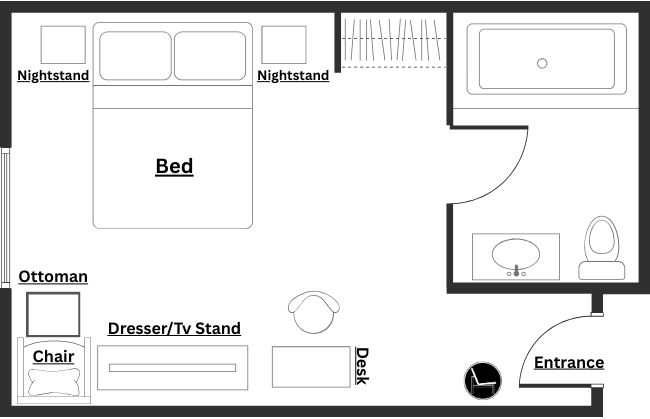
You’ve scrolled through countless bedroom photos featuring furniture you’re not sure you need, and you’re unsure which pieces are worth the investment versus which are just filler.
Most men’s bedroom decor guides push unnecessary furniture that clutters small spaces and drains budgets. Professional designers start with a hierarchy of essential pieces based on function and visual impact, then add secondary furniture only if space and budget allow. Understanding this hierarchy prevents you from wasting money on items that won’t improve your daily life or the room’s aesthetic.
How to apply it:
- Tier 1 (Non-negotiable): Bed frame with headboard, quality mattress, two nightstands (or one if space is limited), and one substantial storage piece (dresser or wardrobe). These form your functional foundation
- Tier 2 (High value if space allows): Upholstered bench at the foot of the bed (provides seating and visual weight), statement chair with side table (creates a secondary zone), and full-length mirror (expands perceived space)
- Tier 3 (Optional additions): Media console if you watch TV in bed, desk if you work from home, and bookshelf if you read extensively. Only add these if Tier 1 and 2 don’t crowd the room
- The 40% rule: Furniture should occupy no more than 40% of your floor space. Measure your room, calculate square footage, and ensure furniture footprints don’t exceed this threshold
- Avoid these traps: Matching bedroom sets (they look mass-produced), decorative ladders (serve no function), and multiple small storage ottomans (one substantial piece works better)
💡Pro Tip: Invest 60% of your furniture budget in your bed and mattress, 30% in storage pieces, and 10% in seating. Your bed dominates the visual field and affects sleep quality—it deserves the majority of your investment. A $1,200 bed with $400 nightstands always looks better than equal $800 pieces.
Focusing on essential furniture pieces prevents clutter and ensures every item in your men’s bedroom decor serves both functional and aesthetic purposes.
Check out this specific guide on: The Complete Guide to Choosing the Best Bedroom Paint Colors: A Designer’s Proven 5-Step Method
IV. Trick #1: Master the 60-30-10 Color Rule for Masculine Depth
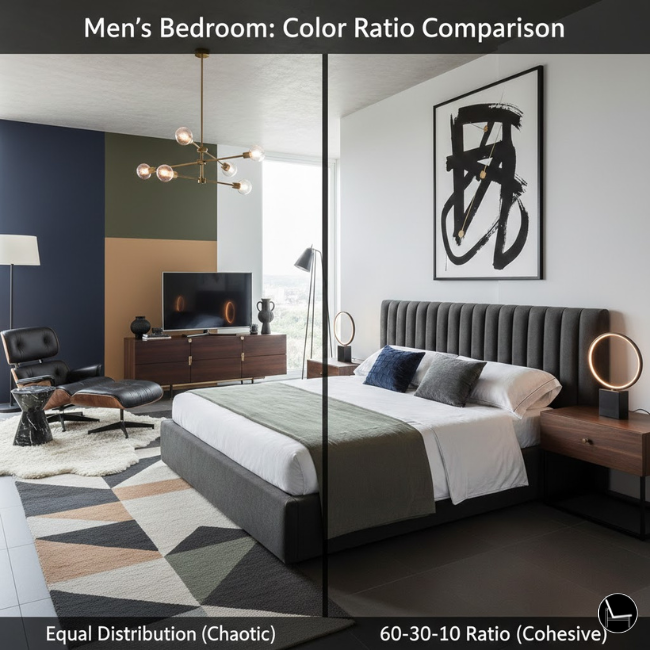
You’ve probably noticed that some bedrooms feel intentionally designed while others look randomly thrown together, even when they use similar colors. The difference isn’t the colors themselves—it’s the distribution ratio.
Professional designers use the 60-30-10 rule to create visual hierarchy and depth without overwhelming a space. Your dominant color (60%) establishes the room’s foundation, your secondary color (30%) adds interest and contrast, and your accent color (10%) provides strategic pops that guide the eye. This ratio prevents the common mistake of using equal amounts of multiple colors, which creates visual chaos and makes men’s bedroom decor feel amateur.
How to apply it:
- Choose your 60% (dominant): This covers walls, large furniture, and bedding. For masculine spaces, use warm neutrals like charcoal gray, deep navy, or rich taupe rather than stark white or beige
- Select your 30% (secondary): Apply this to secondary furniture, window treatments, or a feature wall. Think complementary earth tones—olive green with charcoal, rust with navy, or warm brown with gray
- Add your 10% (accent): Reserve this for pillows, artwork, or small decor items. Cognac leather, brass fixtures, or deep burgundy work exceptionally well in men’s bedroom decor
- Test undertones: Paint sample squares on different walls and observe them in morning, afternoon, and evening light. Cool grays can read blue at night; warm grays can look beige in bright sun
- Start with existing pieces: If you own a dark wood dresser or navy bedding, build your 60-30-10 ratio around what you already have to minimize replacement costs
💡Pro Tip: Use matte finishes for your 60% and 30% to create a sophisticated, non-reflective base, then introduce subtle sheen in your 10% accent through leather, polished wood, or metal. This contrast in finish elevates the entire palette without adding more colors.
This distribution creates a cohesive color story that looks intentional rather than accidental, transforming your bedroom from a collection of random items into a designed space.
Check out this specific guide on: The 60-30-10 Design Rule: A Comprehensive Guide
V. Trick #2: Use Visual Weight to Balance Furniture Proportions
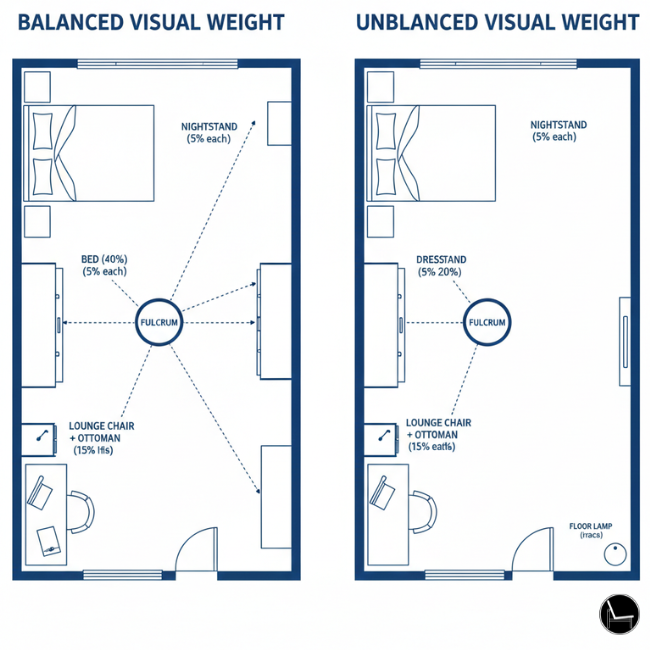
You walk into your bedroom and something feels off, but you can’t identify what’s wrong. The room looks empty despite having furniture, or it feels cramped even though there’s floor space.
The culprit is visual weight—the perceived heaviness of furniture based on size, color, and material. Dark, solid pieces carry more visual weight than light, open-frame furniture. When visual weight is unevenly distributed, your brain registers the imbalance as discomfort, even if you can’t articulate why. Interior designers manipulate visual weight to create equilibrium, making rooms feel properly anchored without appearing overcrowded.
How to apply it:
- Anchor with your bed: Your bed should be the heaviest visual element, positioned as the room’s focal point. For men’s bedroom decor, choose upholstered headboards in dark fabrics or substantial wood frames rather than minimal metal designs
- Balance opposing walls: If your bed wall is visually heavy (dark headboard, layered bedding), the opposite wall needs substantial furniture like a tall dresser or media console—not empty space or a single small chair
- Use the 2/3 rule: Furniture height should be roughly two-thirds the wall height. An 8-foot ceiling needs furniture around 5–5.5 feet tall; a 9-foot ceiling can handle 6-foot pieces
- Create diagonal balance: Place your heaviest pieces on opposite corners of the room. If your bed is in the far-left corner, position your heaviest dresser or seating in the near-right corner
- Mix solid and open designs: Pair a solid upholstered bed with open nightstands that show floor beneath, or balance a heavy dresser with a streamlined chair
💡Pro Tip: If your room feels too heavy despite proper distribution, add one piece of glass or acrylic furniture (coffee table, desk chair, or shelf). The transparency reduces visual weight without sacrificing function, creating breathing room in your design.
Proper visual weight distribution makes your bedroom feel intentionally composed rather than randomly furnished—a hallmark of professional men’s bedroom decor.
Check out this specific guide on: The One Paint Color That Designers Are Too Afraid to Tell You Works in Every Room
VI. Trick #3: Layer Three Lighting Types for Dimensional Atmosphere
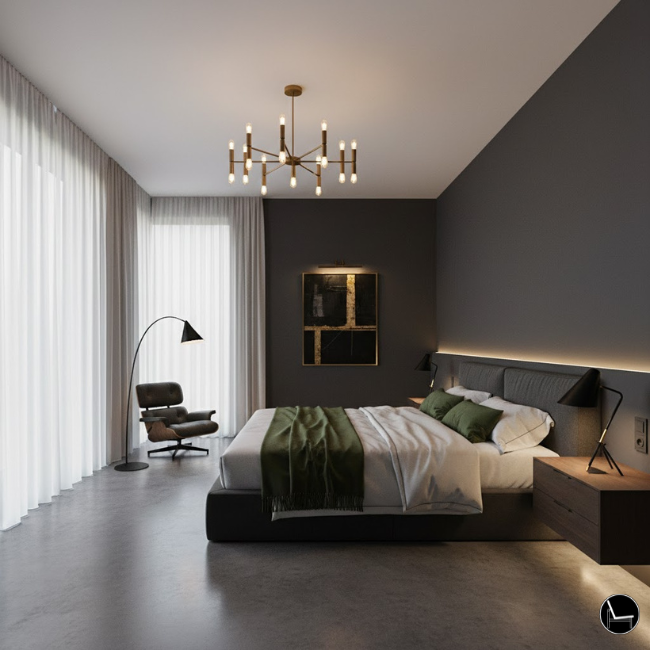
You flip the overhead light on and your bedroom instantly feels like an interrogation room—harsh, flat, and completely uninviting. Or you rely on a single bedside lamp that leaves corners dark and creates a gloomy cave.
Single-source lighting is the fastest way to make men’s bedroom decor feel cheap and uninspired. Professional designers layer three distinct lighting types—ambient, task, and accent—to create depth, functionality, and atmosphere. This hierarchy mimics natural light patterns and allows you to control mood and energy throughout the day, from morning productivity to evening wind-down.
How to apply it:
- Install ambient lighting: This is your room’s base illumination. Replace harsh overhead bulbs with a dimmer switch and warm-white bulbs (2700K–3000K). If overhead lighting isn’t an option, use two matching floor lamps in opposite corners
- Add task lighting: Place adjustable reading lamps on nightstands (or wall-mounted swing-arms for space-saving). For work areas, use a desk lamp with directional focus. Task lighting should be brighter (3500K–4000K) but confined to specific zones
- Introduce accent lighting: This creates visual interest and highlights architectural features or decor. LED strips behind your headboard, picture lights above artwork, or a statement floor lamp in a reading corner all serve as accent sources
- Create lighting circuits: Never turn on all three lighting types simultaneously. Morning: ambient + task. Evening: ambient + accent. Night: accent only
- Hide the sources: Your eye should see the light effect, not the bulb itself. Use opaque shades, indirect uplighting, or recessed fixtures to maintain a sophisticated atmosphere
💡Pro Tip: Install smart bulbs in your ambient fixtures and program three scenes: “Wake” (100% brightness, cool white), “Evening” (60% brightness, warm white), and “Wind Down” (30% brightness, amber). This costs $40–60 but transforms your bedroom’s functionality without rewiring.
Layered lighting makes your space feel professionally designed and adaptable to any activity—a critical component of elevated men’s bedroom decor.
Next, explore this practical guide that shows you exactly how to: How to Light Your Home Properly
VII. Trick #4: Apply the Rule of 3 for Styled Accessories
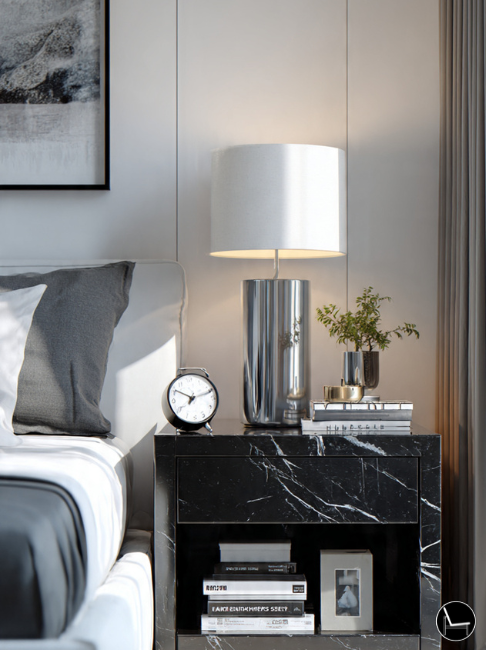
You’ve bought artwork, plants, and decorative objects but your nightstand and dresser still look messy rather than styled. Or worse, you’ve avoided decor entirely because you don’t know what looks intentionally placed versus randomly scattered.
Amateur decorating uses even numbers (two candles, four frames) or random quantities that create visual confusion. Professional designers use the Rule of 3—arranging accessories in odd-numbered groups with varied heights, sizes, and textures—to create visual interest that feels organic rather than forced. This principle works because the human eye processes triangular compositions as naturally balanced and aesthetically pleasing.
How to apply it:
- Create 3-item vignettes: On nightstands, group a table lamp (tallest), a stack of 2–3 books (medium), and a small object like a watch case or succulent (shortest). Heights should follow a 3:2:1 ratio
- Vary materials in each group: Combine three different textures—metal lamp, leather-bound books, ceramic planter. Avoid three items made of the same material
- Use the triangle method: Position items so they form a triangle when viewed from above. Place your tallest item at one corner, medium item at another corner, and shortest item at the third point
- Layer depths: Your tallest item goes in the back, medium in the middle, shortest in front. This creates dimensional layering rather than a flat lineup
- Keep negative space: Your groupings should occupy only 50–60% of the surface. Empty space is part of the design, not a problem to fill
💡Pro Tip: For wall decor, use odd-numbered gallery walls (3, 5, or 7 pieces) with the largest piece positioned one-third from the left or right edge—never centered. This asymmetry feels more sophisticated and dynamic than symmetrical arrangements in men’s bedroom decor.
The Rule of 3 makes styling feel intentional and professional without looking over-decorated—perfect for masculine spaces.
Check out this specific guide on: 11 Must-Have Nightstand Styling Items for Effortless Decor
VIII. Trick #5: Mix Three Textures for Tactile Depth

Your men’s bedroom decor looks flat and one-dimensional in photos, or it feels cold despite using warm colors. The room has furniture and decor, but something essential is missing.
Texture is the most overlooked element in men’s bedroom decor, yet it’s what separates hotel-sterile spaces from rooms that feel rich and lived-in. Professional designers layer a minimum of three distinct textures—combining rough and smooth, matte and gloss, soft and hard—to create tactile and visual depth. Your eye reads texture variation as luxury and intentionality, even before your brain consciously registers what’s creating that impression.
How to apply it:
- Start with your bed: Layer a textured linen duvet (rough), cotton sheets (smooth), and a wool or knit throw blanket (chunky). Add one leather or velvet pillow for sheen contrast
- Add rough textures: Incorporate jute rugs, raw wood furniture, concrete planters, or woven baskets. These ground the space and add organic warmth to men’s bedroom decor
- Introduce smooth elements: Glass table lamps, polished metal fixtures, lacquered nightstands, or smooth leather seating provide visual relief from rough textures
- Include soft textiles: Upholstered headboards, area rugs, curtains, or an upholstered bench add acoustic softening and comfort without feminizing the space
- Follow the 70-20-10 texture rule: 70% matte finishes (walls, most furniture, bedding), 20% subtle texture (linen, wood grain, woven fabrics), 10% gloss or sheen (metal, glass, polished leather)
💡Pro Tip: If your bedroom feels too masculine or industrial, add one chunky knit throw blanket in a neutral tone. If it feels too soft, introduce one piece of blackened steel, raw wood, or leather furniture. A single high-contrast texture often solves the entire balance problem.
Texture layering makes your bedroom feel three-dimensional and sophisticated—engaging multiple senses beyond just visual design.
Dive deeper with this step-by-step guide on: Bold Wall Art: The Complete Guide to Transforming Your Space with Statement Pieces
IX. Trick #6: Create a Focal Point Wall (Without Paint or Damage)
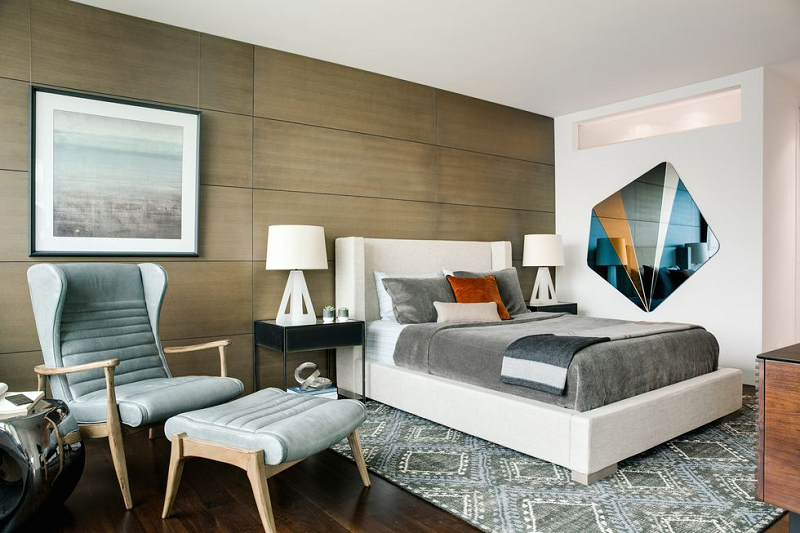
Your bedroom has four blank walls that make the space feel unfinished, but you rent and can’t make permanent changes. Or you own your home but don’t want to commit to paint colors or expensive wallpaper.
Every professionally designed bedroom has an intentional focal point—usually the wall behind the bed—that anchors the entire space and draws the eye upon entry. Without this visual anchor, rooms feel scattered and incomplete. Designers create focal walls using removable, rental-friendly methods that deliver high impact without damaging walls or requiring landlord approval.
How to apply it:
- Use peel-and-stick materials: High-quality removable wallpaper, wood plank panels, or 3D textured tiles create architectural interest behind your bed. Choose geometric patterns, subtle textures, or dark neutrals for men’s bedroom decor
- Install a floating shelf system: Mount a grid of 3–5 floating shelves (using damage-free Command strips for rentals) behind your bed and style them with books, plants, and minimal decor
- Hang oversized art: One large canvas (minimum 40″ wide) or a gallery wall of 5–7 frames creates a focal point without altering the wall itself. Use gallery-grade picture-hanging strips for damage-free mounting
- Add architectural molding: Removable decorative molding or picture frame molding creates visual dimension. Paint it the same color as your wall for subtle sophistication, or contrast it for drama
- Try the headboard-as-focal-point: An oversized upholstered or wood headboard that extends 12–18 inches wider than your mattress creates a focal point through furniture rather than wall treatment
💡Pro Tip: If you’re creating a gallery wall, lay out your arrangement on the floor first and photograph it. Then measure and mark your wall using painter’s tape before hanging anything. This prevents the common mistake of uneven spacing or poor composition that undermines the entire focal point.
A strong focal wall gives your bedroom instant polish and makes the space feel intentionally designed rather than hastily furnished.
Next, explore this practical guide that shows you exactly how to: 10 Steps To A Minimalist Living Room: The Complete 2026 Design Guide
X. Trick #7: Implement the 80/20 Hidden Storage Strategy

Your bedroom has visible clutter—charging cables, dirty clothes, random papers, gym gear—that destroys the intentional design you’ve created. Or you’ve hidden everything in closets that are now exploding with disorganized chaos.
Professional men’s bedroom decor balances aesthetics with real-world function through the 80/20 storage rule: 80% of your belongings should have hidden, organized storage, while 20% can be displayed openly if styled intentionally. This prevents the “too perfect” staged look while maintaining visual order. Most men underestimate storage needs by 30–40%, leading to perpetual clutter despite their design efforts.
How to apply it:
- Calculate your storage needs: Inventory what you need to store (clothes, shoes, electronics, gym equipment, hobbies, extra bedding). Then add 30% to that figure to account for future accumulation
- Choose furniture with hidden storage: Ottoman benches with internal storage, beds with built-in drawers, nightstands with closed cabinets rather than open shelves
- Create landing zones: Designate specific homes for daily-use items. A charging station inside your nightstand drawer, a valet tray on your dresser for wallet/keys, a hamper inside your closet (never visible)
- Use vertical storage: Wall-mounted organizers behind doors, floating shelves in closets, over-the-door hooks for bags and jackets—these maximize space without consuming floor area
- Display only intentional items: Your visible 20% should be styled objects that enhance your design: a few carefully chosen books, a sculptural object, quality grooming products in matching containers
💡Pro Tip: Invest in matching storage containers (leather bins, fabric boxes, wood crates) for closet and under-bed storage. Even hidden storage should be organized—you’ll maintain the system longer and avoid the “junk drawer effect” that defeats the entire purpose of hidden storage.
Strategic storage maintains your bedroom’s clean aesthetic while accommodating real life, making your men’s bedroom decor both beautiful and sustainable long-term.
Next, explore this practical guide that shows you exactly how to: 25 Easy Renter Friendly Hacks On The Budget
XI. Bedroom Layout: Position Furniture to Maximize Space and Flow
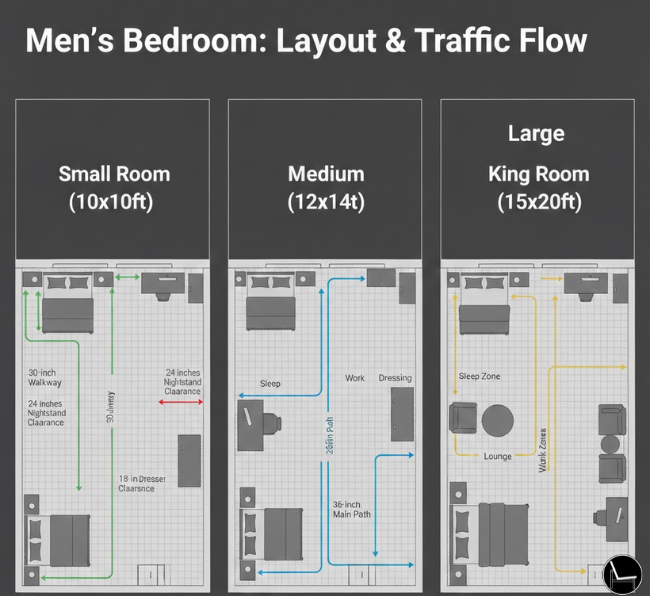
You’ve arranged furniture in the only configuration that seems obvious, but the room feels awkward to move through or the bed placement makes morning routines difficult.
Furniture layout directly impacts how you experience your men’s bedroom decor—not just visually, but functionally. Interior designers use spatial psychology and traffic flow principles to position furniture in ways that optimize both form and function. Poor layout makes rooms feel smaller, creates unnecessary obstacles, and can even disrupt sleep quality through suboptimal bed orientation.
How to apply it:
- Center your bed on the longest wall: This creates visual balance and allows equal clearance on both sides. If your longest wall has windows, center the headboard between them rather than blocking one window entirely
- Maintain 36-inch clearances: You need three feet of walking space on at least two sides of your bed (typically foot of bed and one side). Measure before buying furniture to ensure you’re not creating bottlenecks
- Create functional zones: Divide your bedroom into three areas: sleeping (bed + nightstands), dressing (dresser + mirror), and optional sitting/work. Don’t blend zones—keep 2–3 feet of visual separation between them
- Avoid the “furniture lineup”: Never push all furniture against walls like a waiting room. Float your bed 6–12 inches from the wall if space allows, and angle a chair 45 degrees to break the grid
- Position for morning light: If possible, orient your bed so morning sun doesn’t hit your face directly, but illuminates the room enough to wake naturally. East-facing windows should align with the foot of the bed, not the headboard
- Hide bedroom doors: When the door opens, it should shield your bed from immediate view. This creates privacy and prevents your sleeping area from feeling exposed to the rest of your home
💡Pro Tip: Before moving heavy furniture, use painter’s tape to outline each piece’s footprint on the floor. Live with the tape layout for 2–3 days, walking through your morning and evening routines. You’ll discover traffic pattern problems before committing to the arrangement.
Strategic bedroom layout transforms how you move through and experience your space—making your men’s bedroom decor both beautiful and functional.
Dive deeper with this step-by-step guide on: Masculine Color Palette Ultimate Guide for Home Decorating

XII. Men’s Bedroom Decor: Comparison of Design Approaches
| Approach | Best For | Cost Range | Time Investment | Rental-Friendly | Key Advantage | Main Limitation |
| Full Designer Hire | Homeowners with $15K+ budgets | $$$$ ($10K–50K+) | Low (designer manages) | No (permanent changes) | Custom, cohesive result | Extremely expensive |
| DIY Using Designer Tricks | Most men seeking elevated style | $$ ($1.5K–5K) | Medium (research + execution) | Yes (removable options) | Professional look at fraction of cost | Requires learning curve |
| IKEA Hacking | Budget-conscious renters | $ ($500–1.5K) | High (modification needed) | Yes | Maximum affordability | Can look generic without upgrades |
| Luxury Minimalism | Small spaces or minimalists | $$$ ($5K–12K) | Low (fewer items to source) | Depends (high-quality items) | Timeless, uncluttered | Requires restraint; not for collectors |
| Eclectic Vintage Mix | Creative types with patience | –– –$ ($300–3K) | Very High (thrifting, hunting) | Yes | Unique, characterful spaces | Inconsistent quality; hard to match |
Most Popular Post:
Interior Design Style Quiz
Timeless Paint Colors That Never Go Out of Style
Create Your Perfect Ergonomic Home Office: A Complete Guide
Must-Have Accessories for Guys: The Secret to a Stylish Space
Modular Sofas for Small Spaces: Brilliant Solutions for Compact Living
Conclusion
Men’s bedroom decor isn’t about following rigid masculine stereotypes or spending thousands on designer furniture—it’s about understanding the spatial psychology, proportions, and styling principles that make any space feel intentionally designed.
The seven tricks for men’s bedroom decor in this guide—color distribution, visual weight, layered lighting, essential furniture, strategic layout, the Rule of 3, texture mixing, focal walls, and hidden storage—work together to create cohesive, sophisticated bedrooms that reflect your personal style while delivering functional comfort.
Start with whichever trick addresses your biggest pain point, whether that’s awkward furniture arrangement, flat lighting, or visible clutter. Most men see dramatic improvement by implementing just three of these principles within the first month.
Your bedroom should be a space that restores you, impresses guests, and makes you feel quietly confident every time you walk through the door. These designer tricks make that transformation accessible without hiring a professional or breaking your budget.
Ready to transform your space? Begin with Trick #1—audit your color distribution using the 60-30-10 rule. Identify what percentage each color currently occupies, then make one strategic change this week.
Frequently Asked Questions: Men’s Bedroom Decor
Q1. What colors work best for men’s bedroom decor?
Deep neutrals like charcoal gray, navy blue, forest green, and warm taupe create masculine sophistication without feeling dark or oppressive. Use the 60-30-10 rule with a dominant neutral, a secondary earth tone, and an accent in cognac, brass, or burgundy. Avoid pure black (reads harsh) and stark white (shows every mark)—instead choose off-whites with warm undertones or soft grays with blue undertones.
Q2. How can I make my bedroom look expensive on a budget?
Focus 60% of your budget on your bed (frame, mattress, quality bedding) since it dominates the visual field, then add inexpensive but high-impact elements like removable wallpaper, smart lighting, and textured accessories. Replace plastic hangers with wood, upgrade hardware on existing furniture to brass or matte black, and use large-scale art (print affordable digital downloads at 24×36) rather than multiple small pieces. One $800 upholstered headboard makes a bigger impact than five $160 accent pieces.
Q3. What’s the biggest mistake men make with bedroom decor?
Treating the bedroom as a furniture showroom rather than a layered environment—buying a bed, dresser, and nightstands but neglecting lighting, texture, and intentional styling. The second biggest mistake is pushing all furniture against walls, creating a waiting room effect. Float your bed, add a seating area if space allows, and layer at least three textures and three lighting types for professional results.
Q4. How do I decorate a bedroom without making it look feminine?
Use angular furniture silhouettes (square arms, straight lines) rather than curved or ornate designs, choose matte and rough textures over sheen and softness, and limit pattern to geometric or abstract designs rather than florals. Stick to a maximum of three colors, incorporate natural materials (leather, wood, metal, concrete), and avoid excessive decorative pillows—2–3 pillows per side maximum.
Q5. Should I match my bedroom furniture?
No—matching bedroom sets look mass-produced and dated. Instead, choose furniture in the same general color family (all dark woods, all light woods, all painted) but vary the styles. A mid-century modern bed can pair with industrial nightstands if they share a similar wood tone. This creates an intentionally curated look rather than a catalog purchase.
Q6. How much should I spend on men’s bedroom decor?
Allocate $1,500–$3,000 for a complete bedroom refresh if buying quality pieces that will last 7–10 years. Break this down as: $800–1,200 for bed frame and mattress, $300–500 for storage furniture, $200–400 for lighting, $150–250 for bedding, and $250–450 for styling and accessories. If your budget is lower, phase your purchases over 6–12 months, prioritizing Tier 1 furniture first.
Q7. What size rug should I use in my bedroom?
Your rug should extend at least 24 inches beyond each side of your bed, allowing you to step onto rug rather than cold floor when you wake. For queen beds, use 8×10 rugs minimum; for king beds, use 9×12 rugs. Position the rug so the bed’s lower two-thirds sit on it, or float the entire bed on the rug if your room is large enough. Avoid small accent rugs that make rooms look choppy.
CATCH THE LATEST IN HOME DECOR TRENDS:
Steal These 16 Expert-Approved Decorating Secrets

How To Accessorize Your Living Room
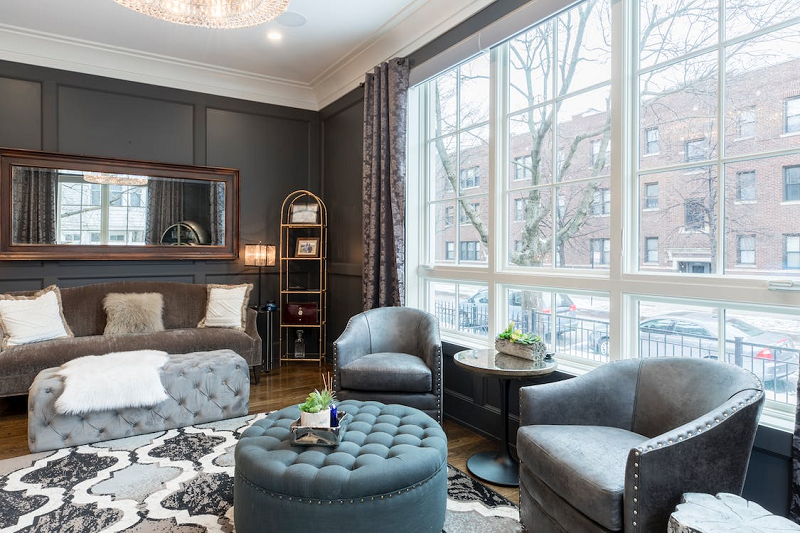
Small Space? 10 Ways To Make A Room Appear Bigger
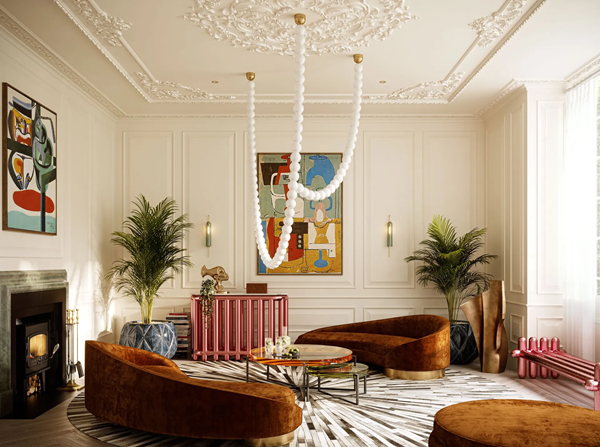
Make Your space Look Expensive
GET CAUGHT UP ON ALL THE INSPIRING DECOR TIPS:
18 Fresh Decorating Ideas To Update Your Fireplace
How to Make a Gallery Wall: The Complete Step-by-Step Guide (Even If You’ve Never Hung a Picture)


