TL;DR Summary: Decorating around a TV becomes effortless once you understand three core principles: proper scale ratios (your console should be 6-10 inches wider than your TV on each side), strategic cable concealment, and intentional visual balance through symmetry or curated asymmetry. This guide provides specific measurements, product solutions, and rental-friendly tactics the competition won’t tell you.
The TV Wall Crisis No One Talks About
You’ve been staring at that black rectangle for six months now. Every design blog promises you can “seamlessly integrate” your 65-inch TV into your living room, but somehow yours still looks like you installed a cinema screen in a closet. The truth? You’re not failing at decorating around a TV—you’re missing the exact formulas that make it work.
Here’s what keeps homeowners up at night: that massive screen dominates your most-used room, the tangled wires mock your organizational skills, and every Pinterest-perfect solution seems to require either a contractor or a trust fund. Meanwhile, friends visit and their eyes immediately lock onto your awkward TV setup, silently confirming what you already suspected—this room isn’t done.

But what if I told you the problem isn’t your TV at all? The issue is that you’re missing three critical design secrets that professionals use on every single project. Once you understand scale ratios, strategic distraction, and proper tech integration, decorating around a TV becomes as simple as following a recipe.
This isn’t another “add a plant and hope for the best” article. We’re diving into the specific measurements, product recommendations, and rental-friendly hacks that transform your TV wall from design disaster to the room’s best feature. Whether you’re working with a 43-inch screen or an 85-inch monster, by the end of this guide, you’ll have a clear action plan that works for your space, budget, and skill level.
I. Why Your TV Wall Feels Wrong: The Psychology Behind Poor Integration

The human brain processes visual weight before aesthetic appeal—and your unbalanced TV wall triggers instant design discomfort.
When you walk into a room and immediately feel “something’s off” about the TV area, you’re experiencing what interior designers call visual weight imbalance. Your TV is a heavy, dark, rectangular focal point with nothing to counterbalance it. It’s like hanging a painting with nothing else on the wall—technically functional, but psychologically unsatisfying.
The science is simple: our brains crave visual equilibrium. When one element dominates without proper support, we perceive the space as unfinished or chaotic. This explains why professionally decorated rooms with TVs feel intentional while yours feels like you just… stopped halfway through decorating.
The three design principles that fix this:
- Visual Anchoring: Your TV needs support from both above and below to feel grounded (think: console beneath, art or shelf above)
- Horizontal Extension: The eye needs to travel beyond the TV’s edges, which requires your console and surrounding elements to be wider than the screen
- Textural Contrast: The glossy black screen needs counterpoints—matte frames, woven baskets, natural wood, or fabric elements
THE SQUINT TEST (Try This Right Now)
Stand 10 feet from your TV wall and squint your eyes until everything blurs slightly. What do you see?
If you only see the TV: Your integration has failed. The black rectangle dominates everything.
If you see 3-5 distinct shapes/colors: Success! Your TV is integrated into a larger visual composition.
The Fix: Add contrasting elements (art, plants, shelving) until your squint test reveals multiple focal points competing for attention, not just one black hole.
💡 Pro Tip: If your TV is the only thing visible in the squint test, you need to increase visual competition by 200-300%. That means bigger art, taller plants, or more substantial furniture.
You’ll Also Like: How to Arrange Pillows on a Couch Like a Pro: The Foolproof Step-by-Step Guide
II. What is the Correct Scale for a TV Console? (The Designer Formula)

Your console should be 6-10 inches wider than your TV on each side, and art should fill 2/3 of the remaining wall space above.
This is the formula competitors won’t give you because it sounds too prescriptive. But here’s the truth: design ratios exist because they work consistently. Stop guessing—start measuring.
The Console-to-TV Scale Chart:
| TV Size | Minimum Console Width | Ideal Console Width | Maximum Art Width Above TV |
| 43″ TV (38″ wide) | 50″ | 55-60″ | 60″ (full console width) |
| 55″ TV (48″ wide) | 60″ | 66-72″ | 72″ |
| 65″ TV (57″ wide) | 69″ | 75-80″ | 80″ |
| 75″ TV (66″ wide) | 78″ | 84-90″ | 90″ |
| 85″ TV (74″ wide) | 86″ | 92-98″ | 98″ |
Why these numbers matter: When your console is too narrow, the TV appears to “float” with nowhere to land. When it’s too wide, the TV looks like an afterthought rather than an intentional focal point. The 6-10 inch extension on each side creates visual legs that anchor the entire composition.
A. Real-World Application: The Three-Point Test
Before you buy anything, do this:
- Measure your TV’s actual width (not the diagonal screen size)
- Add 12-20 inches to get your ideal console width range
- Measure the wall space left above your TV and multiply by 0.66 to determine the maximum art height
Example: You have a 55″ TV (48″ wide) mounted 4 feet from the floor with 3 feet of wall space above it.
- Console should be 60-68″ wide
- Art above should fill approximately 24″ of that 36″ vertical space (leaving 12″ of breathing room)
- Gallery wall or shelving elements should extend to the full 60-68″ width of the console
✅ BEFORE YOU BUY CHECKLIST
Before purchasing a console or planning your TV wall decor, verify these five measurements:
- [ ] TV width (measure the screen, not the bezel)
- [ ] Available wall width (mark stud locations if mounting shelves)
- [ ] Distance from floor to bottom of TV (should leave room for 18-30″ console)
- [ ] Ceiling height above TV (determines if you have space for art/shelving)
- [ ] Viewing distance from sofa to TV (should be 1.5-2.5x your TV diagonal size)
💡 Pro Tip: If your console is already purchased and too narrow, extend the visual width with matching end tables, tall floor plants, or vertical sconces flanking the TV area. The goal is perceived width, not physical furniture dimensions.
In Case You Missed It: 5 Washable Area Rug Designer Secrets to Make Any Room Look Custom
III. The #1 Design Crime: How to Avoid “TV Too High” Syndrome

More TV walls fail because of mounting height than any other single factor—yet most homeowners don’t realize they’ve made this mistake until their neck hurts.
The “TV too high” problem has become a design epidemic. Walk into any new home build or renovation, and chances are the TV is mounted 6-12 inches higher than it should be. Why? Because homeowners think they’re following fireplace mantel logic (where art goes high) or because they’re copying what they see in showrooms (designed for standing viewers).
A. The Eye-Level Rule (The Only Height Formula You Need)
The center of your TV screen should sit at 42 inches from the floor for standard seating, or at your seated eye level.
Here’s how to calculate YOUR perfect height:
- Sit on your sofa in your typical viewing position
- Have someone hold a tape measure and mark where your eyes naturally land when looking straight ahead (not up, not down)
- Mount your TV so its CENTER point (not bottom, not top) aligns with that mark
- For most people, this lands between 40-48 inches from floor to TV center
B. The Math Formula:
TV Mounting Height = (Your Seated Eye Level) – (Half of TV Height)
Example: Your seated eye level is 42″. Your 55″ TV has a screen height of 27″.
- Perfect mounting height: 42″ – 13.5″ = 28.5 inches from floor to bottom edge of TV
C. Why “Above the Fireplace” Always Fails
Mounting a TV above a fireplace is the single most common mistake in home design. Here’s why it doesn’t work:
- Viewing Angle: You’re looking up at 15-30 degrees (causes neck strain after 20 minutes)
- Heat Damage: Fireplaces generate heat that rises directly into electronics (voids warranties)
- Focal Point Competition: Your fireplace and TV fight for attention (both lose)
- Aesthetic Disruption: Mantels are designed for art at 60-65″ height—TVs look awkward there
The Alternative: Mount your TV on an adjacent wall perpendicular to the fireplace. You maintain two focal points without compromise.
D. Common “Too High” Symptoms:
If you experience these, your TV is mounted incorrectly:
- Neck pain or shoulder tension after watching for 30+ minutes
- You find yourself slouching or lying down to watch comfortably
- You unconsciously tilt your head back when the TV is on
- Guests comment “wow, your TV is so high!” (even jokingly)
The Fix: Most wall mounts allow vertical adjustment. Lower your TV 4-8 inches and reassess. Your neck will thank you.
💡 Pro Tip: The “magic number” of 42 inches is calculated for standard 18-inch sofa seat heights. If you have a sectional with deeper cushions (20″+ seat height), add 3-4 inches to this measurement.
You’ll Also Like: Amazon Tiny Home: Your Complete Buying Guide
IV. How to Decorate a TV Wall in a Rental (No-Drill Solutions That Work)

40% of readers are renters—yet most TV decorating advice assumes you own the place. Here’s what actually works when you can’t put holes in walls.
The most frustrating gap in design advice? Everyone assumes you can drill 47 holes for a gallery wall or install custom built-ins. If you’re renting, that advice is useless—and potentially expensive when your security deposit disappears.
A. Command Hook Reality Check
Weight Limits That Matter:
- Standard Command Picture Strips: 4 lbs (perfect for 8×10″ frames)
- Command Large Picture Strips: 16 lbs (handles most gallery frames)
- Command Jumbo Hooks: 7.5 lbs each (use 4 for lightweight floating shelves)
- Command Wire-Backed Hanger: 1 lb (useless for anything substantial)
The Frame Weight Formula: Assume 1.5 lbs for an 11×14″ frame with glass, 3 lbs for 16×20″, and 5-6 lbs for 24×36″. Always mount with double the recommended hook capacity for safety.
B. Three No-Drill TV Arrangements That Look Intentional
Option 1: The Leaning Gallery
- Place 3-5 pieces of art on your console, leaning against the wall at various heights
- Stagger sizes: large piece in the center back, medium pieces flanking, small pieces in front
- Cost: $150-$300 (frames from Target, art prints from Etsy)
- Time: 30 minutes to arrange
Option 2: Tension Rod + Hanging Textiles
- Install a ceiling-to-floor tension rod to the side of your TV
- Hang a woven wall hanging, macramé, or fabric panel to create visual balance
- Cost: $80-$200 (tension rod $25, textile $55-175)
- Damage: Zero—tension rods press against floor and ceiling
Option 3: The Oversized Floor Mirror
- Position a large (4-6 feet tall) floor mirror to one side of your TV
- Lean it against the wall at a slight angle
- Reflects light, adds depth, requires no installation
- Cost: $120-$400
- Bonus: Makes your room feel 40% larger
C. The Designer’s Damage-Free Toolkit
| Problem | Solution Tool | Where to Buy | Price Range | Impact Level |
| Hanging frames | Command Large Picture Strips (16 lb capacity) | Amazon, Target | $8-15 per pack | High |
| Cable chaos | D-Line Cord Concealers (paintable) | Amazon, Home Depot | $12-18 | Very High |
| Need floating shelf | Command Jumbo Hooks (4x for one 24″ shelf) | Target, Amazon | $12-20 | Medium |
| Wire bundling | Cable Management Sleeves (neoprene) | Amazon | $10-15 | High |
| Hide power strips | Woven storage baskets under console | Target, HomeGoods | $25-50 | Medium |
| Eliminate HDMI cable | Wireless HDMI Transmitter/Receiver Kit | Amazon | $60-150 | Very High |
| Mount TV without drilling | Floor-Standing TV Mount (up to 75″) | Amazon, Best Buy | $100-250 | Very High |
💡 Pro Tip: Paint your D-Line cord concealer the exact wall color before mounting. Once painted, it becomes nearly invisible—even to you. Use a small paint sample ($3-5) for this—you only need 2-3 oz.
In Case You Missed It: Swivel Chairs Ultimate Guide: How to Choose & Style the Perfect One for Your Home
V. Solving Awkward TV Layouts: Corners, Windows, and Small Spaces

Not every room has a perfect flat wall for TV placement—here’s how to handle the tricky scenarios competitors ignore.
A. Problem: The Corner TV Struggle
Why it’s awkward: TVs in corners create asymmetrical viewing angles and leave dead space on one side that’s hard to decorate.
The Solution:
- Use a corner console (45-degree angle) that’s specifically designed for this placement
- Add a tall floor plant (5-6 feet) on the exposed side to balance the visual weight
- Mount a floating corner shelf 8-10 inches above the TV for small decorative objects
- Position your sofa at a 45-degree angle to the corner (not parallel to the wall) for comfortable viewing
Product Recommendation: Walker Edison Corner TV Stand (holds up to 65″ TVs, $180-250, available in 5 finishes)
Budget Alternative: Two small bookcases flanking the corner ($60-120 total from Target/IKEA) with TV centered between them on a small table.
B. Problem: TV in Front of a Window
Why it’s awkward: Glare during daytime viewing, and you’re blocking natural light—a design cardinal sin.
The Solutions (Ranked Best to Worst):
Option 1: Perpendicular Wall Mount (Best)
- Move the TV to an adjacent wall perpendicular to the window
- Use the window wall for seating or a reading nook
- Eliminates glare and maximizes natural light
Option 2: Layered Window Treatments (Good Compromise)
- Install sheer curtains for daytime (filters light without blocking it completely)
- Add blackout roller shades behind sheers for movie watching
- Choose a low-profile console (24″ or less height) to minimize window obstruction
Option 3: Anti-Glare Screen Protector (Last Resort)
- Apply anti-glare film to TV screen ($40-80 depending on size)
- Only reduces glare by 60-70%, not a perfect solution
- Best combined with strategic furniture positioning (sofa should be perpendicular to window, not facing it)
💡 Pro Tip: If you absolutely must place a TV in front of a window, position it so there’s at least 12 inches of window visible on each side. This maintains some natural light flow and makes the placement look more intentional.
C. Problem: TV in a Small Studio or Bedroom
Why it’s awkward: Space is limited, and the TV can overwhelm the entire room visually.
The Solutions:
For Studios Under 400 sq ft:
- Go smaller with the TV (43-50″ maximum)—resist the urge to upsize
- Mount it on a swivel arm so you can angle it from different seating/bed positions
- Use a minimal console (floating shelf or narrow table under 16″ deep)
- Embrace the dark wall trick: Paint the TV wall navy, charcoal, or deep green so the screen recedes
For Bedrooms:
- Foot-of-Bed Placement on a dresser (maintains bedroom aesthetic)
- Mounted opposite bed at proper eye level when propped on pillows (typically 48-52″ from floor to center)
- Hide it in a cabinet with closeable doors if budget allows ($400-800 for quality options)
Product Recommendation: IKEA Bestå Wall-Mounted Cabinet with doors ($200-350) hides TV when not in use while providing storage.
D. Problem: Open Concept Layout with Multiple Viewing Angles
Why it’s awkward: Kitchen, dining, and living areas all face different directions—no single TV position works for everyone.
The Solution:
- Invest in a swivel wall mount (Sanus VLF728-B1 holds up to 50″ TVs, swivels 90 degrees, $120-160)
- Create a primary viewing zone with sofa facing TV directly
- Secondary seating at an angle (kitchen island stools, dining chairs) gets 45-60 degree viewing angles
- Accept that not every seat is optimized—design for your most-used viewing position
💡 Pro Tip: In open concepts, your TV wall should be the most decorated/visually interesting wall in the space since it’s visible from multiple vantage points. This is where you invest in quality art, substantial furniture, and cohesive styling.
You’ll Also Like: Statement Light Fixture: The Designer’s 5-Step Framework for Choosing the Perfect One
VI. 8 Designer-Approved TV Styles (Pick Your Formula)
Stop copying random Pinterest pins—choose one cohesive approach that matches your room’s existing vibe.
Style 1: The Symmetrical Gallery Wall
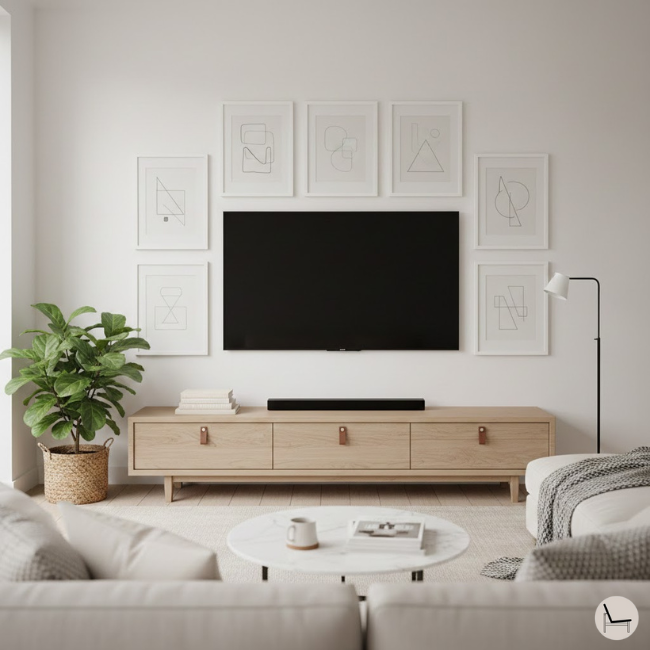
The Formula:
- Mount TV at center
- Frame with 6-8 identically-sized frames (8×10″ or 11×14″)
- Maintain 3-4″ spacing between all elements
- Use all black frames OR all white frames—no mixing
Best for: Modern, minimalist, or Scandinavian spaces
Personality: Clean, orderly, visually calming
Budget: $150-$300 (frames + prints)
Editor’s Pick: Amazon 12 Pcs Vintage Wall Art Decor FRAMED, Vintage Art Prints ($62.99)
Designer insight: Symmetry works when your room has other asymmetrical elements (like an off-center fireplace or angled furniture). It creates visual order that your brain craves for balance.
Style 2: The Asymmetrical Art Lean
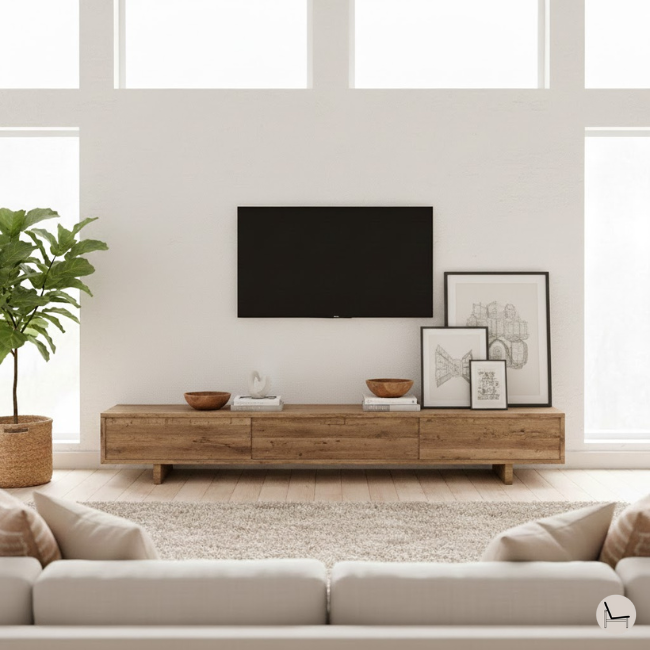
The Formula:
- Leave TV wall empty above
- Style console with 3-5 leaning art pieces (mix sizes)
- Add 2-3 sculptural objects between frames
- Layer tallest pieces in back, graduate forward
Best for: Bohemian, eclectic, or collected aesthetics
Personality: Curated, artistic, personal
Budget: $100-$250
Editor’s Pick: Amazon Monet Impressionism Canvas Wall Art ($37.99 set of 3)
Scale tip: Your largest frame should be at least 2/3 the height of your TV screen for proper visual weight.
Style 3: The Floating Shelf Sandwich
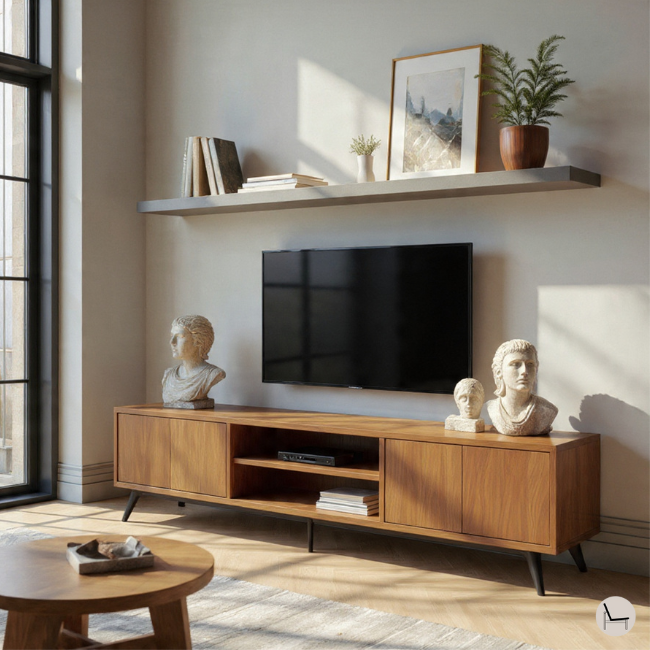
The Formula:
- Mount one shelf 10-12″ above TV
- Keep one console shelf below
- Style upper shelf with 3-5 small objects (books, plants, frames)
- Lower console gets larger sculptural pieces
Best for: Contemporary, industrial, or urban spaces
Personality: Structured, intentional, masculine-leaning
Budget: $80-$200
Editor’s Pick: Amazon Floating Shelves for Wall (55″ length, $84.99 set of 2) + Amazon Greek Roman Statue ($89.00, set of 5 Bust)
Style 4: The Dark Wall Camouflage
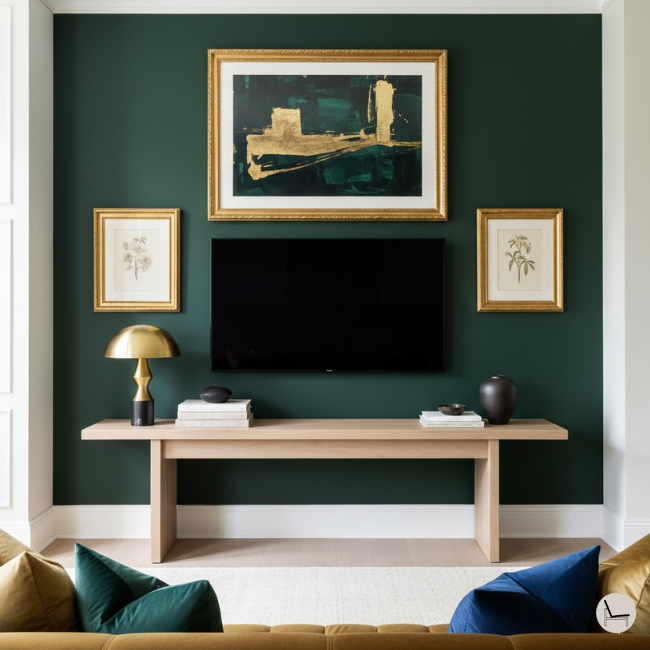
The Formula:
- Paint TV wall a deep charcoal, navy, or forest green
- Mount TV flush to dark wall (it visually recedes)
- Add brass or gold-framed art above and beside
- Use lighter console below for contrast
Best for: Dramatic, moody, or maximalist interiors
Personality: Bold, confident, unexpected
Budget: $50 paint + $100-300 for metallic-framed art
Editor’s Pick: Benjamin Moore Hale Navy (HC-154) or Sherwin-Williams Iron Ore (SW 7069) for wall + Amazon 3 Piece Colorful Abstract Canvas Artwork ($139.99)
💡 Designer Secret: When the TV blends into a dark wall, your eye stops “seeing” it as a black rectangle. This trick works because your brain processes it as part of the wall surface rather than a foreign object.
Style 5: The Built-In Illusion
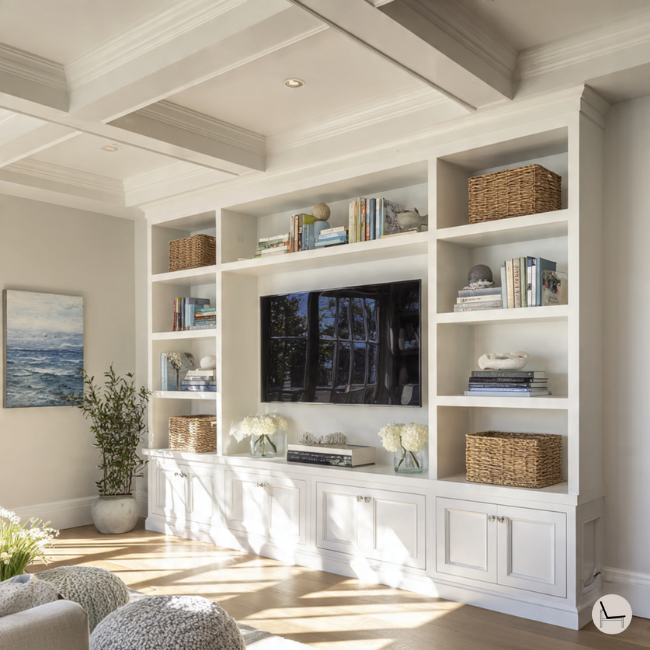
The Formula:
- Flank TV with two narrow bookcases or storage units
- Install LED strip lighting on back of TV and shelves
- Style shelves with books, baskets, and decorative objects
- Aim for 70% filled, 30% breathing room
Best for: Traditional, transitional, or family-room spaces
Personality: Timeless, functional, sophisticated
Budget: $200-$600
Editor’s Pick: Amazon Bookcases ( 70.6 ” height, $79.91 each) + Govee LED Strip Lights with remote ($109.99)
Style 6: The Single Statement Piece
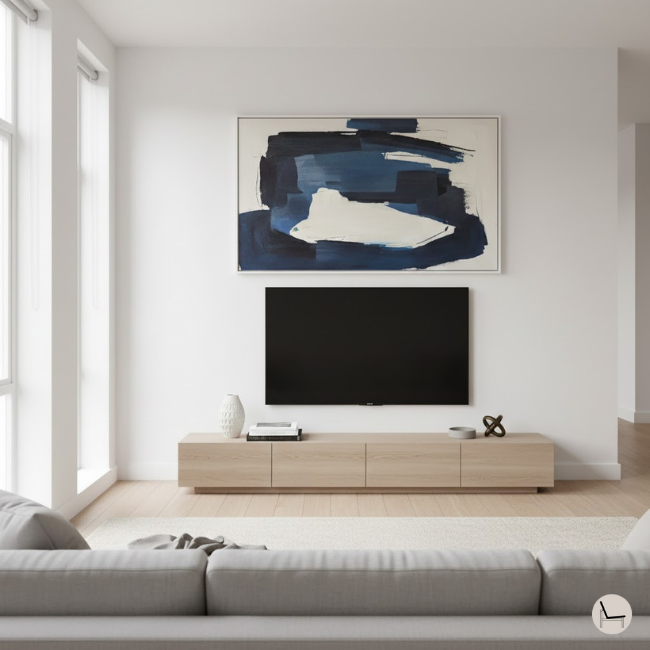
The Formula:
- Hang ONE large-scale art piece above TV (50-60″ wide)
- Keep it simple and bold (abstract, landscape, or photography)
- Console below with minimal styling (2-3 objects max)
Best for: Minimalist, modern, or small space dwellers
Personality: Decisive, uncluttered, zen
Budget: $150-$500
Editor’s Pick: Wayfair Large Canvas Prints (custom sizes, $75.99) or Wayfair Wall Art ($129.99)
Style 7: The Plant Flanks
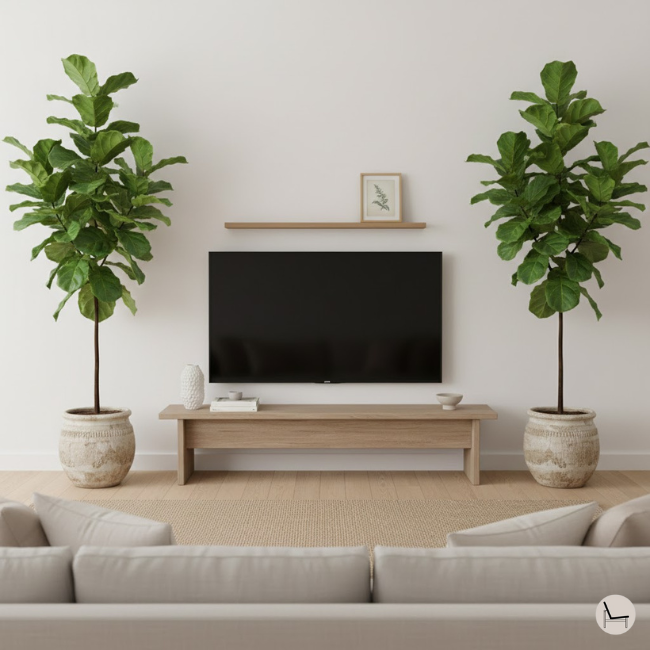
The Formula:
- Position two tall plants (5-7 feet) on either side of console
- Keep TV wall relatively bare
- Add one small shelf or piece above TV
- Console styled with low, organic elements
Best for: Natural, biophilic, California casual spaces
Personality: Relaxed, organic, health-conscious
Budget: $100-$300
Editor’s Pick: Wayfair Fiddle Leaf Fig Trees (6 ft, $112.99 each) + Amazon Live Fiddle Fig Tree (6 ft, $146.18)
Light requirement reality check: Fiddle leaf figs need bright indirect light. If your TV wall is in a dark corner, swap for snake plants or ZZ plants instead.
Style 8: The Tech-First Frame TV
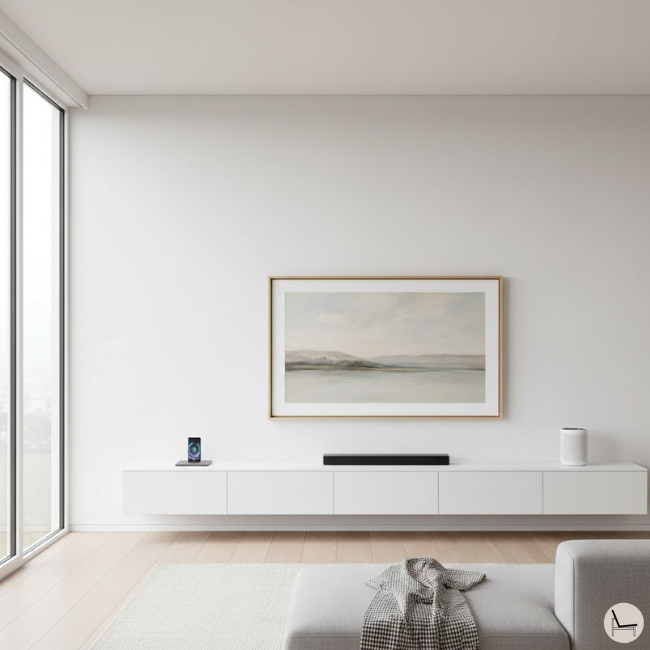
The Formula:
- Invest in Samsung Frame TV or equivalent
- Display rotating digital art when not watching
- Minimal console below with tech accessories
- Let the “art” be the TV itself
Best for: Modern, tech-forward, or small spaces
Personality: Cutting-edge, practical, design-savvy
Budget: $1,000-$2,500
Editor’s Pick: Amazon Samsung Frame TV (65″ sizes, $1,597.99)
💡 Pro Tip: Subscribe to services like Meural or Art.com for rotating digital art. Even non-Frame TVs can display art via screensaver apps.
In Case You Missed It: How to Choose and Style a Mid-Century Wall Unit That Transforms Your Living Space
VII. Which Paint Colors are Best for a TV Wall?

Choosing the right paint color for the wall behind your TV can significantly impact the overall aesthetic of your TV area. Here’s some guidance on selecting the best paint colors:
A. Neutral Shades: Versatile Elegance
Neutral colors like soft grays, warm beiges, and subtle whites are popular choices for TV walls. They provide a neutral backdrop that complements various decor styles and allows your TV and decor to shine. These colors also help reduce glare, enhancing your viewing experience.
B. Darker Hues: Dramatic Contrast
If you prefer a bolder statement, consider deep blues, rich charcoals, or even a dark accent wall behind your TV. These darker hues create a striking contrast with the TV screen, making it stand out as a focal point. Just be mindful of the room’s overall lighting to prevent the space from feeling too dim.
C. Accent Colors: Pop of Personality
Incorporating an accent color can add personality and visual interest to your TV area. Choose an accent color that complements your decor theme or matches other elements in the room, such as throw pillows or artwork. Painting a single wall with the accent color can create a captivating focal point.
In Case You Missed It: How to Arrange Pillows on a Couch Like a Pro: The Foolproof Step-by-Step Guide
VIII. The Console Selection Formula (Don’t Buy Before Reading This)

A $300 console can make a $2,000 TV look terrible—while a $150 console with proper proportions makes everything look intentional.
The Four Console Checkpoints:
1. Width (We covered this—but it’s worth repeating)
Your console must be 12-20″ wider than your TV’s actual screen width. No exceptions. A too-narrow console makes your TV look like it’s about to topple forward.
2. Height Sweet Spot
- For wall-mounted TVs: Console should be 18-24″ tall
- For console-mounted TVs: Console should be 24-30″ tall
- General rule: Your seated eye level should align with the center of the screen (or slightly above)
3. Depth Requirements
- Minimum 16″ deep for equipment storage
- Ideal 18-20″ deep to create visual grounding
- Avoid anything under 14″ (looks flimsy and can’t hold components)
4. Storage Realism
Count your devices: Cable box, gaming console, soundbar, streaming devices, DVD player, router? You need ONE shelf or cabinet space per device, plus one drawer for remote hell.
Console Styles By Budget
Budget Option ($100-$250):
- Jalonda Modern Wood TV: TV Stand with Storage for TVs up to 60” (Check Price on Wayfair)
- Nicolee 59” Media Console: Perfect blend of style and functionality for TV’s up to 65″ (Check price on Wayfair)
- Rattan TV Stand: Boho Entertainment Center with 2 Doors & 2 Drawers for TV’s up to 85″ (Check Price on Amazon)
Mid-Range Investment ($250-$600):
- Fireplace TV Stand for 65″+: Rustic Media Console w/Sliding Barn Door, Antique White (Check price on Amazon)
- Mid-Century Media Console Table: TV Stand with Storage for TVs up to 60” (Check Price on Wayfair)
- Modern TV Stand: Clean lines, multiple finishes (Check Price on Wayfair)
Splurge-Worthy ($600-$1,500):
- Arantza Entertainment Center: reclaimed wood, rustic charm (Check price on Wayfair)
- Joss and Main Modica 3-Piece Entertainment Center: TV stand and two bookshelves (Check price on Wayfair)
- Custom millwork built-ins: tailored to your exact dimensions ($1,500-5,000)
💡 Pro Tip: Buy the best console you can reasonably afford. It’s a 10-15 year piece that impacts your room’s entire aesthetic. Cheap here = regret later.
You’ll Also Like: No-Fail Formula to Create a Gallery Wall
IX. Modern Tech Integration: Soundbars, Frames & Smart Speakers
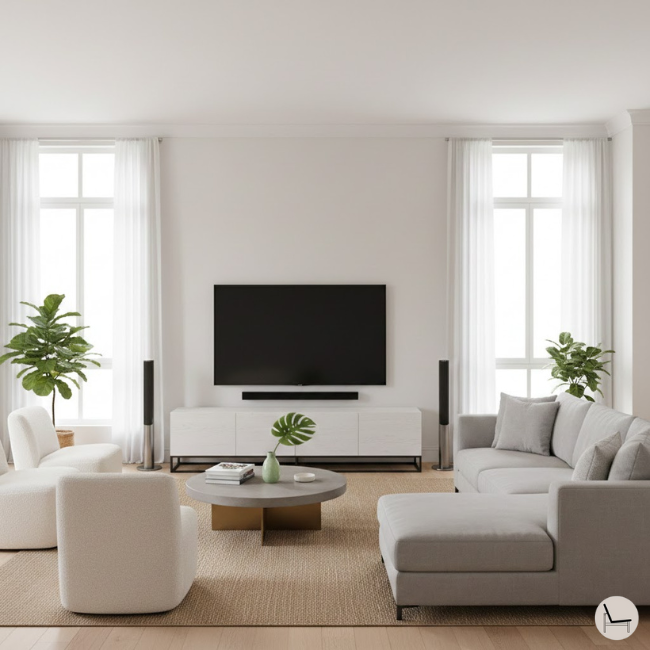
2026 tech looks different than the equipment from 5 years ago—your decorating strategy needs to evolve too.
The Soundbar Styling Dilemma
Soundbars are necessary for decent audio but can be visual nightmares. Here’s how to integrate them without compromising your design:
If soundbar sits below TV (most common):
- Choose a black soundbar to match your black TV (visual cohesion)
- Position it centered and 2-3″ in front of other console items
- Never try to hide it—embrace it as part of the tech display
If soundbar mounts below TV on wall:
- Ensure it’s flush-mounted with minimal gap
- Run cables through the same concealer as TV power cord
- Consider Samsung HW-Q series with wireless rear speakers (fewer wires)
A. The Samsung Frame TV Phenomenon
If you’re in the market for a new TV, Frame TVs deserve consideration. They display art when off, blend with actual frames, and eliminate the “black rectangle” problem entirely.
Honest Assessment:
- Cost: $1,000-$2,500 (significant premium over standard TVs)
- Worth it if: You hate TV aesthetics AND watch less than 15 hours weekly
- Skip it if: You’re a heavy TV user or on a strict budget
Alternative: Regular TV + screensaver art apps (Google Arts & Culture, Meural, Fireplace streams) = 80% of the aesthetic for $0 additional cost.
B. Smart Speaker Integration
Alexa, Google Home, and HomePod create their own styling challenges. Place them:
- On the console flanking the TV (maintains symmetry)
- On floating shelves to either side (if you have those)
- On nearby end tables (if console is too crowded)
Never: Directly in front of your TV. It blocks airflow, looks cluttered, and defeats the purpose of your carefully planned arrangement.
Editor’s Pick: Sonos One (Amazon $379, great sound + Alexa/Google built-in) or Bose SoundLink Revolve+ (On Amazon, $199, perfect sound)
In Case You Missed It: Faux Plants Secrets to Decorate Like a Pro (And Fool Everyone!)
X. Budget Cheat Sheet: What to Spend Where
Strategic spending makes the difference between a $500 setup that looks cheap and a $500 setup that looks $2,000.
| Budget Level | Where to Splurge | Where to Save | Total Investment | Result Quality |
| Tight Budget ($200-400) | Console quality + one statement art piece | Frames from Target, DIY cable mgmt, lean art instead of hanging | $200-400 | Surprisingly polished if scale is right |
| Mid-Range ($400-800) | Console + 3-5 quality frames + soundbar | Plants (propagate your own), skip Frame TV, paint cord concealer yourself | $400-800 | Professional-looking, balanced aesthetic |
| Investment ($800-1,500) | Premium console + Frame TV OR custom art + quality mount/lighting | Storage baskets, decorative objects (thrift/HomeGoods) | $800-1,500 | Showroom-ready, magazine-quality |
| No Compromise ($1,500-3,000+) | Everything—Frame TV, custom millwork, designer art, professional installation | Nothing (but still shop sales) | $1,500-3,000+ | Designer-level perfection |
The $300 Maximum-Impact Setup:
If you only have $300, here’s how to allocate it for maximum visual impact:
- $150: IKEA Bestå console (60″ width, white or black)
- $60: Three 16×20″ frames + prints (Target + Etsy)
- $30: D-Line cord concealer + cable management sleeves
- $40: Two medium plants in ceramic pots (Trader Joe’s/Home Depot)
- $20: LED strip lighting for console back (creates ambiance)
Total: $300 | Impact Level: High | Time to Install: 3 hours
💡 Pro Tip: If you’re choosing between a $400 console and a $200 console + $200 in decorative elements, always choose the better console. Foundation pieces matter more than accessories.
XI. The 7 Mistakes That Make Your TV Wall Look Worse

Mistake 1: The Floating Black Hole
What it looks like: TV mounted on a vast white wall with nothing else. Zero context, zero integration.
Why it fails: Your TV becomes the room’s ONLY focal point—amplifying its presence rather than integrating it.
The fix: Add literally anything. One floating shelf above, two wall sconces beside, or a console below. Just don’t leave it floating alone.
Mistake 2: The Gallery Wall of Random Frame Sizes
What it looks like: 15 frames in completely different dimensions with uneven spacing and no clear pattern.
Why it fails: Your eye can’t find visual order, so the entire wall reads as chaotic clutter.
The fix: Pick ONE consistent frame size for 70% of your gallery, vary the remaining 30% by just one size up or down. Maintain consistent 3-4″ spacing.
Mistake 3: The Console That’s Drowning
What it looks like: Every inch of console surface covered with objects—12+ items fighting for attention.
Why it fails: Clutter creates visual noise that makes your TV look worse by association.
The fix: Follow the “Rule of Three”: Group objects in threes, maintain negative space between groups, and leave 30-40% of console surface empty.
Mistake 4: Art Hung Too High
What it looks like: Small piece of art 18″+ above the TV, floating awkwardly near the ceiling.
Why it fails: Creates a visual gap between TV and art, making both elements feel disconnected.
The fix: Keep art 6-10″ above TV maximum. If your ceilings are high (9’+), add a floating shelf at that height instead of pushing art toward the ceiling.
Mistake 5: The Mismatched Metal Moment
What it looks like: Gold picture frames, silver TV mount, brass console hardware, chrome soundbar.
Why it fails: Metal finishes create visual noise when they clash.
The fix: Choose one metal finish family (warm: gold/brass/copper OR cool: silver/chrome/nickel) and stick with it for everything within 6 feet of your TV.
Mistake 6: The Single Sad Plant
What it looks like: One small pothos plant on the console corner as the sole decorating attempt.
Why it fails: One tiny organic element can’t balance a 65″ TV. The ratio is completely off.
The fix: Go big or go home. Two tall floor plants (5-6 feet) flanking the console, OR a substantial arrangement of 3-5 plants in varying heights.
Mistake 7: TV Mounted Above the Fireplace
What it looks like: Exactly what it sounds like.
Why it fails: You’ll get neck strain watching at that angle, the fireplace competes for focal point status, and heat can damage electronics.
The fix: Mount TV on an adjacent wall, build shelving beside the fireplace for the TV, or accept your fireplace as the focal point and keep TV elsewhere.
💡 Pro Tip: Take a photo of your TV wall setup on your phone, then flip the image horizontally. This tricks your brain into seeing it with fresh eyes—mistakes become glaringly obvious when the mirror image breaks your visual familiarity.
Most Popular Post:
10 Surprising Benefits of Printable Wall Art
15 Must-Have Accessories For Styling A Coffee Table
How to Choose the Perfect Interior Color Scheme for Your Home
Expert Guide On How To Buy A Rug For Each Room

Conclusion: Your Action Plan: Transform Your TV Wall This Weekend
You’ve absorbed the formulas, understood the psychology, and identified your style. Now it’s time to actually do something about that TV wall that’s been bothering you for months.
Hour 1: Measure Everything
- TV width (actual screen, not diagonal)
- Wall space available (width and height)
- Current console dimensions
- Distance from TV to sofa (for scale verification)
Hour 2: Make Your Purchase List
Based on your measurements and chosen style approach, you need:
- Console (if current one fails the width test)
- Art or frames (sized according to the formulas we covered)
- Cable management supplies ($30-60 investment)
- Styling objects for console (books, vessels, plants)
Hour 3: Execute One Style Approach
Don’t try to do everything. Pick ONE of the 8 styles we outlined and commit. You can always evolve later, but completing one cohesive look today beats three half-finished attempts.
The Real Transformation:
Here’s what changes when you properly decorate around your TV. You stop apologizing when friends visit. You actually enjoy spending time in your living room. When you sit down to watch something, you’re relaxing in a space that feels complete and intentional—not settling into an unfinished room that reminds you of all your design failures.
Your TV wall becomes something you’re proud of rather than something you tolerate. And that pride? It spreads. You start tackling the bedroom. Then the entryway. Then the bathroom. Because once you realize that good design isn’t about unlimited budgets or magical creative talent—it’s about understanding proven formulas and having the confidence to execute them—everything becomes possible.
The best room in your house is the one you’re about to create. Start with your TV wall and watch everything else fall into place.
Ready to stop living with design regret?
Pin this guide, take your measurements, and commit to transforming your TV wall this month. The difference between a room that stresses you out and one that welcomes you home is just one focused afternoon and the right plan.
Disclaimer: This post may contain affiliate links. I earn a commission on qualifying purchases at no additional cost to you.
FAQs: Your TV Area Decor Questions Answered
I understand that decorating around a TV can be an exciting yet sometimes puzzling endeavor. To make your journey smoother, here are some frequently asked questions and expert answers to guide you through the process.
Q: Should I center my TV on the wall or center it on the furniture?
Center your TV on the primary seating area, not necessarily the wall. If your sofa is slightly off-center in the room due to other furniture or traffic flow, mount the TV so it faces the sofa directly. Visual comfort for viewers trumps architectural symmetry.
Q: How do I decorate around a TV that’s too big for my room?
You can’t shrink the TV, but you can expand the visual context. Add substantial furniture pieces nearby (tall bookcases, floor plants, large-scale art on adjacent walls) to make the TV feel proportional to its surroundings rather than isolated and oversized.
Q: What’s the best color console for a black TV?
Black or dark wood creates the least contrast and makes your TV feel intentional. However, light wood, white, or gray consoles work beautifully IF you add black elements elsewhere (black frames, black bowls, black lamp bases) to tie everything together.
Q: Can I decorate around a TV in a small apartment?
Absolutely. Small spaces benefit most from the “single statement piece” approach (one large art piece above) or the “dark wall camouflage” technique. Avoid gallery walls in small rooms—they’ll make the space feel busier and smaller.
Q: How high should I mount my TV?
The center of your TV screen should be at seated eye level—typically 42-48″ from the floor to the TV’s center point. If you’re over 6 feet tall, adjust upward by 3-4″. Never mount above 55″ (except above fireplaces, which we don’t recommend anyway).
Q: Do wireless soundbars eliminate the cord problem?
Partially. Wireless soundbars still need power cords, but they eliminate the HDMI cable between soundbar and TV. You’ll still need cable management for the power cord running down the wall.
Q: How do I hide TV wires without cutting the wall?
Use a D-Line cable cover painted the same color as your wall. It becomes 90% invisible for under $20.
Q: What size art should go above a 65-inch TV?
Your art arrangement should span at least 40-50 inches (roughly 2/3 of the console width) to prevent the TV from looking top-heavy.
Q: Can you put a TV in front of a radiator?
We don’t recommend it. Heat can degrade the lifespan of your LED/OLED panels. If necessary, use a “heat shield” shelf at least 12 inches above the radiator.
Remember, your TV area decor should reflect your personal style and preferences. Don’t be afraid to experiment and make it uniquely yours. If you have more questions or need specific advice, feel free to reach out to us – we’re here to help you create the perfect TV space.
Subscribe To the Newsletter!
Subscribe now for an endless feed of inspirational women’s cave decor ideas, pampering rituals, and more tips for curating your ultimate escape. Let’s start making your cozy refuge a reality – you so deserve this!
CATCH THE LATEST IN HOME DECOR TRENDS:
Steal These 16 Expert-Approved Decorating Secrets

How To Accessorize Your Living Room
Small Space? 10 Ways To Make A Room Appear Bigger
Make Your space Look Expensive
GET CAUGHT UP ON ALL THE INSPIRING DECOR TIPS:
18 Fresh Decorating Ideas To Update Your Fireplace
How to Make a Gallery Wall: The Complete Step-by-Step Guide (Even If You’ve Never Hung a Picture)


