By the decorholic · 15 min read · Updated January 2026
TL;DR Summary: A well-decorated front porch starts with four non-negotiable layers — a weather-proof seating zone, layered lighting, a seasonal focal point, and year-round greenery. Nail those four pillars and your porch goes from forgettable to magazine-worthy, regardless of budget or square footage.
Introduction: A Designer Formula to Porch Decor
I remember the first time I stood on a client’s porch and felt that hollow, deflating feeling — the one where everything is technically there (a chair, a plant, a doormat) but nothing feels right. The porch looked abandoned, like furniture waiting for a moving truck.
If that sounds familiar, you’re not alone. Most people approach porch decorating the same way they’d fill a blank wall — one piece at a time, hoping it eventually clicks. It doesn’t work. A porch is an outdoor room, and it needs to be designed like one.

In this porch decor guide, I’m walking you through the exact step-by-step system I use with interior design clients — the one that transforms ordinary front porches into spaces neighbors actually stop and comment on. No fussy seasonal swaps required (unless you want them).
“Curb appeal is the handshake before the conversation. Your porch tells every visitor — and every passerby — exactly who you are before they ever knock.” — Joanna Gaines, Magnolia Home (2022 interview, House Beautiful)
What You’ll Learn in This Porch Decor Guide
- The 4-layer porch decorating formula that professional designers use on every project
- Which porch furniture materials actually survive rain, sun, and humidity long-term
- The “Rule of Odd Numbers” and other styling tricks that make any porch look expensive
- A renter-friendly approach — zero permanent changes required
- Exactly where to splurge vs. save (with specific product picks under $50 and under $300)
✦ Before You Begin
I. Why Bother Decorating Your Front Porch at All?

A decorated front porch does three things money can’t easily buy elsewhere: it boosts your home’s perceived value, it gives you a daily emotional lift every time you come home, and it tells your neighborhood — and your guests — something true about who you are.
I know what you might be thinking: “It’s just a porch. Nobody really notices.” But here’s what 15 years of residential design work has taught me — everyone notices. The mail carrier, your neighbors, the date pulling up for the first time, the appraiser walking the exterior. The porch is the one part of your home the entire world sees, every single day.
And the emotional ROI is just as real. There’s actual psychology behind it. A 2021 study from the University of Exeter found that people who invest in their immediate outdoor environment — even in small ways — report measurably higher daily wellbeing scores. Coming home to something beautiful that you created is a quiet, repeating win. You deserve that.
On the financial side, the National Association of Realtors consistently ranks landscaping and exterior improvements among the highest-ROI home upgrades. A well-styled porch contributes to curb appeal, which influences buyer perception before they ever step inside. Realtors estimate that strong curb appeal can add 5–10% to a home’s sale price — and a thoughtfully decorated porch is the most affordable way to get there.
Still not convinced? Here’s the one that gets my clients every time: your porch is the only room in your house you share with the world for free. Your living room, your kitchen, your bedroom — those are private. Your porch is your public gift. Make it one worth giving.
💡 The 30-Second Test: Park across the street from your house. Look at your porch for 30 seconds — the same way a first-time visitor would. Does it invite you in? Does it feel like someone lives there and loves it? Or does it feel forgotten? That gut reaction is exactly what this guide is going to fix.
Dive deeper with this step-by-step guide on: 9 Spring Porch Decor Tricks That Make Your Home Look Professionally Styled
✦ Choose Your Style
II. Find Your Porch Decor Personality: The “Choose Your Own Adventure” Style Guide
Before you buy a single thing, identify your porch’s aesthetic direction. The four most popular — and Pinterest-searchable — porch decor styles are Modern Farmhouse, Boho Chic, Minimalist, and Seasonal Transition. Each has a distinct formula. Pick the one that matches how you live, not just what looks good in photos.
One of the biggest decorating mistakes I see is people shopping without a style anchor. They buy a rattan chair because it’s pretty, a farmhouse lantern because it’s on sale, and a colorful Moroccan rug because it was marked down. The result looks like three different porches arguing with each other. Choosing a style direction first — and sticking to it — is what separates a styled porch from a collected one.
Style 1: Modern Farmhouse — Warm, Welcoming, and Effortlessly Lived-In

Modern Farmhouse porch decor is built on neutral tones (white, cream, black, natural wood), classic silhouettes, and layered textures. It feels relaxed and inviting — the porch equivalent of a flannel shirt. This is the most forgiving style to execute because it rewards imperfection.
- Seating: White or black wooden rocking chairs, a porch swing, or a natural wood bench with white cushions — the rocking chair is practically the mascot of this style.
- Rug: Layer a large jute or sisal base mat under a smaller black-and-white buffalo check or striped pattern. Neutrals only.
- Lighting: Black lanterns (wall-mounted or freestanding) and warm Edison string lights. No chrome, no brushed nickel.
- Greenery: Potted boxwood topiaries, lavender, simple white or yellow florals in galvanized metal or terracotta pots.
- Statement pieces: A cotton wreath, a shiplap-style house number sign, a “Welcome” board in serif typography, a milk jug or enamelware as a planter.
💡 Modern Farmhouse Pro Tip: The secret weapon of this style is galvanized metal. A galvanized steel bucket, watering can, or trough planter adds an authentically rustic note that elevates the entire setup for under $20. Place one filled with white or cream seasonal flowers beside your door for an instantly Pinterest-worthy vignette.
Style 2: Boho Chic — Free-Spirited, Textured, and Gloriously Maximalist

Boho Chic porch decor layers natural textures, global-inspired patterns, and handcrafted elements into a space that feels like a well-traveled life on display. It’s the most expressive of the four styles — and the most forgiving of mismatched pieces, because eclecticism is the point.
- Seating: A rattan egg chair or hanging wicker chair, floor cushions in jewel-toned or earthy fabrics, a low wooden daybed with throw pillows.
- Rug: A flatweave kilim, a Moroccan-inspired pattern, or a layered jute + patterned combo in terracotta, rust, mustard, and sage tones.
- Lighting: Woven rattan pendant lanterns, Moroccan punched-metal candle holders, battery-operated candles in earthy ceramic vessels.
- Greenery: Macramé hanging planters at varying heights, trailing pothos or string-of-pearls, a large fiddle-leaf fig or banana plant for drama.
- Statement pieces: A handmade macramé wall hanging, ceramic wind chimes, a beaded door curtain, driftwood accents, feathers, and layered throws in natural fibers.
💡 Boho Chic Pro Tip: The key to Boho that doesn’t look chaotic is a consistent color palette underneath all the pattern and texture. Keep your dominant tones to a warm earth range — terracotta, rust, mustard, cream, sage — and let pattern and material vary freely within those boundaries. Everything can be different as long as the colors rhyme.
Style 3: Minimalist — Intentional, Sculptural, and Quietly Stunning

A minimalist front porch decor proves that “less” is not “boring” — it’s disciplined. This style uses clean architectural lines, a monochromatic or two-tone palette, and one or two carefully chosen statement plants to create a porch that feels like a luxury hotel entrance. Every single object earns its place.
- Seating: One sleek bench or a pair of low-profile modern chairs in black, white, concrete gray, or natural teak — no cushions, or a single solid-color cushion.
- Rug: One high-quality, solid-tone or subtly textured outdoor rug in charcoal, stone, or warm white. No patterns.
- Lighting: A single architectural wall sconce in matte black or brushed brass. One well-placed light source beats ten decorative ones in this style.
- Greenery: One large, structural plant in a tall concrete or matte ceramic pot — an olive tree, a large ornamental grass, a sculptural cactus, or a clipped boxwood sphere. One plant. Done right.
- Statement pieces: A bold, oversized house number in matte metal. Nothing else on the door. The architecture is the decor.
💡 Minimalist Pro Tip: The biggest minimalist mistake is buying inexpensive pieces and calling it minimal. Minimalism is not budget decorating — it’s quality over quantity. You have fewer objects, so each one needs to be excellent. One beautifully crafted $120 concrete planter with a perfect olive tree will always beat six $20 decorative accents. Edit ruthlessly, then invest in what remains.
Style 4: Seasonal Transitions — How to Pivot Without a Total Overhaul

The smartest seasonal decorators don’t redesign their porch four times a year — they maintain a consistent “evergreen base” in neutral tones and swap only 3–4 accent pieces per season. Spring florals become autumn warmth with a pillow swap, a new wreath, and a $15 addition to your planter.
- Spring → Summer: Swap wreath for a fresh magnolia or peony style. Add a hanging basket of trailing petunias or fuchsia. Replace throw pillow covers with something bright — cobalt, citron, or coral.
- Summer → Fall: Swap bright pillow covers for burnt orange, burgundy, and cream. Replace florals with ornamental cabbage, mums, and dried pampas grass. Add a pumpkin trio to your step vignette.
- Fall → Winter: Tuck evergreen branches, pinecones, or cedar sprigs into your existing planters. Add a battery-powered candle lantern. Swap the mum wreath for a boxwood or magnolia leaf wreath with a velvet ribbon.
- Winter → Spring: Remove all winter elements. Add one pot of forced bulbs (daffodils, tulips, hyacinths). Hang a simple grapevine wreath with a few fresh eucalyptus sprigs. Done.
“The best seasonal decorators I know spend $30–$50 per transition — not $300. They invested once in a beautiful base, and now they just change the jewelry.”— Sarah Linden, Interior photographer
Keep reading for a designer-approved guide to: How To Decorate Your Apartment Balcony: Step-by-Step Guide
✦ The Essentials
III. The Porch Decor Essentials Checklist: Everything You Actually Need (Nothing You Don’t)
A fully functional, beautifully styled porch needs exactly four categories of essentials: lighting, textiles, greenery, and right-sized furniture. Every other decorative addition is optional. Nail these four and you have a complete porch — regardless of your style, budget, or square footage.
Most porch decorating guides show you beautiful photos and then leave you to figure out the “what, exactly, do I need to buy” part on your own. This section is that list. Think of it as your porch shopping brief — everything on it serves a functional and aesthetic purpose. Nothing is filler.
Essential #1: Lighting — The One Thing You Can’t Skip

- String Lights: The fastest, most affordable way to add warmth and ambiance. Look for outdoor-rated, weatherproof Edison bulbs on a black or brown cord. Hang them along the roofline, between columns, or across the porch ceiling. Budget: $30–$55.
- Wall Sconce or Lantern: A hardwired or plug-in sconce beside your door provides functional light and architectural detail. Black finish is the most universally flattering. If you can’t hardwire, a large freestanding lantern with a solar insert or battery candle achieves the same look. Budget: $25–$120.
- Solar Path Lights: If you have a walkway leading to your porch, solar stake lights define the path and extend your porch’s visual footprint past the steps. Choose warm (2700K) color temperature — cool white lights kill the cozy. Budget: $20–$45 for a set of 8.
💡 Lighting Pro Tip: Always choose 2700K (“warm white”) bulbs for porch lighting. Cool white (5000K) makes your porch look like a parking garage at night. Warm white makes it look like a magazine. The Kelvin number is always printed on the bulb box or product listing — don’t skip checking it.
Essential #2: Textiles — The Quickest Way to Add Warmth and Definition

- Outdoor Rug (Non-Negotiable): A rug defines your porch as a room. Without it, you have a slab with furniture on it. With it, you have a space. Choose a size that fits under all your furniture legs — a 5×8 for most porches, or a 4×6 for small stoops. Material must be polypropylene, not natural fiber, for moisture resistance. Budget: $45–$90.
- Weatherproof Throw Pillows: Cushions and pillows are your fastest style lever — they’re how you change the season without redecorating. Buy inserts once (high-density outdoor foam) and invest in two sets of removable covers: one for warm months, one for cool. Look for “solution-dyed acrylic” or Sunbrella-branded fabric. Budget: $15–$40 per cover set.
- Layered Doormat Set: One large base mat (jute, sisal, or solid rubber) plus one smaller decorative top mat gives your entry dimension and personality. The base mat should extend 3″ on all sides. Budget: $15–$28 per mat.
Essential #3: Greenery — The “Thrillers, Fillers, and Spillers” Formula

Professional container gardeners use a three-plant formula for every planter that guarantees a lush, intentional result — no guesswork required. Apply it to every pot on your porch and it will look like a florist designed it.
- Thriller (the star): A tall, dramatic plant that provides height and anchors the composition. Examples: ornamental grass, canna lily, tall salvia, a standard-form boxwood, or a spike (Dracaena). Aim for 18″–36″ tall.
- Filler (the body): A medium-height, mounding plant that fills in the sides and covers the base of the thriller. Examples: begonias, impatiens, coleus, petunias, or calibrachoa. These provide the color mass.
- Spiller (the cascade): A trailing plant that drapes over the edge of the pot, softening the container and connecting the planting to its surroundings. Examples: sweet potato vine, lobelia, bacopa, million bells, or trailing nasturtium.
💡 Greenery Pro Tip: Choose your thriller first, then match your filler and spiller colors to either complement it (analogous palette — all warm or all cool tones) or contrast dramatically (one thriller in deep purple, spillers in bright lime green). The formula works for any style — just swap the plant varieties for your aesthetic. Farmhouse: white begonias + sweet potato vine. Boho: coleus + trailing nasturtium. Minimalist: ornamental grass, no filler, no spiller — just the thriller, alone, in a beautiful pot.
Essential #4: Furniture — Scale It to Your Square Footage

- Under 30 sq ft (tiny stoop): Skip seating entirely OR use one slim bistro chair (17″ depth). Your statement piece is your door color and your planter. A bench that’s too large here will block the door and read as cluttered.
- 30–60 sq ft (average stoop/small porch): One Adirondack chair OR a two-person bistro set. Leave at least 18″ of clearance in front of your door. A small side table is useful and takes minimal space.
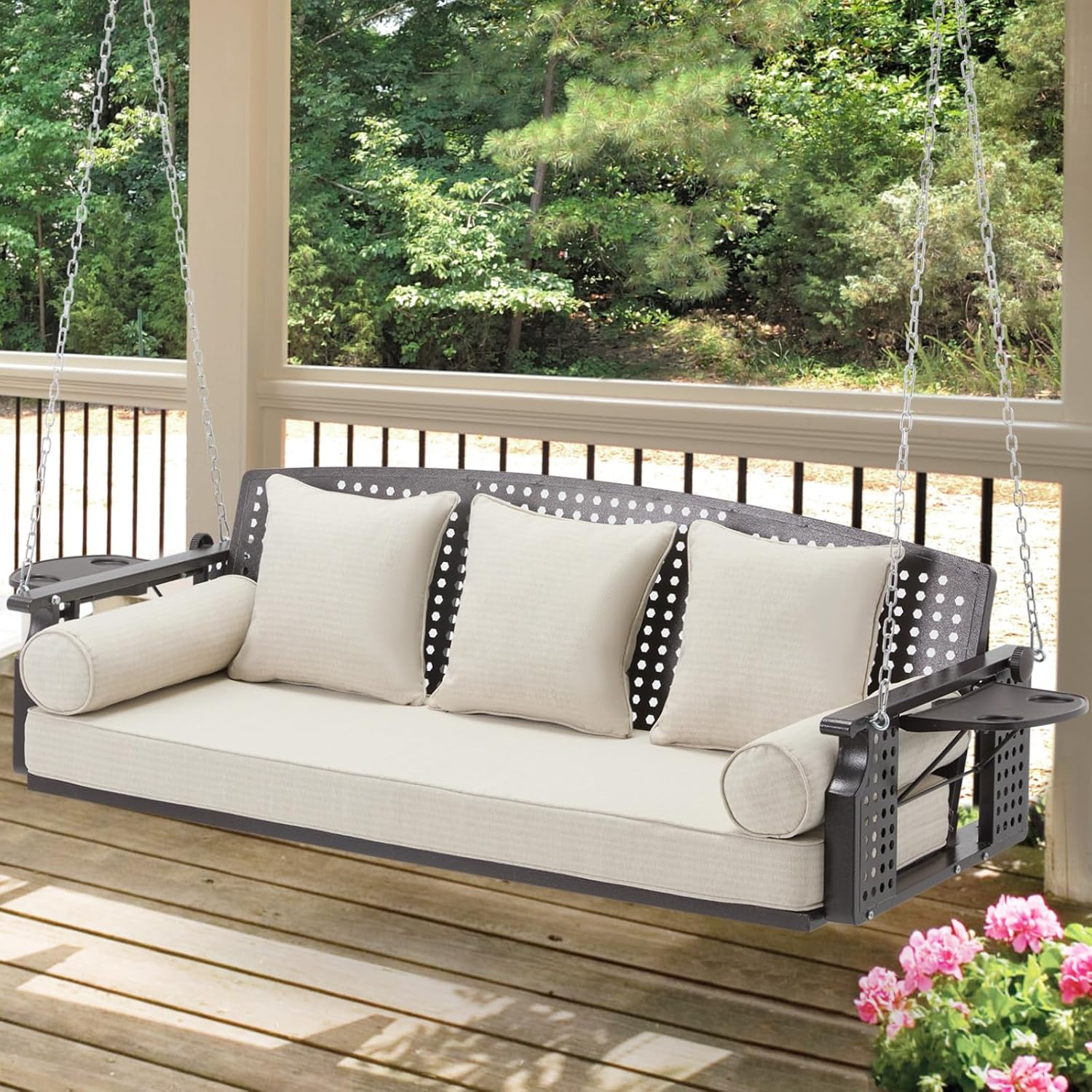
- 60–120 sq ft (mid-size porch): A loveseat or two-chair conversation set with a side table. This is the sweet spot for a porch swing, which provides seating + visual drama + motion all in one piece.
- 120+ sq ft (full porch): A full conversation set (sofa + two chairs + coffee table), OR a dining set with 4 chairs. At this size, you can zone the space — a seating area at one end, a potting/plant display at the other.
| Porch Size | Best Furniture Choice | What to Avoid | Rug Size |
|---|---|---|---|
| Under 30 sq ft | 1 slim bistro chair or no seating | Adirondacks, swings, sofas | 2×3 or 3×5 |
| 30–60 sq ft | 1 Adirondack OR 2-person bistro set | Full conversation sets | 4×6 |
| 60–120 sq ft | Loveseat + 2 chairs OR porch swing | Full dining sets | 5×8 |
| 120+ sq ft | Full conversation set OR dining set | Undersized accent chairs | 8×10 or zone with 2 rugs |
Next, explore this practical guide that shows you exactly how to: Design a Bohemian Patio That Wows
✦ Step 01
IV. Start with the Foundation: The 4-Layer Porch Decor Formula

Before buying a single piece of decor, map your porch into four layers: a seating or focal anchor, layered lighting, greenery, and a seasonal statement piece. Every stylish porch you’ve ever envied has all four — even on a 6×8 ft stoop.
Layer 1 — The Anchor:
A chair, bench, loveseat, or swing that “grounds” the space and invites people to pause.


Layer 2 — Lighting:
String lights, a lantern, a sconce, or candles. Without light, a porch disappears at dusk.


Layer 3 — The Statement:
A wreath, a bold doormat, a seasonal vignette, or a decorative urn. This is your porch’s “personality.”


Layer 4 — Greenery:
At least one plant (potted, hanging, or climbing). Plants signal that someone lives here — and cares.

When I work with clients, I make them audit their porch against these four layers before spending a dollar. Nine times out of ten, they’re missing Layer 2 (lighting) entirely — and that’s the single biggest reason a porch feels cold and unwelcoming after 5 PM.
💡 Pro Tip: Before you shop, take a photo of your porch at 7 PM. If it’s dark and flat, your first investment should be outdoor-rated string lights or a lantern — not more furniture. Lighting is the multiplier that makes everything else look better.
Keep reading for a designer-approved guide to: Patio Decor Ideas on a Budget
✦ Step 02
V. The Material Survival Test: Choosing Porch Furniture That Actually Lasts

Most porch furniture fails within two seasons because buyers choose looks over material science. For longevity in any climate, prioritize powder-coated steel, teak, HDPE poly lumber, or all-weather wicker with aluminum frames. Avoid: untreated pine, hollow-tube aluminum, and wicker over steel frames (they rust through the weave).
This is the content gap I never see addressed in competitor guides — and it’s the one that costs readers the most money in the long run. I’ve watched beautiful rattan chairs turn to splinters in two Midwest winters and $400 cushions fade to nothing after one humid Southern summer.
Material Comparison: What to Buy Based on Your Climate
| Material | Best Climate | Lifespan | Maintenance | Price Range | Verdict |
| Teak Wood | All climates, coastal-safe | 25–50 years | Annual oiling | $$$ | Splurge |
| HDPE Poly Lumber | Harsh winters, UV zones | 20+ years | None | $$ | Best Value |
| Powder-Coated Steel | Dry / moderate climates | 10–15 years | Touch-up rust spots | $–$$ | Best Value |
| All-Weather Wicker (Alum. frame) | All climates | 8–12 years | Wipe-down only | $$ | Best Value |
| Untreated Pine / Softwood | Dry climates only | 2–5 years | Annual staining/sealing | $ | Avoid |
| Hollow Tube Aluminum | Low wind zones only | 3–6 years | Low | $ | Avoid |
✓ HDPE Poly Lumber — Why We Love It
- Made from recycled milk jugs (eco win)
- Never splinters, warps, or rots
- Colorfast — won’t fade after 5 summers
- Cleans with a garden hose
- Looks exactly like painted wood
✗ What to Avoid (Even Though It Looks Good at the Store)
- Wicker over a steel frame (rusts invisibly)
- Cushions without UV-resistant Sunbrella fabric
- Umbrellas with non-weighted bases
- Bare concrete planters in freeze zones
- “Outdoor” rugs not rated for UV + moisture
💡 Pro Tip: Before buying any outdoor cushion cover, find the tag and look for “Solution-Dyed Acrylic” or the brand name Sunbrella. These fabrics are dye-molded, not surface-printed — meaning rain and UV exposure won’t strip the color. A $40 cushion with Sunbrella fabric will outlast a $120 cushion without it.
Next, explore this practical guide that shows you exactly how to: 15 Tips To Get Your Patio Ready For Summer
✦ Step 03
VI. The Rule of Odd Numbers (And Why Your Porch Decor Feels Off Right Now)

If your porch looks “wrong” but you can’t explain why, count your decorative objects. Even numbers feel static and commercial. Professional designers always group in 3s, 5s, or 7s — odd groupings create visual tension that the eye wants to explore, making a space feel alive rather than staged.
I learned this rule the hard way: two matching urns on either side of a door look beautiful on a $2M colonial and look like a hotel lobby on a craftsman bungalow. Symmetry without scale reads as formal. Asymmetry reads as curated.
Trick #1: The Asymmetric Vignette Formula
Place your three items at different heights, with the tallest at the back, the medium piece beside it, and the smallest in front. Try this instantly: one tall ornamental grass in a planter, one medium lantern beside it, and one small pumpkin or stone ball in front. Done. That’s a $35 vignette that looks like a landscape designer built it.
Trick #2: The “Borrowed Height” Hack
Low-ceilinged or small porches feel cramped because everything sits at the same plane. Install one hanging element — a macramé planter, a pendant lantern, or a hanging basket — to pull the eye upward and make the ceiling feel higher. This single change costs $20–$45 and makes a 6×8 porch feel double its size.
Trick #3: The Layered Doormat Trick
Stack a larger natural fiber mat (like jute or sisal) underneath a smaller, more decorative mat with a pattern or phrase. The layered doormat look adds polish for under $40 total and is the most-pinned porch styling trick on Pinterest for good reason — it creates visual depth at the most-noticed focal point of your entire exterior.
💡 Pro Tip: The base mat should extend at least 3 inches on all sides beyond the top mat, and both should be “outdoor-rated.” Avoid coir mats in humid climates — they hold moisture and grow mold within one season. Rubber-backed polypropylene mats clean with a power washer and dry in 20 minutes.
Keep reading for a designer-approved guide to: How To Decorate with Outdoor Lanterns for a Glamorous Home
✦ Step 04
VII. The Renter-Friendly Porch: 8 Zero-Damage Decorating Ideas

Renters can create a stunning porch decor without drilling a single screw. The key is to rely on freestanding, weighted, and surface-mount solutions — removable adhesive hooks, weighted planters, freestanding furniture, and tension rod curtains rated for outdoor use.
Roughly 44 million Americans rent their homes, yet almost every porch decorating guide online assumes you own the property. This section is for you — I’ve been a renter too, and nothing stings more than falling in love with a hanging lantern you legally can’t install.
- Removable Adhesive Hooks (3M Command Outdoor): Rated for up to 7.5 lbs. Perfect for lightweight wreaths, string light hooks, and garlands. They remove cleanly without damaging paint.
- Freestanding Planters with Visual Weight: Tall, dark-colored (black or navy) planters read as intentional anchors. Cluster 3 at different heights near your door for a dramatic, curated look.
- Battery-Powered String Lights: No outlet? No problem. Timer-controlled, battery-operated Edison string lights (Govee and Brightech both make excellent ones) give you full ambiance without any wiring.
- Outdoor Rug on Top of Existing Concrete: A 5×8 outdoor rug defines your porch “room” the way a foundation does in interior design. It requires zero installation and transforms the space immediately.
- Tension Rod Curtains Between Columns: If your porch has columns, outdoor curtain panels on a tension rod between them create a private, enclosed feeling — no drilling required.
- Folding Bistro Table + Chairs: A foldable set stores flat, can be taken when you move, and creates an outdoor dining vignette that transforms even a narrow porch into a lifestyle moment.
- Weighted Planter Stands: Ornate, freestanding plant stands add height and elegance without any wall anchoring.
- Doormat + Welcome Sign Combo: A layered mat with a freestanding letter board or wooden sign (not wall-mounted) creates a personalized entry that moves with you.
💡 Pro Tip: Before placing anything heavy on an upper-level porch or balcony, check your lease and the structural weight limit. Most apartment balconies have a 40–60 lb per square foot limit. One large concrete planter can hit that fast. Lightweight fiberglass planters painted to look like concrete (Crescent Garden makes beautiful ones) weigh 80% less with the same visual impact.
Dive deeper with this step-by-step guide on: The Best Performance Fabric Sofas for Real Life (Kids, Pets & Spills Welcome)
✦ Step 05
VIII. The “Evergreen Core” Strategy: Year-Round Porch Decor With Seasonal Swaps

The most efficient (and cost-effective) porch decorating strategy is to invest once in a permanent “evergreen core” — quality furniture, a neutral rug, classic lanterns, and evergreen plants — then swap out only 3–4 inexpensive seasonal accents twice a year. This approach costs less and looks more intentional than buying seasonal sets.
Most seasonal decorating guides tell you to completely redo your porch for fall, winter, spring, and summer. That’s a $600/year habit. Here’s what professionals actually do: they build once and refresh cheaply.
The Evergreen Core (Buy Once)
- 1–2 weather-proof chairs or a loveseat in a neutral (charcoal, white, natural wicker)
- A 5×8 outdoor rug in a classic pattern (stripe, geometric, or natural jute)
- 2 black or dark bronze lanterns
- 1 planter with a year-round evergreen (boxwood ball, cypress topiaries, or a Japanese maple in warmer zones)
- Outdoor string lights
The Seasonal Swaps (~$30–$60 twice yearly)
- Spring/Summer: Swap in brightly colored pillow covers (watermelon, cobalt, citron), swap wreath for a fresh botanical one, add a hanging fern or begonias
- Fall/Winter: Add a cozy throw in a basket, switch to burnt orange/burgundy pillow covers, add a pumpkin or magnolia leaf wreath, tuck corncobs or cedar branches into the lanterns
💡 Pro Tip: Store off-season cushion covers (not the inserts — just the covers) in a waterproof storage bag or bench ottoman with hidden storage. The inserts can stay outside year-round if they’re high-density foam wrapped in Sunbrella. This single hack eliminates the biggest seasonal decorating headache.
Keep reading for a designer-approved guide to: How to Arrange Pillows on a Couch Like a Pro: The Foolproof Step-by-Step Guide
✦ Step 06
IX. Where to Splurge vs. Save: The Designer’s Honest Breakdown
Splurge on items that touch the body, weather daily abuse, or anchor the entire visual scheme (seating, cushion fabric, a foundational planter). Save aggressively on seasonal accents, wreaths, small decorative objects, and anything that will be swapped out within 12 months.
| Item | Verdict | Why | Budget Pick (Amazon/Wayfair) | Splurge Pick |
| Outdoor seating frame | Splurge | Cheap frames rust, wobble, fail in 2–3 years | — | Teak or HDPE, $300–$600/chair |
| Cushion covers (fabric only) | Splurge | Sunbrella fabric lasts 10+ yrs vs. 1–2 yrs | — | Sunbrella covers, $40–$80 each |
| Outdoor rug | Save | All outdoor rugs fade — no need to overpay | Safavieh Courtyard Rug ~$45–$90 (Amazon) | — |
| Lanterns / candle holders | Save | Aesthetic item — $20 lanterns look identical to $200 | Threshold Lanterns, Target ~$18–$35 | — |
| Planters (large, statement) | Splurge | Cheap planters crack in freeze/thaw; anchor the look | — | Crescent Garden or Pottery Barn, $80–$200 |
| Seasonal wreaths | Save | Replaced 2x/year — no sense in premium spend | Amazon seasonal wreaths, $20–$35 | — |
| String lights | Mid-range sweet spot | Cheap lights fail. Premium Edison last 10K hrs. | Brightech Ambience Pro ~$35–$55 (Amazon) | Cafe lights with G40 Edison bulbs, $60–$90 |
| Doormat | Save | High-traffic item that wears out; buy two, rotate | Ottomanson or DII mats, $15–$28 (Amazon) | — |
Top Amazon Porch Decor Picks:
Based on material quality, durability, and price-to-value ratio, here are the specific products I recommend for your porch decor at every budget level:
1. Tangkula HDPE Adirondack Chair

Why I Love It:
If outdoor comfort had a poster child, this Adirondack chair set would be it. These chairs strike the perfect balance between lounge-worthy comfort and weather-proof durability — so whether guests stay for an hour or all night, they’ll relax in outright comfort.
Top Features
- Set of 4 Chairs – Great value for families, parties, or deck seating.
- Heavy All-Weather HDPE Construction – Won’t fade, warp, crack, or splinter like wood.
- Wood-Textured Finish – Classic look, without the maintenance.
- Built-In Cup Holders – Keeps drinks secure and your hands free.
Best For: Backyard patios, poolside lounges, front porch seating, cabins, decks.
“We sit out here every single evening now. I didn’t realize how much I needed a place to just breathe until I had these chairs.”
— Michelle R., verified Amazon buyer ⭐⭐⭐⭐⭐
✔ Pro Tip: Add your favorite 🛒 outdoor cushions for extra comfort.
🔥 Click here to check current pricing & customer reviews on Amazon!
2. Brightech Ambience Pro String Lights

Ambient lighting isn’t just decoration — it’s atmosphere. These solar string lights are one of the most affordable ways to instantly elevate your outdoor space.
Why They’re a Winner
- Solar Powered + Remote Control — No wiring, no power cords, no hassle.
- Color Adjustable — Choose warm white or vibrant color modes.
- 15 Waterproof LED Bulbs – Built for rain, shine, and long summer nights.
- Extra Long 48-FT Strand – Perfect for pergolas, fences, patios, and trees.
Best For:
Garden parties, date night ambiance, evening gatherings, backyard decor.
What Buyers Love
🌟 Commercial-grade performance with easy DIY setup.
🌟 No electric bill — charge with sun, enjoy all night.
“I put these up on a Tuesday. By Friday my neighbors were asking where I got them. My porch genuinely looks like a restaurant terrace now.” — James T., verified Amazon buyer ⭐⭐⭐⭐⭐
👉 Grab them on Amazon here before prices change!
3. Crescent Garden Planter (TrueDrop)

A beautiful outdoor space isn’t complete without greenery — and the right planter makes all the difference. This lightweight rock garden planter gives you style and flexibility without the heavy lifting.
Standout Benefits
- Lightweight Yet Durable – Easy to move, hard to damage.
- Modern Classic Look – Blends with contemporary AND traditional landscapes.
- Perfect Size (26″) – Ideal for flowers, herbs, or small shrubs.
- UV & Weather-Resistant – Holds up season after season.
Perfect For: Sidewalk accents, patio corners, porch entrances, balcony gardens.
Styling Tip: Pair with colorful annuals in spring or evergreen accents in winter for year-round curb appeal.
“I put two of these on either side of my front door with olive trees. Three different neighbors stopped to ask where I bought them within a week. Best porch purchase I’ve ever made.” — Sandra M., verified Wayfair buyer ⭐⭐⭐⭐⭐
👉 Click to view pricing and styles on Wayfair!
Keep reading for a designer-approved guide to: Swivel Chairs Ultimate Guide: How to Choose & Style the Perfect One for Your Home
✦ Step 07
X. The Small Porch Decor Problem: How to Make a 4×6 Stoop Feel Like a Room

A small porch should follow the same principle as a small room: scale everything down, go vertical, and use mirrors or reflective surfaces to add perceived depth. The biggest small-porch mistake is using full-size furniture — it blocks the door, reads as cramped, and makes the space feel smaller than it actually is.
The average American front stoop is just 36–48 inches deep. That’s barely enough for a doormat and a single chair. But a thoughtfully styled small porch consistently outperforms a carelessly furnished large one — because constraint forces intention.
- Scale down seating: A slim bistro chair (17″ depth) or a wall-mounted fold-down bench keeps traffic flowing and preserves the view of your door — your porch’s most important visual element.
- Go vertical with plants: A tiered plant stand with 3 levels of potted plants takes up the same floor footprint as a single pot but delivers 3x the visual impact and greenery.
- Hang the lantern: A ceiling-mounted or hook-hung lantern eliminates ground-level clutter and draws the eye up, making the ceiling feel higher.
- Use one oversized statement piece: Counterintuitively, one large planter reads better than three small ones on a tight porch. Small objects on small spaces feel like clutter. One bold element feels like design.
💡 Pro Tip: On a tiny stoop, your front door color IS the decor. A beautifully painted door in a rich hue (Farrow & Ball “Hague Blue,” Benjamin Moore “Newburyport Blue,” or Sherwin-Williams “Iron Ore”) does more for curb appeal than $500 of accessories. If you own the property, a front door repaint is the single highest-ROI porch upgrade possible.
Your 3-Step Weekend Porch Decor Transformation Plan
Do these three things in order, on a single weekend, and your porch will be transformed:
- Saturday Morning — Audit & Clear (1–2 hrs)
- Take the “4-layer audit” photo at 7 PM the night before to expose lighting gaps. Remove everything from the porch. Only put back items that belong to one of the 4 layers. Donate the rest. Start with a completely clean slate.
- Saturday Afternoon — Shop with a List (2–3 hrs)
- Using the Splurge vs. Save table above, identify your 1–2 “splurge” items and 3–4 “save” items. Order seating and lighting online if possible (better selection, free returns). Buy seasonal accents in-store so you can see them in natural light before committing.
- Sunday — Style Using the Rule of Odd Numbers (2 hrs)
- Place your anchor piece first (seating). Then add lighting. Then arrange your plants + accessories in asymmetric groups of 3. Step back 20 feet (the driver’s-eye view) and adjust until every element is visible and the groupings feel balanced but not perfectly symmetrical. Take your “after” photo.
Most Popular Post:
Interior Design Style Quiz
Timeless Paint Colors That Never Go Out of Style
Create Your Perfect Ergonomic Home Office: A Complete Guide
Must-Have Accessories for Guys: The Secret to a Stylish Space
Modular Sofas for Small Spaces: Brilliant Solutions for Compact Living
XI. Your Dream Porch Decor is One Weekend Away
You now have the exact system professional designers use for porch decor — the 4-layer formula, the material guide, the styling tricks, and the honest budget breakdown. The only thing left is to start.
Take the 4-layer audit photo tonight. Identify your biggest gap. Then make one focused purchase this week. You don’t need a full renovation — you need a plan.
Start with the one purchase that closes your biggest gap. Every product recommended in this guide has been vetted for material quality, durability, and honest value. No filler. No fluff.
Scroll back up to the Splurge vs. Save section for the full breakdown — or jump straight to your gap below.
Affiliate Disclosure: This post contains affiliate links. I may earn a small commission — at no cost to you — if you make a purchase. As an interior designer, I only recommend products I would use in my own client projects.
FAQ: Porch Decor Questions Answered
Q1. What is the most important element of front porch decor?
Lighting is the most impactful single element most homeowners are missing. A porch that looks beautiful during the day but disappears at night loses half its appeal — and curb appeal is just as important in the evening when neighbors walk by and you come home. A $35 set of string lights or a $25 lantern with a solar insert is the single best ROI upgrade you can make to an underdeveloped porch.
Q2. How do I decorate a front porch on a budget?
Focus your budget on the Evergreen Core (furniture + lighting + one quality planter) and save aggressively on everything seasonal or decorative. A fully styled porch is achievable for $150–$250 if you prioritize: one HDPE Adirondack chair (~$90), one set of battery string lights (~$30), one outdoor rug (~$45), and one layered doormat set (~$30). That’s $195 for a complete transformation.
Q3. What plants look best on a front porch?
The best year-round porch plants are boxwood topiaries (evergreen, minimal maintenance, architectural), ornamental grasses (movement, texture, drought-tolerant), and knockout roses (color, reblooms all season). For seasonal color, wave petunias, begonias, and sweet potato vine are virtually foolproof and look lush within weeks of planting. In low-light porches, cast iron plant (Aspidistra) and ferns thrive where sun-loving plants would fail.
Q4. How do you make a small front porch look bigger?
Use vertical elements (tall planters, hanging baskets, wall-mounted lighting) to draw the eye up. Scale down furniture — a slim bistro chair takes up half the floor space of a standard Adirondack. Use one oversized statement piece rather than many small objects. And keep the color palette tight — a cohesive 2–3 color scheme on a small porch reads as intentional rather than crowded.
Q5. What are the best outdoor materials for porch decor furniture?
HDPE poly lumber is the best all-around material for most climates — it’s freeze-safe, UV-stable, never requires maintenance, and is made from recycled plastic. Teak is the premium choice for those who want natural wood with exceptional longevity (25–50 years with annual oiling). All-weather wicker over an aluminum (not steel) frame is the best option for a traditional or transitional aesthetic. Avoid any wicker with a steel frame — it will rust through the weave invisibly within 3–5 years.
CATCH THE LATEST IN HOME DECOR TRENDS:

Steal These 16 Expert-Approved Decorating Secrets

Accessorize a Small Living Room: 7 Genius Styling Secrets

How to Make a Small Room Appear Bigger